Interview: Mark Wheatley

Today as part of my on-going series focused on the writers, artists, and publishers who will be appearing at Pulpfest this week, I chat with artist Mark Wheatley.

Mark Wheatley holds the Eisner, Inkpot, Golden Lion, Mucker, Gem and Speakeasy awards and nominations for the Harvey award and the Ignatz award. He is also an inductee to the Overstreet Hall of Fame. His work has often been included in the annual Spectrum selection of fantastic art and has appeared in private gallery shows, The Norman Rockwell Museum, Toledo Museum of Art, Huntington Art Museum, Fitchburg Art Museum, James A. Michener Art Museum, the Rice Gallery and the Library of Congress where several of his originals are in the LoC  permanent collection. He has designed for Lady Gaga, created set pieces for The Black Eyed Peas, contributed designs for ABC’s Beauty and the Beast, and Square Roots, as well as Super Clyde, The Millers and 2 Broke Girls on CBS. Several of his original graphic novels have been optioned for motion pictures and television. His most recent print projects include the Edgar Rice Burroughs Visions of Adventure portfolio, Songs of Giants, Doctor Cthulittle, Tarzan and the Dark Heart of Time, Swords Against the Moon Men, The Philip Jose Farmer Centennial Collection, Mine! and Wild Stars. Past creations include Return Of The Human, Ez Street, Lone Justice, Mars, Breathtaker, Black Hood, Prince Nightmare, Hammer Of The Gods, Blood Of The Innocent, Frankenstein Mobster, Miles The Monster, Skultar and Titanic Tales. His interpretations of established characters such as Tarzan, Dick Tracy, The Green Hornet, The Adventures Of Baron Munchausen, Jonny Quest, Dr. Strange, The Flash, Captain Action, Argus, The Spider, Stargate Atlantis, The Three Stooges, Doctor Who and Torchwood have brought them to life for a new generation of readers. He has written for TV, illustrated books, designed cutting-edge role-playing games, hosted a weekly radio program, and was an early innovator of the on-line daily comic strip form.


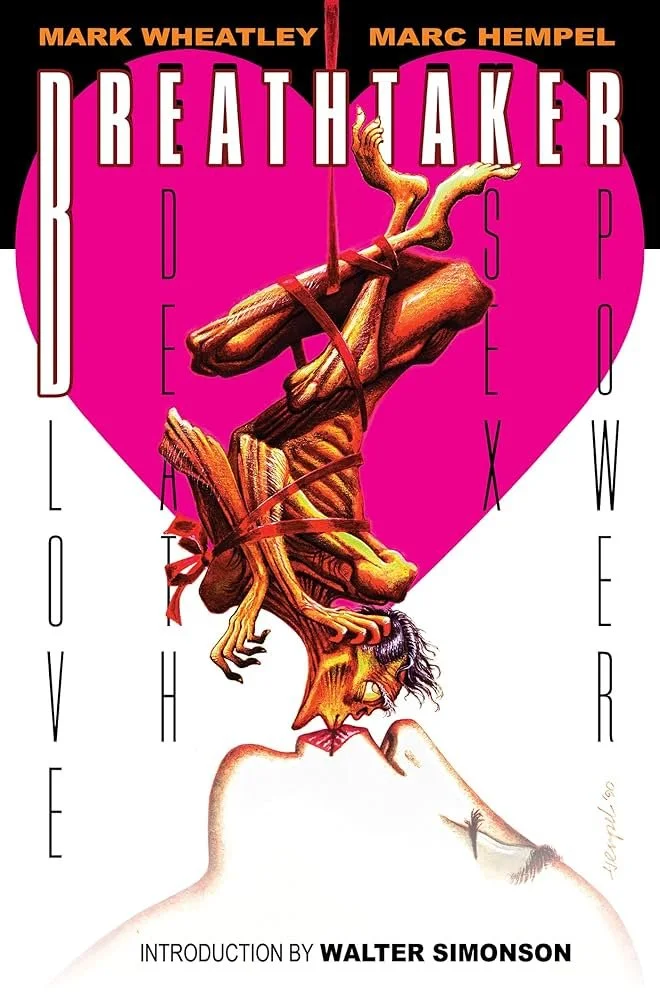
Your cult classic mini-series Breathtaker, co-created with Marc Hempel, is being remastered and released in trade paperback this fall, including some new material. I’d love to hear about the process of bringing it back, and of creating the new material.

It is hard to believe it has been 35 years since Breathtaker first saw print! Breathtaker was one of the very first creator-owned books to come out under the DC Comics banner—though it took some heavy lifting to make that possible. Our attorney, Richard Theibert, spent more than a year in negotiations with DC’s Lillian Laserson to hammer out a new kind of publishing agreement. What came out of those talks would eventually become the blueprint for creator-owned contracts at DC, opening the door for many others after us.

The series launched as a four-issue Prestige Format run and took off quickly, going into multiple reprints and even earning a Harvey Award nomination. It helped shine a light on both Marc Hempel’s work and mine—we were each honored with Inkpot Awards, thanks in large part to Breathtaker's success. When DC decided to collect the series, that edition made history as the first book to carry the new Vertigo imprint. Over the next ten years, it would go through seven printings.

We had big plans for a sequel—but after our editor, Mike Gold, moved on from DC, those plans stalled. Eventually, Marc and I got the rights back. For a moment, it looked like Breathtaker was headed to the big screen: Sony optioned the property, with Kate Hudson lined up to star. But as happens in Hollywood, a change in leadership at the studio sent the project into limbo.

Then something remarkable happened. In 2008, the Norman Rockwell Museum added Breathtaker to their touring LitGraphic exhibition, showcasing the book alongside work by Eisner, Crumb, and Ditko. That exhibit turned out to be their most attended show ever. Later, the Rockwell created a full-scale solo exhibition devoted to Breathtaker, which—after pandemic delays—finally opened at McDaniel College in 2022.

Back in 2014, Marc and I turned to Indiegogo to support a full remaster of the book. Titan Comics came on board as publisher, and we were ready to roll—until a series of curveballs hit: shifting distributors, a global pandemic, and multiple industry slowdowns. We even had the book on press in 2020 when the world came to a halt.

Ironically, every delay gave us time to go further and deeper with the material. What we’ve finally produced is not just a reissue but a definitive edition—a fully remastered Breathtaker with nearly 80 pages of bonus material. That includes a brand-new story, rare behind-the-scenes content, and an introduction by the legendary Walter Simonson.

Marc Hempel and I are good friends and we get to hang out and catch dinner on an irregular schedule. But we have not had any real opportunity or inclination to collaborate in decades. But this new edition of Breathtaker got us thinking about a cool new story featuring THE MAN.

MAKE WAY FOR THE MAN #138 is the in-universe comic book from Breathtaker brought to life. In the original story, The Man isn’t just a government super-agent—he’s also a full-blown media franchise. He’s got a TV show, video games, toys, branded apparel… and, yes, even his own long-running comic book. In one scene, a fan even asks him to sign a copy of MAKE WAY FOR THE MAN #137.

So to mark Breathtaker's 35th anniversary, Marc and I teamed up again—our first real collaboration in decades—to finally create issue #138. We thought: why not make it real? It’s our chance to explore the absurdity of The Man’s mythos from inside his own over-the-top world.

It’s a wild mix of slick spy action and tongue-in-cheek commentary—very James Bond, and very meta. We leaned into the fun, even spoofing those old Hostess snack cake ads with a custom parody strip starring The Man. This is a full comic, not just a throwaway extra.

And to top it off, we brought in the amazing Mike Oeming to create a special variant cover—his take on The Man is fantastic and adds another layer of cool to the project.

The book is already out in Germany and Spain. We’ve had the chance to hold the hardback Breathtaker in our hands! And having seen those editions, I can say with confidence: this is the version we always dreamed of making.

BREATHTAKER: Love, Death, Sex, Power will be on sale in the US on September 3rd.
Blood of the Innocent was my first exposure to your work and Marc Hempel’s. Is there any chance that we’ll get a nice trade paperback collected edition?

No current plans. But it is something that Marc, Rickey Shanklin and I would love to make happen.

What drew you to art? Who were your earliest artistic influences? And who inspires you currently?

Comic books introduced me to art. The earliest artist I could identify was Steve Ditko on Spider-Man. Then one day I discovered the Flash Gordon comics Al Williamson was drawing. Those comics had ads for the Nostalgia Press Flash Gordon collection by Alex Raymond. I got that for Christmas. Once I discovered Raymond, I was on track to discover all the classic Golden Age illustrators, starting with NC Wyeth! To this day, Wyeth is still my favorite artist. But I am inspired by everything! From impressionism to modern installations, music, film, audio recordings, all of it bubbles away in my head. And hey, the current Flash Gordon creator, ‪Dan Schkade is a new inspiration! Maybe I owe it all to Flash?

You’ve worked in many different mediums over the years. Do you have a favorite, a “go-to”? And has that changed over the course of your career?

For real media painting, my medium of choice is watercolor and gouache. I’ve been getting an increasing number of gigs for my line art. For that I use Japanese pens and brushes and ink. Zebra brush pens, Kuretake water brushes, and Sumi ink. For ink work, I prefer a hot press surface. Pencil works better for me if the surface has a tooth. But most of my painting now is digital, if only for schedules and to satisfy my clients who always want changes! But I’ve come to enjoy working digitally. And as my eyes get older, it is a real advantage to be able to enlarge area of a painting as I work! For digital, I have a Cintiq and I work in Photoshop, using my own custom brushes. To get the kind of detail, texture, and color subtlety I expect, most of my digital paintings are about 10’ tall at 300dpi. I offer museum quality giclee prints at conventions and signings, and you can easily see just how “real” my paintings actually are.

I absolutely love your painted work (the Doctor Who covers, the book covers for Meteor House and Edgar Rice Burroughs Inc, Doctor Cthulittle, the book of poetry by pulp-era writers (Songs of Giants), and so much more). I’d be interested to hear about your process of taking them from original concept to finished project.

I keep a sketch book. I generate ideas there. But often, too often, clients come to me with little lead time on the deadline. So, I take as much time as I can to research the piece. This means I spend, sometimes, days scouring the internet, searching for photos, videos, anything that gives me some accurate reference for what I am expected to create. Then, depending on the budget, if there is money for roughs, I come up with some basic ideas, compositions. If approved, I move to working up the final piece. If there is time (there never is) I will sketch some figures. Not a full composition, but some of the pieces of the image. Working out emotions, impressions. When I have something that I’m happy with, I will turn that into a full drawing, maybe taking it to an inked piece. I’ll scan that and start painting. But more often than not, there is no time or budget. And I go from making a few sketches to drawing on the Cintiq, right in Photoshop and the image forms in the fastest way I can manage. Gradually drifting from sloppy, chunky bits, pieces I’m cutting and pasting and distorting until it starts to work for me.

Usually, when I begin a new painting, there is a moment when I think, “Hey this time I think I finally have an amazing piece developing!” Then a few hours later I think, “I can’t draw. I can’t paint! Why do I even try?” But I keep at it, getting rid of anything that offends me, until I finally think, “Maybe I can make this work. It won’t be too bad.”  I work on it longer, and finally a moment comes after I’ve been staring at the painting for a long time and have not seen anything I can do to it. And it is done.

 This is going to be weird to say, but I’m always sort of happy when I hear that even the professionals whose work I love have those moments of doubt during the process of creation. Thanks for sharing that.

Finally, do you have anything in the works you’d like folks to know about?

I’ve got a couple of major projects underway that I can’t talk about just yet—NDAs and all that—but what I can say is that I’m especially excited for people to finally get their hands on the new edition of Breathtaker. It’s been a long time coming, and this is the most complete version we’ve ever done. There are some fantastic events tied to the release, especially at Baltimore Comic-Con this October.

Before that, we’re kicking things off with a launch party on September 6th at Beyond Comics in Frederick, Maryland. It’s a great space, and we’re expecting a big crowd—so if you’re anywhere nearby, definitely come by. Marc Hempel and I will be there, and it’s shaping up to be a really fun celebration.

In the studio, I’ve been deep into work on The Land That Time Forgot for ERB Books. I’ve painted the cover for the first volume and I’m working on a number of interior illustrations now. I’m also illustrating a new book by my Doctor Cthulittle collaborator, G. D. Falksen—it’s been a fantastic collaboration. And I’m continuing to contribute covers for the Robert E. Howard Foundation’s Ultimate series, which has been a real honor.

Next on the calendar is PulpFest, where I’ll be giving a presentation with Doug Klauba on the “Masters of Tarzan Illustration.” I’m really looking forward to it—it’s always a great chance to connect with people who love this material as much as I do.

Thanks again for taking the time to chat, Mark! See you in just a few days at Pulpfest! And readers, don’t forget you can see more of Mark’s work on the Mark Wheatley Gallery website!


Readers, it is not too late to register for and attend Pulpfest 2025 (THE pulp magazine-focused convention in the Northeast) and the other three conventions it hosts: FarmerCon (dedicated to the works of Philip Jose Farmer), ERBFest (dedicated to the works of Edgar Rice Burroughs) and DocCon (dedicated to all things Doc Savage related). Check out the Pulpfest website for registration and hotel information!
Interview: Mike Chomko of PULPFEST

Today, I chat with Mike Chomko, one of the founders and organizers of Pulpfest. Mike Chomko, the winner of the 2010 Munsey Award,  has been a regular at pulp cons since the early nineties. In September of 2008, he joined Jack Cullers, Barry Traylor, and Ed Hulse to launch PulpFest. Mike serves as the marketing and programming director of the convention and is also the publisher of The Pulpster. A former member of the Pulp Era Amateur Press Society, Mike was the publisher of Purple Prose, a highly respected pulp fanzine that ran for seventeen issues in the late 1990s and early 21st century. Around the same time, he founded Mike Chomko Books, an independent purveyor of genre fiction and related materials. His specialty is pulp-related material. In “real life,” Mike is a retired registered nurse who worked in the operating room for nearly 20 years. Married for over forty years, he is the father of two adult children and a grandfather. To reach Mike by email, write to mike@pulpfest.com.

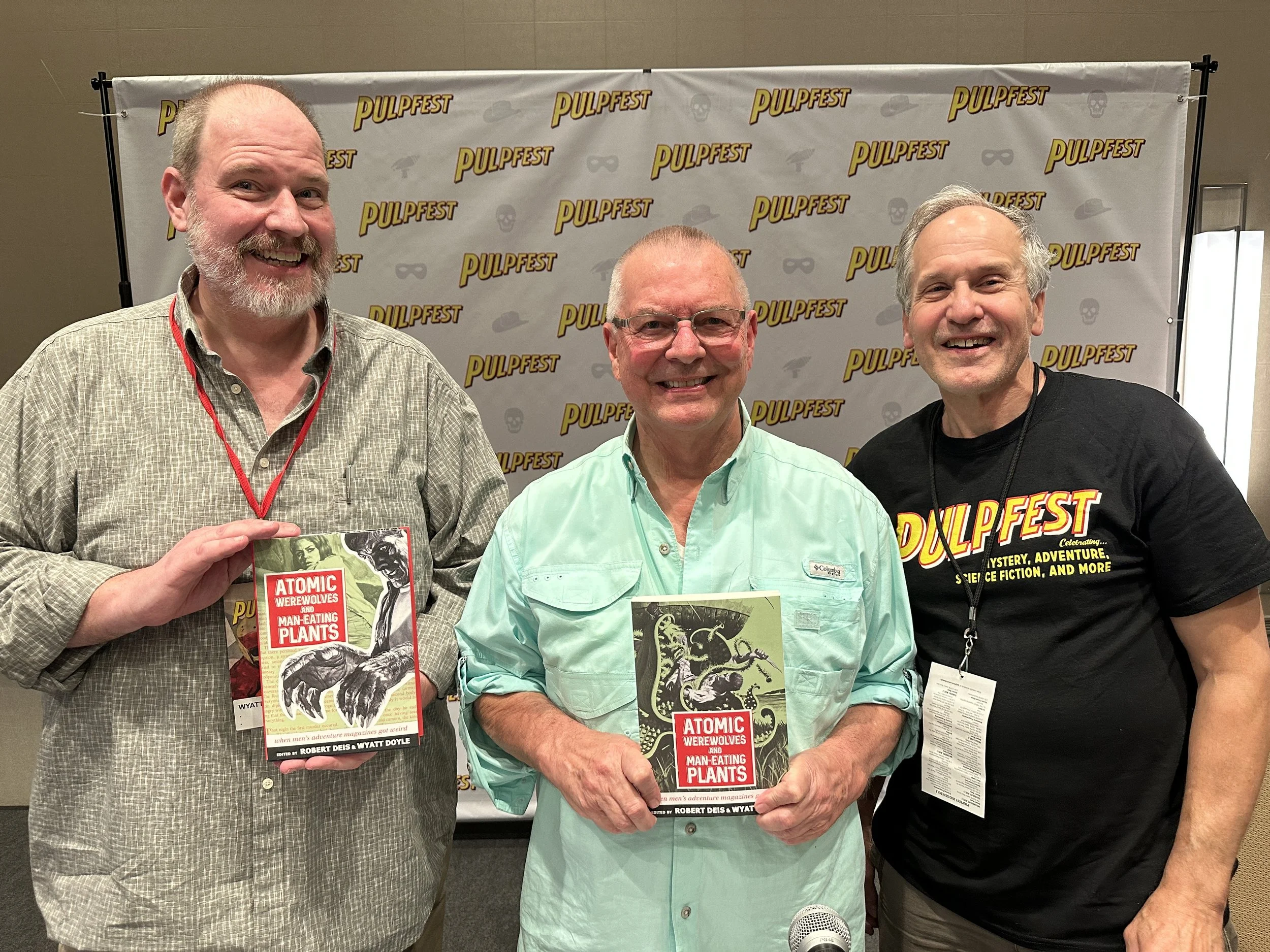
Mike Chomko (right) with authors Bob Deis and Wyatt Doyle

Hi Mike! Thanks for taking some time out of what I’m sure is a busy schedule prepping for PulpFest 2025 to chat.

Of course, Anthony/Antny/Anton/Ant/Dinty/Thanny/T/Sandy/Andrew/The Other Guy /Stormy/;  . . . I’m not exactly sure what to call you. Perhaps I’ll just call you, Lamont.

I mean, I don’t mind being mistaken for one of The Shadow’s many identities … (For those who don’t know, my email signature is a list of every nickname I’ve ever had. I guess I need to add Lamont now!)

For readers who may be unfamiliar with PulpFest, can you tell me a little about the convention’s focus and history?

The focus of PulpFest is pulp magazines — fiction periodicals named after the cheap pulp paper on which they were printed. The first pulp was published in 1896 by Frank A. Munsey. It was called The Argosy.

The first PulpFest took place in 2009 in Columbus, Ohio. The convention was founded by Jack Cullers, Barry Traylor, Ed Hulse, and me. Chris Kalb, a very talented artist and illustrator, helped us by setting up our website. He also put together several flyers and ads for the convention. So Chris was a big help getting PulpFest off the ground, but he didn’t want to be one of the so-called organizers or founders. But he helped big-time.

Before the first PulpFest, there was a long-running pulp convention known as Pulpcon. The first of these took place in 1972, and the convention pretty much continued on a nearly annual basis through 2008. Jack, Barry, and I were all members of the “crew” that organized Pulpcon during its final years. But many people felt that major changes were required for the convention to survive, and PulpFest was the result.

So between PulpFest and Pulpcon, we’ve been around for more than fifty years, celebrating “mystery, adventure, science fiction, and more” pretty much each and every summer.

Every year, PulpFest has a theme. What is the theme for PulpFest 2025, and what programming can attendees expect to enjoy related to that theme?

My wife likes to kid me about the anniversaries we celebrate at each and every PulpFest. Of course, if I forgot about our wedding anniversary, she’d be ticked off at me.

Regardless, we have this spreadsheet listing the start of important magazines such as Black Mask, Doc Savage, Weird Tales, or what have you. And then there’s another that lists the birthdays of major writers, artists, editors, publishers, and so on.

Well, I already knew that 2025 was the 150th anniversary of the birth of Edgar Rice Burroughs. But when I was looking at our spreadsheets last summer, I also noticed that Edgar Wallace, who was called “The King of the Thrillers” in Great Britain, and Rafael Sabatini, the celebrated author of historical fiction, were also born in the same year.

I pointed this out to Bill Lampkin, the convention’s advertising director, and we came up with the line, “Celebrating the Masters of Blood and Thunder.” We thought the phrase pretty much summed up the writing of all three writers.

So this year’s programming will have presentations on Wallace, Sabatini, and Burroughs, along with films related to at least two of the authors: King Kong and The Sea Hawk.

Although both Wallace and Sabatini had a good deal of fiction in America’s pulps, ERB was one of the “big guns” of the industry, creating Tarzan of the Apes, John Carter of Mars, and other series for the rough-paper magazines. So we’ll have presentations on Tarzan illustrators, Tarzan merchandising, and ERB’s “disciple,” Ray Bradbury. All of these will be part of our mini-convention, ERBFest 2025. Your membership in PulpFest also makes you a member of ERBFest.

2026 is also the anniversary of the “villain pulps.” These were character pulps that had bad guys as their so-called “star.” There was Doctor Death, The Mysterious Wu Fang, and in Weird Tales, a series of Doctor Satan adventures. These all began in 1935. Doctor Yen Sin, The Octopus, and The Scorpion came later.

In addition to ERBFest, we’ll also be hosting Farmercon XX, a convention that we’ve been hosting almost every year since 2011. And then there’s Doc Con 2026, a convention that we’re reviving thanks to a group of Doc Savage fans who have been attending PulpFest for a number of years. This year, PulpFest and Doc Con will be celebrating the Golden Anniversary of the George Pal film, Doc Savage: The Man of Bronze. It came out fifty years ago, back in 1975.

I would love to hear about your own personal connection to the pulps: your first encounter with them, favorite titles or characters, etc.

Well, my birthday is around the middle of August. So every year, I’d get presents from our relatives right before the start of school. And not having a whole lot of money, my parents naturally used the bulk of my birthday money for school clothes.

Back in the mid-sixties, there used to be a big department store in Allentown, PA (where I now live) where we’d go for school clothes and other necessities. This store had a book department, and I liked to read. So my parents let me have five bucks of my birthday money and let me wander off to the book department. And that’s where I found my first three Doc Savage paperbacks — The Land of Terror (because I loved dinosaurs), The Quest of Qui (because I thought Vikings were great), and The Brand of the Werewolf (because I liked to watch monster movies, despite the nightmares they caused).

That’s how I found out about the pulps. My first pulp was a Shadow magazine with no back cover, the one featuring the story “Chicago Crime.”

Somewhere along the line, I heard about Tom and Ginger Johnson’s Echoes, John Gunnison’s The Pulp Collector, Doug Ellis’s PulpVault, and the late Howard Hopkins’ Golden Perils. I probably started getting them from Bob Weinberg and later subscribed.

I used to write letters of comment to most of these fanzines. Then some short book reviews. I began to index them. I probably learned about Pulpcon by reading someone’s report in one of the fanzines I read religiously.

My first Pulpcon was the one in Wayne, New Jersey . . . the so-called “Pulpcon from Hell.” As Wayne was about 90 minutes from where I lived, I could commute nightly to it. Of course, I pretty much only spent my time in the dealers’ room (so I missed out on the programming). But I was hooked.

I began writing my own Pulpcon reports. I volunteered to help Jack and Barry with the Pulpcon auctions. The three of us became fast friends. It was John DeWalt — one of this year’s nominees for our Munsey Award — who nudged me to join the Pulp Era Amateur Press Society, AKA PEAPS. There, I started Purple Prose, my own fanzine, modeled after the things I admired in Echoes and the rest. Eventually, I expanded Purple Prose and made it available by subscription.

Although I had to give up publishing my own fanzine when I returned to college to become a registered nurse (I’m a retired operating room nurse), I recently rejoined PEAPS when they asked me to contribute to their 150th issue. I guess I’m a glutton for punishment.

I’m pretty much a generalist when it comes to the pulps. I’ve enjoyed the character pulps, science fiction, adventure, detective pulps, and so on and so on. Although both of my kids (both now in their late 30s) are readers, neither wanted my pulps. So I’ve sold off most of what I ever owned. About all I have left are a few readers copies and a bunch of aviation and detective pulps because I happen to really like the writer, Franklin H. Martin.

What do you think we can or should do to maintain interest in (or foster interest and awareness of) this pretty quintessentially American publishing format, and the great characters and concepts that originated in it?

Well, I honestly think that PulpFest does an awful lot to foster interest and awareness of pulps. When we moved to Mars, PA in 2017, our first guest was the artist Gloria Stoll-Karn. She had previously been a guest at Pulpcon, but we had her back because she lived right in Pittsburgh, just south of the convention.

A few years after that, the Pittsburgh public television station contacted me about a documentary on local women artists. One of them was Gloria. They wanted me to appear in the film, but I guess because of budget limitations, they didn’t have me come out to Pittsburgh . . . although Allentown is in the same state, the two cities are nearly 300 miles apart). So I recommended a local professor to them, and she was interviewed about Gloria. I think not long thereafter, the Norman Rockwell Museum in Massachusetts put on an exhibit of Gloria’s work, including some of her pulp covers.

I honestly believe that PulpFest having Gloria as its guest made people aware of her, and hence the interest. After all, we do have a pretty darn active website.

What can the average pulp fan do to keep the pulps alive?

Attend at least one pulp convention a year, be it Windy City, Pulp Adventurecon, PulpFest, ECOF, or what have you. I know it's hard to travel, and it's certainly not cheap. But the pulp cons have done a lot to promote interest in pulps and pulp collecting. The only way we can keep doing this is to have people attend. Yes, it's easy to buy pulps online by bidding in an Adventure House or Heritage Auction, but pulp cons have been plugging away for decades, trying to keep the interest there and to grow it as much as possible. And we can only keep doing it with your help.

This year’s PulpFest is also host to three other conventions: FarmerCon (dedicated to the work of Science Fiction Grandmaster Philip Jose Farmer), DocCon (focused on classic Pulp character Doc Savage) and ERBFest (devoted to the “Master of Adventure,” Edgar Rice Burroughs). How did PulpFest come to play host to these other conventions?

Back when I was publishing Purple Prose, I started selling books part-time to help pay for my printing bills. Fanzine publishing is a money loser, a time-honored tradition. Anyway, people would ask me if I could get this book or that.

I can’t recall who it was, but someone inquired about a fanzine called Farmerphile. I wrote to its publisher, Mike Croteau, and worked out a deal to sell his periodical. I think I made a buck a copy.

Anyway, Mike was involved with Farmercon. After Phil Farmer and his wife, Bette, passed away, there didn’t seem much impetus to continue the pilgrimage to Peoria, Illinois where the early Farmercons were held (often in the Farmer’s backyard). Mike asked me if they could have the 2011 Farmercon at that year’s PulpFest. After clearing the idea with my partners, the first combined PulpFest and Farmercon took place.

Phil’s fans had such a blast, they asked if they could return. After all, where else could they find a room full of pulp and book dealers to enjoy? Plus all of the programming (including their own) and socializing. And PulpFest gets to do a lot of the heavy lifting like working with the hotel, maintaining an active website, and so on.

Some years later, the country was hit with COVID. That was the year we had to cancel PulpFest. Come 2021, things continued to be a little dicey, and some conventions continued to be shut down. Things didn’t look good for the return of a Burroughs’ convention.

I emailed Henry G Franke III of The Burroughs Bibliophiles and proposed ERBFest to him. He cleared it with his board and our Burroughs mini-con was born.

Doc Con came about when Jen DiGiacomo and Bill Lampkin approached me in 2024 and proposed reviving the convention devoted to The Man of Bronze at this year’s PulpFest.

Started in 1998, Doc Con ran for about 20 years, with its last one — until now — taking place in 2017. Now thanks to the efforts of Jen, Bill, Ron Hill, Scott Cranford, and several more fans, we’ll have the 21st Doc Con as part of this year’s PulpFest.

And word has it that another group wants to talk to me about adding a fourth “mini-con” to the mix. Thank goodness I can use my fingers to count or I’d lose track of all of our associates.

Regardless of what happens, it’s great to have Doc Con, ERBFest, and Farmercon be part of PulpFest. It’s nice to have so many fans with different interests under the pulp con tent.

What are the odds that in the next year or two, we’ll see PulpFest grow to include, say, ShadowFest or AvengerCon?

Well, I think I kind of answered that in the last question. Let’s see what I learn at this year’s convention.

Finally, is it too early to share the dates, location, and/or theme for PulpFest 2026?

I can’t remember when we started, but Bill Lampkin and I have been running an ad in recent issues of The Pulpster — our conventions’ main program book — advertising the dates, location, and theme of the next year’s PulpFest and its associated conventions.

So we started looking at our spreadsheets about two months ago and 2026 happens to be the centennial of the first science fiction magazine, Amazing Stories. So that will be the main theme for 2026: “An Amazing Century!”

But it’s also the centennial of Bernarr Macfadden’s Ghost Stories. Unfortunately, one of the leading experts on the magazine lives in England, while the other lives in California. So we’re looking for someone to speak about the magazine/pulp of “true” ghost stories.

There are other anniversaries, including important birthdays for Rogers Terrill, Earle K. Bergey, Ryerson Johnson, Arthur Sullivant Hoffman, and others. And for magazines like Ka-Zar, Thrilling Wonder Stories, Sheena, and The Witch’s Tales. And let’s not forget about The Skipper and The Whisperer.

And 2026 also marks the 80th anniversary of “O’Brien and Obrenov,” Philip José Farmer’s first professional sale. And the centennial of Burroughs artist Bob Abbett. And who knows what ideas Doc Con will have for me.

Next year’s convention will be July 30 - August 2 at the DoubleTree by Hilton Pittsburgh - Cranberry in Mars, PA. It’s a good location for us (as long as our experiment this year, using the foyer outside our dealers’ room for more dealers’ tables works out for us) and our attendees really like it here.

I for one really like the location. It’s only a 6-hour drive for me from northwest NJ, and I travel enough by plane for work that being able to drive to/from Pulpfest makes it easier to attend. One last question: what can you tell me about this year’s Auction at Pulpfest?

In addition to our great programming, all put together by volunteers, we have a very nice auction this year. Currently, we have more than 200 lots, mostly consigned by PulpFest 2025 members. We also have a few small estates that also placed items with us for the auction.

We have a nice run of the large-sized Argosy from 1941 – 42; over 50 issues of New Worlds Science Fiction, long the leading British science fiction magazine; the first two issues of The Pulpster from its years as the Pulpcon program book; a complete set of Bantam’s Doc Savage paperbacks; several Arkham House first editions; a nice selection of Shadow pulps; the first appearance of Peter Pan; the ultra-rare LA Bantam Book #13, Children’s Favorite Stories; a run of Who’s Who in Baseball from the 1930s; artwork by Michael Wm. Kaluta; and much more. Also consigned are nearly 30 issues of Weird Tales from the 1920s and some pretty science fiction digests from the 1950s.

If you can't make it to PulpFest 2025, we do accept online bids. Visit our website and click the auction button to learn how to participate. Online bidding has been extended through Tuesday, August 5th, 2025.

Because off how close this post is going live to the start date of Pulpfest, parties interested in bidding remotely by phone can also email Mike (at mike@pulpfest.com) for contact information.

That’s a lot to bid for! I can’t wait to check it all out. Thanks again, Mike!

You’re very welcome, Lamont. Thanks very much for having me.


Readers, it is not too late to register for and attend Pulpfest 2025 (THE pulp magazine-focused convention in the Northeast) and the other three conventions it hosts: FarmerCon (dedicated to the works of Philip Jose Farmer), ERBFest (dedicated to the works of Edgar Rice Burroughs) and DocCon (dedicated to all things Doc Savage related). Check out the Pulpfest website for registration and hotel information!
Interview: Glen Held

Today I chat with author Glen Held. Born on a Monday, Glen Held grew up in Brooklyn, then was unceremoniously whisked off to Long Island where he still resides with his wife Kathy and the fabulous Eddie the dog! His writing credits include the just published 1930's adventure Legends in the Earth, the pulp team-up novel, The Devil You Know, the young adult sci-fi tale Way Out World (all three available on Amazon), The Killer -  a short story anthology (available from Gromagon Press) and the mystery/romance novel Burning Secrets (available nowhere.) In addition, he has a number of science fiction and fantasy short stories published in various magazines/anthologies. Glen is retired from a thirty year plus Civil Service career and enjoys travelling as well as watching the Mets - having converted his adult children into fans, thus teaching them the agonies of NY National League baseball.


Hi Glen. Thanks for taking some time to chat with me.

A pleasure!

Indeed — always a pleasure talking to a fellow long-suffering Mets fan!

I’m running this series of interviews as a lead-up to PulpFest, so my first question is: what draws you to the pulp genre?

What drew me to the pulps, what I guess drew most of us, was Doc Savage. It really was a strange circumstance that introduced me to The Man of Bronze. I was in fifth grade and this one kid, who was a bit nutso, raced over to me at lunch, stopping inches from my face. He said he had this book I must read (I learned afterwards, his parents forced him to read a book as punishment for something he did, and he wanted me to give him a summary of it.) It was The Devil’s Playground, one of the Bantam Doc reprints. The cover interested me in it immediately…as did the fact I didn’t want to have to fight him.  So I put aside the Foundation novel I was reading, and started the Doc. Even though it’s not a Dent, I was drawn in immediately. From then on, I devoured every Doc I could find. As my neighborhood had a number of antique stores, I went to them hoping to find original Doc pulps. The few I found were way expensive, however I did find other pulps that I could afford and that lead me to other reprints and heroes and…here we are!


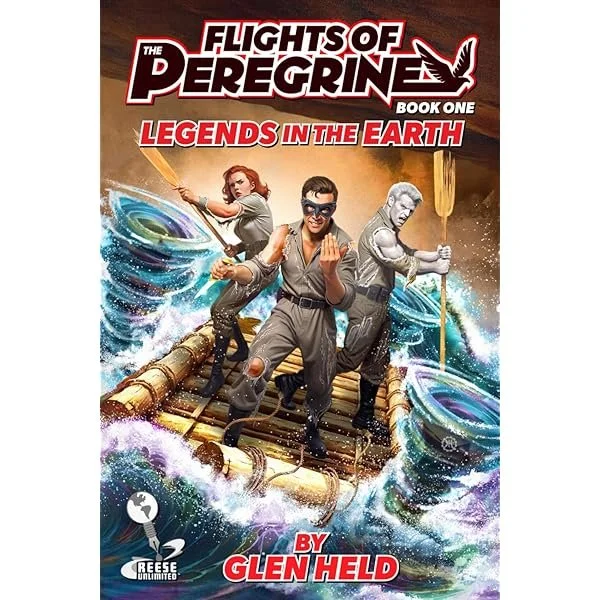
Your latest release is Flights of the Peregrine Book One: Legends of the Earth. Tell us a little about the book and how you came to re-launch the character.

This book had a strange journey from the start. A few years back, I saw an ad on the old Pro Se site saying they were looking for authors to write a novel based on Barry Reese’s character The Peregrine. At that time, I had one book published, a romance/mystery printed in 1991, and a few short stories. Fascinated by the art for the character, I came up with a proposal and was thrilled when I was given the okay to write the book! Four months later it was done, and I submitted the finished manuscript. I heard nothing for over a year. I kept contacting the company and was told various things. I had just about given up, when I was contacted by Dale Russell who would be the book’s editor. Together we polished up the story and got it ready for publication. More months passed and I saw various things on the internet which led me to believe Pro Se was in trouble. Eventually I was contacted by them and told, yes, they were going out of business and releasing stories back to their respective authors. However, as The Peregrine belonged to its creator Barry Reese, I would have to work something out with him to use it or change all the names and descriptions. Luckily, Barry was thinking about starting his own publishing company and we worked out a deal bringing Legends out as the first of his Flights of The Peregrine series.

The book itself is a two-part story. The first section deals with establishing the characters and has our good guys fight a truly evil menace that they had inadvertently released. But when the bad guys are defeated, it turns out  there’s a bigger bad behind them. Part two deals with The Peregrine, his fiancé, and a surprise from part one, venturing into the hollow Earth with the fate of the world resting on their shoulders. I tried to give the story as many twists and turns as I could, throwing in some easter eggs and cameos, and gave an ending which, I hope, was thought provoking. Once I get some reviews, I’ll know for sure.

 Will you be writing further installments? Or is this a multi-author franchise?

There will be at least two more novels in the series, but I won’t be writing them. One of the stories will be written by my friend, J.P. Linde, author of Fool’s Gold. I can’t wait to read his take on the characters Barry allowed me to play with. I suppose one should never say never though as The Peregrine is a great character and I’d be happy to return to chronicle more of his adventures.

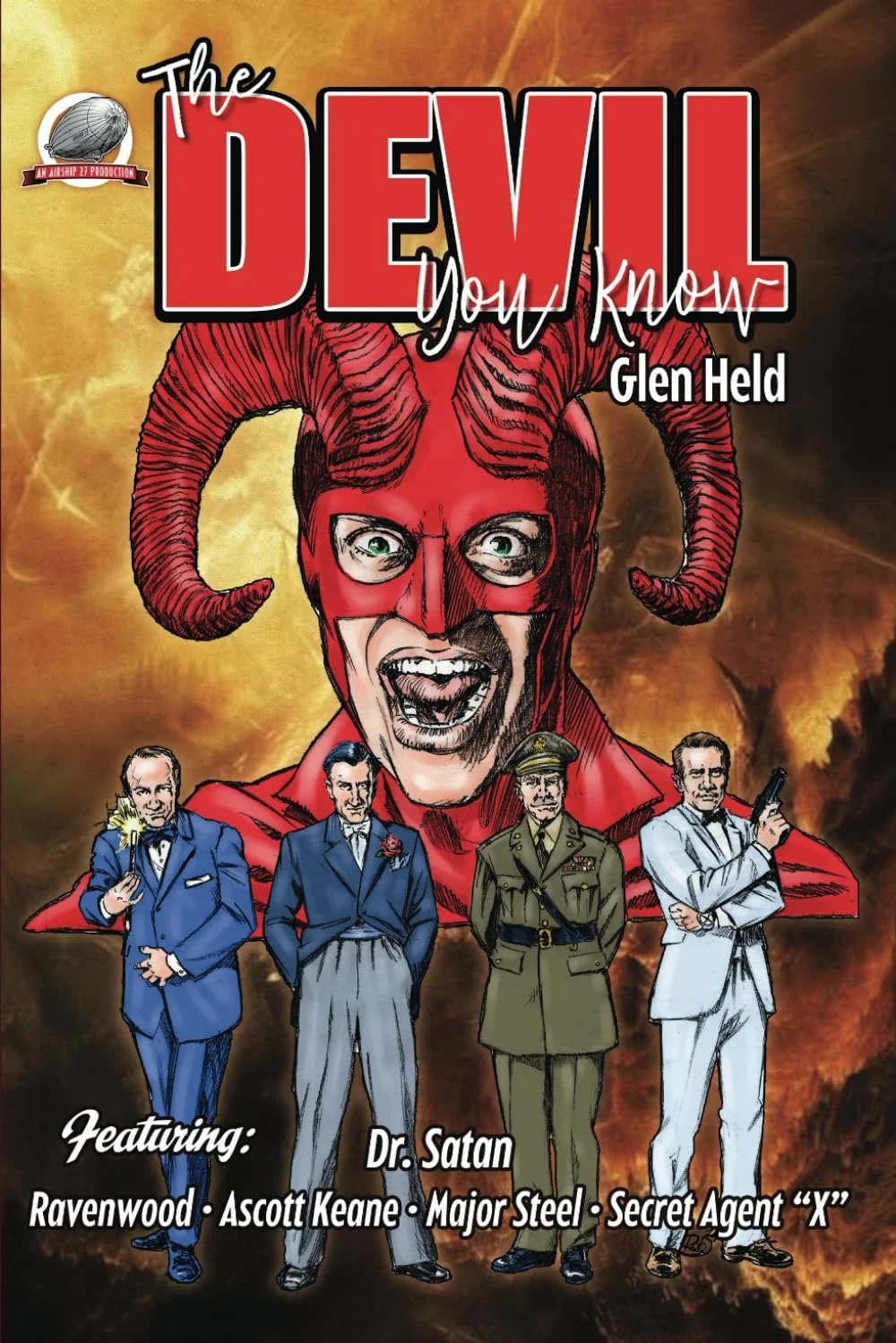
Tell us a bit about your other recent novel, The Devil You Know, which came out in 2024. This also has some strong connections to both classic pulps and the “New Pulp” movement, right?

Boy that one was a doozy to write! At the time I started thinking about concocting a story for Airship 27, I figured I’d have a better chance of getting published if the tale had as many public domain characters as possible. Doing my research, I came upon an image that blew me away. It was the cover of the August 1935 Weird Tales with a picture of a red clad, horn masked man with the words “Meet the Sinister and Mysterious DOCTOR SATAN, the World’s Weirdest Criminal” I mean, come on! What could better than to have a character like that as my antagonist?

I immersed myself in all eight Satan stories, feeling a fondness for not only him, but his enemy, Ascott Keane. Although Keane, a minor practitioner of the mystic arts, would be my main hero, he would need help going up not only against Satan, but another villain of my imagination who would be working for the nazis.

Since there would be a decent amount of magic in the tale, I figured Ravenwood, Stepson of Mystery, would be likely to give a hand. So, I read a bunch of his stories. Considering the worldwide scope I had planned, there would have to be a governmental liaison to eventually coordinate the efforts. More research brought Major Steele, a minor pulp character, as that liaison. And, what the hell, why not add a bigger hero into the fray? I looked for someone who wouldn’t overshadow Ascott. When I discovered that the girlfriend of Secret Agent X, the man of a thousand faces, shared the same last name of Keane’s girlfriend, I knew it was fate. (And I also had an easy way of bringing X into the picture when the cousin’s got together.)

After that, I sprinkled in some real-life characters of the time (such as Amelia Earnhardt’s navigator Fred Noonan and the criminal Meyer Lansky) as well as historical places such as the German bund camp in Yaphank on Long Island and, eventually, I had a story. It’s gotten some good reviews (always room for more!) so I think I may have done a good job.


I’d be interested to hear a bit about your writing process. Are you a plotter, a “pantser,” somewhere in-between? Do you have a set writing schedule?


Definitely not a plotter; not even close. Nope. No, sir! I have a vague idea of the story’s beginning and nothing more than that. My chapters are usually a few pages long and end on cliffhangers to get me (and hopefully the reader) excited about what’s to come. After chapter one, I have to spend some time thinking about where to go from there. Usually a new chapter idea comes to me overnight or on a walk with Eddie the dog. It’s really a terribly time-consuming way to write since I have to go back and change the previous parts to agree with any new plot twist. However, writing this way keeps me engaged with the story and I don’t get bored. Frustrated? Yes. Bored? No.


I know you’ve published short stories in anthologies like Atomic Stories, Dead Science, and Spectacular! Spectacular! Does your process for writing short stories differ at all from writing novels?

That depends on what sort of short I’m writing. If it’s someone else’s character – like the ones I’ve written for Code Name Intrepid, the Reese Unlimited Universe, Atomic Stories and the Radio Rita anthology – I have to immerse myself in the character’s established histories. I don’t want to go against anything that’s already established or have the characters behave differently than readers of the series are used to. Completely new stories require a different kind of research as I try to make my stories believable in their unbelievability. Like for my story ‘At His Hands’, which featured John Wilkes Booth and Dr. Samuel Mudd (‘Hands’ appeared in Freedom Fiction Journal) I read everything I could about the aftermath of the Lincoln assassination and visited both Mudd’s house in Maryland and Ford’s Theater. (Actually, I would have gone to those places anyway as history fascinates me.)


Finally, do you have anything in the works that readers should keep an eye out for?

Thankfully, I do! Currently, I’m writing a Lazarus Gray story for a Barry Reese anthology as well as a tale bringing a version of The Shadow into the Doc Talos universe. I’m just starting to write a sequel to my book The Devil You Know, available on Amazon (plug, plug)  with what I hope is a really cool idea that I just got on a walk with Eddie. In it, Doctor Satan…well, that would be telling.

At the moment, I have a young adult book making the rounds at a number of agents and another I’ve written about 10,000 words of that I’d like to finish. I also have a story in Robert J. Mendenhall’s Code Name Intrepid anthology coming out mid-August as well as a Radio Rita short to be published later this year by Airship 27.

I’d like to write a mainstream novel, but I’m still hunting for that one great idea. I think Eddie and I are going to have to start taking much longer walks!


Thanks again Glen! See you at Pulpfest!


Readers, it is not too late to register for and attend Pulpfest 2025 (THE pulp magazine-focused convention in the Northeast) and the other three conventions it hosts: FarmerCon (dedicated to the works of Philip Jose Farmer), ERBFest (dedicated to the works of Edgar Rice Burroughs) and DocCon (dedicated to all things Doc Savage related). Check out the Pulpfest website for registration and hotel information!
Interview: METEOR HOUSE PRESS

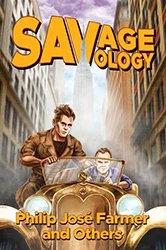
Today I chat with Meteor House founders Paul Spiteri, Win Scott Eckert, and Michael Croteau, to discuss their new collection Savageology, showcasing Philip José Farmer’s love of Doc Savage and some of the work it has inspired. Savageology is available to order from the Meteor House website and will also be available for purchase at Pulpfest.

Meteor House is a publisher of science fiction and fantasy. They publish The Worlds of Philip José Farmer anthology series, authorized limited edition novellas set in Farmer’s worlds written by other authors, and high-end limited-edition hardcovers of Farmer’s classic works.

Philip José Farmer fans are well aware of his love for, and work on, Doc Savage. What made Meteor House decide that now was the time to publish a collected volume of Farmer’s non-book-length Doc writings, along with writing about Farmer and Doc by other authors?

METEOR HOUSE: We published The Man Who Met Tarzan in 2021, a collection of Farmer’s writings about the jungle lord, including an interview he did with Lord Greystoke. We knew then we wanted to also publish a collection of his writings on Doc. When we heard last year that DocCon would be held at PulpFest this summer, we thought Savageology would be a great way to celebrate.

How would you compare Savageology and The Man Who Met Tarzan?

There is a fundamental difference. The Man Who Met Tarzan is, apart from introductory essays, all by Farmer and looks at how Farmer built his theories about Tarzan. Savageology takes a wider perspective and includes many pieces from fans and scholars influenced by Farmer and his varied writings about Doc.
    The commonality is Savageology is a fan focused love letter to Doc, and The Man Who Met Tarzan is his love letter to the lord of the jungle.

Savageology sports a truly impressive table of contents. Are there any pieces that are particularly rare or that were difficult to get included?

We really wanted to include “Doc Savage and the Cult of the Blue God,” a screen treatment Farmer wrote for George Pal as a potential sequel to the movie, Doc Savage: The Man of Bronze. It took a bit of time to negotiate with Condé Nast for permission to reproduce this, but it worked out in the end.
    Another item that was a lot of work, but really worth the effort, is the expanded version of the 8,000-word interview Will Murray did with Farmer in 1989 for Starlog magazine (published in 1990). Murray gave us access to the tapes of the over three-hour long interview, and we were able to expand it by over 10,000 words.

Meteor House has now brought out two editions of Doc Savage: His Apocalyptic Life. Is it accurate to describe Savageology as a companion piece to that biography?

Yes, absolutely. We believe anyone who enjoyed Doc Savage: His Apocalyptic Life will find this book just as educational and entertaining.

Doc fans can be notoriously split on how they view Farmer’s Savage-related writings. Would you say Savageology is aimed more at Farmer fans or Doc fans?

Both. We’re hoping this book may bridge that gap some. We always want to stress that Farmer absolutely loved Doc Savage. He had many different takes on Doc; he was not a black-and-white thinker and creator. So one of the points of the book is not adherence to one, strict interpretation, but rather an all-encompassing enthusiasm for the character and for fandom, something that everyone can share in. As Farmer and Murray discuss in the interview, Farmer was striving to explore the character of Doc Savage, to get into the essence of what a superhuman would actually be like.

Of course, some of that split has to do with Farmer’s creation of Doc Caliban, as Chuck Welch points out in his piece that acts as an introduction to the collection. There is some Doc Caliban content in this book. What are the essential differences between Doc Savage and Doc Caliban?

Put simply, Doc Savage is not flawed. He rarely makes mistakes, and he rarely, if ever, regrets a course of action he has taken. Doc Caliban is just as brilliant, both mentally and physically, but he comes with all the hangups and neuroses that we all have, coupled with the baggage of his highly unusual upbringing. Consequently, Caliban made a deal with the Devil when he joined The Nine. That’s not a decision (a mistake) that Savage would have made.

I never got to meet or interact with Phil before his and Bette’s passing, but you all at Meteor House did. Do any of you recall having conversations with him about Doc (Savage/Caliban) that readers here may find interesting?

Not about Savage or Caliban specifically, but rather pertaining to the novel about Doc’s daughter, Patricia Wildman. Win Eckert and Chris Carey were sitting with Phil and Bette, having a deep discussion about the approach Win should take in completing Phil’s unfinished novel The Evil in Pemberley House. At issue was whether to excise the highly graphic sex scenes Phil had written, or leave them in. Bette was in favor of deleting the sexual material; Phil wanted it left in but seemed resigned that due to the sensibilities of the late twenty-aughts (the book saw publication in 2009), the material would be removed. In the end, the sex scenes were deemed essential to the plot, theme, and character, and were left intact. It was an interesting conversation, to say the least.

Do you have plans for any more themed collections like Savageology and The Man Who Met Tarzan?

MH: We would like to someday publish a collection of Farmer’s writings relating to Sherlock Holmes, both fiction and non-fiction. And if we ever reprint his novel, A Barnstormer in Oz, we’d like to also include several shorter pieces he wrote about Oz. Perhaps one day we’ll collect his original Sturch stories and maybe do a collection of his shorter Riverworld stories.

And finally, what do you think Farmer would have made of books like Savageology and The Man Who Met Tarzan?

Farmer loved these characters so much he spent years researching them and writing about them. We think he would have liked how the pieces were presented and how, in concise volumes, he could see how his own thinking on these two iconic characters developed over time. And also appreciate the further study of these characters he inspired.

Thank you, Paul, Win, and Mike for your time. I look forward to seeing you all at PulpFest.

Thank you, Anthony, this has been a lot of fun!


Readers, it is not too late to register for and attend Pulpfest 2025 (THE pulp magazine-focused convention in the Northeast) and the other three conventions it hosts: FarmerCon (dedicated to the works of Philip Jose Farmer), ERBFest (dedicated to the works of Edgar Rice Burroughs) and DocCon (dedicated to all things Doc Savage related). Check out the Pulpfest website for registration and hotel information!

Interview: Douglas Klauba

Today I chat with artist Douglas Klauba. An award-winning illustrator, Douglas Klauba was born and raised in Chicago, and is a graduate of the American Academy of Art. His paintings have been included in the art annuals of Spectrum: The Best in Contemporary Fantastic Art, the Society of Illustrators, and Imagine FX magazine. His artwork has graced the covers and interiors of books from Edgar Rice Burroughs Inc. (Tarzan Trilogy, Untamed Pellucidar, Tarzan and the Valley of Gold, The Girl from Hollywood Centennial Edition, and Tarzan and the Forest of Stone), Flinch! Books (the Midnight Guardian series), and Craig McDonald’s Zana O’Savin Doc Savage pastiches.


Hi Doug! Thanks for taking some time to chat.

Thanks for thinking of me, Anthony!

First, I’d like to ask about your early influences. What are your earliest memories of really connecting with a piece of art?

Looking over my earliest childhood drawings that my family saved, you would see drawings of Batman and Robin, Superman, The Beatles, and lots of monsters. One of my earliest recollections of the visual world around me was movies and the magazine and comic racks at the corner grocery store. There I saw Famous Monsters of Filmland for the first time and my obsession with monsters began. Soon after, a newsstand/cards and gift shop opened next to the grocery store and that became my place to explore paperbacks, monster magazines, and comic books. I began collecting the Warren magazines, because the artwork looked the best to this 8-year-old developing artist. With the Frazetta and Sanjulian covers, and inside I found the Reed Crandall, Pepe Gonzales, and Richard Corben stories. And soon I would become obsessed with an artist named Wrightson. The artists that have influenced me the most is a long list. Some of them are: Frazetta, Basil Gogos, Steranko, Michael Wm. Kaluta, Barry Windsor-Smith, Franklin Booth, Joseph Clement Coll, Dean Cornwell, N. C. Wyeth, Roy Krenkel, J. Allen St. John, Hubert Rogers, Reynold Brown, Drew Struzan, Thomas Blackshear, and Alphonse Mucha.

What were your earliest creative outlets?

I was fortunate to be raised in a creative household. My father was a painter in the trades who grew up on EC and Classics Illustrated comics. His original career choice was to follow his older brother and become a Chicago illustrator. Instead, my father decided on marriage and starting a family. So he went into the trades. Our home was still decorated by oil paintings that my father painted. My uncle George was an illustrator at the Chicago Sun-Times newspaper, and I would see his artwork every week in the newspaper. We would visit my aunt and uncle often and I got to hang out in his home studio. We would visit his gallery openings, and I always thought it was pretty cool that my siblings and I were the youngest in attendance. I would soak up each experience. George Klauba is an internationally recognized painter and is best known for his Moby Dick series. There was always some form of inspiration throughout my early years - and beyond. Drawing was pretty contagious, and I did it daily, for hours. I didn’t lack imagination and when I didn’t have anything to draw, I would copy the Famous Monsters covers by Basil Gogos. My mother would often ask me to stop drawing and go outside and play with the neighborhood kids. But, throwing rocks at passing trains, or getting into fist fights grew old fast. One memorable Halloween, I entered a contest to paint a Halloween scene on a store front window. I painted Lon Chaney’s vampire from London After Midnight. I didn’t win the contest, but all of a sudden, I had made myself known as the neighborhood artist - and more importantly I met this kid, John, who lived two blocks away on another street. Like me, John had the Aurora monster models, collected the Warren monster magazines, he was into old monster movies and John had a Super 8 movie camera and his own projector! It was pretty fortunate to meet someone else that shared my interest in movies, comics, and monsters. Over the years we made our amateur movies, we tried our hand at stop motion animation, I worked with make-up to transform ourselves into monsters. We soon found other like-minded creative kids and spent hours creating fanzines, reading monster magazines, comics and going to the movies.

I’m always interested in hearing about the creative process. What medium and materials do you work with most frequently (your “favorites,” I guess)?

I love to draw in pencil. I am happiest when I am sitting at my drawing table and working on drawings. The last few years, I have been drawing with black acrylic paint. It was a natural transformation of working on a pencil drawing or using a black color pencil and I have continued to explore and enjoy working this way. It’s similar to any illustrator or comic book artist working with brush and ink - only I am using acrylic paint. I have been using acrylic paints for my color work since my advertising years of working in a Chicago illustration studio. Originally, I was hired because I was able to work in a variety of mediums from pen and ink, markers, watercolor paint, etc. But eventually the air brush was forced upon me at the studio, and I soon acclimated myself to this new tool and form of applying paint. I began exploring all that I could do with it and developed a working technique that has evolved into how I work today with acrylic paint. My process when working on a color piece has its measured steps. I start with putting gesso on a Crescent illustration board, followed by transferring my drawing onto the gessoed surface. I sometimes tighten up the drawing with color pencils before painting with the brush. At some point, I soon break out the air brush and apply color. I then finish up with my lighter values, using opaque acrylic paint. That’s basically the painting process from start to finish. The only thing not mentioned is finding good music to accompany the session (or listening to an old time radio drama) to help capture the mood of the narrative, the back and forth wrestling the artist will go through with the painting, maybe some frustrations, but eventually emerging through the challenges.

Has this changed over the arc of your career?

When I entered the art program at The American Academy of Art in Chicago, I was mainly a pen and ink artist that emulated Bernie Wrightson’s style. I had some experience with watercolors, but I didn’t have any confidence with working in color. I was intent on developing my craftsmanship with black and white ink and becoming a comic book artist. However, the few years at the Academy was more than I could have asked for. The academia of figure drawing, oil painting, watercolor instruction, and commercial illustration classes formed me into a much more rounded artist. My pen and ink illustrations became more developed, but I soon realized my passion for painting. In particular, I was drawn more towards pursuing a commercial art path, than a comic book career. Those were exciting times, as a developing art student. I worked at a few Chicago illustration studios that serviced advertising agencies for the next few years. I worked in every medium: pencils, pen and ink, marker renderings, watercolor / gouache paints, pastels, oil paints, air brush, and acrylics. It soon lost its lustre and the many hours of work, switching mediums, being told which technique to do a project - soon burned me out. I fell into an awful depression because I had lost my path. I no longer knew what kind of artist I was or wanted to be. I thought that if this was what the rest of my life was going to look like, I didn’t want it. But, instead of quitting, I left my studio position. And, within days (literally) I packed up my things and moved to California. I enrolled at the Academy of Art College in San Francisco for a semester, and studied with my favorite illustrators: Thomas Blackshear, Kazuhiko Sano, and Drew Struzan. The program, the fellow students, and the art community opened my eyes to becoming a better artist. The work that I developed, the friendships I made, put me back on a better footing of the artist I wanted to be and goals to pursue. I eventually ran out of money and returned back to my hometown of Chicago and intended to save up funds to permanently move back to San Francisco. But I became a busy illustrator, and life took its course. I eventually returned to working in pen and ink and developed a painting style of working in acrylics. The technique has changed a little over the years, but the process is more focused.

Does your process change at all depending on the type of project you’re working on?

Deadlines can dictate a path for a project. Under tight deadlines, I might not develop tight sketches or studies - and go straight to board. Spend less time constructing the drawing, and do more work with the painting process. It has its advantages, and the work is more immediate, and have a certain impact. The most important part of working on an illustration is the thumbnail sketch. Very small sketches, maybe 1 x 2, or 2 x 3 inches a piece. And I’ll sometimes do endless concepts. Usually, every assignment gets the 12 to 36 thumbnail session. I’ll immediately rough out every idea that comes to mind. The thumbnails are very simple, just shapes and scribbles - until something catches my eye.

I know you primarily as the artist of so many amazing book covers. Can you walk us through the process of developing a book cover? How much input does the author or publisher have throughout the project?

Once I finish the thumbnail session, I’ll pick the best of the lot and narrow them down to the best four or five to present to the client. I like having a discussion. I like getting input and much information or thoughts during this stage. This has worked well for me, so I don’t second guess myself or over analyze during the next stage of drawing studies and the finished pencil drawing. Once this drawing is approved, I have all of the confidence of creating the finished painting. I’ll spend up to 10 hours developing the drawing onto the board. Depending on the design and composition, applying paint can be 12 to 16 hours over 2 days, and then approximately 12 more hours of finishing. Depending how much time the painting wants to wrestle with me. Then I scan it and send the file for its approval.

What projects do you have coming up that fans should be on the lookout for?

I am developing an original pulp, sci-fi book of illustrations. I have been talking about it for years and I am slowly going through it. I would love to work on it full time, but commissions and projects come in at their own timing. I started a personal project earlier this year of painting black and white portraits of the classic movie monsters, as I reconnect with my younger monster kid roots. I also would like to strengthen my pulp influence. So, I’ll be exploring ideas with color paintings and black and white illustrations. Even while teaching part-time, I am always open for more assignments. I enjoy working with new creatives, and I like working in a team setting to develop new ideas and concepts. It’s that work that opens my eyes and fuels growth. In the meantime, I’m working on ideas and sketches for The Land That Time Forgot from ERB Books, as well as an alternative movie poster for the film, Caligula: The Ultimate Cut. You can also expect more covers for Craig McDonald’s Zana O’Savin books, as well as John Bruening’s The Midnight Guardian. And I look forward to any upcoming project from Edgar Rice Burroughs, Inc.

Thanks, Doug! Looking forward to talking to you more in person at Pulpfest in a few weeks!


Readers, it is not too late to register for and attend Pulpfest 2025 (THE pulp magazine-focused convention in the Northeast) and the other three conventions it hosts: FarmerCon (dedicated to the works of Philip Jose Farmer), ERBFest (dedicated to the works of Edgar Rice Burroughs) and DocCon (dedicated to all things Doc Savage related). Check out the Pulpfest website for registration and hotel information!
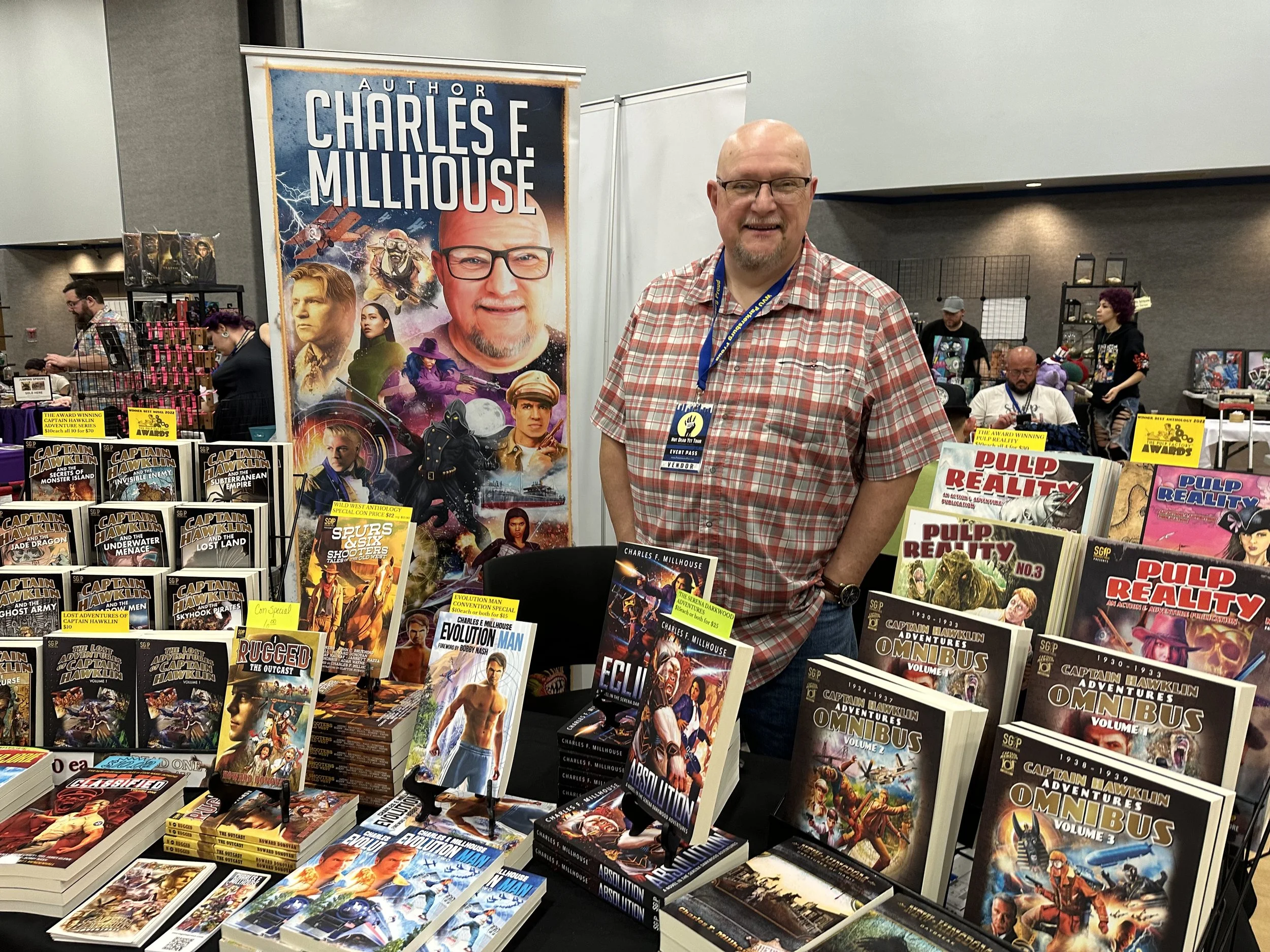
Interview: CHARLES F. MILLHOUSE

Today I chat with writer Charles F. Millhouse. Charles is the author of more than thirty books in the Science Fiction/Fantasy/New Pulp genres. A storyteller/dreamer since childhood, Charles published his first book in 1999, and he hasn’t looked back. A pioneer in Independent Publishing, he patiently waited for technology to catch up with his visions and with the advent of Print on Demand and the eBook craze, Charles created Stormgate Press in 2006 to further his publishing endeavors.


Hi Charles! Thanks for taking some time to chat with me.

It’s my pleasure, thank you for asking me to participate.

You write across a variety of genres. What were some of your earliest influences in science fiction, fantasy, adventure, pulp, etc.?

My earliest influence in science fiction of course, for many people my age was Star Trek. I immersed myself in anything I could when it came to the final frontier. Of course, for my generation, TV was like a best friend and there was a lot of science fiction throughout the 1970s into the early 80s. And by the time I hit my teens I started to read a lot more, The first book I remember reading was Ringworld, by Larry Niven. But when I encountered DUNE when I was in high school, everything changed for me, including how and what science fiction I gravitated to.

From science fiction I found myself reading a lot of fantasy books, one of my favorites then and still now, is Elric of Melniboné and of course Conan, by Robert E. Howard (Great stuff!)

After I saw Raiders of the Lost Ark in 1981, my dad introduced me to the world of pulp. The Shadow, Zorro, the Spider, on and on. In the 1980’s you could find a lot of pulp in boxes under tables at comic shops I went to. The owner sold them to me cheap, and I didn’t turn down a deal. I discovered a lot of serials around that time, The Phantom Empire with Gene Autry my favorite.

Your longest-running series features a golden age / pulp adventure named Captain Hawklin. Can you tell us a bit about the genesis of the character and how the series has developed?

I first created Captain Hawklin in the early 1990s but then he was named Captain Thunder, but a friend of mine made me realize that that name was overused and could eventually get me sued lol, if I decided to publish it. It was his suggestion that I changed the name, and he threw out, “Just call him Hawklin, or something like that.” Originally, he was set in the early 1960s and an astronaut who ran a secret organization that had been travelling to other planets since the 1950s. From there he evolved into a 1930s pulp character. (I’m not sure why. I think it could have possibly been that I had an idea for a 30’s story, and that’s why he manifested into that.) I only intended on writing one book just to fulfill my need to write a pulp character. So, I wrote The Skyhook Pirates in 2004, And after I wrote the first couple chapters I saw the trailer for Sky Captain and the World of Tomorrow, and it kind of mirrored my work in progress. So, I held off writing the book until after I saw the movie thinking that—if it was a lot like what I had written I would change the story completely. I'm happy to say that even though there were some similarities I felt there was enough difference between the two characters. And sadly, Sky Captain never manifested into a series.

After I published the first book in 2012, I discovered there was this new movement called “New Pulp” and there were other people writing their own versions of pulp type characters. Skyhook Pirates sold really well, to my surprise, and I decided to write a second one. I'm happy to say that he has gotten a bit of a following over the years and the evolution of the character has really taken root not only by me, but from other pulp writers who have written the character, adding to his already growing vast history.

 I think the first of your books that I read was the first Serena Darkwood science fiction adventure. I hear you’re working now on the third book in the series. How’s that going?

Thank you for reading Absolution. Serena doesn’t get the love that Captain Hawklin does. When I first wanted to be a published writer, I thought I would be a science fiction author, but as fate would have it, I became more of a pulp writer. Which I have embraced. But my love for science fiction is still in my heart. I'm currently outlining the third book for Serena Darkwood called “Capital” this will move the story forward immensely and will really put her in the middle of some galaxy changing events. Readers can look for “Capital” to release in the first quarter of 2026.

I’m always interested in hearing about a person’s creative process. Tell us a bit about how you develop a story. Does your process differ from genre to genre? Does it differ at all when you’re working on a short story versus a novel?

First, and I think this goes for most writers, I come up with the idea for a story. Most of my ideas come from driving in the car, and pitching them to my wife, who is great at helping me flush out ideas. Sometimes it's just a premise, other times it's a character and the story revolves around that character.

Sometimes the story begins one way and ends up totally different. My idea for my supernatural western trilogy “New Kingdom” started out as a mining colony in space and then took a sharp right turn to the Old West.

I scribble my ideas on index cards and keep them taped above my head when I'm writing.

I do this for novels and short stories. I write more from the seat of my pants than I do from an outline. My outlines generally are just a description of the characters and if I think of something that I really want to say in the story I'll jot it down on an index card.

I consider my first draft my outline, and from that outline I sculpt it into its final version. I always write my first draft at my desk. Working on the second draft and editing I tend to do on my iPad at work during breaks.

Speaking of short stories: I am intrigued by and loving your Stormgate Press Quick Reads series, which feels like it is meant to cover ALL THE GENRES! What inspired you to create this line and give it such diversity in content and tone?

I have to give credit where credit is due, and the idea for the Quick Read Books came from my wife. (The actual name Quick Read Books came from my cover designer Jeffrey Hayes.)

I have a banner that I sit up at my shows and on that banner are several characters that I created that had appeared only in the “Pulp Reality” series, and I had a lot of people at a show we were at in 2024 ask about characters like the “Purple Mystique” and “Night Vision.”

I knew I would never have time to write full-fledged novels with those characters, and it was my wife's idea to publish a series of short stories around 10,000 words and offer them on my table for $5, this would give patrons a chance to read my work who might not spend $10 or $15.00 for a novel and allow them the opportunity to see how I write. I’m happy to say it’s been a huge success.

I intend on keeping the series primarily on pulp style characters and manifesting them into the Captain Hawklin universe. Given time I will even work my barbarian character into that universe.

Finally, what do you have coming up that readers should keep an eye out for? And where will you be appearing in the near future?

I just released “Evolution Man Year Three” back in June of this year, I had great fun writing that book and the series is quickly becoming a favorite for returning readers.

On August 12th the third book in “The Lost Adventures of Captain Hawklin” will be available on Amazon, and its eBook will be available on several platforms. It is my intention to have copies exclusively on my table at PulpFest in August.

Readers can keep an eye out for more Quick Read Books; I'm currently writing another “Purple Mystique” story that will end this current wave of Quick Reads.

Also, for the Captain Hawklin fans who may be reading this interview, I am writing a new series of short stories set in the 1930s that are being released exclusively on my Patreon page.

My upcoming appearances:

On August 7th – 10th you can find me in Mars PA at PulpFest

For a complete list of my appearance, you can visit www.stormgatepress.com.


Thanks again for chatting, Charles! See you at Pulpfest!


Readers, it is not too late to register for and attend Pulpfest 2025 (THE pulp magazine-focused convention in the Northeast) and the other three conventions it hosts: FarmerCon (dedicated to the works of Philip Jose Farmer), ERBFest (dedicated to the works of Edgar Rice Burroughs) and DocCon (dedicated to all things Doc Savage related). Check out the Pulpfest website for registration and hotel information!
Interview: WIN SCOTT ECKERT 2025

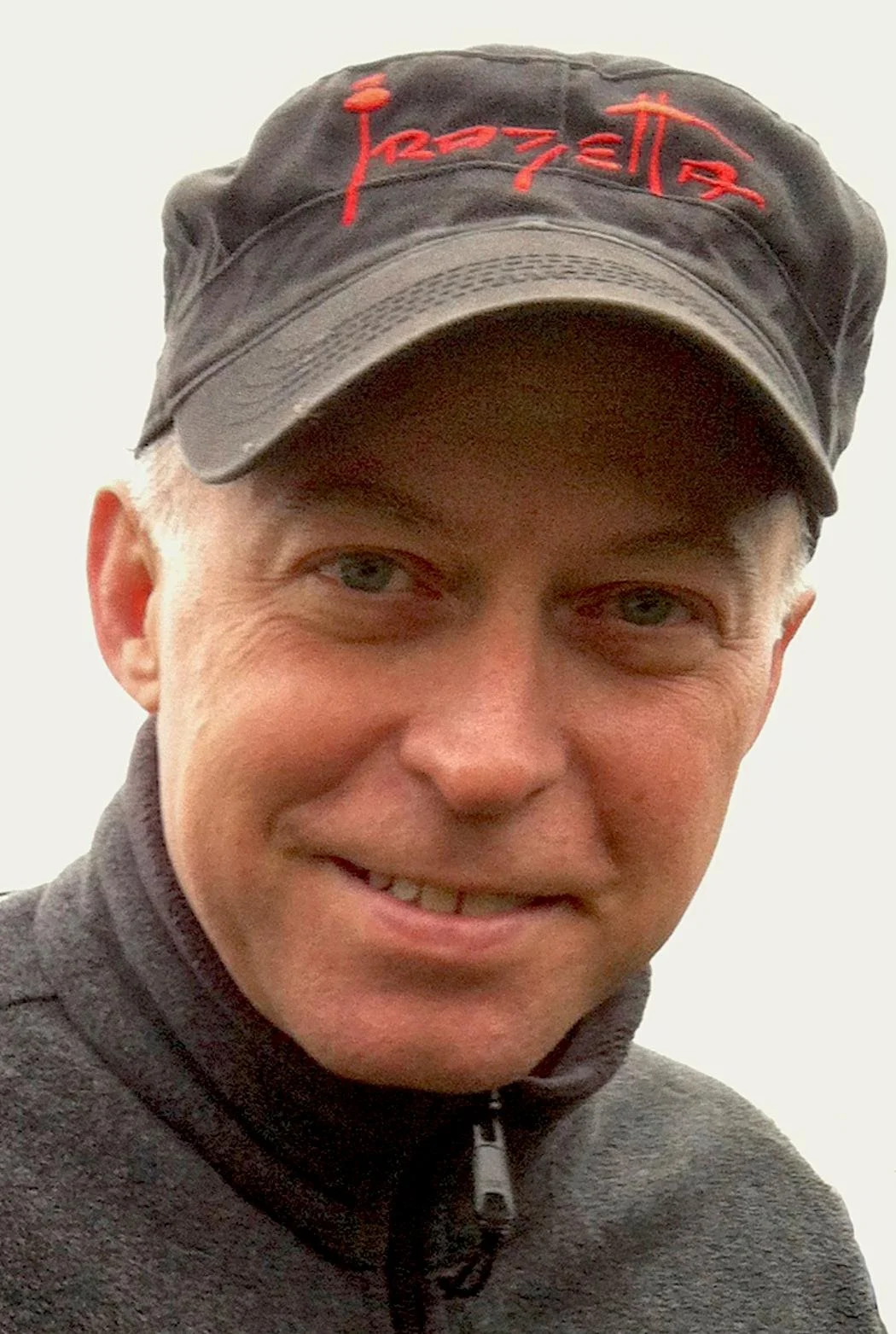
Today I chat with author and friend Win Scott Eckert, as a part of my ongoing series featuring creative folks who will be appearing at Pulpfest 2025. Win is the editor of Myths For the Modern Age and three volumes of short stories featuring The Green Hornet, co-author with Philip Jose Farmer of The Evil in Pemberley House and The Monster on Hold, and author of Crossovers: A Secret History of the World, The Scarlet Jaguar, and the authorized Edgar Rice Universe canonical novels Tarzan: Battle for Pellucidar, and Korak At The Earth’s Core. He has also written short stories featuring classic characters like The Green Hornet, the Lone Ranger, the Avenger, the Phantom, Sherlock Holmes, the Domino Lady, Honey West, T.H.E. Cat, and Irma Vep. Win is a member of the International Association of Media Tie-In Writers, holds a B.A. in anthropology and a Juris Doctor.


Hi, Win! Thanks for taking some time to chat. I know you’re busy working on the second book in your Edgar Rice Burroughs Universe trilogy, the Dead Moon Super-Arc.

WSE: Hi, Anthony! Yes, Pellucidar: Land of Awful Shadow.


We’ll talk about the new book shortly, but my first question is more general. You’ve had a wonderful career writing in the worlds of Edgar Rice Burroughs, Philip José Farmer, the Green Hornet, The Avenger, Honey West, the Lone Ranger, and others. Talk to me a bit about your earliest memories of wanting to write these characters/in these worlds.

To be honest, I didn’t consider writing fiction until after I started my metafictional Wold Newton Universe site in 1997. My first forays were non-fiction (or rather, metafiction) essays which were writing about characters’ chronologies and family trees, rather than traditional fiction stories. It was only when Jean-Marc Lofficier suggested that I try my hand at straight fiction for his annual Tales of the Shadowmen anthologies that I considered it. This was in 2004.

What is your current writing process like? That is, are you a plotter, a “pantser,” etc.? Do you set daily wordcount goals? And has that process changed at all throughout your career?

I am not a “pantser.” I definitely outline, but at a high level. I know the beginning, middle, and most importantly, the end. Part of this is because it is generally required when writing for licensed properties (although requirements for licensed properties are on the spectrum of detail from “almost no detail, just a pitch” to a strict chapter-by-chapter outline). Even with a strict chapter outline, there is a lot of room for creativity as I actually write the chapters, as additional inspiration inevitably hits while I am writing. And sometimes the chapters end up getting moved around as I write, and so forth. So, the outline is not a strict contract, but rather a demonstration that I know where I’m going in the end, even if the path of getting there deviates from the outline. As for your other questions, when I am deep in a writing project, I do set wordcount goals. My process has not changed much in the last twenty years, with the exception that within the last five years or so I occasionally dictate some portions of a novel; it speeds up my writing, but I’ve also noticed that more errors are introduced which I sometimes fail to catch despite intense proofing, so I am a bit gun shy right now about dictating too much.


You’re on your third novel for the Edgar Rice Burroughs Universe (the first being Tarzan: Battle for Pellucidar in the “Swords of Eternity Super-Arc” that launched the Edgar Rice Burroughs Universe (ERBU), and the second being Korak at Earth’s Core, the first book in your “Dead Moon Super-Arc”). I’d love to hear a bit about how you came to write for ERB Inc., and how you crafted your pitch for the “Dead Moon Super-Arc.”

Shortly before Christopher Paul Carey joined ERB, Inc. as Director (now VP) of Publishing, I pitched a Korak novel to CEO Jim Sullos, which was accepted. Once Chris joined, and outlined his plans for the ERBU, to be kicked off with the “Swords of Eternity Super-Arc,” it was a no-brainer that a Tarzan novel was needed for that launch. I reworked my Korak pitch into a Tarzan pitch which became Tarzan: Battle for Pellucidar. After that, Chris and I still really wanted to do a Korak novel. I explained my idea to him in person at PulpFest, to which he burst out laughing, and said, “Let’s do it!”

Philip José Farmer wrote an article originally published in ERB-dom No. 57, April 1972. His ideas were worked into his mock biography, Tarzan Alive. The article has also been republished in my collection Myths for the Modern Age: Philip José Farmer’s Wold Newton Universe (MonkeyBrain Books), Pearls from Peoria (Subterranean Press), and The Man Who Met Tarzan (Meteor House). The article is entitled “The Great Korak-Time Discrepancy” and deals with how Korak, the son of Tarzan, impossibly ages about eight-ten years between the ERB books The Beasts of Tarzan and The Son of Tarzan. Farmer proposes an explanation, and there is another branch of fandom that proposes a different explanation. You can read the article online here. The “Dead Moon Super-Arc” will present a third, in-universe explanation.

We also wanted to explore as-yet untouched (or relatively untouched parts) of Pellucidar, the hollow world at the Earth’s core, and decided that the Dead World and the Land of Awful Shadow would be great settings for this trilogy.

What challenges have you encountered in moving Burroughs’ classic characters forward in time and in expanding the ERBU while still remaining true to his spirit and Burroughs’ original timeline and characters?

Honestly . . . not many. The biggest challenge is ensuring that all the writers’ stories remain consistent with each other, with no contradictions. That is one of the big selling points of the ERBU: the novels, stories, and comics are consistent both in continuity and in character with what ERB wrote, but they are all also consistent with each other. It’s not difficult to portray these characters as honorable and heroic. Perfect? No, of course not. I had a good time portraying Korak as less than perfect, and yet still heroic.


Without spoilers, what can you tell us about the upcoming second “Dead Moon Super-Arc” novel, Pellucidar: Land of Awful Shadow?

Yes! It takes place mostly concurrently with Korak at the Earth’s Core (this was a technique Burroughs used; for examples, see the Pellucidar novels Tarzan at the Earth’s Core and Back to the Stone Age), in which it is mentioned that Rahnak and Kyrianji have set off into the Land of Awful Shadow in search of Rahnak’s mother, Suzanne Clayton. So, Pellucidar: Land of Awful Shadow is the tale of their adventure. Rahnak the Daring is the grandson of Korak, and thus the great-grandson of Tarzan! Kyrianji is a great Waziri warrior princess.

Along the way, they have many adventures in this weird Land of Awful Shadow as they struggle to get back to their friends and allies, including David Innes, with some important information. We’ll also get some insight into what happened to Suzanne (Tarzan’s granddaughter), who was mentioned in Korak at the Earth’s Core (her disappearance set off the events of that book).

It's a lot of fun because the book is probably eighty or more percent focused on characters I was privileged to create: Rahnak, Kyrianji, and Suzanne.

All the plotlines will come crashing together in the third book, Tarzan Unleashed. (You see … there’s really no way to “pants” this. 😊)

You also had a short story in the anthology Thrilling Adventure Yarns 2025, edited by Robert Greenberger. Tell us a little bit about that story and what inspired it.

It was an honor to be invited to contribute to that anthology, with such an awesome lineup of authors, and it was great to flex my short story muscles. My entry was a weird menace tale, bordering on occult, called “She-Devil of Paris.” It was very much a Sax Rohmer homage, and featured Irma Vep, the anti-heroine of a 1915–16 French serial in ten chapters called Les Vampires. (The Vampires are a criminal gang who terrorize Paris, not actual vampires.) But, as with most Rohmer stories, the main character isn’t really the one who appears more “on camera,” Irma Vep, but rather her antagonist, who in 1923 Paris is calling herself Astarte.

Finally, do you have anything else upcoming that you’re able to tell us about?

I do! After Tarzan Unleashed, I plan to write the fifth and final Secrets of the Nine novel, as yet untitled. You may recall that the fourth book, The Monster on Hold (cowritten with Philip José Farmer from his outline and including large sections of his prose), most of Doc Caliban’s plotlines were wrapped up. Caliban was the POV character, and Phil’s outline and plot did not include anything regarding Lord Grandrith. Therefore, we still have dangling plotlines regarding Grandrith going all the way back to A Feast Unknown, Lord of the Trees, and The Mad Goblin. Phil’s estate and agent have granted me permission to write a Lord Grandrith-centric novel (I’m sure Caliban will also make an appearance, but its Grandrith’s book) resolving all the plotlines. I want to be clear that we do not have anything in Phil’s files (“The Magic Filing Cabinet”) regarding a fifth book, so this will be solely by me. Believe me, I wish we did have notes or hints. The book will be published by Meteor House, with consistent trade dress, art, and design as seen on the other Secrets of the Nine books.

I also plan to finally return to Patrica Wildman and write more novella-length follow-ups to The Evil in Pemberley House and The Scarlet Jaguar. I’d like to write more Sherlock Holmes short stories, following up on “The Adventure of the Fallen Stone.” And I want to do a series of novels featuring Astarte in different time periods, from the Victorian era, to the 1930s, and perhaps even into the 1960s and ’70s.

Finally, Anthony, I want to thank you for the interview. It’s been quite a while since we’ve done this (2017!), and I appreciate it. I’m looking forward to seeing you at PulpFest 2025 / FarmerCon XX in August 2025!

It was my pleasure, Win! Always fun discussing writing and Phil and Burroughs and Star Trek and The Man From U.N.C.L.E and everything else we have in common. See you in a few weeks!


Readers, it is not too late to register for and attend Pulpfest 2025 (THE pulp magazine-focused convention in the Northeast) and the other three conventions it hosts: FarmerCon (dedicated to the works of Philip Jose Farmer), ERBFest (dedicated to the works of Edgar Rice Burroughs) and DocCon (dedicated to all things Doc Savage related). Check out the Pulpfest website.com/ for registration and hotel information!