Today for Writer Wednesday, I chat with author Christa Carmen.

Christa Carmen lives in Rhode Island. She is the Bram Stoker Award-winning and two-time Shirley Jackson Award-nominated author of The Daughters of Block Island, Beneath the Poet's House, and How to Fake a Haunting, as well as the Indie Horror Book Award-winning Something Borrowed, Something Blood-Soaked, the Bram Stoker Award-nominated "Through the Looking Glass and Straight into Hell" (Orphans of Bliss: Tales of Addiction Horror), and co-editor of the Aurealis Award-nominated We Are Providence and the Australiasian Shadow Award-nominated Monsters in the Mills. She has a BA from the University of Pennsylvania, an MA from Boston College, and an MFA from the University of Southern Maine.
When she’s not writing, she keeps chickens; uses a Ouija board to ghost-hug her dear, departed beagle; and sets out on adventures with her husband, daughter, and bloodhound–golden retriever mix. Most of her work comes from gazing upon the ghosts of the past or else into the dark corners of nature, those places where whorls of bark become owl eyes, and deer step through tunnels of hanging leaves and creeping briars only to disappear.
Hi Christa! Thanks for taking some time to chat.
Thank you so much for having me, Anthony!
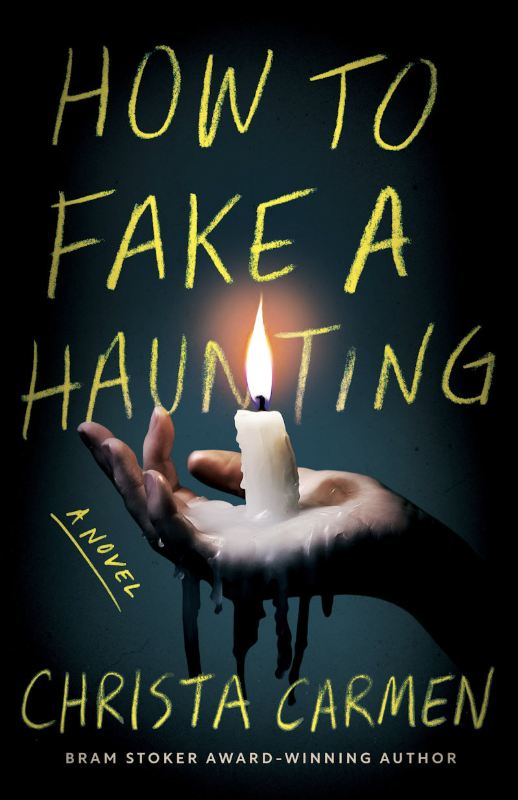
How To Fake A Haunting, which released on October 7th, is your third book in three years. That’s consistent output! Tell us a bit about the plot.
Lainey Taylor is being pushed to the brink by her alcoholic husband, Callum. However, without any DUIs or missed work days for a judge to point to, Lainey knows she won’t win against Callum–and his influential family–in divorce proceedings or an attempt to gain full custody of their daughter, Beatrix. She’s trapped, angry, and completely helpless.
Her best friend Adelaide has a wild solution. They’ll stage a haunting so convincing it will drive Callum out of Lainey’s life for good. They start small, with strange smells, noises in the walls, and flies unleashed along the windowsills (I had to insert at least a little Amityville-esque influence!). But with each stage of their plan (and a little help from Callum’s alcohol-induced night terrors), Lainey is closer to seeing the haunting through to its bitter, freeing end.
Without giving anything away, I’ll just say that there’s far too much rage, resentment, and fear for Lainey and Adelaide’s plan not to go horribly wrong. As their fake haunting spirals into something no one can control, Lainey discovers that the only way out is to join forces with Callum, or die trying.
What inspired or influenced How To Fake A Haunting?
There was a very specific moment of inception for this book. My husband and I have been married for nine years this October, and like all married couples (or maybe just like all people once they reach a certain age), we tend to occasionally (ahem, often) spend so much time choosing a movie to watch, that by the time we turn it on, one or both of us falls asleep. On this particular evening, my husband swore he wasn’t tired; we chose a movie, and not five minutes later, I heard heaving breathing coming from the couch.
Annoyed, I decided to head in and get ready for bed. But before I could, an idea–BAM–hit me like a horror movie jump scare. I grabbed his cell phone, and took a picture of him sleeping on the couch. I think maybe I was planning to show him the picture in the morning, like, “I told you you’d be the one to fall asleep!” Instead, I texted the picture to myself, walked into the kitchen, and then stormed back into the living room loud enough to wake him. “Why did you just text me a picture of yourself sleeping?” I asked. Disoriented, he replied, “What? Why would I text you a picture of myself sleeping?” But I doubled down, narrowed my eyes, and said, really cryptically, “You mean, you didn’t just text me this picture of you sleeping from your phone?” Needless to say, he was suitably freaked out, and eventually, I caved and admitted to the prank. When the time came to get working on a new novel, I thought of the playfulness of scaring your spouse, and how the idea of faking a haunting could be really fun, which morphed into questions of why someone would want to commit to a fake haunting, and then things just took off from there!
It seems like you did quite a bit of research into the paranormal investigation field, and particularly in regards to faking a haunting. Can you tell us a bit about that research?
I think the research for this book might have been some of the most bonkers research I’ve ever conducted. Around two-thirds of the way through the book, in chapter 32, Lainey and Adelaide have returned to Lainey’s house under cover of darkness to orchestrate the mother of all fake hauntings, a terrifying spectacle that will finally send Callum packing for good. In order to pull off what is essentially an elaborate theatrical production, the women dig deep into their arsenal, acquired through extensive horror movie research and a meeting with a husband-wife team of paranormal investigators. Without spoiling anything, I’ll say that, in order to write the scene, I had to rely on my own knowledge of horror films, titles like Let’s Scare Jessica to Death, The Conjuring, The Amityville Horror, Poltergeist, Carrie, The Changeling, and Malevolent, as well as deep dives into smart speaker and television programming capabilities, magnetized candles, recordable teddy bears, and how much pig’s blood might be required to recreate an abattoir inside a bathroom.
Having read and loved all three of your novels, I feel like it’s safe to say you have slowly increased the supernatural quotient in each book. Daughters of Block Island was more classically Gothic, with mostly eerie vibes; Beneath the Poet’s House had some moments that could have been supernatural or could have had mundane explanations but were left up to the reader to decide, and now, without spoilers, it appears the fake haunting turns real. Has this slow increase in the supernatural been a conscious decision on your part?
So, short answer… yes? But one that was met with a fair amount of reluctance on my part and lots of encouragement from writer friends and beta readers.
I recently took part in a wonderful event an An Unlikely Story in Plainville, MA with fantastic thriller writers Vanessa Lillie and Tracy Sierra, and Tracy said that she thinks one of the most difficult things in writing horror is coming up with a ‘system’ of the supernatural—or monsters, or killers, or whatever frightening thing the author is working with—that is unique but also makes sense in the world of the story, and she stated that she felt I’d done a good job with it in How to Fake a Haunting (for which I’m eternally grateful). She then asked if I had any advice on how to invent a ‘horror world’ that is also logical, and my answer was that I start by getting something onto the page that serves the story, but that ultimately, I don’t want the supernatural in my work to be, as the kids say, “cringe.”
I think I shied away from the supernatural on the page in the past because I was worried I would do it in a way that would be hokey or take readers out of the story. I should have trusted myself more, however, because I was happy with how the final third of How to Fake a Haunting played out.
I’m always interested to know what an author’s creative process is like. Are you a plotter, a pantser, somewhere in between? Has your process changed over the years you’ve been writing?
I am neither, I suppose. I’m a writer who tends to know where she wants a story to begin, where she wants it to end, and the major beats in between. The details, though, how I get from beginning to beat one, beat one to beat two, etc., those are apt to surprise me. I do tend to—if I stumble on an idea I want to include somewhere in a manuscript—get nervous that I’ll forget it, so I text myself little “breadcrumbs,” as I call them, so I can go back over the text thread at the end of each draft and make sure I’ve incorporated everything I wanted to include. So…I’m a ‘Hansel-and-Greteler?’
I love that term! Let’s make it a thing. You also write short stories and have edited some anthologies of local Rhode Island writers’ work. What do you look for as an editor?
First and foremost, adherence to submission guidelines! It may sound nitpicky, but this shows an editor that you respect their process and their time, and helps you put the right foot forward from first glance. As for content, I look for work that keeps me guessing, keeps me uneasy, has me questioning everything I thought I knew in the world of the story. I love a well-done ambiguous ending, a jump-scare-on-paper, and both quiet and cinematic horror, as long as it’s well done. Most importantly, I want to be thinking about the story long after I read it, turning over lines and plot points in my mind. I’m currently editing an unannounced project right now, and it’s been a delight to discover some new voices and be told some amazing, get-under-your-skin stories from writer’s I’ve come to admire.
I’m already eagerly anticipating your next book, as you probably have guessed. Can you tease us at all about your next project and when we might expect it?
Well, thank you! That’s so nice to hear. I’m indeed hard at work finishing up my fourth novel, as well as putting a second short story collection together. The novel will NOT be set in Rhode Island, which is pretty wild for me, but in London, Geneva, and Rome, and is a sort of body horror/sci-fi/artifact chase mashup. I’m having lots of fun with it and am looking forward to getting back to work on the project post-release of How to Fake a Haunting.
In the meantime, my short story, “The Clearing,” is part of Lindy Ryan and Stephanie M. Wytovich’s HOWL: An Anthology of Werewolves from Women-in-Horror, out November 4th. I also have a story, “Comeback Kid,” in The Rack II: More Stories Inspired by Vintage Horror Paperbacks, edited by Tom Deady, that came out October 14th, and several other stories in anthologies, as well as an editing project, that I can’t announce just yet.
Anyone interested in updates can find me online, at Facebook (https://www.facebook.com/christaqua/), Instagram (@christaqua), and Bluesky (@christaqua.bsky.social), as well as on my website, www.christacarmen.com.
And my traditional final question: What is your all-time favorite book?
I’m going to be such a downer on this question, because my favorite book is A Little Life by Hanya Yanigahara. I’ve never read something beyond this book in which the characters felt realer to me than some of the real people I know. Yanigahara’s ability to immerse you in the story, in the world she’s created, is unparalleled. Jude’s plight also helped me understand more about how trauma can follow and shape a person than some of my experiences working at an actual inpatient psychiatric hospital ward; I worked to get into patients’ heads, to help them, but one can never quite reach through someone’s barriers the way you can into a well-rendered character’s head, and this was Jude St. Francis all the way.
Thanks, Christa!
Thank you, Anthony! This was a blast!
You can find my review of Christa’s second novel, Beneath the Poet’s House HERE.



Quisque iaculis facilisis lacinia. Mauris euismod pellentesque tellus sit amet mollis.