Interview: Douglas Klauba

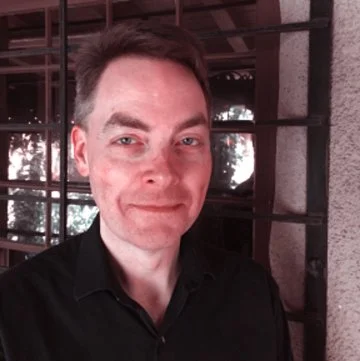
Today I chat with artist Douglas Klauba. An award-winning illustrator, Douglas Klauba was born and raised in Chicago, and is a graduate of the American Academy of Art. His paintings have been included in the art annuals of Spectrum: The Best in Contemporary Fantastic Art, the Society of Illustrators, and Imagine FX magazine. His artwork has graced the covers and interiors of books from Edgar Rice Burroughs Inc. (Tarzan Trilogy, Untamed Pellucidar, Tarzan and the Valley of Gold, The Girl from Hollywood Centennial Edition, and Tarzan and the Forest of Stone), Flinch! Books (the Midnight Guardian series), and Craig McDonald’s Zana O’Savin Doc Savage pastiches.
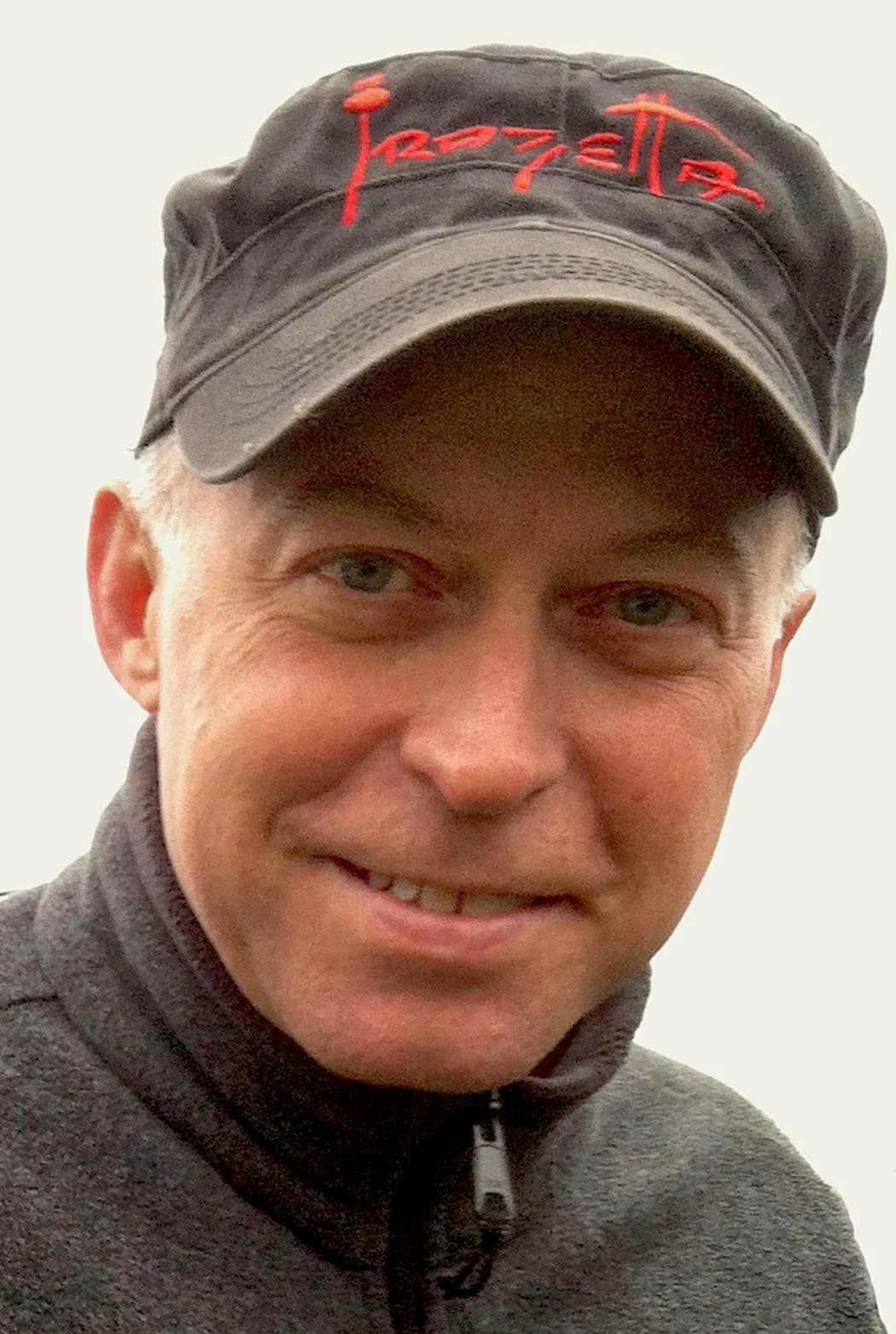
 

Hi Doug! Thanks for taking some time to chat.

Thanks for thinking of me, Anthony!

First, I’d like to ask about your early influences. What are your earliest memories of really connecting with a piece of art?

Looking over my earliest childhood drawings that my family saved, you would see drawings of Batman and Robin, Superman, The Beatles, and lots of monsters. One of my earliest recollections of the visual world around me was movies and the magazine and comic racks at the corner grocery store. There I saw Famous Monsters of Filmland for the first time and my obsession with monsters began. Soon after, a newsstand/cards and gift shop opened next to the grocery store and that became my place to explore paperbacks, monster magazines, and comic books. I began collecting the Warren magazines, because the artwork looked the best to this 8-year-old developing artist. With the Frazetta and Sanjulian covers, and inside I found the Reed Crandall, Pepe Gonzales, and Richard Corben stories. And soon I would become obsessed with an artist named Wrightson. The artists that have influenced me the most is a long list. Some of them are: Frazetta, Basil Gogos, Steranko, Michael Wm. Kaluta, Barry Windsor-Smith, Franklin Booth, Joseph Clement Coll, Dean Cornwell, N. C. Wyeth, Roy Krenkel, J. Allen St. John, Hubert Rogers, Reynold Brown, Drew Struzan, Thomas Blackshear, and Alphonse Mucha.

What were your earliest creative outlets?

I was fortunate to be raised in a creative household. My father was a painter in the trades who grew up on EC and Classics Illustrated comics. His original career choice was to follow his older brother and become a Chicago illustrator. Instead, my father decided on marriage and starting a family. So he went into the trades. Our home was still decorated by oil paintings that my father painted. My uncle George was an illustrator at the Chicago Sun-Times newspaper, and I would see his artwork every week in the newspaper. We would visit my aunt and uncle often and I got to hang out in his home studio. We would visit his gallery openings, and I always thought it was pretty cool that my siblings and I were the youngest in attendance. I would soak up each experience. George Klauba is an internationally recognized painter and is best known for his Moby Dick series. There was always some form of inspiration throughout my early years - and beyond. Drawing was pretty contagious, and I did it daily, for hours. I didn’t lack imagination and when I didn’t have anything to draw, I would copy the Famous Monsters covers by Basil Gogos. My mother would often ask me to stop drawing and go outside and play with the neighborhood kids. But, throwing rocks at passing trains, or getting into fist fights grew old fast. One memorable Halloween, I entered a contest to paint a Halloween scene on a store front window. I painted Lon Chaney’s vampire from London After Midnight. I didn’t win the contest, but all of a sudden, I had made myself known as the neighborhood artist - and more importantly I met this kid, John, who lived two blocks away on another street. Like me, John had the Aurora monster models, collected the Warren monster magazines, he was into old monster movies and John had a Super 8 movie camera and his own projector! It was pretty fortunate to meet someone else that shared my interest in movies, comics, and monsters. Over the years we made our amateur movies, we tried our hand at stop motion animation, I worked with make-up to transform ourselves into monsters. We soon found other like-minded creative kids and spent hours creating fanzines, reading monster magazines, comics and going to the movies.

I’m always interested in hearing about the creative process. What medium and materials do you work with most frequently (your “favorites,” I guess)?

I love to draw in pencil. I am happiest when I am sitting at my drawing table and working on drawings. The last few years, I have been drawing with black acrylic paint. It was a natural transformation of working on a pencil drawing or using a black color pencil and I have continued to explore and enjoy working this way. It’s similar to any illustrator or comic book artist working with brush and ink - only I am using acrylic paint. I have been using acrylic paints for my color work since my advertising years of working in a Chicago illustration studio. Originally, I was hired because I was able to work in a variety of mediums from pen and ink, markers, watercolor paint, etc. But eventually the air brush was forced upon me at the studio, and I soon acclimated myself to this new tool and form of applying paint. I began exploring all that I could do with it and developed a working technique that has evolved into how I work today with acrylic paint. My process when working on a color piece has its measured steps. I start with putting gesso on a Crescent illustration board, followed by transferring my drawing onto the gessoed surface. I sometimes tighten up the drawing with color pencils before painting with the brush. At some point, I soon break out the air brush and apply color. I then finish up with my lighter values, using opaque acrylic paint. That’s basically the painting process from start to finish. The only thing not mentioned is finding good music to accompany the session (or listening to an old time radio drama) to help capture the mood of the narrative, the back and forth wrestling the artist will go through with the painting, maybe some frustrations, but eventually emerging through the challenges.

Has this changed over the arc of your career?

When I entered the art program at The American Academy of Art in Chicago, I was mainly a pen and ink artist that emulated Bernie Wrightson’s style. I had some experience with watercolors, but I didn’t have any confidence with working in color. I was intent on developing my craftsmanship with black and white ink and becoming a comic book artist. However, the few years at the Academy was more than I could have asked for. The academia of figure drawing, oil painting, watercolor instruction, and commercial illustration classes formed me into a much more rounded artist. My pen and ink illustrations became more developed, but I soon realized my passion for painting. In particular, I was drawn more towards pursuing a commercial art path, than a comic book career. Those were exciting times, as a developing art student. I worked at a few Chicago illustration studios that serviced advertising agencies for the next few years. I worked in every medium: pencils, pen and ink, marker renderings, watercolor / gouache paints, pastels, oil paints, air brush, and acrylics. It soon lost its lustre and the many hours of work, switching mediums, being told which technique to do a project - soon burned me out. I fell into an awful depression because I had lost my path. I no longer knew what kind of artist I was or wanted to be. I thought that if this was what the rest of my life was going to look like, I didn’t want it. But, instead of quitting, I left my studio position. And, within days (literally) I packed up my things and moved to California. I enrolled at the Academy of Art College in San Francisco for a semester, and studied with my favorite illustrators: Thomas Blackshear, Kazuhiko Sano, and Drew Struzan. The program, the fellow students, and the art community opened my eyes to becoming a better artist. The work that I developed, the friendships I made, put me back on a better footing of the artist I wanted to be and goals to pursue. I eventually ran out of money and returned back to my hometown of Chicago and intended to save up funds to permanently move back to San Francisco. But I became a busy illustrator, and life took its course. I eventually returned to working in pen and ink and developed a painting style of working in acrylics. The technique has changed a little over the years, but the process is more focused.

Does your process change at all depending on the type of project you’re working on?

Deadlines can dictate a path for a project. Under tight deadlines, I might not develop tight sketches or studies - and go straight to board. Spend less time constructing the drawing, and do more work with the painting process. It has its advantages, and the work is more immediate, and have a certain impact. The most important part of working on an illustration is the thumbnail sketch. Very small sketches, maybe 1 x 2, or 2 x 3 inches a piece. And I’ll sometimes do endless concepts. Usually, every assignment gets the 12 to 36 thumbnail session. I’ll immediately rough out every idea that comes to mind. The thumbnails are very simple, just shapes and scribbles - until something catches my eye.

I know you primarily as the artist of so many amazing book covers. Can you walk us through the process of developing a book cover? How much input does the author or publisher have throughout the project?

Once I finish the thumbnail session, I’ll pick the best of the lot and narrow them down to the best four or five to present to the client. I like having a discussion. I like getting input and much information or thoughts during this stage. This has worked well for me, so I don’t second guess myself or over analyze during the next stage of drawing studies and the finished pencil drawing. Once this drawing is approved, I have all of the confidence of creating the finished painting. I’ll spend up to 10 hours developing the drawing onto the board. Depending on the design and composition, applying paint can be 12 to 16 hours over 2 days, and then approximately 12 more hours of finishing. Depending how much time the painting wants to wrestle with me. Then I scan it and send the file for its approval.

What projects do you have coming up that fans should be on the lookout for?

I am developing an original pulp, sci-fi book of illustrations. I have been talking about it for years and I am slowly going through it. I would love to work on it full time, but commissions and projects come in at their own timing. I started a personal project earlier this year of painting black and white portraits of the classic movie monsters, as I reconnect with my younger monster kid roots. I also would like to strengthen my pulp influence. So, I’ll be exploring ideas with color paintings and black and white illustrations. Even while teaching part-time, I am always open for more assignments. I enjoy working with new creatives, and I like working in a team setting to develop new ideas and concepts. It’s that work that opens my eyes and fuels growth. In the meantime, I’m working on ideas and sketches for The Land That Time Forgot from ERB Books, as well as an alternative movie poster for the film, Caligula: The Ultimate Cut. You can also expect more covers for Craig McDonald’s Zana O’Savin books, as well as John Bruening’s The Midnight Guardian. And I look forward to any upcoming project from Edgar Rice Burroughs, Inc.

Thanks, Doug! Looking forward to talking to you more in person at Pulpfest in a few weeks!


Readers, it is not too late to register for and attend Pulpfest 2025 (THE pulp magazine-focused convention in the Northeast) and the other three conventions it hosts: FarmerCon (dedicated to the works of Philip Jose Farmer), ERBFest (dedicated to the works of Edgar Rice Burroughs) and DocCon (dedicated to all things Doc Savage related). Check out the Pulpfest website for registration and hotel information!
Interview: CHARLES F. MILLHOUSE

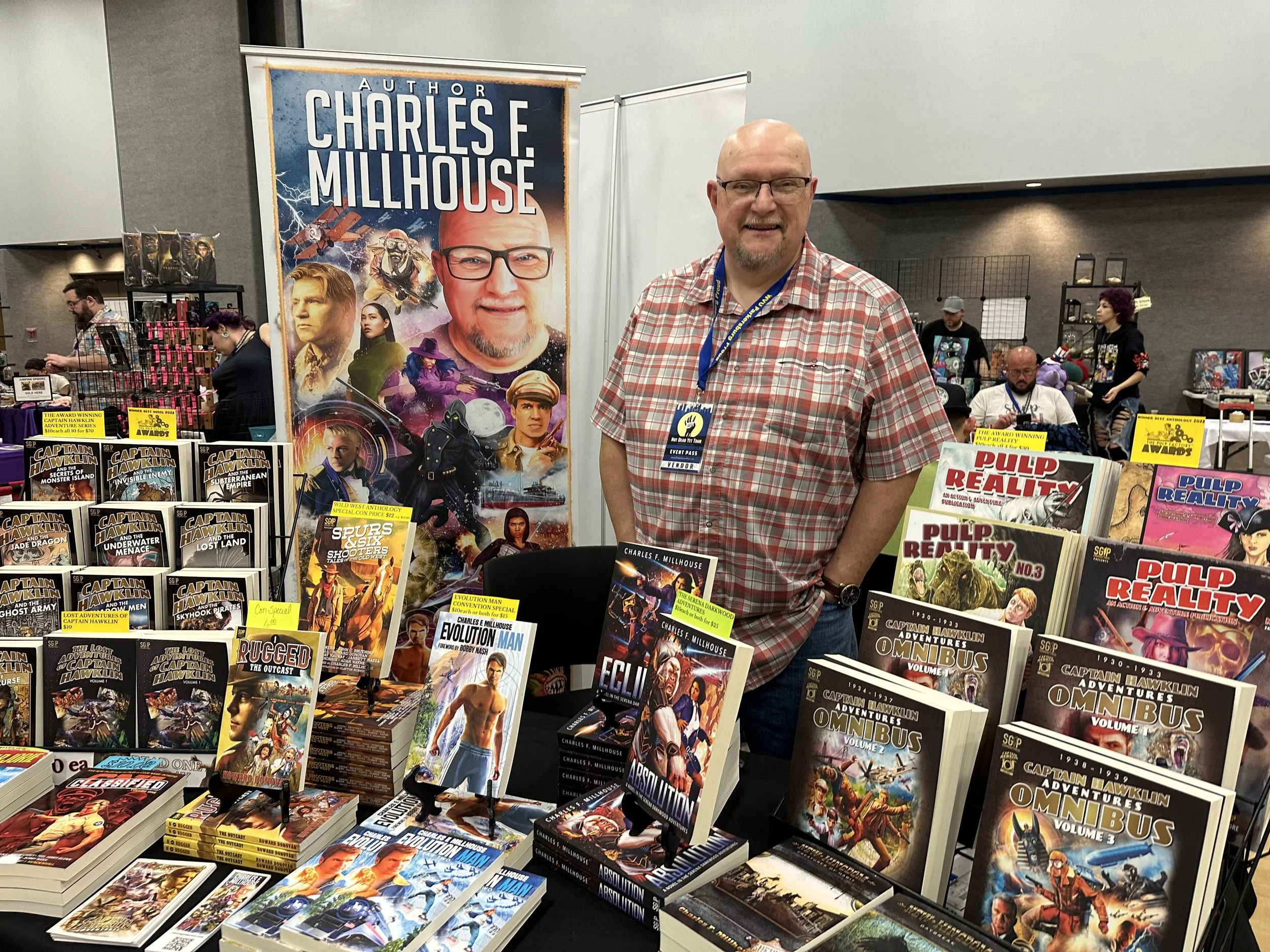
Today I chat with writer Charles F. Millhouse. Charles is the author of more than thirty books in the Science Fiction/Fantasy/New Pulp genres. A storyteller/dreamer since childhood, Charles published his first book in 1999, and he hasn’t looked back. A pioneer in Independent Publishing, he patiently waited for technology to catch up with his visions and with the advent of Print on Demand and the eBook craze, Charles created Stormgate Press in 2006 to further his publishing endeavors.


Hi Charles! Thanks for taking some time to chat with me.

It’s my pleasure, thank you for asking me to participate.

You write across a variety of genres. What were some of your earliest influences in science fiction, fantasy, adventure, pulp, etc.?

My earliest influence in science fiction of course, for many people my age was Star Trek. I immersed myself in anything I could when it came to the final frontier. Of course, for my generation, TV was like a best friend and there was a lot of science fiction throughout the 1970s into the early 80s. And by the time I hit my teens I started to read a lot more, The first book I remember reading was Ringworld, by Larry Niven. But when I encountered DUNE when I was in high school, everything changed for me, including how and what science fiction I gravitated to.

From science fiction I found myself reading a lot of fantasy books, one of my favorites then and still now, is Elric of Melniboné and of course Conan, by Robert E. Howard (Great stuff!)

After I saw Raiders of the Lost Ark in 1981, my dad introduced me to the world of pulp. The Shadow, Zorro, the Spider, on and on. In the 1980’s you could find a lot of pulp in boxes under tables at comic shops I went to. The owner sold them to me cheap, and I didn’t turn down a deal. I discovered a lot of serials around that time, The Phantom Empire with Gene Autry my favorite.

Your longest-running series features a golden age / pulp adventure named Captain Hawklin. Can you tell us a bit about the genesis of the character and how the series has developed?

I first created Captain Hawklin in the early 1990s but then he was named Captain Thunder, but a friend of mine made me realize that that name was overused and could eventually get me sued lol, if I decided to publish it. It was his suggestion that I changed the name, and he threw out, “Just call him Hawklin, or something like that.” Originally, he was set in the early 1960s and an astronaut who ran a secret organization that had been travelling to other planets since the 1950s. From there he evolved into a 1930s pulp character. (I’m not sure why. I think it could have possibly been that I had an idea for a 30’s story, and that’s why he manifested into that.) I only intended on writing one book just to fulfill my need to write a pulp character. So, I wrote The Skyhook Pirates in 2004, And after I wrote the first couple chapters I saw the trailer for Sky Captain and the World of Tomorrow, and it kind of mirrored my work in progress. So, I held off writing the book until after I saw the movie thinking that—if it was a lot like what I had written I would change the story completely. I'm happy to say that even though there were some similarities I felt there was enough difference between the two characters. And sadly, Sky Captain never manifested into a series.

After I published the first book in 2012, I discovered there was this new movement called “New Pulp” and there were other people writing their own versions of pulp type characters. Skyhook Pirates sold really well, to my surprise, and I decided to write a second one. I'm happy to say that he has gotten a bit of a following over the years and the evolution of the character has really taken root not only by me, but from other pulp writers who have written the character, adding to his already growing vast history.

 I think the first of your books that I read was the first Serena Darkwood science fiction adventure. I hear you’re working now on the third book in the series. How’s that going?

Thank you for reading Absolution. Serena doesn’t get the love that Captain Hawklin does. When I first wanted to be a published writer, I thought I would be a science fiction author, but as fate would have it, I became more of a pulp writer. Which I have embraced. But my love for science fiction is still in my heart. I'm currently outlining the third book for Serena Darkwood called “Capital” this will move the story forward immensely and will really put her in the middle of some galaxy changing events. Readers can look for “Capital” to release in the first quarter of 2026.

I’m always interested in hearing about a person’s creative process. Tell us a bit about how you develop a story. Does your process differ from genre to genre? Does it differ at all when you’re working on a short story versus a novel?

First, and I think this goes for most writers, I come up with the idea for a story. Most of my ideas come from driving in the car, and pitching them to my wife, who is great at helping me flush out ideas. Sometimes it's just a premise, other times it's a character and the story revolves around that character.

Sometimes the story begins one way and ends up totally different. My idea for my supernatural western trilogy “New Kingdom” started out as a mining colony in space and then took a sharp right turn to the Old West.

I scribble my ideas on index cards and keep them taped above my head when I'm writing.

I do this for novels and short stories. I write more from the seat of my pants than I do from an outline. My outlines generally are just a description of the characters and if I think of something that I really want to say in the story I'll jot it down on an index card.

I consider my first draft my outline, and from that outline I sculpt it into its final version. I always write my first draft at my desk. Working on the second draft and editing I tend to do on my iPad at work during breaks.

Speaking of short stories: I am intrigued by and loving your Stormgate Press Quick Reads series, which feels like it is meant to cover ALL THE GENRES! What inspired you to create this line and give it such diversity in content and tone?

I have to give credit where credit is due, and the idea for the Quick Read Books came from my wife. (The actual name Quick Read Books came from my cover designer Jeffrey Hayes.)

I have a banner that I sit up at my shows and on that banner are several characters that I created that had appeared only in the “Pulp Reality” series, and I had a lot of people at a show we were at in 2024 ask about characters like the “Purple Mystique” and “Night Vision.”

I knew I would never have time to write full-fledged novels with those characters, and it was my wife's idea to publish a series of short stories around 10,000 words and offer them on my table for $5, this would give patrons a chance to read my work who might not spend $10 or $15.00 for a novel and allow them the opportunity to see how I write. I’m happy to say it’s been a huge success.

I intend on keeping the series primarily on pulp style characters and manifesting them into the Captain Hawklin universe. Given time I will even work my barbarian character into that universe.

Finally, what do you have coming up that readers should keep an eye out for? And where will you be appearing in the near future?

I just released “Evolution Man Year Three” back in June of this year, I had great fun writing that book and the series is quickly becoming a favorite for returning readers.

On August 12th the third book in “The Lost Adventures of Captain Hawklin” will be available on Amazon, and its eBook will be available on several platforms. It is my intention to have copies exclusively on my table at PulpFest in August.

Readers can keep an eye out for more Quick Read Books; I'm currently writing another “Purple Mystique” story that will end this current wave of Quick Reads.

Also, for the Captain Hawklin fans who may be reading this interview, I am writing a new series of short stories set in the 1930s that are being released exclusively on my Patreon page.

My upcoming appearances:

On August 7th – 10th you can find me in Mars PA at PulpFest

For a complete list of my appearance, you can visit www.stormgatepress.com.


Thanks again for chatting, Charles! See you at Pulpfest!


Readers, it is not too late to register for and attend Pulpfest 2025 (THE pulp magazine-focused convention in the Northeast) and the other three conventions it hosts: FarmerCon (dedicated to the works of Philip Jose Farmer), ERBFest (dedicated to the works of Edgar Rice Burroughs) and DocCon (dedicated to all things Doc Savage related). Check out the Pulpfest website for registration and hotel information!

Interview: WIN SCOTT ECKERT 2025

Today I chat with author and friend Win Scott Eckert, as a part of my ongoing series featuring creative folks who will be appearing at Pulpfest 2025. Win is the editor of Myths For the Modern Age and three volumes of short stories featuring The Green Hornet, co-author with Philip Jose Farmer of The Evil in Pemberley House and The Monster on Hold, and author of Crossovers: A Secret History of the World, The Scarlet Jaguar, and the authorized Edgar Rice Universe canonical novels Tarzan: Battle for Pellucidar, and Korak At The Earth’s Core. He has also written short stories featuring classic characters like The Green Hornet, the Lone Ranger, the Avenger, the Phantom, Sherlock Holmes, the Domino Lady, Honey West, T.H.E. Cat, and Irma Vep. Win is a member of the International Association of Media Tie-In Writers, holds a B.A. in anthropology and a Juris Doctor.


Hi, Win! Thanks for taking some time to chat. I know you’re busy working on the second book in your Edgar Rice Burroughs Universe trilogy, the Dead Moon Super-Arc.

WSE: Hi, Anthony! Yes, Pellucidar: Land of Awful Shadow.


We’ll talk about the new book shortly, but my first question is more general. You’ve had a wonderful career writing in the worlds of Edgar Rice Burroughs, Philip José Farmer, the Green Hornet, The Avenger, Honey West, the Lone Ranger, and others. Talk to me a bit about your earliest memories of wanting to write these characters/in these worlds.

To be honest, I didn’t consider writing fiction until after I started my metafictional Wold Newton Universe site in 1997. My first forays were non-fiction (or rather, metafiction) essays which were writing about characters’ chronologies and family trees, rather than traditional fiction stories. It was only when Jean-Marc Lofficier suggested that I try my hand at straight fiction for his annual Tales of the Shadowmen anthologies that I considered it. This was in 2004.

What is your current writing process like? That is, are you a plotter, a “pantser,” etc.? Do you set daily wordcount goals? And has that process changed at all throughout your career?

I am not a “pantser.” I definitely outline, but at a high level. I know the beginning, middle, and most importantly, the end. Part of this is because it is generally required when writing for licensed properties (although requirements for licensed properties are on the spectrum of detail from “almost no detail, just a pitch” to a strict chapter-by-chapter outline). Even with a strict chapter outline, there is a lot of room for creativity as I actually write the chapters, as additional inspiration inevitably hits while I am writing. And sometimes the chapters end up getting moved around as I write, and so forth. So, the outline is not a strict contract, but rather a demonstration that I know where I’m going in the end, even if the path of getting there deviates from the outline. As for your other questions, when I am deep in a writing project, I do set wordcount goals. My process has not changed much in the last twenty years, with the exception that within the last five years or so I occasionally dictate some portions of a novel; it speeds up my writing, but I’ve also noticed that more errors are introduced which I sometimes fail to catch despite intense proofing, so I am a bit gun shy right now about dictating too much.


You’re on your third novel for the Edgar Rice Burroughs Universe (the first being Tarzan: Battle for Pellucidar in the “Swords of Eternity Super-Arc” that launched the Edgar Rice Burroughs Universe (ERBU), and the second being Korak at Earth’s Core, the first book in your “Dead Moon Super-Arc”). I’d love to hear a bit about how you came to write for ERB Inc., and how you crafted your pitch for the “Dead Moon Super-Arc.”

Shortly before Christopher Paul Carey joined ERB, Inc. as Director (now VP) of Publishing, I pitched a Korak novel to CEO Jim Sullos, which was accepted. Once Chris joined, and outlined his plans for the ERBU, to be kicked off with the “Swords of Eternity Super-Arc,” it was a no-brainer that a Tarzan novel was needed for that launch. I reworked my Korak pitch into a Tarzan pitch which became Tarzan: Battle for Pellucidar. After that, Chris and I still really wanted to do a Korak novel. I explained my idea to him in person at PulpFest, to which he burst out laughing, and said, “Let’s do it!”

Philip José Farmer wrote an article originally published in ERB-dom No. 57, April 1972. His ideas were worked into his mock biography, Tarzan Alive. The article has also been republished in my collection Myths for the Modern Age: Philip José Farmer’s Wold Newton Universe (MonkeyBrain Books), Pearls from Peoria (Subterranean Press), and The Man Who Met Tarzan (Meteor House). The article is entitled “The Great Korak-Time Discrepancy” and deals with how Korak, the son of Tarzan, impossibly ages about eight-ten years between the ERB books The Beasts of Tarzan and The Son of Tarzan. Farmer proposes an explanation, and there is another branch of fandom that proposes a different explanation. You can read the article online here. The “Dead Moon Super-Arc” will present a third, in-universe explanation.

We also wanted to explore as-yet untouched (or relatively untouched parts) of Pellucidar, the hollow world at the Earth’s core, and decided that the Dead World and the Land of Awful Shadow would be great settings for this trilogy.

What challenges have you encountered in moving Burroughs’ classic characters forward in time and in expanding the ERBU while still remaining true to his spirit and Burroughs’ original timeline and characters?

Honestly . . . not many. The biggest challenge is ensuring that all the writers’ stories remain consistent with each other, with no contradictions. That is one of the big selling points of the ERBU: the novels, stories, and comics are consistent both in continuity and in character with what ERB wrote, but they are all also consistent with each other. It’s not difficult to portray these characters as honorable and heroic. Perfect? No, of course not. I had a good time portraying Korak as less than perfect, and yet still heroic.


Without spoilers, what can you tell us about the upcoming second “Dead Moon Super-Arc” novel, Pellucidar: Land of Awful Shadow?

Yes! It takes place mostly concurrently with Korak at the Earth’s Core (this was a technique Burroughs used; for examples, see the Pellucidar novels Tarzan at the Earth’s Core and Back to the Stone Age), in which it is mentioned that Rahnak and Kyrianji have set off into the Land of Awful Shadow in search of Rahnak’s mother, Suzanne Clayton. So, Pellucidar: Land of Awful Shadow is the tale of their adventure. Rahnak the Daring is the grandson of Korak, and thus the great-grandson of Tarzan! Kyrianji is a great Waziri warrior princess.

Along the way, they have many adventures in this weird Land of Awful Shadow as they struggle to get back to their friends and allies, including David Innes, with some important information. We’ll also get some insight into what happened to Suzanne (Tarzan’s granddaughter), who was mentioned in Korak at the Earth’s Core (her disappearance set off the events of that book).

It's a lot of fun because the book is probably eighty or more percent focused on characters I was privileged to create: Rahnak, Kyrianji, and Suzanne.

All the plotlines will come crashing together in the third book, Tarzan Unleashed. (You see … there’s really no way to “pants” this. 😊)

You also had a short story in the anthology Thrilling Adventure Yarns 2025, edited by Robert Greenberger. Tell us a little bit about that story and what inspired it.

It was an honor to be invited to contribute to that anthology, with such an awesome lineup of authors, and it was great to flex my short story muscles. My entry was a weird menace tale, bordering on occult, called “She-Devil of Paris.” It was very much a Sax Rohmer homage, and featured Irma Vep, the anti-heroine of a 1915–16 French serial in ten chapters called Les Vampires. (The Vampires are a criminal gang who terrorize Paris, not actual vampires.) But, as with most Rohmer stories, the main character isn’t really the one who appears more “on camera,” Irma Vep, but rather her antagonist, who in 1923 Paris is calling herself Astarte.

Finally, do you have anything else upcoming that you’re able to tell us about?

I do! After Tarzan Unleashed, I plan to write the fifth and final Secrets of the Nine novel, as yet untitled. You may recall that the fourth book, The Monster on Hold (cowritten with Philip José Farmer from his outline and including large sections of his prose), most of Doc Caliban’s plotlines were wrapped up. Caliban was the POV character, and Phil’s outline and plot did not include anything regarding Lord Grandrith. Therefore, we still have dangling plotlines regarding Grandrith going all the way back to A Feast Unknown, Lord of the Trees, and The Mad Goblin. Phil’s estate and agent have granted me permission to write a Lord Grandrith-centric novel (I’m sure Caliban will also make an appearance, but its Grandrith’s book) resolving all the plotlines. I want to be clear that we do not have anything in Phil’s files (“The Magic Filing Cabinet”) regarding a fifth book, so this will be solely by me. Believe me, I wish we did have notes or hints. The book will be published by Meteor House, with consistent trade dress, art, and design as seen on the other Secrets of the Nine books.

I also plan to finally return to Patrica Wildman and write more novella-length follow-ups to The Evil in Pemberley House and The Scarlet Jaguar. I’d like to write more Sherlock Holmes short stories, following up on “The Adventure of the Fallen Stone.” And I want to do a series of novels featuring Astarte in different time periods, from the Victorian era, to the 1930s, and perhaps even into the 1960s and ’70s.

Finally, Anthony, I want to thank you for the interview. It’s been quite a while since we’ve done this (2017!), and I appreciate it. I’m looking forward to seeing you at PulpFest 2025 / FarmerCon XX in August 2025!

It was my pleasure, Win! Always fun discussing writing and Phil and Burroughs and Star Trek and The Man From U.N.C.L.E and everything else we have in common. See you in a few weeks!


Readers, it is not too late to register for and attend Pulpfest 2025 (THE pulp magazine-focused convention in the Northeast) and the other three conventions it hosts: FarmerCon (dedicated to the works of Philip Jose Farmer), ERBFest (dedicated to the works of Edgar Rice Burroughs) and DocCon (dedicated to all things Doc Savage related). Check out the Pulpfest website.com/ for registration and hotel information!

TOP TEN(ISH) TUESDAY: THE SUPERMAN FAMILY

In honor of the release of Superman (2025) (of which I will post a review eventually), I thought I’d focus my first Top Ten(ish) post in a while on my favorite Superman Family characters. It will come as no surprise to anyone who knows me that most of the list is characters who debuted in the Silver Age of comics, several of whom were regular features in the much-beloved (by me, at least) Superman Family title (my collection of which I have almost finally successfully rebuilt after selling them off years ago), and several of whom lived on the much-missed Earth Two of the Silver and Bronze Ages. I’ve chose to ignore the “Big Three” (the current Superman/Clark, Lois, and Jonathan Kent) and also to focus on heroes and supporting cast rather than the villains (hence, no Lex, Brainiac, etc. Maybe I’ll do a Superman’s Villains list down the road).

IMAGE: Superman carrying Lois Lane, alongside Supergirl carrying Jimmy Olsen. (c) DC Comics


MR. & MRS. SUPERMAN: While the wedding of the Golden Age/Earth-Two Superman and Lois Lane occurred in Action Comics (long before their Earth-One/post-Crisis counterparts tied the knot), most of their 1950s-set post-wedding adventures were chronicled in the pages of Superman Family, and I loved every one of them. The easy rapport between husband and wife, the updates and expansion of the Golden Age Superman’s rogues gallery (including the creation of an Earth-Two Insect Queen and frequent use of the Ultra-Humanite), and the guest appearances of fellow Justice Society members like Batman and Johnny Thunder made my eagerly await each issue. I really need to do a re-read and write a Series Saturday post about the series. DC really needs to give us a nice trade paperback collection.

POWER GIRL: When PG was introduced at the start of the 1970s All-Star Comics revival, I was shocked at how different this Kara Zor-L was from the Kara Zor-El of Earth-One. She was less powerful but surer of herself (or at least, better at pretending she was more secure in her identity). Her three-issue solo run in Showcase enhanced her origin and her supporting cast and further differentiated her from Supergirl. DC’s Crisis on Infinite Earths cut all of her background and has resulted in multiple rewrites of her history. I am one of those relatively few folks who didn’t mind the rewrite that tied her to ancient Atlantis (and at least implied that she was the sister of at least one reincarnation of the Golden Age Hawkman, although that was never followed up on), but I’m happy to have her original history somewhat restored now that the Multiverse is back.

JIMMY OLSEN: If you know me, you are not at all surprised that Jimmy is on this list. One of my earliest fictional crushes and examples of my Catastrophic Attraction Complex for redheads, thanks largely to Kurt Schaffenberger’s art on Jimmy’s feature in Superman Family. Jimmy was “Mister Action” then, leisure-suit wearing ladies’ man. He had swagger and he had skills, and that’s still my favorite version of Jimmy. I also have a soft spot for his weird Silver Age transformations (Elasti-Lad, Turtle Boy, Werewolf-Jimmy, and more).

SUPERGIRL: I have an admitted soft spot also for Kal-El’s first cousin. By the time I was regularly reading comics, Kara/Linda Danvers was already known to the world (and bouncing from career to career and city to city, it seemed), so I remember being kind of shocked when I read Silver Age reprints where Clark shoved her off to an orphanage and made her hide her powers. I enjoyed her Superman Family stories and her later (always short-lived, it seemed) solo series. I was honestly devastated when she was killed off during the Crisis. That didn’t stop me from enjoying Peter David’s run on the character trying to make her various post-Crisis iterations gel, but I’m still happy so many aspects of her Silver and Bronze Age existence have been worked back into the character. I’m also a fan of the “she was Kal-El’s older cousin, but space warps got her to Earth after he grew up” addition to her lore thanks to the TV show.

NIGHTWING AND FLAMEBIRD: Originally super-hero identities Superman and Jimmy Olsen adopted when they visited the Bottle City of Kandor (where Supes didn’t have powers), these characters really took off for me when the mantles were passed to Kandorian former criminal Van-Zee and his sidekick Ak-Var – because it allowed the characters to just become a gimmick allowing Superman and Jimmy to play at being Batman and Robin, and there was some real pathos in their stories. There have been a few Kryptonian variations on these characters in the Post-Crisis world, but none of them have resonated with me the way Van and Ak did. (Special Mention: I wish DC had done more, post-Crisis, with Dick Grayson and Bette Kane as Nightwing and Flamebird – but that’s a post for another time.)

MA AND PA KENT: One of the few things I appreciated from John Byrne’s post-Crisis revamp of Superman was the decision to have the Kents still be alive and supportive of their super-son. They are best when written as down-home, loving, supportive everyday people; their post-Crisis involvement in helping to raise or influence Supergirl, the Connor Kent Superboy, and their grandson Jonathan (and presumably more recently, the Super-Twins) has been a great enhancement to their history. To me, they were best personified by K Callan and Eddie Jones on Lois & Clark: The New Adventures of Superman.

KRYPTO: Superman’s best friend (sorry, Jimmy, but it’s true), his stories in Superman Family were always fun. Sure, his super-intelligence compared to normal dogs and his detailed thought balloons could be overdone, but that was half the fun. The current comics mini-series seems to be downplaying it, but I always enjoyed it.

THE LEGION OF SUPER-PETS: Krypto was eventually joined by Streaky the Super-Cat, Beppo the Super-Monkey, and Comet the Super-Horse (not all of whom originated on Krypton), and the occasions when the animals teamed up to save the day always made me smile. Silver Age Silliness, yes. Silliness isn’t always a bad thing, despite what the cynics will tell you.

SUPERBOY (CONNOR KENT/KON-EL): One of my two favorite characters to come out of the “Death of Superman” / “World Without a Superman” storylines. I admit, he annoyed me at first. But the Karl Kesel/Tom Grummet series went a long way to adding depth to the character and endearing him to me, as did his time in Young Justice and the Geoff Johns-scripted New Teen Titans run. I do wish DC would decide how old he’s supposed to be/look and commit to it (I don’t mind the alternating between variations on his first costume and the black tee-shirt/jeans look – but why does he look 13 in one costume and 18 in the other?)

STEEL: My other favorite character to come out of those storylines. It didn’t take me long to get over the co-opting of the name of one of my favorite Bronze Age/DC Implosion-era D-listers (Steel, the Indestructible Man), and I appreciate John Henry Irons for who he is and what he adds to the Superman Family: a character easily as intelligent as Lex Luthor who uses that intelligence to aid the Man of Steel rather than destroy him. I enjoy Natasha Irons as well, especially her appearances in the recent Power Girl series and her camaraderie with Lilith/Omen.

MON-EL: Lar Gand wasn’t the first amnesiac space traveler to be mistaken for Kal-El’s long-lost older brother, but he proved to be the one with the most staying power (thanks largely to Jim Shooter adding him to the Legion of Super-Heroes). Something about the tragedy of Lar spending 1,000 years in the Phantom Zone waiting for a cure for his lead allergy to be discovered really spoke to me. As with Power Girl and Supergirl, I was okay with the post-Crisis attempts to make him a viable character without his connection to Superman but I’m happy to have his pre-Crisis history restored (as seen in the recent “Phantoms” story that ran in Action Comics).

NEW SUPER-MAN (KONG KENAN): I was not reading comics regularly during the New 52 through Rebirth phases of DC, so I’m only just now reading this character’s original solo run (in trade paperback form). I like his origin and his character growth from selfish jerk to someone more aligned with the Super-Family’s code of conduct, and I look forward to seeing more of him.


THE SUPER-TWINS (OSUL-RA and OTHUL-RA): Another addition to the Super-Family that I missed the introduction of, having not been reading most of the Super-Titles during the “Superman on WarWorld” storyline. But anything that enhances the history of Krypton and allows Clark and Lois to show off their parenting skills (after Brian Michael Bendis unnecessarily ages Jonathan Kent up to adulthood) is alright be me. I don’t hope the twins, along with Kong Kenan, don’t get lost in the shuffle of so many Super-family characters.


HONORABLE MENTIONS: THE OTHER SUPER-TWINS: It is no secret that Superman & Lois is my favorite live-action Superman TV series and how sad I was that it got cancelled after only four seasons (another show I need to do a Series Saturday post about eventually). I loved the work that Alex Garfin and Jordan Elsass/Michael Clive Bishop did as Jordan and Jonathan Kent. I wish there was some way for them both to exist in comics continuity without negating the history established for the comics Jonathan (who I enjoy as a character even after the unnecessary aging-up).


Top Ten(ish) is a feature where I identify my personal top ten (or so) favorites in a given category. The key words there are “my” and “favorites.” My favorites may not be your favorites, and I’m not claiming that my favorites are necessarily the best in a given category. Everyone’s tastes are different, and “best” is subjective. I welcome polite discussion on these lists.