Top Ten(ish) Tuesday: 10 Favorite Books of 2025

I read 123 books in 2025. Disregarding titles that were re-reads from previous years, here are my Top Ten(ish) favorites, in no particular order, with links to reviews if I posted one.


How To Fake a Haunting by Christa Carmen. I have loved all of Christa Carmen’s “New England Gothic/Spooky” novels to date, so it is probably no surprise that this in on my list of favorites. A woman in an emotionally abusive relationship decides to gaslight her husband into thinking their house is haunted … but what if it really is? Keeps you guessing throughout as to how supernatural it really is and provides more than a few good scares and creepy moments along the way. I interviewed Christa earlier this year about her writing process and this book in particular.

Christmas and Other Horrors, edited by Ellen Datlow. The darkest, shortest days of winter in general, and Christmas in particular, is traditionally a time for ghost stories. Editor par excellence Ellen Datlow once again assembles a great group of writers to spin horror stories around Christmas, Hannukah, Solstice, Yule, and even sometimes your average winter day. Favorites included Mary Robinette Kowal’s “To Speak in Silence,” Benjamin Percy’s “The Ones He Takes,” “Return to Bear Creek Lodge” by Tananarive Due, “Gravé of Small Birds” by Kaaron Warren, and M. Rickert’s “The Lord of Misrule,” but there isn’t a clunker in the group.

The Breathtaker Collection by Mark Wheatley and Marc Hempel. I didn’t read a lot of graphic novels in 2025, but even if I had this one would stand out. A woman who survives by draining the energy from the men who loves her is pursued by a government super-hero for her perceived crimes. There are so many twists in this one I can’t say much more without giving them away. I interviewed Mark Wheatley earlier this year about his creative process.

Our Share of Night by Mariana Enriquez, translated into English by Megan McDowell. In a narrative that spans decades and changes not just character point of view but narrative style multiple times, Enriquez melds almost every sub-genre of horror (cosmic, cult, supernatural, slasher, body, medical, and haunted houses) with generational trauma and the real-world horrors of living under Argentine dictatorship. This is not an easy read, but I stand by my assessment that it is an important, vital, one. I read it for the Stanza Books (Beacon NY) Dark Fiction Book Club and reviewed the book back in February.

Born A Crime by Trevor Noah. Noah’s memoir of growing up under Apartheid as a mixed-race child moved me deeply. Highly recommended. I listened to the audiobook, narrated by the author, which just heightened the emotion.

The Front Seat Passenger by Pascal Garnier, translated into English by Jane Aitken. I tripped across this French noir novella at McNally Jackson Books in Rockefeller Center, apparently the only one of Garnier’s books currently in print in English translation. At first it didn’t feel particularly noir, but man does it get there. And when it does, the twists are fast and furious. I loved this one so much I immediately sought out everything of Garnier’s I could find in translation and look forward to doing a deep dive at some point soon.

Saint Death’s Herald by C.S.E. Cooney is a complex fantasy featuring Miscellaneous “Lanie” Stones, a young necromancer who gets ill at any signs of violence, which makes her job – hunting down the man possessed by the ghost of her evil grandfather – must more difficult. This is the second book about Lanie (the first was Saint Death’s Daughter) and the third volume is coming in 2027. The world-building is wonderful, the characters quirky and relatable, the footnotes hysterical. I reviewed the book earlier this year.

Cheddar Luck Next Time by Beth Cato. The mystery I loved so much, I read it then listened to it on audio, then moderated a Sparta Books (Sparta NJ) book club meeting about it. Set in a small town on the central California coast and featuring an autistic lead character who gets embroiled in a murder investigation while dealing with the recent death of her grandmother, Cheddar Luck is hopefully the start of a new series that is part cozy mystery, part thriller. I reviewed the book earlier this year, and interviewed author Beth Cato as well.

The Art Thief by Michael Finkel. The second non-fiction book on the list. Read this one for the Mystery Book Club at Stanza Books, and I’m so glad we did. The book is a fascinating character study of the most successful art thief in European history – a thief who operated not in the 18th or 19th century, when such thefts would have been easier, but the 1990s!

Amplitudes: Stories of Queer and Trans Futurity, edited by Lee Mandelo. The second short story anthology on the list, almost every story in this volume blew me away with honest yet still hopefully looks at the future and in particular how LGBTQIA+ people exist in that future. I particularly liked Sarah Gailey’s “Moonwife,” Bendi Barrett’s “Six Days,” “The They Whom We Remember” by Sunny Moraine, and “Sugar, Shadows” by Aysha U. Farah, all of which I talked about in my review back in July.

Sgt. Janus and the House That Loved Death by Jim Beard is the fourth book in his occult detective series starring the mysterious Sgt. Roman Janus. This may or may not be the last book in the series, as it establishes quite a change in the status quo for the main character and his compatriots. The previous three books, which I reviewed in a Series Saturday post in 2020, were purely epistolary in style; this book breaks that mold a bit to great effect. I really need to update the series post to include this latest book.

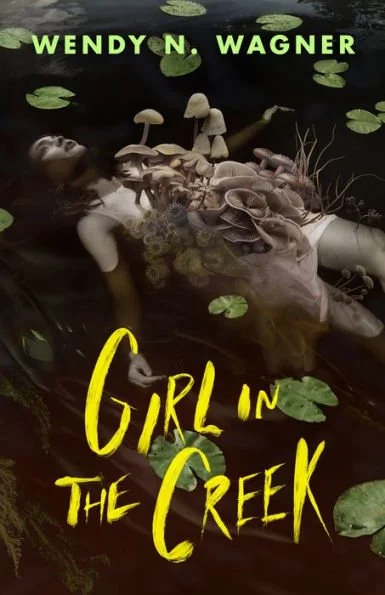
Girl in the Creek by Wendy N. Wagner. A fantastic ecological horror novel set in the Pacific Northwest that manages to feel cosmic and claustrophobic at the same time and equally effectively. That’s quite a feat in my opinion. Wendy N. Wagner’s work always excites and intrigues me, and this one was no exception. I reviewed this one back in July.

Dogs Don’t Break Hearts by ‘Nathan Burgoine. Burgoine is another of my “go-to” auto-buy authors. This is his second “HiLo” book (High Interest, Low Readability, aimed at getting kids who struggle with reading to read). Teenager Beck volunteers at a dog rescue to get over being gaslit by who he thought was his boyfriend, and through the dogs finds both healing and a new love interest.

Black Hole Heart and Other Stories by K.A. Teryna, translated into English by Alex Shvartsman. The only single-author short story collection on this list, for which I still need to write a review. Teryna’s speculative fiction (mostly science fiction, but not all) is character-based while still exploring larger ideas of how technology improves and disrupts our lives and our greater need for community. I particularly enjoyed “Lajos and His Bees,” “Madame Felides Elopes,” “The Chartreuse Sky,” “Songs of the Snow Whale,” and the title story.


I have to also include Jack of All Comics! A Fan Conversation About the King of Comics, edited by Jim Beard. I had an essay in the book, discussing Jack Kirby’s work on DC’s 1970s Sandman title, so this feels a little like cheating or shameless self-promotion … but the other essays in the book are all great. Each one focuses on a different series Kirby wrote and/or drew for Marvel and DC through the 60s and 70s – from the well-known (Fantastic Four, Thor, Superman’s Pal Jimmy Olsen) to the more obscure (his issues of DC’s First Issue Special, the aforementioned Sandman run and his work on DC’s war comic The Losers).


Top Ten(ish) is a feature where I identify my personal top ten (or so) favorites in a given category. The key words there are “my” and “favorites.” My favorites may not be your favorites, and I’m not claiming that my favorites are necessarily the best in a given category. Everyone’s tastes are different, and “best” is subjective. I welcome polite discussion on these lists.
Sunday Shorts: Three from Autumn Cthulhu

Editor Mike Davis takes a line from H.P. Lovecraft’s story “Polaris” (“And in the autumn of the year, when the winds from the north curse and whine, and the red-leaved trees of the swamp mutter things to one another in the small hours of the morning under the horned waning moon…”) and uses it as the core principal of the anthology Autumn Cthulhu (Lovecraft ezine Press, 2016). Here are my thoughts on a few of the stories contained therein:

cover image by andreiuc88


“In the Spaces Where You Once Lived” by Damien Angelica Walters

Helena and Jack, a couple in their retirement years, live in a house that backs up onto a beautiful forest. Jack is falling victim to dementia/Alzheimer’s and Helen is struggling to accept the slow loss of her husband and to cope with the changes in his personality. Jack is convinced this house is not his home, that his home is elsewhere: perhaps somewhere in the woods. Walters’ story balances a very real fear (Jack’s health and eventual full loss of memory and cognitive function) with a slow-growing dread that something is very wrong in the woods. Of course, something is, or this wouldn’t be a Lovecraftian story. The relationship between Helena and Jack is drawn so indelibly by Walters, it is easy to see the love that underpins the strangeness and discomfort; scenes with their child and grandchild add to both the poignancy of Jack’s situation and the tension of the mystery of the woods. Helena does eventually learn what’s lurking just out of sight and why it is affecting Jack – but thankfully the author does not use it as an explanation for Jack’s declining mental acuity. That would have been a bit too precious for an otherwise realistic look at the horror of Alzheimer’s and similar diseases.


“The Black Azalea” by Wendy N. Wagner

The protagonist of Wagner’s story is Candace, a recent widow whose marriage to Graham was not a happy one especially in the later years. Before he passed, Graham had planted an azalea bush in the shadow of an elm tree that succumbed to Dutch elm disease, leaving room for sunlight to kill the azalea. The dead azalea blocks Candace’s view of her garden, so she decides on the last nice day of autumn to dig the bush out. Which is when she discovers strange rot at the bush’s core … strange rot that seems to be incredibly contagious to all the other plant life on Candace’s property. And eventually to more than just the plants. Wagner is an expert at moving a story from subtle unease to full out horror, and “The Black Azalea” is yet another example of that skill. The story also does not skimp on characterization in favor of horror; Candace’s life as a widow, and her life before becoming a widow, are just as central to the story as the rot is (and, in fact, I began to consider that this (supernatural? extraterrestrial?) rot is something of a metaphor for the course of Candace and Graham’s marriage.


“A Shadow Passing” by Daniel Mills

“A Shadow Passing” is one of the most fever dream-like short stories I have read in recent memory. A young boy’s mother leaves their house each day, dressed in widow’s black, to track down “them” – winged batlike shadows that speak to her, taunt her, are leading her to something. Something the boy seems tied to, with his strange fevers. Something the boy’s aunts and grandfather don’t seem to want him to be a part of, seeking medical assistance for him while his mother is away. Mills’ prose is perfect for the story’s overall sense of disconnection from logical reality, of a sick child’s inability to understand why the adults in his life seem to be at odds, of the way fevers especially steal time from us and cause us to hallucinate. I might have been reading too much into the story, but it also feels like an investigation of how adults who get caught up in cults will sacrifice everything, potentially even their own children, for the sake of their new beliefs – and how difficult it is for family members outside the cult to save the ones who have been sucked in.


I love short fiction in all its forms: from novellas to novelettes, short stories, flash fiction, and drabbles. Sunday Shorts is the feature where I get to blog about it.

Sunday Shorts: Two from Cthulhu's Daughters

In 2015, Silvia Moreno-Garcia and Paula R. Stiles co-edited Cthulhu’s Daughters: Stories of Lovecraftian Horror, in an effort to put paid to the rumor that “women don’t write Lovecraftian Horror / Weird Fiction.” No matter how many anthologies like this come out, there will be some people who still make that claim (heck, there are some who would claim women don’t write horror at all, or that women writing horror is a relatively recent development. Clueless, those people are.)

Here are my thoughts on a few of the 25 stories Moreno-Garcia and Stiles brought together.


Lockbox by E. Catherine Tobler

My opinion is that it takes a certain type of talent to write good serious “footnoted fiction.” (The type of story where as much is revealed in footnotes from the narrator as in the main text itself, that is. I thought about being cutesy and making this parenthetical aside a footnote, but I’m not sure I can get the formatting to work on my blog, and would it really be worth it?) I’ve read a fair number of such stories over the years, and in most of them I find the footnotes an affectation, often a distraction, rather than an enhancement. Not so here. Tobler’s story of two modern college students’ discovery of a long-buried but legendary Priory drips with atmosphere and foreboding from the very first sentence (“If nothing else, remember this: Edgar always knew.1”) and the footnotes enhance those feelings (“ 1 We may debate exactly when Edgar knew at length, but I am not convinced there was ever a single, discernable point one can reference; as the notions herein are circular,20 I feel so to was Edgar’s knowledge.” Yes, there’s a footnote to the footnote, which plays out very effectively later in the story). The narrator reveals the bloody history of the Priory and the history of his relationship with Edgar in just enough detail for the reader to understand how much isn’t be said … either because the narrator isn’t ready or is physically unable to share such details. It’s a fantastic counterpoint to Lovecraft, whose narrators often fell into what we call “purple prose” and shared too much detail; Tobler is as effective, or more so, in ramping up the creeping horror and dread with much less flowery language. And in the female protagonist, Tobler has created a character I find as horrifying as any of Lovecraft’s cosmic horrors.


Queen of a New America by Wendy N. Wagner

What is it about Nitocris, possible last queen of Egypt’s Sixth Dynasty, which draws so many writers of Lovecraftian horror to use her? Maybe it’s simply that Lovecraft himself mentions her in passing in two of his stories, making her a usable hook to expand on Lovecraft’s universe. Maybe it’s that so little is known about the historical Nitocris (including some debate over whether she actually existed at all), which makes her rife for use in all manner of genres from historical fiction to horror. Whatever it is, my experience is that usually in Lovecraftian horror, Nitocris is the Big Bad of the story/novel. Wendy N. Wagner turns that tradition upside down by showing a Nitocris who is far from the height of her power, her influence shrunk to being able to occasionally take control of a young girl’s body. Wagner explores the psychological effect of a drop from such lofty heights as well as revealing how it happened and draws comparisons between an Egypt where magic was commonplace and an America where logic and science have pushed magic to the background. Just when I thought I knew where the story was going, Wagner reveals a detail I hadn’t even noticed was missing and spins the story into a commentary about society we currently live in and where and how structures of power might be found in a world so different from the one Nitrocris knew. I enjoyed the claustrophobic feel of the story and the twist.


I love short fiction in all its forms: from novellas to novelettes, short stories, flash fiction, and drabbles. Sunday Shorts is the feature where I get to blog about it.