PRIDE 2020 INTERVIEWS: 'Nathan Burgoine

Today’s Pride 2020 interview is with author ‘Nathan Burgoine:

Nathan Burgoine photo.jpg

Hi, ’Nathan! I hope you’re staying safe and healthy during current events. What are you doing to stay creatively motivated in these unusual times?

About a month before the lockdown began, my dog, Max (short for Maximum, his default setting) launched himself at a squirrel on a snow-drift behind me and to the left, pulling my left arm all the way around my body, suddenly and at a terrible angle, and blowing a bunch of my tendons. I was in physiotherapy, getting dry-needling, TENS, and so forth, trying to recover the use of my left hand especially (I still can’t quite type, or at least, not for long), so all writing kind of crashed to a halt, and is still pretty much at a halt.

But I like to remind other people when they’re stuck how much of writing is as much in your head as words on paper, so I am trying to remind myself of that. I’ve scribbled notes and scenes (I’m right handed, so I can at least scribble on paper), and I can accomplish little bursts when my hand cooperates. Mostly? I’ve given myself permission not to be creative on any sort of scale beyond what I can manage, at least until I can get back to physiotherapy.


Since June is Pride Month, I have to ask: how has being gay influenced or informed your writing?

The short answer: in almost every way.

The long answer: I approach writing from a “what if this is the first time someone queer sees themself?” most of the time, especially if I’m writing stories with a remotely heavy (and queer) topic. We all know the damage done by terrible representation, and while I’m not mister roses-and-sunshine, I do try very hard to make sure that even in darker toned stories there is hope, or at the very least a range of hopeful queer characters. Not that I write many dark stories at all. I’ve touched on horror only once.

Even in the happy stories, though—like romance—I also want to do my best to write characters who are facing down the realities of queerness without shying away from the impact of those realities. A few of my novellas have specifically been born from frustration in particular plot patterns repeating that shut the door on me as a queer reader with my own queer lived experiences. I think I had a lightbulb moment a year or two ago where I realized I couldn’t write an “everyqueer,” but I could write a specific person with experiences that mirrored the queerness I see all around me, and that’s been liberating even as it’s doubled down on the sense of responsibility.


You’re almost halfway through a really cool project on your blog: reviewing one short story per day for the entire year. What inspired you to take this project on?

It’s no secret that I’m a lover of short fiction, and also that I get frustrated at the short shrift it gets (no pun intended). I put a lot of the “I don’t like short fiction” attitude down to what we were forced to read in school (even I didn’t like many of those, especially the ones chosen for us in high school), and it colouring opinions even after graduation. Much like how when you talk about Canadian books and many readers kind of glaze over with “Oh no!” looks in their eyes because their only exposure to CanLit was the stuff forced upon them in high school.

Talking about a story I loved every day isn’t hard work (or, well, wasn’t until I blew those tendons, but I’m managing), and if even a couple of people decide to pick up an anthology or collection because of what I’ve said, that’s a win.

Also, as an author, I’m a slow producer to begin with, and completely stuck right now. I have almost nothing to talk to my readership about right now that’s from me, but recommending others? That I can do without blinking. You can take the bookseller out of the bookstore, etcetera.


How are you choosing the stories you’ll review? Is there any rhyme-or-reason to which authors, genres, etc. you’re featuring when?

A little bit of reason, but mostly not. In February I only spoke about stories written by Black authors, and in June I’ve been focusing on queer authors (and being conscious of not only talking about white-cis-male queer authors, especially). October will be horror (well, horror-ish. I don’t read a lot of horror, so…) Early December will likely be full of holiday novellas. And I try not to talk about the same book within a week, so if it’s an anthology or a collection, the “next” story won’t appear until at least a week goes by, so books where I’ve really enjoyed a lot of the stories are taking months to complete, and that’s kind of fun. I have a chart, and I write the blogs as I finish the stories, so sometimes I’m many days ahead with blogs to go, and then other times I realize I’ve got four more until there’s a day without a blog lined up, and I need to dive back into my pile of anthologies, collections, novellas, and magazines and put down the book I’m loving.

So… borderline organized chaos?


I know thanks to physical issues you’ve been on a bit of a hiatus from working on your next novel or short stories. How are things on that front?

I hate it. J

I talk a really good game with my author friends about being okay with low word-counts and taking time to recharge the creative batteries, but I honestly loathe this right now. That said, I did manage to tune up a trunked tale (it’s about nine thousand words long, so it never found a home), and I’m going to take this opportunity to attempt a self-publishing release given the stakes are so low. It’s a comedic and erotic story (which is another reason it never found a home), and we’ll see how that goes, but it’s giving me a project I can poke at with zero time limits.

That is one saving grace: I’m really lucky this happened before I signed a contract and had deadlines. As much as I’m hating not being able to type properly, at least I’m not having to force myself to do it through injury.


I absolutely loved Of Echoes Born, your collection of connected short stories taking place in The Village. Can you tell us a bit about what inspired The Village, and what keeps drawing you back there to tell more stories?

Linked short fiction is my favourite as a reader as well as a writer, so I think it just honestly comes down to being the sandbox where I like to play the most. Also, it allows me to build on what came before without the daunting task of plotting out a whole series ahead of time (it’s much harder to write yourself into a corner with linked short fiction, as you can shift to another character, or if I realize I’ve maybe given a character a bit too much magic or power or closed off plot avenues by giving them a specific gift, say, I haven’t wrecked future stories, just narrowed options for that specific character).

The Village is also my love-letter to the way the queer community was when I originally came out, and while I love so many of the changes that have happened in the past decades, I do mourn the strip/shops that used to be, and so having a dash of magic reinvigorate a fictional version of that place is as much homage as it is wish fulfillment, but also a way to talk about our history for some readers who maybe weren’t there for it and haven’t bumped into it yet, which was basically the whole point of Of Echoes Born, really.


And finally, where can people find you and your work online?

If you head on over to nathanburgoine.com, there’s a handy tag on the blog where you can find all my published work, with links even! But there’s also a tab for some free short fictions I’ve written if you wanted to take me for a test run first.


 ‘Nathan Burgoine grew up a reader and studied literature in university while making a living as a bookseller. His first published short story was “Heart” in the collection Fool for Love: New Gay Fiction, and was followed by dozens of short stories. His first collection of short fiction, Of Echoes Born, is now available through Bold Strokes Books, and includes six stories unique to the collection. Despite preferring the shorter fiction life, he’s also released three novellas (In Memoriam, Handmade Holidays, and Faux Ho Ho), co-authored a fourth novella (Saving the Date), and written three novels for adults (Light, Triad Blood, and Triad Magic), and one for young adults (Exit Plans for Teenage Freaks), all between walking his rescued husky a lot, usually alongside his husband, Dan. He lives in Ottawa, Canada.

PRIDE 2020 INTERVIEWS: Dane Kuttler

Today’s Pride Month interview is with poet and activist Dane Kuttler.

Dane Bauer Hassid photo.jpg

Hi, Dane! I hope you’re staying safe and healthy during current events. What are you doing to stay creatively motivated in these unusual times?

It’s been a struggle at times, no doubt about that. But luckily, I have a yearly practice of writing 30 poems in 30 days during the month of April, and that really helped carry me through. The other creative endeavor I’ve been throwing myself into is working on a book about food, with an artist and page designer. Collaborations have always energized me.


Since June is Pride Month, I have to ask: how do you identify, and how has that identity influenced or informed your art/craft?

I’m a big ol’ queer. I used to write a lot of poems about being queer, back when it was still something I was sorting out in the world. I also made the mistake of thinking it was the most interesting thing about me for a long time. Spoiler: it’s definitely not. Though now that I’m thinking about it, this year I’ll have been out for twenty years, and there’s something that feels good about that. I look back at the fears that people may have had for me when I came out as a young teenager – my teachers, my family – and being able to say, “No. None of that happened. I’m living a beautiful life, and I’m incredibly happy, and being queer hasn’t caused me any undue suffering,” is a powerful thing. 


You are a poet who has traveled the country performing on stage and who has won awards. This is the spot where I ask the generically broad question about your creative process. I’m not even going to try to narrow it down, because I really want to see where you go with this.

Equal parts rigid discipline and total anarchy. Every April and November, I write 30 poems in 30 days and post them on Facebook for accountability. During the rest of the year, my writing routine is haphazard and undisciplined, but having the raw material of those 60 days has shaped several books, which get completed over the rest of the year. Locking myself into April and November actually has had some really interesting constraints – for instance, there’s almost always a slew of poems about Passover in the April run, and November gets political, for obvious reasons. I’ve been doing it for over 10 years like that.

Like I said above, I love collaboration, and the projects I’ve been able to collaborate with other writers and artists have been, without a doubt, the most rewarding of my career. I don’t submit much to publication at all these days – I sort of gave up on that game – and delved into the things that seemed to resonate the most with people, which ended up being Jewish liturgical stuff. Stuff which is, it cannot be denied, very, very queer.


As part of The G!d Wrestlers, you’ve self-published The Social Justice Warrior’s Guide to the High Holy Days and The Book of Solace. They are beautiful inspirational works that, while rooted in your deep Jewish faith and upbringing, speak to readers across religious, ideological, and identity lines. I wish they had a wider audience than they seem to have. Tell me about the writing of each book what you hope people get out of them.

Oh hey, speaking of Jewish liturgical stuff! There’s also a third book in that trilogy, the stepchild of the bunch – Unlikely Victories: A Handbook for the Good Fight, which deals with the “historical holidays” of Chanukah, Purim, and Passover.

Anyway, the writing of these have been truly amazing experiences, religious experiences. They’re the closest I’ve ever come to feeling that kind of awe-filled inspiration where I don’t even feel like I’m writing the stuff – I’m just furiously transcribing it from Somewhere Else. Imagine the very best idea you ever head, an idea so good you felt consumed with the need to share it – it was like that. At least, the first one was. It helped that I was working with another writer, who was editing it with me, and we fell madly, dizzyingly in love over it. Falling in love with someone over a book can go one of two ways – you end up indulging each other, and your book becomes what Anne Lamott called a “self-indulgent sack of spider puke,” or you end up with something transcendent, something way better than the sum of its parts. I got lucky; we ended up with the latter.

The next two books, I was much more alone, and it did take away some of the magic, but the feeling of transcribing, rather than creating, was still very much there.

It never occurred to me to try to find a publisher. I don’t know that the publisher for these books exists. I have published one chapbook of poems on a small press, and it was a wonderful experience, but after that, the success of self-publishing (the GW books have paid for themselves, which is a rare feat in self-publishing) gave me no incentive to get back in that game.

The wonderful thing about writing books tied to holiday cycles is that each year, I reach new people. This past year, someone printed out a few quotes from SJW’s Guide and put them up on the wall of their synagogue, and that was absolutely mind-boggling. I was so honored, AM so honored that people continue to find value in it.


In the days I’ve been composing these interview questions, the world has taken a darker turn with the murder of George Floyd and the ensuing riots. Has this been inspiring you to write, or do you feel (as so many do) that being creative in such dark times is frivolous and that our energy is better spent elsewhere?

Oh dear Gd, no. It’s never frivolous. As white artists, though, it’s not the time to be taking the spotlight. I think now is the time to be vigorously reading and uplifting the works of Black writers and artists, and using our own creative pursuits to further our own understanding. Unfortunately, we’ve been here so many times before that it feels familiar, now. Book of Solace was written right after the Pulse shooting, and so I felt, as a queer writer, that I had something valuable to say about that – to speak to other queers about love, resistance, resilience, grief. This, though, these murders of Black people – I see myself as having a different role to play, one that’s much more about holding space for Black grief and creativity, much the way space was held for me after the Pulse or Pittsburgh synagogue shootings.


“Poet” and “Activist” are just two of the many hats you wear. You’ve written in several places about the process of becoming a foster parent, and about being parent to children who are transgender or gender-nonconforming. What do you wish more people would understand about foster children in general, and trans/gender-fluid children in particular?

I wish people understood that the work is hard, but 1000x harder on the kids. That no kid is “lucky,” in foster care. I get what people are saying when they say “X kid is so lucky to have you,” and it’s a kind thought, really, but it stings. Lucky kids don’t have to go live with strangers. Lucky kids get to stay home with their parents, who get the help they need in order to parent them safely. Lucky kids don’t get yanked away from their homes. I don’t expect my kids to be grateful for their situations – in fact, I fully expect them to resent the hell out of it. Even when I’m doing my best. My best is never going to be home, and that’s okay. That’s what I signed up for.

You know what I’d rather people say? “How lucky for you, that you get to know and love this awesome kid.” That’s more accurate.


Are you working on any new projects currently? New poetry, or perhaps a “Pantry Meals” cookbook? (For readers who don’t know, you regularly raid your pantry and create meals on the fly and then post about them on Facebook.)

Actually, I’ve been trying to tap into that sweet groove of liturgical writing ever since the rebellion broke out, and it’s finally starting to show up, in little bits around the edges. Right now it’s just called “Blessings,” and are short, one-sentence brachot. A bracha (singular of brachot) is a one-line prayer that Jews say before doing just about anything – Eating. Waking. Sleeping. Putting on a new pair of shoes for the first time. Even learning – there’s a bracha to say before you open your books. These are brachot for things like newly woke white people, and a bracha of protection for the Capitol Hill Autonomous Zone, the chunk of Seattle that’s been turned into a momentary anarchist community, with beautiful results.

I’m also in the middle of working on a book about food – not pantry meals, but a book that’s a love song to my “queerfam,” my immediate chosen family community. In non-pandemic times, we get together for dinner once a week, and it’s some of the richest community I’ve ever been a part of. The book is partially about community building, partially about food, and partially about the wealth of showing up.


Finally, where can people find you and your work online?

www.danepoetry.com is my digital home.


Dane Kuttler writes poems and hates bios in Western Massachusetts.

PRIDE 2020 INTERVIEWS: Craig Bond

Today’s Pride Month interview is with Vintage Theatre executive director Craig Bond:

Craig Bond headshot.jpg

Hi, Craig! I hope you’re staying safe and healthy during current events. What are you doing to stay creatively motivated in these unusual times?

During the past few months I have been very busy with Vintage Theatre and trying to stay creative, nimble, and flexible to weekly changes with this pandemic. Honestly, I have been reading a bunch of plays, while researching new titles to replace some of the current titles that have been selected to present.  I have also been my children’s online teacher and stay at home papa! It has been a quiet and very thoughtful time for me to ponder – “what is Vintage’s next big move?”  Even with all of this extra time to think and interact with my boys, I have loved taking the time to hear from patrons of Vintage Theatre and have been elated by the community in Colorado.

I drive into the theatre each week and find mail from patrons with thank you cards and donations. Most have a theme of “we love vintage”, “come back” and “stay safe”.  This reminds me of a few years ago, maybe 2012, and we were so close to being shut down and I opened the mail and there was a check for $5,000 then. Patrons and the community are so generous, as they give from their hearts and I am always humbled by the support we receive.

I also am very proud of my board of directors and staff, as they have called our subscribers over the past few weeks to touch base and let them know that we will be back after the pandemic and we care about our family.


Since June is Pride Month, I have to ask: how has being gay influenced or informed your art/craft?

I remember attending “Angels in America” on Broadway when it first opened and being mesmerized by the relationship between the characters of Joe and Louis. I thought how I could someday present these same stories in Denver and how important it was for the voiceless to have a voice. I remember how being gay in America was not accepted in the 1980s and wanted to help to change the view that gay people were deviant and choose to be gay.

Having been an artist for the past thirty years has helped me to shape the direction of my audiences with the themes of the work that I choose to produce. To that end, for the past 20 years I have worked to have Vintage Theatre present work that had characters represented from the LGBTQ including Larry Kramer’s “Normal Heart”,” Angels in America”,” Love! Valour! Compassion!”, “Unmarried in America”, “Boys in the Band”, and the list goes on and on. I am very proud of the work and how these pieces have shaped me as an artist.


You co-founded Vintage Theater Productions in 2002 with friends over martinis (as reflected in the company’s logo), correct? Tell us a little about those early collaborative days and the struggles a small professional theater company faced in Denver.

The toughest struggle we had was how to make audiences aware of us (marketing) and then how to build a following with a loyal base of attendees.  When Vintage Theatre started the troupe was a traveling theatre company that would bring an entire production to a senior home or country club and we would present the work for one night only. Talk about the amount of energy needed to load and present a show as a touring production, it was truly exhausting and exciting. From there we decided to have performances for a few weeks as a rental group at small theaters. Eventually we found our own home and each year we grew and grew. Watching the growth from 6 to 20 people in an audience to sell out houses of 150 people at each performance has been truly amazing to behold. Last year we reached close to 21,000 people at our shows.


Has the mission of Vintage Theatre changed at all in the intervening years, as you’ve changed spaces and expanded?

Actually we stayed pretty true to the same mission that started Vintage Theatre. We wanted to entertain and challenge both our audiences and our artists that present the work. We wanted to be the serious/fun place for performers to hone their craft and have audiences love the diversity and sheer mass of work we produce each year. We have done it, up to this year with the pandemic, by presenting at least ten shows a year with varieties of themes. Our audiences have trusted us that even if they don’t know the title they will enjoy themselves when they attend.


As a director, what does your creative process look like throughout putting a show together?

I love directing as I am able to step into all of the characters within the piece and look at what type of work or theme do we really want to go for out of a scene. I like to equate theater to cutting into a red onion vs. an apple. With an apple there are a few seeds which are the basic element that you are trying to convey, but when I direct I like to find the layers after layers to get to the heart. Peeling back each layer is the ideal way of telling a story and I love the work that I create.


Your husband, David Bond-Trimble, was one of your fellow co-founders, and your sons are also involved in the company. How do you separate Work from Family Time?

David and the boys get involved once in a while – maybe every other year as performers. I am very grateful that I am still able to get to direct three productions a year and get to watch all of the work that we present. Life balance is always tricky, but I feel that having a great support from my family gives me the anchor I need to create.


What are you, and Vintage, working on now? What changes do you anticipate making as the country slowly reopens to larger-scale gatherings like live theater?

Vintage Theatre will present “Shakespeare in Love” as soon as we are ready to open up safely. We are also looking at David Sedaris’s “Santaland Diaries” will also be presented, hopefully by the end of the year. During the pandemic, Vintage has been working on a deep clean of our theatre and our theater holdings. We have condensed our costumes and taken the opportunity to inventory and improve our equipment. We are ready to go and when we reopen the facility will have never looked better. We are also working on a reopening plan that will keep our patrons safe and we will be lowering our capacities to create safe social distancing at our performances.


Finally, where can people find you and Vintage online? 

Vintage Theatre is located in the heart of Aurora, Colorado – about 8 minutes outside of Denver. Vintagetheatre.org is for all ticket information and cbond@vintagetheatre.com is my email if anyone has additional thoughts or questions.


PRIDE 2020 INTERVIEWS: Steve Orlando

Todays’ Pride Month interview is with comics writer Steve Orlando:

Steve Orlando photo.jpg

Hi, Steve! I hope you’re staying safe and healthy during the current pandemic lockdowns. What are you doing to stay creatively motivated in these unusual times?

Paying rent! Honestly, when you're freelance, you often have to put your head down and just lean into the work. Yes, the background stress is higher than ever, the highest in my lifetime. But this is the job, and with some companies on pause, we push our connections, hustle as much as possible, and get as creative as possible. I've probably hustled more original ideas during this pandemic lockdown than ever before. If anything, there's going to be a lot of new content coming your way! And less sleep for me! But more shelf space, more stories I get to tell. So it's an easy price to pay.


Since June is Pride Month, I have to ask: how has being bisexual influenced or informed your writing?

For me it's all about perspective. Being bisexual, being Jewish, I know what it's like to have something inside yourself that others can't necessarily see, to be able to pass, if you like, but at the cost of your integrity and your truth on a daily basis. So I think that inner secret connects me to the concept of a secret identity, something that plays so strongly into superhero comics. And in my originals, the leads still tend to be outsiders, people with a secret.

It also reminds me constantly, being bisexual, how important representation is in comics. It's important we tell stories with a world that looks like the one outside our window. Honest, bold, often primal, but true...and that means diverse. It means aggressive. It means stories that have no choice to be told, because they're the stories I wish I had when I was growing up. They're the holes in my life, in the role models I didn't have, that stories could've filled.


I have to tell you that I read your Midnighter and Midnighter and Apollo series knowing absolutely nothing about the characters beforehand, and absolutely fell in love with them. Thank you for that. Both books were short-lived, as was Sina Grace’s Iceman series at Marvel. Why do you think books from the Big Two headlining gay characters don’t seem to last as on-goings? It feels like there’s absolutely an audience for it.

I can only speak to my experience, but unfortunately as with anything in publishing, this question comes down to sales. And while there is a big audience for LGBT storytelling, it is not always as reachable as we might think. It generally lives outside the sales outlets that exist, so books don't reach those that want them until they're released in trade paperback for the book market. However, in the current industry, with overall numbers and margins what they are, a book lives or dies on its periodical sales. MIDNIGHTER AND APOLLO launched to cancellation numbers, which is the unfortunate reality. It's TPB of course did better, but the industry as a whole isn't robust enough right now for that to matter, only periodical sales do.

So, do we need to change? Yes. Of course. And the good news is that for better or worse, this year’s lockdown is going to force us to. So watch this space for innovation, and better work getting these books to those who want them, in a way that speaks to the people that publish them.


I’m always interested in hearing about people’s creative process. How do you approach developing a pitch for a new series? And how do you then script each issue?

When it comes to actually building a pitch, it's all about the lead you hang your lore on. Raw ideas can come from everywhere – that comes from consuming creative calories on a lot of fronts. Almost every pro I know keeps an idea board for this reason. But once you need to take that idea from a sketch to a pitch, it's all about deciding who inhabits the world you've created. The best idea is nothing without a relatable lead – that's why more people like THE LORD OF THE RINGS than THE SILMARILLION. One focuses more on an emotional journey within a fascinating world, the other focuses on the lore first. Once you know your characters, and their core, what they want and where they're going, you can throw any adversity at them and know how they'll react. That begets the story.


In the past few years, you’ve had critically-acclaimed turns on Wonder Woman (another gay icon) and Martian Manhunter. Are there any characters from the Big Two that you’re just dying to take a crack at?

There's a ton! I would love to take on Doctor Fate, I'd love to work with Ladytron, I'd love to work with Alan Scott or Wesley Dodds, or Ted Grant! But I also have just jumped across the street to Marvel, where I have such a long list. The big ones, Captain America, probably my favorite Marvel Character. But also people like Living Lightning, like the Blazing Skull, the Destroyer. The Mutant Force is also something I've always loved, oddly enough. I also love, love, love the Green Goblin and Black Bolt. And, of course...Scarlet Witch, Doctor Doom, and Jim Hammond, the android that killed Hitler.


What are you working on now and what do you have coming out soon?

“Soon” is a relative term these days, is it not? That said! You're going to see some shorts and specials still outstanding from DC COMICS this summer. WONDER WOMAN ANNUAL #4 brings what we had planned for my Wonder Woman run together in a beautiful way, and there are some other unannounced works, shorts, coming before the end of the year.

OCTOBER, for National Comic Out Month, is KILL A MAN, an LGBT Mixed Martial Arts graphic novel from me, Phil Kennedy Johnson, and Alec Morgan, out from AfterShock Comics. And this is the one! For people who read VIRGIL from Image or MIDNIGHTER from DC, this is the next big, hard hitting gay story I'm telling. And it is the proudest thing I've ever done.

After that? You're going to see me all over. Works from TKO Studios, more from AfterShock, more from places I can't even hint yet! And NONE of it superhero, all of it fresh...until I return to superheroes in my own original way before the end of 2020. Stay tuned!


And finally, the usual: where can people find you and your work online?

I am pretty active on Twitter at @thesteveorlando and on Instagram @the.steve.orlando – head over and follow! As for my work, my comics are all available through online comic book stores like Third Eye Comics, which ships nationwide. And my digital DC FIRSTS are available direct from the DC Comics website. And there's more to come!


Steve Orlando writes and edits, including VIRGIL (IGN’s best Graphic Novel of 2015), Undertow and stories in the Eisner Award Nominated Outlaw Territory at Image Comics. As well, he launched 2015’s Midnighter and 2016’s Midnighter and Apollo, both nominated for GLAAD awards, and took part in Justice League of America, Batman and Robin Eternal and most recently Wonder Woman, Supergirl, Batman/The Shadow and Wonder Woman for DC Entertainment, as well as The Shadow/Batman for Dynamite Entertainment, NAMESAKE for BOOM! Studios, CRUDE for Skybound Entertainment, Dead Kings and Kill a Man for Aftershock Entertainment. Outside of comics, he has been featured in Hello Mr and National Geographic. His 2018 sold-out launch Martian Manhunter was one of Tor's Best Single Issues of 2018. In animation, he's worked with Man of Action Studios on season four of Ben 10, and in translation, has produced localizations for Arancia Studios Best-Selling UNNATURAL and MERCY at Image Comics.

PRIDE 2020 INTERVIEWS: David B. Roundsley

Today’s Pride Month interview is with musician, designer, and memoirist David B. Roundsley:

Dave-Library-Sepia.jpg

Hi, David! I hope you’re staying safe and healthy during the current pandemic lockdowns. What are you doing to stay creatively motivated in these unusual times?

Hello Anthony. We’re definitely staying safe. We generally work from home, so there were no big shifts there, but I found my productivity and creativity were suddenly in high gear without much prompting.


Since June is Pride Month, I have to ask: how has being gay influenced or informed your art/craft?

Knowing I was gay from a very early age (and knowing it was neither approved of and under no circumstances ever discussed) definitely influenced me and my art. Being born in Southern California at that point in time, there was definite pressure to conform and not stand out. My earliest creative efforts were in art: oil painting, watercolors, pen and ink. Very bland. After moving to the bay area in my teen years and seeing the self-assurance and bravery of much of the gay community living their lives openly showed me a path that you don’t have to hide in the shadows or pretend that you’re something you’re not.

The real turning point was the late 70’s collision of gay pride / dance music / punk and the whole D.I.Y. (Do It Yourself) ethos where people were allowed to overlap in areas that might be discordant or seemingly incompatible. While going to see gay cabaret and the disco scene, I was also a regular at Winterland (there were weeks where I was there six out of seven nights) seeing everyone from Blue Öyster Cult, KISS, Bowie, Styx, Judas Priest on through to the Sex Pistols combusting. At the time it would seem like the hard-rock part didn’t mesh, but now with historical hindsight, there was a lot of gay subtext lurking there.


What is your process like for creating a Munich Syndrome album? Has it changed at all over the years?

The first era of Munich Syndrome was two synths, a drum machine, a mixing board and a Tascam PortaStudio. I’d generally play the bass part on one keyboard, melody or chords on the other, and set up a rhythm. I played it live, and then would mix things down, to open more tracks. This was time consuming and painstaking, but it always fell a bit short of what I wanted it to be.

The second era worked much better. I started out with ProTools and was making some headway when an acquaintance suggested Logic, saying it might suit what I was doing better. It was a much better fit.

 My creative process for the most part is to go into the studio with no preconceptions. I fail miserably every time I sat down and said, “I’m going to do a “fill-in-the-blank” song”. If I had it in my mind to do a dance song, more often than not, I’d end up with something atmospheric, downtempo and significantly slower. The same when I sat down to do something introspective. Now I just start exploring sounds, playing with tempos and beats and let them take me where they want me to follow.


You’ve recently completed work on a memoir about your search to know more about your birth parents, which took some wild twists and turns. How did you approach writing the book? Was there anything you initially wanted to include but decided it was too much of a tangent?

I honestly never saw myself writing a proper book when I was younger. Ironically, my adoptive mother always used to say I’m a great storyteller and should write a book. If she wasn’t already deceased, I think this book would do her in. The search for my birth parents was a fluke, but within 48 hours of starting, I was suddenly in quite deep. Several months in and talking to people, everyone started saying “oh, you should write a book about this. I’d read it.” I thought, “yeah, right.” About 8 years in (I just had the 13th anniversary of when this all started) I seriously thought about it and made some attempts. I started with a fairly straightforward retelling of my birth parent’s history. It felt clunky. It read like a very dry history book and I put it away. Well, not that dry, with the drugs, swinging, organized crime, a possible Zodiac link…

Around Christmas of 2017 I received a holiday card from the woman who got me started, who was incredibly helpful in providing me with information and introducing me to other sources. She kiddingly said, “I’m still waiting for the book”, so I decided it was “do-or-die” time.

Ultimately the only way I could really tell it was chronologically as it unfolded for me. So, there are a lot of jumps back and forth in time, but I think it makes sense. The only area I had to think about a tangent on was giving my disabled half-sister a chance to tell her story. It’s rather unorthodox and probably breaks most rules of literature, but I felt it gave substance to the story and an insight to who my birthfather was at that point in time.

I didn’t hold back too much and hopefully my conclusions are substantiated with the hundreds of hours of interviews and calls that took place over the last 13 years. I will say, some of the conclusions surprised me. 


You’ve also created/curated a “soundtrack” of sorts to the book. Talk about that process a little bit, if you could.

This kind of ties back into the first question about creativity. At the start of the year, the book most definitely felt done. As we are nearing the point of launching a Kickstarter campaign, I thought doing a song for the book would be appropriate. The song “Bad Blood (The Ballad of a Bad Man)”, is a distillation of my birth father’s life, but also opened me up to stretching out musically. Munich Syndrome originated from the synth pop / electro new wave in the 80’s, but mentally, I never saw Munich Syndrome in strictly defined musical terms. My first stabs at music were teaching myself the blues on the piano. I felt the book had some David Lynch overtones, so for a few of the songs I anchored things in acoustic and electric guitar and went for a more cinematic feel in spots. At this point, I recognized some songs dating back to 2007 were written specifically about what I was going through with the journey and thought about a curated listening experience including past songs. But as I moved into this, I felt some of the older ones weren’t quite the right fit sonically, so I ended up remixing, re-recording and re-envisioning some of the tracks. Also, there was one piece of music, “Out of the Blue” from Alan Parson’s 1999 album, “The Time Machine”, that really resonated with me. It came up often while we were on the long drives out to Montana and beyond. The theme of the album was time travel and it was definitely something I was doing at the time. Much like the book, I felt the album was done, until I redid the ending of the book at the start of the year. I went back and added one more song, “Goodbye”, about letting go of expectations, the past and any pain or regret associated with it.


The book/soundtrack project will be on Kickstarter in the near future. Where can people go to be informed when the project launches? And where else can they find you and your work online?

This will be my first attempt at a Kickstarter campaign, and it’s not for the faint of heart. As we’re getting nearer to formally launching it, we’ve set up a page to subscribe on MailChimp: https://david-b-roundsley.mailchimpsites.com/

In the meantime my main website, which started out to be strictly about my graphic design work now is a central location for my art, music and the book: <https://dbrdesign.com/>


My music with Munich Syndrome is available on all major music websites and at BandCamp: https://munichsyndrome.bandcamp.com/

And lastly, my YouTube Channel for Munich Syndrome: https://www.youtube.com/user/munichsyndrome

I appreciate you including me in your interviews for Pride Month!!!

It was my pleasure!


David B. Roundsley has been involved in a wide array of artistic disciplines ranging from fine art (painting, pen & ink, watercolor), to graphic design, multi-media, writing, video, and music (composing and studio production) over the past 50 years. He has run an independent design company since 1994 as well as having held the Creative Director positions at GetSmart and Fast Find, and has released 11 albums under the moniker Munich Syndrome.

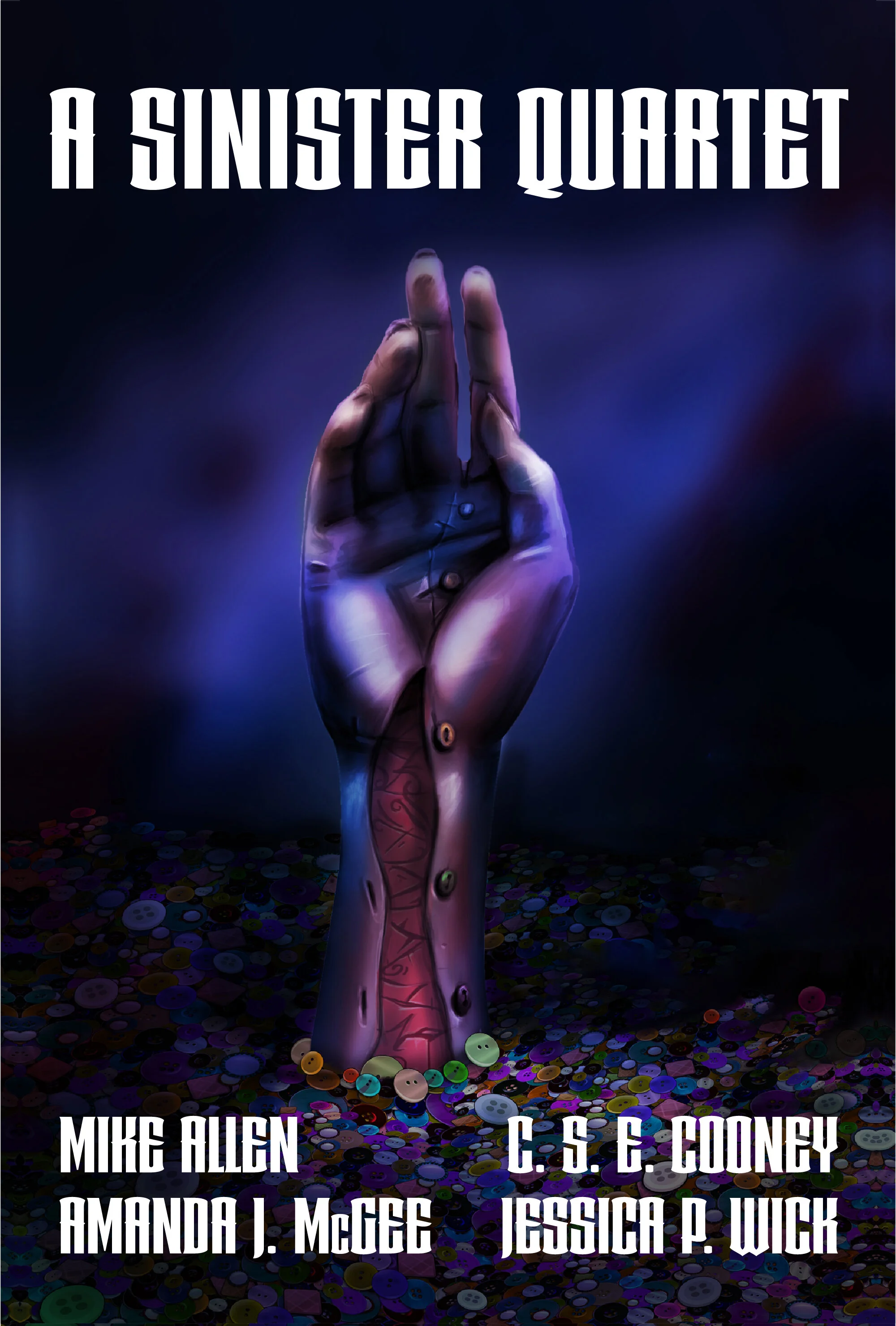
Review of A SINISTER QUARTET

TITLE: A Sinister Quartet

AUTHOR: Mike Allen, C.S.E. Cooney, Amanda J. McGee, Jessica P. Wick

382 pages, Mythic Delirium Books, ISBN 9781732644038 (paperback, ebook)

Sinister-quartet-cover-2screen.jpg


DESCRIPTION: (from the back cover): Behind the walls of an invulnerable city ruled by angels, old movies provide balm for the soul and a plan to escape risks grisly retribution. A princess discovers a passage to a nightmarish world of deception and blood-sealed enchantment. A woman who has lost everything meets a man of great wealth and ominous secrets. In a town haunted by tragedy, malevolent supernatural entities converge, and the conflict that ensues unleashes chaos.

A Sinister Quartet gathers original long-form wonders and horrors composed in unusual keys, with a short novel by World Fantasy Award winner C. S. E. Cooney and a new novella from two-time World Fantasy Award finalist Mike Allen joined by debut novellas from rising talents Amanda J. McGee and Jessica P. Wick. All four offer immersions into strange, beautiful and frightening milieus.


MY RATING: five out of five stars


MY THOUGHTS: The short novel and three novellas debuting in A Sinister Quartet play a familiar lament: the abuse by those in power of those they deem powerless. But listen closely: there are crescendos of rebellion, adagios of personal loss, secrets revealed sotto voce and bravura, and a trembling bass line of body horror tying it all together. These stories are not happy, but they are hopeful, even if that hope doesn’t come until the coda.

In C.S.E. Cooney’s short novel “The Twice-Drowned Saint: Being a Tale of Fabulous Gelethel, the Invisible Wonders Who Rule There, and the Apostates Who Try to Escape its Walls,” the power is wielded by the Angels who rule their walled-off city and protect it from the world outside. But the Angels require obeisance and tribute, and in recent times they’ve become addicted to blood sacrifice – not from their own citizens but from the pilgrims seeking to become citizens and escape the worn-torn outer world. Not everyone within the city, not even among the ruling Angels, is happy about this turn. But is rebellion a new concept in Gelethel or is it a part of the very bones of the city? That’s one of many secrets that underpin and drive the story of the Angel Alizar and his saint, Ish. There are other secrets that surround Ish’s family, including the history of her parents’ marriage and the lives of her Uncles who are part of the Holy Host. And in this story, “host” means exactly that: when the Fourteen Angels fill their hosts with power, they distort the Hosts’ bodies gruesomely. The Angels, like most power brokers, don’t care about the effects of their power on the people who serve them, as long as they get their way. (The descriptions of these bodily transformations are not for the squeamish, nor are a couple of torture scenes midway through the novel.) The past losses and compromises experienced by Ish, by the Angel Alizar, by Ish’s family, all bubble under the surface of the story, releasing and resolving and repeating throughout. And through it all, there is Cooney’s masterful use of language, soaring into the ethereal and plummeting through the earthen – colors and sounds and smells evoked with unexpected turns of phrase and exacting word choice. Sometimes the story feels sf-nal, sometimes high (almost Biblical) fantasy, but it never feels at odds with itself despite the mix of genres.

High fantasy and portal fantasy are the genres for “An Unkindness,” Jessica P. Wick’s marvelous look at the power of the Fae over the mortal world. The tale is narrated by the young Princess Ravenna and is propelled by her sense that she is losing her beloved older brother Aliver to … something. At first, she’s not sure if it’s a growing ailment, a romantic malaise, or something more sinister. But it quickly becomes apparent that he’s been seduced by the power of a fairy ball and the queen who presides over it, and it’s up to Ravenna to save him. All the elements of classic young-girl-adventures-in-Faerie are here: the labyrinth that must be traversed, the portal (in this case, a pool) that must be descended through, the court ball that must be navigated with strange sights abounding, the confrontation with the Queen … but that’s only the middle of Ravenna’s story. The conclusion takes a slightly darker turn, an exploration of a young heroine’s loss of innocence (no, not by rape) that we don’t see in the classic “portal fantasy” stories. This is a rite of passage, a trial by fire, and Ravenna will not emerge unchanged as Dorothy and Alice are wont to do. Ravenna’s voice is endearing but also a little annoying, as befits a pre-teen and very precocious princess whose surety and love for her brother lead her into situations she almost can’t get out of. The sibling relationship we see at the beginning of the story is so real and touching that the sudden antipathy/distance of Aliver in the second chapter hits the reader as hard as it does Ravenna. Kudos to Wick for establishing that relationship so well in such a short opening space; the rest of the story would not work as well if we didn’t believe in the bond between sister and brother that threatens to be severed.  Also fair warning: the body horror is not as explicit is in the other stories but there is one pretty brutal scene involving a unicorn that may make animal lovers upset.

By comparison, Amanda J. McGee’s “Viridian” is very much rooted in the “modern Gothic” and “reconstructed fairy tale” traditions, and this melding is also perfect for the story being told. The setting is a remote part of modern Vermont. Lori Adams is a woman on the run from losses in her recent past (we find out quickly it’s the loss of her sister but don’t find out the details of that loss until later in the story). She settles in a small town and soon meets Ethan, a handsome and very rich stranger. The story is part courtship, part married life, and part the slow revelation of each partner’s secrets. Thanks to the occasional flashback chapter, the reader knows sooner than Lori what Ethan’s secret is (although not why he’s done what he’s done) and in the present-day section sees the way Ethan exerts increasing power over Lori by methods not limited to gaslighting her – but aren’t those the tenets of the Gothic suspense novel, as well as most modern psychological horror? McGee reveals Amanda’s secrets and the depths of Ethan’s depravities at a pace that made this reader anxious for the denouement and not at all eager to get there. It’s always interesting to me when a writer can make a story feel both laconic and urgent, and McGee shifts seamlessly from one to the other in the same scene. There’s only a touch of real body horror (and I won’t ruin the surprise of it here), but there’s a lot of very dark moments for Lori before the story is over. Of the four stories in A Sinister Quartet, this is the one I can most easily see being adapted to film – and in the right hands, I think it would be amazing (let’s not talk about what could happen in inept or cautious hands).

The concluding novella, “The Comforter” by Mike Allen, is the one most firmly rooted in a single genre. This is body horror, straight-up and unadultered, mixed as it may be with classic supernatural thriller elements. Throughout the story, and in increasing detail as the story unfolds, characters are physically altered in horrific ways. The feel of being fully immersed in the genre is enhanced by the multiple points-of-view: some omniscient, some narrowly third-person, some disturbingly second person. The constant shifts in POV keep the reader off-center and always on edge, not sure where the story will go or how much of the truth will be revealed or even if the disparate threads will converge. It’s a masterful mind-fuck, if I may be permitted a bit of vulgarity. “The Comforter” ties to several other of Mike Allen’s fictions, but one need not have read those to feel like this is a complete story. At points you may not understand what’s going on any more than the characters do, but it all comes together in the end. Allen also gives us a different spin on the use/abuse of power and control: the powerful in the first three stories (Cooney’s Angels, McGee’s Ethan, and Wick’s fae queen) allow those they have control over a modicum, at least, of individuality, while Allen’s nebulous protagonist is all about absorption and the removal of differences to make a cohesive and ever-expanding whole. And that protagonist goes to disturbing lengths to get what it wants. This is easily the bloodiest and most physically disturbing of the four pieces of A Sinister Quartet, nudging out the more disquieting scenes of “The Twice-Drowned Saint.”

This review would not be complete if I didn’t mention the Introduction, which I presume was also written by Mike Allen and which functions as a full additional short story. It sets the tone of the anthology and gives oblique, musical nods at each of the stories that follows, but it can be read on its own as a treatise on the power of music and the nature of stumbling, unprepared, into fictional worlds that you perhaps want to look away from but just can’t.

A Sinister Quartet released today, June 9th, and I find it apropos (and perhaps destined?) that I’m writing and posting this review on the cusp as the 9th turns into the 10th, straddling days the way three of these stories straggle genres. So go, now, seek out this strange, sinister quartet and be immersed in these worlds.


Note: I received an Advance Review Copy of this book from the publisher.

PRIDE 2020 INTERVIEWS: Brianna Dee

Today’s Pride Month interview is with activist Brianna Dee:

Brianna Dee photo.jpg

Hi, Brianna! I hope you’re staying safe and healthy during the current events. What are you doing to stay creatively motivated in these unusual times?

I find that artful creative expression comes in waves for me. Some of my most powerful musical improvisations, prose, and comedy development manifests during periods of high stress as cathartic release. When I channel pain into storytelling, I find comfort in the reactions of those that share how it impacted them.


Since June is Pride Month, I have to ask: how has being queer and transgender influenced or informed your career path?

When I was contracted as a Senior Risk Advisory Consultant for an international consulting firm, I showed up at work one day with new stud earrings. I had gotten them to celebrate taking my first dose of estrogen. My boss’s boss’s boss was a stereotypical Texas sales jock in his mid-50s and he pulled me into the hall and asked me not to wear them in the workplace. Long story short, my plans to ease into transition were disintegrated and I came out leading to being “released from contract” a couple months later. 

I eventually was able to get my dream job working for a social justice non-profit in Detroit as their Accountant.  During the interview, they asked me how I worked with people that are different than I am.  I responded “As a queer transgender woman, almost everyone is different than me. I focus on what we have in common and celebrate what makes us different.”  My career was cut short due to physical injury and compounding mental health complications. Now, I spend my time being vocal and involved in efforts for racial equity, social justice, and direct action.


You were Pentecostal and now you’re Muslim. I would love to hear about that journey from one belief system to another.

Muslims really aren’t all that different than Christians. They don’t accept me either. Joking aside, Islam is more similar to Christianity than it is different.  Like Christianity, there are an infinite number of interpretations, segmentations, and differentiations in the way it is practiced. What I found when I decided to learn about Islam directly from Muslims instead of through third-parties was that we shared so many familiar traditions and practices. The progressive Muslimahs I met accepted me as their sister despite being queer and transgender.  I began to study the religion I had always heard of but never investigated for myself.  I found peace, hope, and inspiration from the Quran and made the decision to convert to a progressive, inclusive, merciful practice of Islam, which I believe, in its purest form, it is. Hardly a zealot, my spiritual practice is personal and meaningful.


I’m also interested in the intersectionality of being queer, transgender, and Muslim. In America, that’s pretty much a trifecta of targets for bigots and hate.

I recently had a social worker tell me that I am a walking taboo. I’m just a masochist. Being queer and transgender wasn’t enough. I decided to add another layer to the onion.


You play piano and percussion, and were a Pentecostal musician and vocalist. You told me your proudest paid performance was playing call and response gospel style piano at Affirmations LGBTQ community center fundraiser that brought in 60k. in one night. Tell us about that experience.

Your activism is not radical if it doesn’t include the poor and differently abled. Affirmations hosts a popular fundraiser where the price of admission is two bottles of wine; one to share and one to go into the prize raffle that each attendee gets a ticket for. This is contrast to the annual gala with a ticket price that is out of reach for many. I frequent the community center often because it has a computer lab, support groups, and two pianos in its art gallery.

As I was playing one day, the executive director asked if I would be interested in playing for the upcoming event. I was thrilled and accepted. He insisted that I would be paid even though I offered to donate my talent.

We didn’t plan too much. I was told I would play for an hour or so.  I arrived early and helped where I could.  The executive director eventually asked me to play behind him quietly as he gave his official address to the attendees and made “the ask” for support. I totally improvised and tapped into my formative youth playing in a Pentecostal church band and filled in the “pockets” aka the quiet spaces in between talking, with arpeggios, riffs, and melodies.  The crowd ate it up especially since the executive director was caught off guard and got a kick out of it. When it was all said and done, after corporate sponsorships and donations from those in attendance, they raised $60,000 in one night with a total expense around $1000, including the market-rate stipend they insisted on giving me.

My favorite part of the night was looking out into the crowd and seeing friends I know survive on fixed incomes rub shoulders with those that enjoy the best material things in life. That’s how you do activism.


What inspires you now? What are you passionate about?

I’m passionate about authenticity and queer visibility. It’s my daily goal to send positive ripples of change into the world. In my closeted days, I always noticed those that lived openly and authentically and looked up to them, hoping one day I would be able to live with such confidence. I purposefully share my lived experiences, the good, the bad, and the ugly, so that those who want to be allies can learn firsthand. Perhaps it will prevent future harm because they got to learn from my journey.


And finally, where can people find you and your work online?

https://www.facebook.com/GADESFERNDALE/?modal=admin_todo_tour

https://www.facebook.com/dee.kingsley.94


Brianna Dee Kingsley is the founder of Grassroots Activism Direct Emergency Support – GADES, a project she started in the autumn of 2019.  In June, 2020, GADES was awarded $2500 in seed money from The Trans Justice Funding Project.

Stirred to action when she heard the 2016 presidential election results, she got up off the couch and joined the Metro Detroit Political-Action Committee, eventually serving a period as the LGBTQ liaison, helping organize, promote, and coordinate a half dozen protests and rallies cresting a cumulative 1,000 attendees. 

She took the lead on a collaborative effort to protest conversion therapy being offered at Metro City Church in Riverview, MI resulting in local, state, and international news coverage of the event that saw greater than 300 people braving 20 degree weather, snowfall with an impending blizzard, and a foot of snow on the ground to protest the trauma-inducing $200 service and reinforce the idea that we are born perfect.

A disabled Finance and Accounting professional of ten years, she has leveraged her Bachelor of Business Administration degree and progressive experience that she developed working in the finance departments of Hewlett-Packard, Fiat-Chrysler, and AAA Life Insurance Company to support non-profit operations as an employee for humanitarian and social justice organizations like Habitat for Humanity, Equality Michigan, and Allied Media Projects. She is currently volunteering her time with GADES.


PRIDE 2020 INTERVIEWS: Jeff Baker

Today’s Pride 2020 Interview is with author Jeff Baker

Jeff Baker author photo.jpg

Hi, Jeff! I hope you’re staying safe and healthy during the current pandemic lockdowns. What are you doing to stay creatively motivated in these unusual times?

 I have to remind myself that I actually have the time to write and I shouldn’t waste it. I turn sixty years old this summer, and I keep remembering that some of my favorite writers (like Lovecraft and Henry Kuttner) didn’t make it to fifty! So, I just knuckle down and write. It helps that I’ve been doing this a while and also that I’m posting progress reports on my blog for all to see.


Since June is Pride Month, I have to ask: how has being bisexual influenced or informed your art/craft?

I’m Bisexual, and while I write about Bi/Gay characters, I am a writer first, not just a Bi writer. But being Bi does give me a voice of authority when I do stories like the science-fictional tall tales set in Demeter’s Bar, the fictional gay bar I write a series about.  Also, I write a supernatural series about a Gay teenager who calls himself Bryce Going, who runs across the country, not wanting to be a gay kid in a boy’s home in 1976, after his Mom walks out on him, so I get to have a little historical perspective as well as this guy’s Gay sensibilities in stories where he runs into strange and spooky things along the way. In one he wanders into an abandoned diner and talks with the ghost of the victim of a gay-bashing from the 60s, who warns him (vaguely) about AIDS. (“There’s something coming. Something bad. You have to—take precautions.”)

I didn’t realize when I started that series that I was emulating Manly Wade Wellman, a writer I love, but like I said, I’m a writer first.


You’ve been publishing a lot of flash fiction on your website, and you’ve also had work in a number of anthologies (the most recent of which was The Necronomicon of Solar Pons, from Belanger Books). What inspires you? What does your creative process look like?

 My creative process is a well-controlled mess! I get an idea and I sort of plot it out and then I start writing on it! I work from a sort of “half-assed outline.” To give you an idea: I write the weekly flash fiction from a picture prompt; the current one is of a big house on the tip of a mountain, which reminded me of something I used to muse on in bed looking over at my radio with the lit station tuner and it reminded me of a big house at night on the edge of a dark cliff and I wondered about a long stairway inside the house just beyond that big lit window, and how it’s a long way down from the edge of the cliff. In other words: sometimes I let my mind ramble and I grab ideas from everywhere. Figuring out what happens next can be the tricky part!


What are you working on now and what do you have coming out soon?

I’m actually working on a mystery story that I should get back to! I have to do some fact-checking, as the mystery is set several centuries earlier. I’m also working on a pulp-adventure-type fantasy set in this world I’ve used before which is a sword-and-planet world with a vaguely Middle-Eastern culture and a pro-LGBT attitude. I figure it was settled by colonists from Earth several millennia earlier (in our far future) and blends science-fiction with some supernatural elements. I’ve written about this World of Three Moons in some of the flash fictions and in a few unfinished stories. The only thing coming out is an interview I did on the Two Gay Geeks podcast which will be up sometime in the near future. Oh, yeah, and I have a column “Boogieman in Lavender” up on the Queer SciFi site around the thirteenth of every month.

That’s part of the process: I’m always working on something.


And finally, where can people find you and your work online?

Besides the Queer SciFi site for the column, I regularly post stories and the like on my blog which is authorjeffbaker.com , and I link everything to my Facebook page: Jeff Baker, Author.

Oh, and, If you’re interested, there’s a fine reading of my story “Something In The Dark” on the December 25, 2018 posting on the “Monsters Out Of the Closet” webpage.


The writer of the “Boogieman in Lavender” column for Queer sci-fi, Jeff Baker is the product of a misspent youth reading comic books and watching TV shows like “Bewitched” and “Night Gallery.” He worked as a “sandwich jock” in a food court, a stand-up comic and a deliveryman before moving to full-time writing. His stories have appeared in Sherlock Holmes Mystery Magazine and the recent anthology The Necronomicon of Solar Pons among other places.  He lives happily with his husband Darryl Thompson in Wichita, Kansas.

SERIES SATURDAY: Hexworld

This is a series about … well, series. I do so love stories that continue across volumes, in whatever form: linked short stories, novels, novellas, television, movies. I’ve already got a list of series I’ve recently read, re-read, watched, or re-watched that I plan to blog about. I might even, down the line, open myself up to letting other people suggest titles I should read/watch and then comment on.

Hexworld banner.png


Jordan L. Hawk’s most well-known series is likely their Lovecraftian Whyborne & Griffin series, which ended recently after 11 books and several novellas and short stories. W&G took place in something very close to our own world, where only a select few people know that magic and Elder Gods are real. In Hawk’s Spirits series, the existence of magic is a bit more widely known but still not commonplace. Of all Hawk’s historicals, the Hexworld series is the most removed from our world and definitely qualifies as alternate history.

In the 1890s New York City of the Hexworld books, there exists the Metropolitan Police, which handles every-day crime, and the Witch Police, which handles magic-based crimes. “Witches” here is an umbrella term for anyone who can wield magic, regardless of gender. But for a witch to reach their full potential, they must be bonded with a familiar. Familiars are shifters – people who can turn into a specific animal – and they are the conduits through which magic flows to witches. The bond, once forged, is difficult to break. While any witch and familiar can be bonded, the bond works best when the witch-familiar combo are meant for each other; a witch comes across “his” familiar, or vice-versa. The implication is that for most witch-familiar combos, it’s a working relationship, with the partners going home to their own lives when the work day is over. But the bonds can be romantic, and for the main characters in the books they pretty much always are. (Hawk’s hallmark is historical m/m paranormal romance with plenty of sex tossed in the mix.)

The general public (worldwide, not just in NYC) is aware of magic and in fact dependent on it. Shop-owners rely on hexes to keep thieves out of their stores, for instance. But they also distrust familiars. Prejudice runs deep, especially towards unbonded, or “feral,” familiars, who are often the first suspects when a magic-based crime has been committed. There are those among the Witch Police who would force-bond feral familiars, even though it’s illegal, and it’s a fair bet a portion of the general public feels the same. The prejudice rears its head in sometimes very subtle ways, but it’s always at least in the background of each book, and it’s not always easy to read.

Each book focuses on the beginning of a different witch-familiar pair. They usually come across each other in the course of investigating (or in one case, committing) a crime. Sometimes the familiar realize he’s found his witch first, sometimes the other way around. Romantic and sexual tensions increase as the investigation of whatever crime is at the center of the story goes on, and in the end the main pair of the book are not only bonded professionally, they’re paired romantically. Again, these are m/m paranormal romance from an author who believes in happy endings – so I’m not really spoiling anything major by telling you that out of four novels and two novellas, Hawk has yet to introduce us to a pair who don’t end up together. The romance/sexual side of the books is a bit more formulaic in that regard than either of Hawk’s other two historical series, but I don’t really mind. Knowledge that whatever romantic misunderstandings and trials the characters encounter will be overcome by the end of the book allows me to concentrate on the surprises and twists of the crime plots.

Those crimes range from murder to a feral-child-trafficking ring. The clues to each crime/mystery are laid out very well throughout each book, along with red herrings to keep the reader guessing. The crime introduced at the beginning of each book is resolved by the end, so each book is “one and done” in that regard. But there is an over-arching conspiracy our growing group of heroes becomes aware of that will need to be resolved before the series ends (and I do believe that as with the Whyborne and Griffin series, Hawk is working steadily towards that resolution and already has an end-point in mind).

Even though each book focuses on a different witch-familiar pairing, the main characters of previous books don’t disappear. Most of these pairs end up working for the NYC Witch Police, but not all. We get to see their romantic relationships continue beyond the end of the book they star in, as they provide support for the new focal pairing. Hawk is essentially building a large “found family” of characters who come together to support each other (and deal with that pesky over-arching conspiracy). This is something intrinsically recognizable to queer readers: building a family around yourself when your own family has let you down or abandoned you. It’s interesting to see this play out in a world where being a familiar, and especially a feral familiar, seems to be more disdained than being gay. (I’m not saying there’s no anti-gay sentiment in Hexworld, just that it seems less of a threat that anti-familiar sentiment.)

It should also be noted that at least as of book four, the short story/novellas “A Christmas Hex” and “Wild Wild Hex” do not tie into the main continuity but do give us a look at witch/familiar pairs outside of the NYC Witch Police. They are nice bits of world-expansion and are equally as romantic/erotic as the main books. (Also, full disclosure: I suggested the title for “Wild Wild Hex.” Yes, I was and am a fan of the Wild Wild West television series.

The alternate history worldbuilding is spot-on, the 1890s milieu perfect for the story Hawk is telling. The characters are endearing, interesting, aggravating, and, yes, sexy (in their varied ways). If you like alternate history m/m paranormal romance with a thriller/crime aspect, these books are for you.

The books in the Hexworld series are:

·         “The 13th Hex” (prequel short story)

·         Hexbreaker

·         Hexmaker

·         “A Christmas Hex” (short story)

·         Hexslayer

·         “Wild Wild Hex” (novella)

·         Hexhunter

PRIDE 2020 INTERVIEWS: Seanan McGuire

Today’s Pride Month interview is with author Seanan McGuire (who also publishes as Mira Grant, and soon as A. Deborah Baker).

Seanan-McGuire.jpg


Hi Seanan! First off, how is the McGuire household doing during the pandemic shutdown? How are you staying motivated creatively during these times?

I like paying my bills.  It gives me the warm, fuzzy feeling of not having my power cut off for non-payment.  I know that sounds a little flippant, but it’s true, and the need to keep writing in order to make those payments is highly motivational for me.  To be completely honest, it’s the people who have other jobs but are still producing creatively during this time who really impress me—I don’t understand how they’re managing to convince themselves that the job we share matters when the world is on fire.


Since June is Pride Month, I have to ask: how does being pansexual/demisexual influence or inform your craft, if at all?

I identify mainly as bisexual and demisexual these days, after some serious conversations with a pansexual rights activist who noted that I will exclude some partners on basis of gender identity, which did not fit my personal definition of the term.  The line between bi and pan is both flexible and mobile, and three people will get you five opinions.  I’ve never been anything other than what I am, even if the name has changed, so I don’t know how it informs my craft.  You’re asking the fish what the water’s like, and the fish doesn’t know.


Belated congratulations on the multiple Hugo Award nominations for Best Novel (Middlegame), Best Novella (In an Absent Dream), and Best Series (InCryptid), AND your (newly-announced as I’m typing this!) Locus Award nominations for Best Fantasy Novel (Middlegame) and Best Novelette (“Phantoms of the Midway”). All well-deserved! It’s a shame those events are only happening virtually this year.

Thank you so much!  It does suck that everything has to happen online this year, but it also makes it easier for me to lose with dignity, so there’s that.  (I desperately want to win, Best Series and Best Novel especially.  Middlegame is my strongest work to date, and I feel like if the name on the cover were George R R Martin or Neil Gaiman, there would be no discussion; I’d already be the community accepted winner.  And urban fantasy is really one of the genres Best Series was made for.)  Being nominated for Hugos as many times as I have in a short period really just means you get the constant opportunity to lose.


You announced on Twitter just a couple of days ago that you’ve completed work on the next InCryptid novel, Calculated Risks. One of the many things I love about this series is the way you rotate first-person protagonists, something I’m not sure I’ve seen in other urban fantasy series. How do you decide who’s going to narrate each upcoming book? And, if it’s not too spoilery, are there any narrators coming up who haven’t helmed their own installment yet?

I’m moving the overall family plot forward with each book, and each character has their own way of dealing with problems.  Present Alex with a snake god and he brings it home, he doesn’t fight it on national television, for example.  So as the plot progresses, the correct narrators for the situation naturally present themselves.  Our narrator after Sarah will be Alice, which has been coming for quite some time now.


I can’t tell you how excited I am that present-day Alice will get to narrate, after seeing younger Alice in so many short stories on your website and Patreon. On a different but similar note: you have a trio of interconnected stories coming up in John Joseph Adams and Hugh Howey’s Dystopia Triptych anthologies. Can you tell us a bit about the inspiration and world-building for “Opt-In,” “Conscription,” and “Recovery”?

Sometimes we encounter ethical arguments where the shallow end of the slippery slope is completely reasonable and fine.  If we can pay for plasma, why can’t we pay for kidneys?  And then as we get deeper and deeper, the reasons that this was an ethical argument in the first place start to make themselves known.  I wanted to poke at one of the underlying arguments of modern medical ethics.


I have to tell you: you and Saladin Ahmed are the reasons I’m reading Spider-Man books again on a monthly basis for the first time in over a decade. Now that you’re pretty firmly into the Ghost Spider on-going, what have been the hurdles or differences in creative process that you’ve had to become accustomed to compared to writing novels? Outside of the obvious that you’re writing someone else’s property, of course.

A couple of times now, I’ve reached the point of getting a plotline fully approved and started drafting, only to have it pulled out from under me by developments elsewhere in the company, or someone else wanting to do a better focus on one of the same characters, or, or, or.  And that’s been hard to adjust to.  Otherwise, it’s been fun and a wonderful challenge.  I love comic books so, so much.  I love Gwen.  This has been just a dream.


Finally, since you always have so many things going on: what’s coming out in the near future? What are you working on now? And where can interested folks find you and your work online?

I mean, right now, I’m working on email and interviews and all the other administrative fluff that builds up when I’m deep in book-mode and not raising my head to deal with the world outside it.  But I’ll be starting the edits on Calculated Risks sooner than later, and my next book, A Killing Frost (October Daye #14) will be out in September.  Then, in October, I’m launching a new pseudonym, as A. Deborah Baker’s first book, Over the Woodward Wall, reaches shelves.


Seanan McGuire is the author of the Hugo, Nebula, Alex, and Locus Award-winning Wayward Children series, the October Daye series, the InCryptid series, and other works, including the ongoing Spider-Gwen: Ghost Spider for Marvel Comics. She also writes darker fiction as Mira Grant. Seanan lives in Seattle with her cats, a vast collection of creepy dolls, horror movies, and sufficient books to qualify her as a fire hazard. She won the 2010 John W. Campbell Award for Best New Writer, and in 2013 became the first person to appear five times on the same Hugo ballot.