Sunday Shorts: Two From The Dark #56

Sunday Shorts is a series where I blog about short fiction – from flash to novellas. For the time being, I’m sticking to prose, although it’s been suggested I could expand this feature to include single episodes of anthology television series like The Twilight Zone or individual stories/issues of anthology comics (like the 1970s DC horror or war anthology titles). So anything is possible. But for now, the focus is on short stories.


The-Dark-Issue-56-220x340.jpg


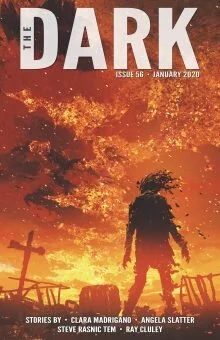
Each issue of The Dark features two original stories and two reprints. In the January 2020 issue, edited by Silvia Moreno-Garcia and Sean Wallace, the two new stories both center on childhood trauma infecting and affecting adult life.

Clara Madrigano’s “Mother Love” features a writer processing her fractured relationship with the woman who raised her. The first-person narrative allows Madrigano to slowly morph the story from a standard “cold mother with childhood issues of her own that affected her ability to raise her indigent sister’s child” to something more horrific as the mother’s secrets are revealed. A passive father and a missing childhood friend add to the main character’s insecurity as an adult about why her mother chose others to fill a role rather than her own daughter. I don’t want to spoil the mother’s secret here, because the slow reveal of it – and the dread that built as I started to suspect what was really going on – is so well-crafted you need to experience it for yourself.

The main character in Steve Rasnic Tem’s “Forwarded” is not a writer but a former actor of some repute, struggling with trauma in his own childhood mostly based around an abandoning mother and a drunk, angry father. This time, there’s a slightly-estranged sibling in the mix. Tom, the actor, is drawn back to his childhood hometown by the twin impetuses of weird scrawled messages that have been forwarded to him from previous places he’s lived and wanting to attend his brother’s retirement from the police force. Tom’s angry past and his mistreatment (intentional or not) of his brother seem to be something he’s put behind him, but has he really? Tem balances the potential supernatural horror element and the more human terror superbly through the story. He leaves the reader with questions about what will happen next, but it still makes for a satisfactory and intriguing look at childhood trauma and what motivates us to behave poorly towards those we love.

Sunday Shorts: The Eight People Who Murdered Me (Excerpt from Lucy Westenra’s Diary)


Sunday Shorts is a series where I blog about short fiction – from flash to novellas. For the time being, I’m sticking to prose, although it’s been suggested I could expand this feature to include single episodes of anthology television series like The Twilight Zone or individual stories/issues of anthology comics (like the 1970s DC horror or war anthology titles). So anything is possible. But for now, the focus is on short stories.

nightmare-magazine-issue-86-november-2019.jpg


As a fan of Bram Stoker in general and his most famous novel specifically (some would say “fanatic” is the more accurate term), I’m always curious about works that expand, expound upon, or deconstruct, Dracula. Even works I don’t enjoy will give me some new insight into my favorite novel, or at least insight into how other people regard it. And if I do like the work, even better!

Gwendolyn Kiste’s “The Eight People Who Murdered Me (Excerpt from Lucy Westenra’s Diary)”, from Nightmare Magazine #86 (November 2019), fair fully blew me away. It’s a wonderful deconstruction/reconstruction of a part of the novel that often gets ignored or conflated/downplayed by media adaptations: the life and death(s) of Lucy Westenra. Thanks to movie and television focus on independent, poor-but-plucky Mina Murray and her eventual marriage to damaged hero Jonathan Harker, people tend to forget that the novel features two female leads and that one of them doesn’t fare quite so well as the other. (And with the recent penchant for making Mina Dracula’s reincarnated soulmate or current lover, poor Lucy gets even less attention. But that’s a post for another time.)

Stoker gives us some of his original story in Lucy’s POV mostly via letters to Mina about Lucy’s courtship by three dashing young men of very different backgrounds – but you have to squint hard to see past the flighty exterior presented. What little else we know of Lucy we know from Mina’s own journal entries. Stoker never quite gives Lucy the introspective moments Mina experiences, especially once Lucy suffers her first death and we lose her POV.

Kiste gives us what is missing from the original work: Lucy’s inner self, conflicted over how she had to act to survive in high society and fulfill her mother’s expectations. The entire story is narrated by Lucy post-death, listing out how each of her friends, would-be-saviors, Dracula, and even society itself contributed to the end we see her receive in the novel. It starts out feeling like we’re just going to get a litany of blame – but as the diary entries go on, the story becomes so much more. Kiste doesn’t reveal anything regarding Lucy’s final death in the novel that many authors haven’t also revealed about Dracula (and Sheridan LeFanu’s Carmilla, and other such creatures); the twist is what Lucy will do next.

The key to the story is the voice Kiste gives Lucy – there are glimmers of the flightiness and flirtiness we see in the original novel, but Kiste builds off of the few more serious moments Stoker gives to reveal a Lucy who knows exactly what her place in British society is and rails against it – and who discovers the power to do something about it.

2019 By The Numbers

Earlier than previous years, here’s my media round-up for 2019: what I wrote, what was published, and what I read, listened to, and watched.

WRITING

Not much to report on this front. 2019 was not a good year for creating new content. I didn’t track what little writing I actually managed to do – but I know there were more days where I didn’t write than there were days I wrote, by far. I’m considering it a “recharging” year, as I consumed and processed a lot of wonderful (and not-so-wonderful) books, television, movies, live theatre and music events. The writing I did manage was mostly work on previous unfinished short stories.

PUBLISHING

2019 saw the publication of one short story:

  • “Regardless of How Lost You Are Returning From, Regardless of How Far” appeared in Kaleidotrope magazine, edited by Fred Coppersmith

I also wrote a six paid book reviews for Strange Horizons magazine, and one for Out In Print (non-paid):

·         So You Want To Be A Robot: 21 Stories by A. Merc Rustad

·         Friday Black: Stories by Nana Kwame Adjei-Brenyah

·         Forget The Sleepless Shore: Stories by Sonya Taaffe

·         The Hidden Witch by Molly Ostertag

·         Sealed by Naomi Booth

·         The History of Soul 2065 by Barbara Krasnoff

·         Of Echoes Born by ‘Nathan Burgoine (Out in Print)


READING

I set myself a variety of reading challenges in 2019. I managed to complete a few of them.

Goodreads Challenge:

I challenged myself to read 125 books. I read 144 books from approximately 73 different publishers.

Here’s the breakdown of what I read:

  • Fiction: 140 books

    • 6 anthologies

      • 1 crime

      • 1 horror

      • 1 romance

      • 1 fantasy

      • 1 science fiction

      • 1 mixed-genre

    • 12 single-author collections

      • 3 science fiction

      • 3 horror

      • 2 fantasy

      • 2 crime/mystery

      • 2 poetry

    • 33 graphic novels

      • 8 super-hero

      • 4 horror

      • 12 fantasy

      • 1 crime

      • 2 pulp adventure

      • 2 romance

    • 12 magazines (all issues of Lightspeed magazine)

    • 40 novels

      • 8 crime

      • 3 horror

      • 1 thriller

      • 1 mystery

      • 6  Fantasy

      • 8 science fiction

      • 3 paranormal romance

      • 4 urban fantasy

      • 1 romance

      • 3 pulp adventure

      • 1 suspense

      • 1 mythology

      • 1 Christmas

    • 34 novellas

      • 11 horror

      • 5 fantasy

      • 4 romance

      • 7 literary

      • 4 pulp adventure

      • 1 science fiction

      • 1 crime

      • 1 Christmas

    • 2 novelettes

      • 1 fantasy

      • 1 horror

  • Non-Fiction: 8 books

    • 2 Memoir

    • 1 History

    • 1 literary analysis

Other Book Stats:

# of Authors/Editors: approximately 136 (including graphic novel artists; I need to be better at listing all of the creators of graphic novels somehow). The following breakdown is estimated because not every author shares their personal information online, but roughly:

·         39 female creators

·         5 Trans/Non-Binary

·         29 LGBTQIA+

·         10 Persons of Color

Shortest Book Read: 25 pages (Christmas with the Dead by Joe Lansdale)

Longest Book Read: 669 (Upon A Burning Throne by Ashok K.Banker)

Total # of pages read: 25,513

Average # of pages per book: 205

# of Rereads: 6 (including annual rereads of Roger Zelazny’s A Night in the Lonesome October and Charles Dickens’ A Christmas Carol)

Monthly Breakdown:

·         January: 11

·         February: 18 (most read in a month)

·         March: 14

·         April: 7 (fewest read in a month)

·         May: 11

·         June: 10

·         July: 8

·         August: 14

·         September: 11

·         October: 15

·         November: 13

·         December: 13

Review-wise on Goodreads I gave 2 two-star reviews, 21 three-stars, 86 four-stars, and 35 five-star reviews.

Format Summary:

  • 17 audiobooks

  • 31 ebooks

  • 96 print

    • 25 hardcovers

    • 71 softcovers

365 Short Stories Challenge:

Each year, I challenge myself to read one short story per day. I read 401 stories in 2019, beating the goal handily. The shortest was approximately 7 pages and the longest approximately 61. Those 401 stories appeared in:

  • 12 Magazines

    • Nightmare

    • Lightspeed

    • The Dark

    • One Story

    • Analog

    • The Strand

    • Interzone

    • Lamplight

    • Black Static

    • Abyss & Apex

    • One Teen Story

    • Uncanny

  • 9 Anthologies

    • Resist Fascism

    • From Sea to Stormy Sea

    • If This Goes On

    • A Secret Guide to Fighting Elder Godds

    • The Many Tortures of Anthony Cardno

    • Fool For Love

    • F is for Fairy

    • At Home in the Dark

    • Devil Take Me

  • 15 Single-Author Collections

    • The Assimilated Cuban’s Guide to Quantum Physics by Carlos Hernandez

    • The Time Machine and Other Stories by H.G. Wells

    • Three Blind Mice and Other Stories by Agatha Christie

    • Beyond the Farthest Star by Edgar Rice Burroughs

    • Untranslatable by Alma Alexander

    • Hunt the Avenger by Win Scott Eckert

    • Trans Space Octopus Convention by Bogi Takacs

    • Oriental Ghost Stories by Lafcadio Hearn

    • Spinning Around A Sun by Everett Maroon

    • A History of Soul 2065 by Barbara Krasnoff

    • Acres of Perhaps by Will Ludwigsen

    • Under the Sunset by Bram Stoker

    • Two Todd Tales by Joseph Pittman

    • In Re: Sherlock Holmes by August Derleth

    • Forget the Sleepless Shores by Sonya Taaffe

  • 5 published as “back-matter” in the following novels

    • If Dragon’s Mass Eve Be Cold and Clear

    • Ms. Tree: One Mean Mother

    • Rosemary and Rue 10th Anniversary Hardcover Edition

    • That Ain’t Witchcraft

    • The Unkindest Tide

  • 16 Stand-alone (self-pubbed or publisher-pubbed in e-format)

    • Seanan McGuire (Patreon)

    • Lucy Snyder (Patreon)

    • Sabrina Vourvoulias (Cast of Wonders audio podcast)

    • Lydia M. Hawke (author website)

    • Jim Butcher (Evil Hat website)

Those 401 stories were written by 232 different authors. The following breakdown is estimated because not every author shares their personal information online, but roughly:

·         104 female creators

·         6 Trans/Non-Binary

·         33 LGBTQIA+

·         32 Persons of Color

I gave 13 two-star ratings, 208 three-star, 157 four-star, and 23 five-star ratings. The shortest story was 7 pages long and the longest 61.

Graphic Novel Challenge:

Because I own so many, I challenged myself to read one graphic novel per week. I didn’t make it, reading a total of 33 from 11 different publishers:

·         DC Comics: 7

·         Marvel Comics: 8

·         BOOM! Box: 8

·         Dynamite Comics: 2

·         Image Comics: 2

·         Hard Case Crime: 1

·         TO Comix: 1

·         Scholastic Books: 1

·         Panic Button Comics: 1

·         Dark Horse: 1

·         Self-Pubbed: 1

Non-Fiction Challenge: I didn’t do as well on this one. I challenged myself to read 24 non-fiction books in 2019, and I only read 4.

Read the Book, Watch the Movie Challenge: Completely bombed this one. Planned to do at least 10 of these and did 0.

Complete the Series Challenge: Bombed this one too. Planned to read 3 complete series, totally 16 books, and read 0 of 16, completing 0 series.


VIEWING

I tried tracking the movies, TV and live events I watched this year. Here’s how that went:

Movies: Apparently, I only watched 17 movies this year. (I suspect I forgot to enter a few things into the database.)

·         9 on DVD

·         2 on Netflix

·         6 in the theater


Live Events: I attended 15 live events this year.

·         10 plays

  • 6 straight plays (4 on Broadway, 2 high school, one attended twice)

  • 4 musicals (1 Broadway, 1 regional, 2 high school)

·         4 concerts (Dennis DeYoung, Greyson Chance, Blue Alien Mystic, and the Mahopac High School Pacapellas)

Television: I watched approximately 162 hours of episodic television:

·         Arrow (20 episodes)

·         Batwoman (9 episodes)

·         Beyond Stranger Things (7 episodes)

·         Black Mirror (2 episodes)

·         Doctor Who (1 episode)

·         The Flash (21 episodes)

·         Game of Thrones (1 episode)

·         Good Omens (6 episodes)

·         Great Performances (1 episode)

·         DC’s Legends of Tomorrow (9 episodes)

·         Planet of the Apes (14 episodes)

·         Stranger Things (25 episodes)

·         Supergirl (22 episodes)

·         The Big Bang Theory (2 episodes)

·         Vera (1 episode)

·         Vicious (14 episodes)

·         Watchmen (6 episodes)

·         Young Sheldon (1 episode)


So there you have it: my writing, publishing, reading, and viewing by the numbers, for 2019.

Earlier this week, I posted about my reading challenges for 2020. I plan to post about my writing plans, and possibly viewing plans, next week.

Reading Challenges For 2020

I always set myself more than one reading challenge per year. Some carry over from year to year, and some are new. Some are broad and some are themed. And in many cases, books read will help me meet more than one challenge. Here’s this year’s list.


TO BE READ CHALLENGE

In past years, the wonderful Roofbeam Reader has hosted a “To Be Read Challenge” with specific rules about posting, etc. He’s not hosting one this year, but I’m going to do a version of the challenge for myself without making it a separate post this year. The idea is to pick 12 books (plus 2 alternates in case you find yourself unable to finish a couple of your main choices) that have sat unread on your bookshelf for a year or more. Thus, books published in 2019 wouldn’t be eligible, nor would re-reads. I plan to come back to this post and add “date completed” for each book individually and for each series as a whole. Here are my 14 for 2020 (not listed in intended reading order):

1.       Tales of the City by Armistead Maupin

2.       No Longer at Ease by Chinua Achebe

3.       Logan’s Run by William F. Nolan and George Clayton Johnson

4.       A Diet of Treacle by Lawrence Block

5.       Shadowhouse Falls by Daniel Jose Older

6.       Greatheart Silver by Philip Jose Farmer - finished September 23, 2020

7.       Pirates of Venus by Edgar Rice Burroughs - finished January 22, 2020

8.      The Bad Seed by William March - finished October 30, 2020

9.    The Parable of the Sower by Octavia E. Butler - finished February 19, 2020

10.   Choke Hold by Christa Faust - finished March 29, 2020

11.   Trail of Lightning by Rebecca Roanhorse

12.   The Complete Persepolis by Marjane Satrapi

Alternate #1: The Mystery of the Sea by Bram Stoker

Alternate #2: Excalibur! by Gil Kane and John Jakes


366 SHORT STORIES CHALLENGE

Every year, I challenge myself to read one short story per day. Some years I keep the pace pretty well, and some years I fall behind and then scramble to catch up (and some years, I catch up and fall behind again). I used to post thoughts on each individual story over on my now-largely-defunct Livejournal; this year I plan to review a story or two in-depth each Sunday and then do a monthly “round-up” of all stories read that month. I’m defining “short story” as anything from flash fiction to novella-length. If a story/novella is published as a stand-alone book (ebook or otherwise), that story will also count towards my annual Goodreads “Books Read Challenge.” 2020 being a leap-year, the goal is 366 instead of the usual 365.


GOODREADS CHALLENGE

Goodreads allows members to set a challenge. In 2019, I set a goal of 125 books and actually read 144. For 2020, I’m setting the same goal of 125 to start with, and we’ll see what happens. Goodreads counts magazines and individually-published short stories as “books,” so I count them for this challenge as well. Of course, any book read for the TBR Challenge, or the other challenges mentioned in this post count towards this one.


GRAPHIC NOVEL CHALLENGE

I own far more graphic novels and trade paperback collections of classic comics than I’ve read. In 2017 I started trying to turn that around, and I’m again setting a goal in 2020 of reading one graphic novel per week, so 52 for the year, tracking them in the monthly Reading Round-Up Posts.


NON-FICTION CHALLENGE

As with graphic novels, I tend to get intrigued by and purchase far more non-fiction books than I actually end up reading. In an effort to clear some shelf-space, justify the money spent, and increase my knowledge a bit, I’m setting myself a new challenge this year to read two (2) non-fiction books per month, or 24 for the year, also tracked via the monthly Reading Round-Up posts.


READ THE BOOK / WATCH THE MOVIE CHALLENGE

I have so many books in my collection that are the basis for classic (and sometimes not-so-classic) movies that I thought it would be fun to read some of them and then see how the movies compare. In 2019, I didn’t do so well on this challenge, but I’m game to try again, and of course track them in the monthly Reading Round-Up posts.


COMPLETE THE SERIES CHALLENGE

In previous years I’ve challenged myself to come “up to date” on series I’d started but fallen behind on. Last year, I challenged myself to also read one series that I own but have not read. Titles that I have read in each series are indicated with (read). Last year, I blew this completely, so I’m repeating two of the challenges from last year, adding two (one that will be audio rather than print) for 2020.  I plan to come back to this post and add “date completed” for each book individually and for each series as a whole. If I complete any other series on my shelves, I’ll come back and add that series to this entry.


THE VELVETEEN SERIES by Seanan McGuire

1.       Velveteen Vs. The Junior Super-Patriots

2.       Velveteen Vs. The Multiverse

3.       Velveteen Vs. The Seasons


THE AFRICA TRILOGY BY Chinua Achebe

1.       Things Fall Apart – read in 2018

2.       Arrow of God - read in February 2020

3.       No Longer At Ease


CARSON OF VENUS by Edgar Rice Burroughs

1.       Pirates of Venus - read in January 2020

2.       Lost on Venus

3.       Carson of Venus

4.       Escape on Venus

5.       The Wizard of Venus


THE PHILIP MARLOWE SERIES (audiobook versions)

1.       The Big Sleep – listened to in November 2019

2.       Farewell, My Lovely – listened to in November 2019

3.       The High Window - listened to in January 2020

4.       The Lady in the Lake - listened to in January 2020

5.       The Little Sister - listened to in January 2020

6.       The Long Goodbye - listened to in April 2020

7.       Playback

8.       Poodle Springs (started by Chandler, completed by Robert B. Parker)


MONTHLY MINI-CHALLENGES

In 2019 for the first time I set myself some monthly mini-challenges based on various factors. I’m going to do it again in 2020, but list those challenges here as well:

January: No specific challenge (because I want to catch up on stuff from late 2019)

February: Authors from Africa or of African descent (for Black History Month)

March: Women Authors (for Women’s History Month)

April: Poetry (for National Poetry Month)

May:  Asian/Pacifican Authors (for Asian Pacific / South Asian Heritage Month)

June: Queer Authors (for Pride Month)

July: US and World History (because of Independence Day)

August: Classic and New Pulp Authors (because Pulpfest/Farmercon is held this month)

September: Hispanic authors (Hispanic Heritage Month)

October: Horror! Horror! Horror! (because Halloween, obviously)

November: Noir (because “Noirvember”)

December: Winter Holiday-related Fiction (Christmas, Hannukah, etc.)

Sunday Shorts: At The Bay

Sunday Shorts is a series where I blog about short fiction – from flash to novellas. For the time being, I’m sticking to prose, although it’s been suggested I could expand this feature to include single episodes of anthology television series like The Twilight Zone or individual stories/issues of anthology comics (like the 1970s DC horror or war anthology titles). So anything is possible. But for now, the focus is on short stories.


at the bay cover.jpg


TITLE: At the Bay
AUTHOR: Katherine Mansfield
56 pages, Melville House Publishing, ISBN 9781612195834 (softcover)


DESCRIPTION: (from Goodreads): Told in thirteen parts, beginning early in the morning and ending at dusk, At the Bay captures both the Burnell family's intricate web of relatives and friends, and the dreamy, unassuming natural beauty of Crescent Bay.

MY RATING: 3 out of 5 stars

MY THOUGHTS: Yet another classic novella that I don’t remember being assigned to read. Mansfield packs a lot of characterization and social commentary into 56 or so pages. The focus is on the women in the Burnell family, both adults and children, and a small cross-section of their neighbors. How they interact, how they empower and disempower each other in everyday moments. There is no grand event the story builds toward, no community-threatening or -destroying big moment that ties everything together. We’re experiencing a day-in-the-life of a very specific group of women and girls at a specific moment in time (1922), but much of what the author relates, in terms of what is deemed appropriate behavior and the like, is still true today. The moments among the children (three girls and their two boy cousins) mirror the moments among the adult women.


Because the story is set on a week-day the men in the family are fairly peripheral, acting on the women mostly from afar rather than in-scene. The men clearly think they are the center of the universe (one, near the story’s end, is highly concerned that his wife’s day was totally ruined because he rushed out to work without saying goodbye.), and are pretty much oblivious (willfully, I think) to the details of how the women spend their day. Interestingly, Mansfield starts and ends the story with the men: the opening scene focuses on two men going for a swim as well as the movements of a local shepherd. The shepherd retraces his route near the end of the story, overlapping with one of the few moments where a man’s effect on one of the Burnell women is direct and in-scene rather than from afar.


Mansfield’s descriptions of the weather and the natural setting are just beautiful. The weather isn’t the focus of the story, so one might be tempted to take these descriptions as window-dressing and choose not to linger over the language. I also found it interesting that she personifies some of the animals (a cat, and the shepherd’s dog, have distinct personalities), and also that the one infant in the story is described the way the animals are – he’s given a bit of personality but remains nameless unlike the older children. Even nameless and speechless, the baby still comes across as as much of a burden/inconvenience to his mother as his father is.


I wasn’t as enamored of the vignette-style telling of the story as I was of what it had to say about culture and the treatment of women (both by men and by other women). It felt more disjointed than cohesive.

Reading Round-Up: December 2019

Continuing the monthly summaries of what I’ve been reading and writing.


BOOKS

To keep my numbers consistent with what I have listed on Goodreads, I count completed magazine issues and stand-alone short stories in e-book format as “books.” I read or listened to 13 books in December: 9 in print, 4 in e-book format, and 0 in audio. They were:

1.       Lightspeed Magazine #115 (December 2019 issue), edited by John Joseph Adams. The usual fine assortment of sf and fantasy short stories. This month’s favorites for me were T.L. Huchu’s “Njuzu,” Rick Wilber’s “Today Is Today,” Cat Rambo’s “The Silent Familiar,” and KT Bryski’s “The Path of Pins, The Path of Needles.”

2.       Faux Ho Ho by ‘Nathan Burgoine. Another wonderful holiday m/m romance novella from one of my favorite authors. This time, the story involves a fake relationship to appease nosy family members, and a gathering of conservative family members at a sibling’s Christmas wedding. The two leads are adorable (I may be crushing on Silas still, weeks after reading the book), the supporting cast wonderfully varied. Read my Full Review HERE.

3.       From Sea to Stormy Sea: 17 Paintings by Great American Artists and the Stories They Inspired edited by Lawrence Block. The paintings range from naturalist to abstract, the stories range from noir to science fiction. Favorites include Charles Ardai’s “Mother of Pearl,” Jerome Charyn’s “The Man From Hard Rock Mountain,” Janice Eidus’ “You’re A Walking Time Bomb,” Christa Faust’s “Garnets,” and Gary Phillips’ “A Matter of Options.”

4.       The Dead Girls Club, by Damien Angelica Walters. One of my most-anticipated books of the year came out in early December, and Walters did not disappoint. Time-jumping between the narrator’s present adult life and the summer when she was 12 and her best friend went missing, the story is a multi-layered supernatural mystery.

5.       Kolchak: The Last Temptation by Jim Beard. In this novella, Beard digs back into a mystery from the very first Kolchak TV movie and gives the reporter some closure. The story also involves investigating a charity organization called “Sons of the Morningstar,” so there’s some devilry afoot.

6.       Rawhide Kid: The Sensational Seven by Ron Zimmerman, Howard Chaykin, and more. The trade collection of the second Rawhide Kid mini-series from Marvel teams the character up with Annie Oakley, Doc Holliday, Billy the Kid, Red Wolf, Kid Colt and the Two-Gun Kid to rescue Wyatt and Morgan Earp. Tons of fun in the old West. Also pretty bloody.

7.       A Christmas Carol by Charles Dickens. My annual reread of the print edition signed for me by Dickens’ great-great-grandson was accompanied by a listen to the audiobook version narrated by Tom Baker. Baker struggles with some of the character voices, but as Scrooge and the Narrator he’s wonderful.

8.       Into Bones Like Oil by Kaaron Warren. A troubled woman checks into a seaside hotel that promises to help her sleep – but is also haunted by the ghosts of a shipwreck.

9.       A Family for Christmas by Jay Northcote. Another truly wonderful “fake relationship” gay Christmas romance, this one between an awkward young man and the somewhat anti-social coworker he takes home to his family for Christmas. Bonus cute kittens.

10.   Fearless by Seanan McGuire, Claire Roe, Rachelle Rosenberg (main story), various creators (backup stories). The trade collection of a four-issue mini-series from earlier this year with stories told completely by female creators. The main story involves Sue Storm, Captain Marvel, and Storm as guest-speakers as a science-based summer camp for girls which Ms. Marvel and a few teenage mutants are attending. One back-up pays tribute to the unsung female comics creators of the Golden and early Silver Ages.

11.   Lumberjanes Volume 13: Indoor Recess by Shannon Watters, Kat Leyh, Dozerdraws, Maarta Laiho, Aubrey Aiese. The Janes find themselves stuck in the dining hall during a particularly bad storm. Jo and Molly find themselves helping Athena Cabin with play-testing a new board game, while April, Mal and Ripley unexpectedly explore caverns underneath the camp.

12.   If Dragon’s Mass Eve Be Clear and Cold by Ken Scholes. A beautiful novelette that explores grief after the loss of a parent and why we continue to uphold traditions in which we no longer believe. Print edition also includes a prequel short story. Longer review HERE.

13.   Christmas with the Dead by Joe Lansdale. A fun short novelette about a guy just trying to get in the holiday mood after a zombie apocalypse.


STORIES

I have a goal of reading 365 short stories (1 per day, essentially, although it doesn’t always work out that way) each year. Here’s what I read this month and where you can find them if you’re interested in reading them too. If no source is noted, the story is from the same magazine or book as the story(ies) that precede(s) it:

1.       “A Bad Day in Utopia” by Matthew Baker, from Lightspeed Magazine #115 (December 2019 issue), edited by John Joseph Adams.

2.       “Njuzu” by T.L. Huchu

3.       “Motherhood” by Pat Murphy

4.       “Today is Today” by Rick Wilber

5.       “The Mocking Tower” by Daniel Abraham

6.       “End of the Sleeping Girls” by Molly Gutman

7.       “The Silent Familiar” by Cat Rambo

8.       “The Path of Pins, the Path of Needles” by KT Bryski

9.       “Help Wanted” by Seanan McGuire, on the author’s Patreon page.

10.   “The Eight People Who Murdered Me” by Gwendolyn Kiste, in Nightmare #86 (November 2019), edited by John Joseph Adams.

11.   “The Prairie Is My Garden” by Patti Abbott, from From Sea to Stormy Sea: 17 Paintings by Great American Artists and the Stories They Inspired, edited by Lawrence Block

12.   “Mother of Pearl” by Charles Ardai

13.   “Superficial Injuries” by Jen Burke

14.   “The Man From Hard Rock Mountain” by Jerome Charyn

15.   “Adrift Off the Diamond Sholes” by Brendan DuBois

16.   “You’re A Walking Time Bomb” by Janice Eidus

17.   “Garnets” by Christa Faust

18.   “He Came In Through the Bathroom Window” by Scott Frank

19.   “On Little Terry Road” by Tom Franklin

20.   “Someday, A Revolution” by Jane Hamilton

21.   “Riverfront” by Barry M. Malzberg

22.   “Silver at Lakeside” by Warren Moore

23.   “Get Him” by Micah Nathan

24.   “Baptism in Kansas” by Sara Paretsky

25.   “A Matter of Options” by Gary Phillips

26.   “Girl With An Axe” by John Sandford

27.   “The Way We See The World” by Lawrence Block

28.   “The Doom of Love in Small Spaces” by Ken Scholes, included in the print edition of If Dragon’s Mass Eve Be Cold and Clear.

So that’s 28 short stories in December. Slightly under “1 per day,” but still enough to keep me way ahead for the year so far. (December 30th was the 365th day of 2019.)


Summary of Reading Challenges:

“To Be Read” Challenge: This month: 0 read; YTD: 3 of 14 read.

365 Short Stories Challenge: This month:  28 read; YTD: 402 of 365 read.

Graphic Novels Challenge:  This month: 3 read; YTD: 35 of 52 read.

Goodreads Challenge: This month: 13 read; YTD: 144 of 125 read.

Non-Fiction Challenge: This month: 0; YTD: 5 of 24 read.

Read the Book / Watch the Movie Challenge: This month: 0; YTD: 0 of 10 read/watched.

Complete the Series Challenge: This month: 0 books read; YTD: 0 of 16 read.

                                                                Series fully completed: 0 of 3 planned

Monthly Special Challenge: I didn’t set a mini-goal of any kind for December, other than trying to get some recently-acquired books in before the end of the year. 11 of the 13 books read were books acquired in the past 3 months.

I’ll be posting a full 2019 Round-Up as soon as I’m able to crunch numbers and put it all together. Ditto a post about my Reading Challenges for 2020!
So You Got Bookstore Giftcards For The Holiday!

If you’re like me, you got a LOT of gift cards to various online, chain, or local bookstores and comics shops for the holidays. So I thought I’d offer up a list of books folks might like based on your interests. Some have been reviewed here, some have not. Links will be to publisher sites where possible, Goodreads pages otherwise. Support your local bookstores as much as you can!

And if you didn’t get bookstore gift cards for the holidays (what were your family thinking, really?), seek these out at your local library or convince them to order copies for their shelves!

If you’re a fan of:

The Beatles: you might like:

Pulp/Adventure Fiction: you might like:

Horror, you might like:

Fantasy, you might like:

Science Fiction, you might like:

YA (Various Genres), you might like:

Series to Read (various genres), you might like:


I tried to concentrate on books/series that came out in 2019. This of course doesn’t scratch the surface. Hit me in the comments with YOUR favorite book published in 2019. Or your favorite book published earlier that you read for the first time in 2019! I’m always looking for suggestions!

Sunday Shorts: If Dragon's Mass Eve Be Cold and Clear

Sunday Shorts is a series where I blog about short fiction – from flash to novellas. For the time being, I’m sticking to prose, although it’s been suggested I could expand this feature to include single episodes of anthology television series like The Twilight Zone or individual stories/issues of anthology comics (like the 1970s DC horror or war anthology titles). So anything is possible. But for now, the focus is on short stories.

Dragons Mass Eve cover.jpg


It’s been a few years since I’ve reread Ken Scholes’ “If Dragon’s Mass Eve Be Cold and Clear.” It was first published on Tor.com as their holiday story for 2011. It’s been newly released this year in a nice slim paperback edition from Fairwood Press, and as it is holiday-related, I thought it might be an appropriate final 2019 entry for Sunday Shorts.

This is the story of Melody Sheffleton-Farrelly (call her “Mel”), coping with the first Dragon’s Mass Eve without her father – which just so happens to also be the day of his death. Mel and her father lived on the outskirts of town, operating a dormant Hope mine. Neither were really believers anymore (Mel possibly never was) in the Santaman or the promise of Dragon’s Mass Eve. But they kept the traditions, minus going to church, going through Mel’s entire life.

The thing that struck me when I first read the story online and which still strikes me reading this print edition, is how well Scholes captures the effect a parent’s death has on the holidays. I lost my mother in 2005 (after spending her final Christmas with her, as Mel does with her father Drumm) and my father two years later, so the first time I read this story I had a few years’ remove from the loss. But I still recognized how Mel acts on that first Dragon’s Mass Eve without Drumm: at first, going through the motions, almost flying on autopilot reciting the Santaman Cycle (as she buries her father), then throwing traditions out as the emotional (and physical) exhaustion hits. A year later, she’s able to observe some of the traditions with fond memories of her father – and she’s also able to do things they never did on the holiday (I won’t spoil what those are here.) Healing from the loss of a parent happens at different speeds for all of us, and Scholes expertly shows that process over the course of the story.

Does it matter that Dragon’s Mass Eve is a holiday the author made up, with only winking nods to recognizable figures and stories? Not at all, because the effect is the same as if he were writing about Christmas, Hannukah, Kwanzaa, or Yule (or any non-Winter holiday that has adherent family traditions, for that matter). In fact, the effect may be stronger because the story doesn’t become bound up in one’s own experiences of any particular current holiday. We get a strong enough sense of the reason for the holiday and the historical/legendary underpinnings thanks to the sections of the Santaman Cycle interspersed throughout the story. The Cycle itself raises questions about the world Mel, her father, and their neighbors exist in: there’s enough we recognize (“Santaman,” and aspects of various Creation myths) to think this is possibly Earth long after some climate change cataclysm, but enough fantastical (Hope comes from mines; Love is a feral creature) to think it might be a completely fictional, or at the least alternate-Earth, world. Scholes has never weighed in conclusively on which it is, and ultimately it’s not as important a piece of knowledge as it might feel.

Mel has a really strong character arc, starting in grief/death and ending in hope/life. I don’t want to spoil any of the events that lead from the one to the other, so I won’t say much more. Just that the conclusion is satisfying and feels very true to the character we meet in the early pages and the child we meet through her own memories.

This story gives me so much to think about that I’m not sure why I haven’t long since made it a part of my Christmas reading tradition (which includes annual rereads of A Christmas Carol and others). I’ll rectify that going forward. I highly recommend seeking this one out. (I also hadn’t realized that Fairwood Press had started a Novelette Series, of which this is the latest volume. I’ve gone to their site and ordered all of the earlier entries and pre-ordered the next one, coming in 2020. I’ll do my best to do Sunday Shorts entries about all of them.)

Series Saturday: Nathaniel Dusk


This is a series about … well, series. I do so love stories that continue across volumes, in whatever form: linked short stories, novels, novellas, television, movies. I’ve already got a list of series I’ve recently read, re-read, watched, or re-watched that I plan to blog about. I might even, down the line, open myself up to letting other people suggest titles I should read/watch and then comment on.

Nathaniel Dusk covers.png


At least once a year, I Tweet at DC Comics about what older, now defunct, series they should collect in bound (softcover, hardcover, whatever works) editions. Somewhere at the top of that list pretty much every time are two long-out-of-print series: Nathaniel Dusk Private Investigator, and Silverblade. We’ll get to Silverblade in a future installment. Today, I want to wax poetic about Nathaniel Dusk.

Nathaniel Dusk appeared in two eponymous four-issue mini-series from DC. The first, Nathaniel Dusk Private Investigator (subtitled “Lovers Die at Dusk”) was published with cover-dates of February to May, 1984. The second, Nathaniel Dusk Private Investigator II: Apple Peddlers Die at Noon, was cover-dated October 1985 to January 1986. And that was it. Other than a profile in DC’s Who’s Who in the DC Universe, and a quick cameo in an unusual issue of Lobo, Dusk hasn’t been seen again. (He apparently shows up as a movie character played by an actor in the recent Doomsday Clock maxi-series from DC, but I haven’t read that yet.)

Dusk should be a much more well-known character than he is. That he’s somewhat faded into obscurity to me feels like a crime (although not the type of crime ol’ Nate himself would investigate. Not enough blood or bullets in it). He should be up there with Philip Marlowe, Sam Spade, and Mike Hammer. He’s of their ilk, created in homage but not slavishly so (definitely not as violent as Hammer, although they inhabit the same streets only a decade or so apart). He’s got his own history, his own character, and thanks to Gene Colan, his own distinct look. But the publishing gods were not kind. Despite the powers-that-be at DC backing the idea for two mini-series, Dusk just never took off well enough to come back for a third round. Would it have been different if the book had been launched as an on-going title from the start, without that year-plus gap between the two minis? We’ll never know.

Created by Don McGregor and based at least in part on Robert Culp in his “I Spy” days, Dusk is a private investigator (a “peeper,” as several characters call him throughout the books) in 1930s New York City. He’s a former World War One flying ace, a former NYC cop who couldn’t stomach the shadier side of the NYPD and so struck out on his own as a PI. He’s still got a good relationship with his former partner in the detective squad, Murray Abrahams, but we never really get to see how he is with the other cops he used to work with. Dusk is disgruntled but not totally world-weary. He may not like People as a herd, but he likes individual persons well enough. Of course, it’s his job to be cautious, to question everything – although sometimes, as these things go, he asks the right question too late. Which tells us he’s not perfect. I like my heroes on the fallible side, so it’s no surprise I really like Nathaniel.

The books are peopled with supporting characters you want to care and know more about because Dusk clearly cares about them: Oscar Flam, the local newsstand operator has a paralyzed young son; Freddie Bickenhacker, the shoe-shine guy is a former Wall Street biggie who lost it all in the stock market crash and believes he’ll work his way back up. Dusk is dating a young widower, Joyce Gulino, with two young kids, Jennie and Anthony, with whom Dusk has a playfully adversarial relationship. Throughout the two books, Dusk is also surrounded by strong women who know what they want and who will do whatever it takes to protect the people they love. Sometimes this backfires on them (it is noir, after all) but not always. There are also mobsters a plenty at the heart of each story, because what is New York or Atlantic City or Chicago in the 30s without gangsters. (I’d like to think that if there’d been a third mini-series, McGregor would have varied things up a bit.) This is a well-developed world, grounded in the reality of 1934-35 NYC: in one of the issue’s essays, McGregor gives a taste of the level of research he did to keep things as accurate as possible.

At the time these books came out, first person narration captions were not the prevalent storytelling mode in comics that they are now. Most of the other books published at this time from the Big Two still had omniscient narrator captions that allowed the action to jump away from the main character and back again, with the hero’s thoughts relegated to balloons. Dusk narrates the entire story himself (the same way Marlowe would: poetic turns of phrase here, quippy wordplay there, a bit of navel-gazing introspection usually at just the wrong moment) – there are no cut scenes to give the readers information Dusk lacks, which makes for a pair of very fair-play mysteries for the reader. The clues are there to be followed, sometimes in what characters say and sometimes in their physicality.

And if that’s not a segue to talk about the art, nothing is. Both mini-series were shot directly from Gene Colan’s uninked pencils and then those stats were colored. The process was, I think, fairly experimental at the time of the first mini-series, but the results are much sharper in the second. (Folks more knowledgeable about the history of this process, feel free to chime in in the comments.) Either way, what we gets is a sense of the fluidity of Colan’s artwork that was sometimes lost depending on who was providing the ink work (Tom Palmer over Colan on Marvel’s Tomb of Dracula was a one-of-a-kind pairing that brought out the best in both artists, in my opinion). Colan understood the hard-boiled detective genre as well as McGregor did, and he knew how to make it work in comics form. He gets across the danger and the high speed chases but also the grit of NYC in winter and summer (two very different feelings) and the romance/sexual tension that is part and parcel of these stories. And the lack of inks allows colorist Tom Ziuko to do some really amazing work.  Sometimes the colors are more muted, sometimes they pop at the eye. There are sequences washed entirely in grey tones for memories, for blinding rainstorms. (Interestingly, the covers of the first mini-series are all inked: 1, 3, and 4 by Dick Giordano, #2 by Bob Smith, and they convey a very different tone from the more pulp-influenced uninked-but-colored covers of the second mini-series.)

It would be great to see a new Nathaniel Dusk book hit the stands. The character is perfect for Hard Case Crime’s line of novels and comics, and they seem to be having some success bringing Max Allan Collins and Terry Beatty’s Ms. Tree back into print. Sadly, I think the rights to Nathaniel Dusk are owned by DC. Even more sadly, Gene Colan left us in 2011, and I’m not sure I’d want to see Nathaniel drawn by anyone else.

But the least DC can do is give us a nice hardcover Nathaniel Dusk The Complete Series to sit on our shelves alongside the Marv Wolfman – Gene Colan Night Force The Complete Series they gave us last year. (And a Cary Bates – Gene Colan Silverblade to go with that, a voice whispers – but that’s a different Series Saturday post).