Yesterday I posted about my writing accomplishments in January. Today’s post is about my reading.
I set myself several reading challenges each year, and I’ll write about this year’s challenges in an upcoming post. (I also need to write up a post about how I did with my reading challenges for 2016, but first I have to find the word doc in which I crunched all those numbers…) For now, here’s a look at the two I do every year, and how I’m progressing:
BOOKS
I set myself an annual goal over on Goodreads of 100 books. I track books the same way GR does, so self-published short stories in ebook format count, as do magazines if I read the entire issue and not just a story or two. January’s books read were:
- Locke and Key Vol 1.: Welcome To Lovecraft, by Joe Hill and Gabriel Rodriguez. I’ve been meaning to read this series for a while, and finally got around to it because my nephew Brandon forced it into my hands during a December visit. I’m glad he did. Really enjoyed the set-up, and am looking forward to reading the rest of the series soon.
- Battle Hill Bolero (Bone Street Rhumba #3) by Daniel Jose Older. I love urban fantasy. If you love urban fantasy, and you’re not reading Older’s NYC-set story of ghosts, magic, and political machinations … well, why not? This third book closes out the Rhumba series, but I’m sure Older isn’t done with these characters or this world. And his writing has a musicality to it I can’t remember feeling with anything else I’ve read.
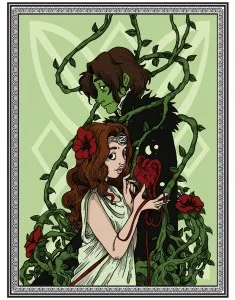
- Lily, by Michael Thomas Ford, with illustrations by Staven Andersen. Classic fairy-tale tropes (Baba Yaga, hidden villages, a girl with a power she doesn’t understand, adults who try to suppress that power) come together in a modern setting. Some types of stories stay true no matter when they’re set, and Ford does a great job of balancing the fantastical with modern realities. And Andersen’s illustrations are disturbing and beautiful at the same time.
- Heaps of Pearls by Seanan McGuire. McGuire publishes a lot of stand-alone short stories from her various fictional series worlds on her website and her Patreon page. This one details how two secondary characters from the October Daye series, Patrick and Dianda, first met. It takes place prior to book one of the series but is probably best read after book 9. And what a meet-cute it is.
- Lightspeed Magazine #80 (January, 2017), edited by John Joseph Adams. I’m the proofreader for the Kindle ebook edition of Lightspeed, so it’s the one magazine I read front-to-back every month. The eight stories and one novella in each issue also account for 9 of the short stories I read every month. (See below for brief thoughts on those.)
- Lumberjanes Volume 5: Band Together, by Shannon Waters, Noelle Stevenson, Grace Ellis, Brooke Allen and Carolyn Nowak. My good friends Kay Holt and Bart Leib introduced me to the Lumberjanes collected volumes on a visit to Boston last year, and I’ve eagerly awaited each new volume (since I don’t buy individual monthly comics anymore for a variety of reasons). I love the characters, the mystery, and the pacing. I have to admit that the change to the art in the run of issues collected here didn’t quite work for me: some of the characters barely looked like themselves for me. The art’s not bad, it just took some getting used to. But the story is a lot of fun.
- In Sea-Salt Tears by Seanan McGuire. Another short story in McGuire’s October Daye universe, this time telling a tale of romance and secrets involving everyone’s favorite sea-witch, The Luideag. I know, I know: “romance” and “the Luideag” are not words one expects to hear in the same sentence. Best read after book five of the October Daye series.
- Dusk or Dark or Dawn or Day by Seanan McGuire. A new novella from McGuire that doesn’t seem to connect to any of her other existing series (although I can see it connecting to her novel Sparrow Hill Road in some ways). There’s some great world-building around a main character whose voice clicked with me right away, making me want to know more about her and the characters around her. A very satisfying “done in one” story.
So: eight books read in January, and Goodreads tells me that means I’m “on track” for my yearly goal.
SHORT STORIES
I also set myself a goal each year of reading 365 short stories: 1 per day, theoretically, although it doesn’t always work out quite that way. (366 in leap years, of course)
I didn’t quite hit the “one per day” goal in January, but here’s what I did read and where you can find them if you’re interested in reading them too:
The first 9 stories come from the January 2017 issue of Lightspeed Magazine. The first 8 are available to read for free on the magazine’s website, while the 9th story is only available as part of the ebook edition.
- Rate of Change by James S.A. Corey. A look at a future where brain/spinal transplants have become the norm — how does that affect our basic humanity.
- The Whole Crew Hates Me by Adam-Troy Castro. First person narrative about why the title of the story may be true. As soon as I finished reading it, I thought “man, this would make a fantastic acting monologue!” Great, is-he-paranoid-or-not voice.
- Tracker by Mary Rosenblum. Intriguing future (?) world where seeming gods control the weather, population, etc., and the title character is trapped in the middle of a power struggle.
- Nine-Tenths of the Law by Molly Tanzer. What happens when your husband is replaced by an alien intelligence just as you’re getting ready to divorce him. There’s a bit of comedy and tragedy mixed together here.
- Seven Salt Tears by Kat Howard. Another moving, very personal story from Howard, this one about how childhood stories involving the ocean impact a woman’s life.
- Daddy Long-Legs of the Evening by Jeffrey Ford. I read this one years ago, was completely creeped out by it, and am happy to say the reread was just as creepy. Urban legend about a boy whose brain is infested by a spider.
- The West Topeka Triangle by Jeremiah Tolbert. This one really brought back middle school memories, even though I didn’t grow up anywhere near Kansas nor in any urban setting. I love that lingering question as to whether anything supernatural is really happening, a tone Tolbert expertly keeps up throughout the story.
- Nine by Kima Jones. Fantasy trappings on a real-world setting: Tanner, Jessie and Flo run a motel for blacks moving west after the Civil War, but even the three proprietors are running from something that seems destined to catch up with them. Heart-breaking and full of love at the same time.
- Awakening by Judith Berman. Aleya wakes in a dungeon full of corpses, unsure how she got there. This story takes more twists than a D&D campaign, and each one is layered brilliantly onto the previous. It kept me guessing throughout as to how it would end.
- Heaps of Pearls by Seanan McGuire. (self-pubbed on the author’s website). As mentioned above, a really cute story about how Patrick and Dianda met. It has the feel of a screwball rom-com.
- Stage of Fools by Seanan McGuire. (self-pubbed on the author’s Patreon page) A story of Tybalt, the King of Cats, during his days in London, long before Toby Daye was even born. The first of three connected stories about how Tybalt re-opened his court after a long period of being alone.
- The Voice of Lions by Seanan McGuire (self-pubbed on the author’s Patreon page) The second connected story about Tybalt reopening his court in London, with some interesting political intrigue thrown in.
- Lunching with the Sphinxes by Richard Bowes. (from Grendelsong magazine, issue #2). A story set in Bowes’ Big Arena (NYC) future-history. Political intrigue from the perspective of a person who never thought she’d be a politician. I’d not read this when it first came out, but it seems a bit prescient in light of recent political events here in the US.
- Singing Wings by Keffy R.M. Kehrli. (from Fireside magazine #27). Aduaa is about to go through her species’ natural transformation, which means saying goodbye to those she’ll no longer be able to interact with. Kehrli really sucker-punches you with a depth of emotion we all recognize when life forces us to move on.
- Bones at the Door by John Wiswell (from Fireside magazine #27). Mandy starts discovering animal bones left at her front door, which leads to life changes she never could have expected. Eerie and disturbing.
- The Closest Thing To Animals by Sofia Samatar (from Fireside magazine #27). The narrator discloses a history ofher failing relationships in a city closed off from the rest of the world due to a plague that doesn’t kill. Great world-building, interesting story structure.
- The Acts of Hares by Seanan McGuire (self-pubbed on the author’s Patreon page). The third of the connected Tybalt stories, this one about how he finally finds that last reason to re-open his court to other cats, putting him further on the road to being the Tybalt we know in the current Toby Daye books.
- Beks and the Second Note by Bruce Arthurs. (from the December 2016 issue of Alfred Hitchcock magazine). Appearances are deceiving and not every case is as simple as it seems, as Detective Beks discovers investing a case of a good gun-carrying citizen killing a bank robber.
- Whatever It Takes by Lawrence Block (from the December 2016 issue of Alfred Hitchcock magazine) An old, previously-unpublished Block tale of a group of cops trying to get a man to turn informant against a big time, almost-untouchable gangster, and the lengths to which they’ll go. The dialogue-heavy story structure makes it an even more fun read.
- Through This House by Seanan McGuire (from the anthology Home Improvement: Undead Edition). Another story set in McGuire’s Toby Daye universe, but in modern times compared to the others read this month. Toby, May, Quentin and Danny must figure out how to reopen the sealed fairie Knowe of Goldengreen before it kills them. It’sbit of a haunted house adventure, with all the creeping shadows and jump-scares one would expect.
- In Sea-Salt Tears by Seanan McGuire (self-pubbed on the author’s website). As mentioned above, this one is set prior to the first novel of the Toby Daye series and doesn’t involve Toby herself. But it’s a great love story, slowly and carefully told.
So: 21 stories read in January, which means I’m 10 stories behind on my “read 365 stories this year” goal. But I suspect I’ll be catching up soon. One of my problems is I keep buying short story anthologies and then setting them aside for when I have time to read “the whole thing.” Which rarely seems to happen. So I’m making a sub-challenge for myself that each time I buy a new anthology, I will read at least one story the day I buy it. That might help with this a bit.
Clearly, between books and stories this has been a Seanan McGuire heavy month. She is one of my favorite authors, and I’ve been working towards finally reading all of the stories connected to her main novel series. So there’ll be another batch of McGuire reviews in the wrap-up post for February’s reading as well.