INTERVIEW: BETH CATO

Today, I’m chatting with author Beth Cato. Beth Cato hails from Hanford, California, but currently writes and bakes cookies in Red Wing, Minnesota. She usually has one or two cats in close orbit. A 2015 Nebula finalist, she is the author of the cozy mystery CHEDDAR LUCK NEXT TIME as well as fantasy like A THOUSAND RECIPES FOR REVENGE. Her short stories can be found in publications ranging from Beneath Ceaseless Skies to Uncanny Magazine. In 2019 and 2022, she won the Rhysling Award for short speculative poetry. Her website BethCato.com includes not only a vast bibliography, but a treasure trove of recipes for delectable goodies. Find her on BlueSky as @BethCato and Instagram as @catocatsandcheese.

Photo Credit: Corey Ralston Photography (2013)

ANTHONY: Hi Beth! Thanks for taking some time to chat. Your latest release, which was an Amazon First Reads pick for September, is A House Between Sea and Sky. Tell us a bit about the plot.

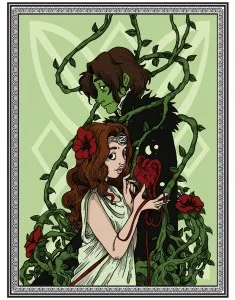
BETH: It’s a cozy standalone set in 1926 Carmel-by-the-Sea in California. A grieving writer and a secretive silent film star are adopted by a sentient cottage with a dark past.

What inspired you to write A House Between Sea and Sky?

After I wrapped up my Chefs of the Five Gods series, I asked my then-editor what she’d like to see next. She said she wanted historical fantasy set in the real world. From there, I started mulling. I’m a native Californian, so exploring that setting feels right.

House is historical fantasy, much like your Blood of Earth trilogy. How much research did you have to do into the time period this book takes place in, and how did you go about that? (I loved all the details you incorporated about the Silent Film industry of the time, even the unsavory aspects of it.)

I spent a solid three months on research before I could even finish a synopsis, and then I kept researching through the writing and revision process. For me, worldbuilding really needs to come before fleshed-our characters or plot. Our world shapes everything. I was truly blessed to find a wealth of scanned Carmel 1920s newspapers on Archive.org, plus a tourism book that was published in 1925. There is a very special famous person cameo appearance in the book, and that person’s involvement determined the exact days of the plot. As for the silent film elements... I actually have a trunked novel I wrote a few years ago that I think is one of the best things I’ve ever written, but my agent wasn’t able to sell it. My main character in that book was a scenarist in 1923 Hollywood. I had kept the most interesting research books and had tons of information on my computer, so I was able to repurpose that material, which felt wonderful!

I would love to see that trunked novel be published some day! Without spoiling anything, I think it’s safe to say that Russian folklore plays a large role in the book. Was this folklore that you grew up with?

In my teens, I collected a number of century-old Andrew Lang Color Fairy Tale books and other mythology tomes that were discarded from my local library. (There’s a reason those Lang books get a mention in A House Between Sea and Sky!) I still have them all, too. That’s really the first place I encountered a broader variety of stories that were identified with their places of origin, and I was then able to connect creatures and elements to the AD&D books I was also reading at the time.

While I don’t think it’s ever explicitly stated in the text, I got the very strong feeling that Fayette is asexual/aromantic (although those terms probably didn’t exist in the 1920s), and thus her relationship with Rex is one of mutual respect and quickly-developing friendship, but nothing more. I think we still don’t see enough of this in historical fantasy (the lack of a romance between leads). I’m not sure I have a question here, other than “is my understanding of the character correct?” But would you like to talk a bit about how you approach representation in your books (which always have diverse casts)?

You’re 100% right. I wrote Fayette to be ace. I love a good main character romance, but I don’t think that should be a requirement even if it appeals to the big trend. People CAN just be friends. I want my books to be realistic, and for me, that means diversity is natural. That includes a spectrum of queer rep as well as different skin tones and ethnic backgrounds. By the way, the racism shown in this book was directly inspired by reading Jack London’s book The Valley of the Moon, which is partly set in Carmel, and is also horrendously racist with very particular ideas on who is a “real American.” So I guess my approach to representation is sometimes inspired by active defiance against a book that is over 100 years old!

I would love to know what your writing process is like, and if it varies when you delve into different genres (you know how much I loved your foray into cozy mystery/thriller territory, Cheddar Luck Next Time) or different story lengths (novels vs. novellas vs. short stories for instance).

I’m a hardcore outliner and researcher. Even for a flash fic, which is normally about a thousand words, it’s not uncommon for me to have a few sentences of outline to guide me! Poetry is the only thing I write spontaneously. So many of my recent fantasy books have been historical, and the research has been immersive. A Feast for Starving Stone had a 25,000-word outline, but that was also long because my characters were talking a lot in my head, and that dialogue was sketched in. Cheddar Luck Next Time was nowhere near as intense, but I still had to research details on running a cheese board business. The details on the many cheeses included were largely drawn from my own personal cheese log, which is over 200,000 words and is nearing 2,000 cheeses. Bird’s taste note on cheese are pulled from my own experiences.


Speaking of Cheddar Luck Next Time (which I reviewed HERE … is there any word on whether we’ll get to see more adventures of Bird and company?

I hate to be a tease, but I hope to be able to talk more about that soon!

I’ll take whatever teases I can get! What do you have in the pipeline/coming out next?

I do have one contract signed that I can’t talk about yet, and I’m in a very early research stage for something else. I’ve been very busy recently!

And my traditional final question … what is your all-time favorite book?

There is one recent stand-out for me, and that is The Wishing Game by Meg Shaffer. It’s really a suspenseful love letter to the power of children’s fantasy novels and how they can save lives. I recently read it again because I proposed it to a local book club, and the other members loved it so much that they all immediately picked up her second book, The Lost Story, which is also excellent. It’s a queer take on Narnia-style portal fantasies. Really, you can’t go wrong with Meg Shaffer’s books! Her third one will be out next year, and I can’t wait.

I am adding Meg Shaffer to my To Be Read list as soon as I finish posting this interview. Thanks again Beth!
MAURICE BROADDUS & JERRY GORDON, authors - Interview

This week’s interview, delayed from last week due to lots of personal circumstances, is with Maurice Broaddus and Jerry Gordon, the editors of Apex Publications’ DARK FAITH and DARK FAITH: INVOCATIONS.

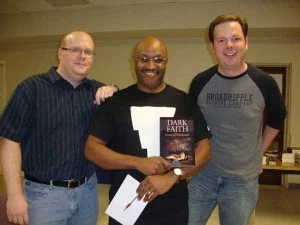
Jason Sizemore, Maurice Broaddus and Jerry Gordon

Jason Sizemore, Maurice Broaddus and Jerry Gordon

ANTHONY: Before we talk about the new book you’ve co-edited, DARK FAITH: INVOCATIONS, I’d like to talk about the experience of putting together the first DARK FAITH anthology. How did that come about, and what did you learn from that process that influenced your work on the new volume?

MAURICE:  I host an annual convention called Mo*Con (http://www.mocon.indianahorror.org/).  Each year I invite a few horror, science fiction, and fantasy writers in, we hold the convention in a church, and we discuss topics related to genre and faith.  You tell people you’re having a convention in a church, all they hear is “church” and, again, there are preconceptions to what goes on there.  With the great line up of writers that we have regularly attending Mo*Con, we talked with Jason Sizemore, of Apex Books, about doing a Mo*Con anthology.  That project evolved into Dark Faith.  I guess you could say that I’ve always been fascinated with hearing people’s stories about faith, no matter where that story takes them.

I think every writer should take a turn behind the slush pile to see what an editor faces every day.  From the lack of professionalism, the inability to follow guidelines, to the ideas/stories they see all the time.  That was my first major take away lesson.  The second was that after we put together the original Dark Faith, we had a better idea of what kind of stories we were looking for.  Our writers did also, which was reflected in the (much better) slush pile.

JERRY:  Mo*Con gives people with wildly divergent views a place to discuss controversial issues.  The respect for ideas and emphasis on civil discourse at the heart of the convention went a long way toward winning me over when Maurice brought up the idea of doing Dark Faith together.

ANTHONY: What is the focus of DARK FAITH: INVOCATIONS, and does it differ at all from the intent or theme of the first volume?

MAURICE:  The focus honed in even more on the idea of faith.  That being said, I think the second volume is lighter in tone overall, even as it is still soul crushing.

Dark Faith 2: Invocations

Dark Faith 2: Invocations

JERRY:  Invocations is tightly focused on the testing of faith from a broad variety of belief systems (atheism to magic and everything organized in between).  The book does have more fun with the subject.  Imagine hunting giant Buddhas in a post-apocalyptic future or learning the secrets of the universe from a wish-granting vending machine.

ANTHONY: You held an open call for submissions for INVOCATIONS, correct? How many submissions did you receive, and how long did it take to whittle the slush down to your final choices?

JERRY:  We received just over seven hundred total submissions, enough to fill twenty-six anthologies.  It took about four months to whittle that avalanche down to a final table of contents.  From a process perspective, we went through four rounds of cuts:

Round 1 – Top 150 stories

Round 2 – Top 75 stories

Round 3 – Top 40 stories

Round 4 – Final 26 stories

The first round involved weeding out the amateur, semi-pro, and off-topic stories.  Once the easy cuts were made, thematic overlap, space constraints, and a whole host of editorial issues guided the rest.  I posted a detailed deconstruction of the process on my website (http://www.jerrygordon.net/2012/06/01/behind-the-scenes-dark-faith-2/).

ANTHONY: You’ve co-edited both volumes. What is your process for deciding the final Table of Contents and then story order? Have there been any violent disagreements? (I’m picturing Editor-Dome in Maurice’s living room right now…)

MAURICE:  The first time around was a lot easier.  The stories that worked REALLY worked and stood out from the rest.  This time around, there were so many GREAT stories that it was a lot tougher to get that final pool cut.  I really feel like at times we were team captains and we were choosing up members of our side until we hit our word count limit.  This whole process was made easier by judicious application of Riesling.  Another place where Riesling is your friend is in figuring out the order.  It becomes a lot easier to see a flow to the stories…

JERRY:  We had forty stories left when we met to decide the final table of contents.  We played with half a dozen potential approaches, discussing the merits of each story and how they might work in concert.  In the end, we took turns drafting stories like NFL players.  With each round we recalculated the word count, talked about the remaining stories, and made another round of picks.  The last few rounds were positively heart wrenching.  This is a small business, and putting on the editor’s hat means disappointing talented writers that also happen to be good friends.

ANTHONY: Do your individual editing styles differ when you’re working on an anthology of your own? What do you each bring to the table as co-editors?

MAURICE:  I do quite a bit of freelance editing, but my style doesn’t really change.  I’m looking for the best stories, ideas that intrigue me, or some ineffable quality that makes a story great.

I like to think that I bring a particular vision to Dark Faith.  It’s a project that’s close to my heart and who I am.

JERRY:  On the first book, Maurice set the initial vision and worked very hard to solicit a cadre of amazing writers.  I honed that vision and handled the logistics.  This time around we traded duties back and forth, stepping in for each other when our schedules turned from busy to insane.

Maurice Broaddus

Maurice Broaddus

ANTHONY: I won’t ask you each to pick a favorite story from INVOCATIONS, but I will ask what authors we can expect to see in the book and if there’s anything in particular you think will stun readers.

MAURICE:  “Subletting God’s Head” by Tom Piccirilli kind of sets the tone for this volume (which is why it is first) then “The Cancer Catechism” by Jay Lake immediately rips your heart out.  “Magdala Amygdala” demonstrates that there is something fundamentally wrong with Lucy A. Snyder (I kid because I love).  And “A Strange Form of Life” by Laird Barron is a particular favorite of mine (I’m not scared to choose a favorite child!)

JERRY:  Readers are almost universally surprised by the broad range of stories and ideology.  An Asian artist that can reshape reality with her sketches.  A middle-eastern robot fighting his addiction to a futuristic drug called faith.  African folk magic and family rivalries mixing it up in the boxing ring.  A small-town boutique that offers you the chance to shop for your own personal god.  I could go on.  It’s an eclectic mix of tones and worldviews.

As for personal favorites, I love Richard Wright’s “The Sandfather.”  This story sneaks up on you emotionally, and I’ve already had several reviewers email me to say the story blew them away.  The subtle beauty of Alma Alexander’s “Night Train” also impresses.  Looking at the table of contents, I want to hijack this interview so I can talk about Kyle S. Johnson’s haunting portrayal of a North Korean family and Tim Pratt’s wishful fantasy and K. Tempest Bradford’s take on mythology.

ANTHONY: Are there any authors who have work in both volumes, or was that something you consciously avoided?

MAURICE:  The answer’s a little bit of both.  We didn’t want to completely overlap TOCs, but we didn’t want to rule out great stories from writers who have already demonstrated that they get what we’re looking for.  I think we set some arbitrary percentage of how many authors could repeat (which we probably ignored, thus I can’t remember what it was).

JERRY:  We went into the book hoping to bring about a third of the original authors back.  Maurice and I solicited a second third and dove into the slush pile to find the remaining stories.

ANTHONY: What else would you like potential readers to know about INVOCATIONS?

MAURICE:  You need to buy many copies of it and pass them out to your friends.

JERRY:  This book will entertain you, make you think, and magically remove ten pounds from your waistline.

ANTHONY: What’s in the near future for each of you?

MAURICE:  My urban fantasy trilogy, The Knights of Breton Court, is being re-released as an omnibus (by Angry Robot Books).  I have a short story in the current issue of Shroud Magazine and have stories coming out in a bunch of upcoming anthologies (Appalachian Undead, The New Hero, Vampires Don’t Sparkle, Relics and Remains, and Cadence in Decay).  My short story, “Awaiting Redemption”, will be in the HorrorWorld Anthology as well as available for a listen on Pseudopod.com.  Apex Books will also be publishing my novella, I Can Transform You.

Jerry Gordon

Jerry Gordon

JERRY:  My apocalyptic novella, Breaking The World, is set to be released in 2013 (Apex Publications).  It follows a trio of teenagers forced into adulthood by the end of the world.  I also have a short story out in the current issue of Shroud called “Ghost in the Machine.”  In it third-party politics, torture bans, and a mysterious ‘Ghost Program’ conspire to change the course of our Republic.  Add to that “Vampire Nation” for the forthcoming Vampires Don’t Sparkle! tribute anthology (Seventh Star).

ANTHONY: And my usual closing question: What is your favorite book, and what would you say to someone who hasn’t read it yet to convince them that they should? 

MAURICE:  The Gift by Patrick O’Leary, Confederacy of Dunces by John Kennedy Toole, and Beloved (heck, anything) by Toni Morrison.  If I have to convince you to read any of them, especially Morrison, I’ll just pluck out your eyes because you obviously aren’t doing anything worthwhile with them anyway.

JERRY:  Talk about your impossible questions!  My brain freezes just trying to come up with a top ten list.  I can’t give you a favorite, so I’ll just give you a recommendation.  The Prophet by Kahlil Gibran.  The book, given to me during a rough patch in my life, contains a lifetime of wisdom.  I’ve purchased several copies for friends over the years.

ANTHONY: Thanks again to you both!

You can purchase DARK FAITH: INVOCATIONS through AmazonBarnes & Noble or directly from Apex Publications. On Twitter, you can follow @MauriceBroaddus and @jerrylgordon. You can also keep track of the authors/editors on Maurice’s website and Jerry’s website, and they’re both on Facebook: Maurice Broaddus and Jerry Gordon.