• HOME
  • ABOUT
  • BIBLIOGRAPHY
    • INVISIBLE ME
    • CANOPUS
    • PARADISE FEARS
  • BLOG
  • CONTACT
Menu

ANTHONY R. CARDNO

Street Address
City, State, Zip
Phone Number
Anthony R. Cardno is an American novelist, playwright, and short story writer.

Your Custom Text Here

ANTHONY R. CARDNO

  • HOME
  • ABOUT
  • BIBLIOGRAPHY
  • FREE STORIES
    • INVISIBLE ME
    • CANOPUS
    • PARADISE FEARS
  • BLOG
  • CONTACT

SUNDAY SHORTS: Two from Lightspeed #144

May 15, 2022 Anthony Cardno

I love short fiction, and Sunday Shorts is the feature where I get to blog about it. I’ve considered promising to review a short story every day, but that’s a lot of pressure. And while no one will fault me if I miss days, I’ll feel guilty, which will lead to not posting at all. So better to stick to a weekly post highlighting a couple/three stories, as I’ve done in the past.


Two From Lightspeed Magazine #144

Grace Chan’s “Nobody Ever Goes Home to Zhenzhu” starts out as a simple missing persons thriller: Orin’s sidekick/mechanic Calam, an orphan taken under Orin’s wing a decade earlier, has pulled the disappearing act Orin always suspected he would – but Orin isn’t letting go that easily. The pilot/Beaconer wants answers about who Calam really is and where he came from. And so Orin tracks Calam back to Calam’s homeworld. If this story was a simple “find the missing person / learn their secret” story, it would still be fantastic. Chan paces the reveals wonderfully throughout, threading Orin’s feelings about Calam neatly into the overall narrative. But the story takes on added resonance as Orin learns more about the injustice Calam’s family, in fact entire society, has been dealt. Without spoiling too much: this is a story about colonization, about how the winners write the history books, and about how the colonized are forced to assimilate or be wiped out. I had just recently completed Roxane Dunbar-Ortiz’s An Indigenous Peoples’ History of the United States before reading this story, and the non-fiction book heavily influenced my reaction to the events of the fictional story. The reveal of what happened to Calum’s family is not the denouement of the story, however. There’s more to it than that, and Chan kept me riveted up to the final paragraph.


In “The Plastic People,” Tobias S. Buckell extrapolates a future in which Earth is essentially a giant trash heap and the rich have, generations ago, escaped to live in orbiting space stations. Occasionally, the children of these families like to camp amongst the trash-heaps for a bit of adventure. On one such trip, Rhea finds a seemingly-feral child among the trash and decides to “rescue” the boy – after all, bringing the boy to live among the civilized surely must be better for him than leaving him among the trash where his own parents don’t seem to care if he’s fed or lives or dies. Complications ensue, of course. Buckell makes his main character likeable at first, but she’s still very, very flawed thanks to the way she’s been raised. The privilege of Rhea and her friends is on display from the very start of the story, and even though she thinks she’s doing something good and noble she’s still mis-informed about the nature and history of the people still living below – including why families like hers left Earth for … well, not greener pastures, exactly, but certainly for a less polluted life. The story comments on how what’s passed down as family historical truth isn’t always true, how the privileged often take on “rescue” projects that they then lose interest in, and how sometimes the idea of “one life-changing encounter” is just that – a nice idea, but not something that happens as often as one would hope. But there’s also a nice underthread about the resiliency of humanity in general, and how we might adapt physically to survive, even if that survival doesn’t look like the gleaming future we’ve longed hoped for.


Full disclosure: I am one of the proofreaders for Lightspeed Magazine, as well as its sibling publication Fantasy Magazine.

In READING, BOOK REVIEWS Tags Short Fiction, short stories, Lightspeed Magazine, Tobias S. Buckell, Grace Chan
Comment

SERIES SATURDAY: Pellucidar: Across Savage Seas

May 14, 2022 Anthony Cardno

Cover art by Miriana Puglia and Arthur Hesli.

This is a blog series about … well, series. I love stories that continue across volumes, in whatever form: linked short stories, novels, novellas, television, movies, comics. It’s been on hiatus for a while, but returns this week with the first of two posts about new content from Edgar Rice Burroughs, Inc.


Pellucidar: Across Savage Seas,

Publisher: American Mythology, 2022 (in conjunction with Edgar Rice Burroughs, Inc.)

Story: Christopher Paul Carey

Writer/Editor: Mike Wolfer

Pencils and Inks: Miriana Puglia

Colors: Periya Pillai

Letters: Natalie Jane


In Pellucidar: Across Savage Seas, Gretchen von Harben (all grown up her from last appearance as a twelve-year-old girl in Edgar Rice Burroughs’ Tarzan and the Tarzan Twins) narrates to an unseen audience her first visit to Pellucidar, the hidden world at the Earth’s core. Accompanying adventurer Jason Gridley on the airship Favonia as a college student, Gretchen is knocked loose when the Favonia is attacked by a flock of pterosaurs. She parachutes to a remote, uncharted island with only a pistol and limited ammo. There she encounters beings fans of the Pellucidar books will recognize (human Gilaks and ape-like Sagoths) as well as entirely new races that this series adds to the official Burroughs canon (Kratalaks and Azlaks). Gretchen faces a lot of peril over the course of four issues, and in the tradition of the strong female Burroughs characters who have preceded her (Jane Porter-Clayton, Dejah Thoris, Duare, and more), she more than rises to the occasion. This may be Gretchen’s first recorded adventure as an adult, but I certainly hope it’s not the last. She’s an engaging and dynamic character who deserves to be featured (along with the supporting cast that’s been built around her) in many more stories.

Christopher Paul Carey crafted the general story of Gretchen’s first adventure in Pellucidar, originally intending it to be a novel. Writer Mike Wolfer did a wonderful job converting the story to comic book form, pacing the story perfectly across four issues. Fewer issues would have rushed the story too much, and I think five or six issues would have padded the story out too much. Reading the series as it was issued in monthly (or as close to monthly as the publisher could get given various supply chain issues plaguing small independent publishers these days), I was very satisfied with where each issue left off – cliffhangers, of course, as befits a story that could easily have been told as a classic 1940s movie serial – and never felt like the drama of the end of a chapter was unearned. Carey is a Burroughsian scholar of the highest level, and Wolfer matches him well in creating a story that Burroughs would be proud of. For instance, I have no idea how much of the dialogue was in Carey’s original plot, how much the writers crafted together, and how much is purely Wolfer – but regardless, each character’s voice is distinctive and clear while still being perfectly Burroughsian in style.

Complimenting the writing, Miriana Puglia’s artwork is wonderful. Her clean lines and fluid body language convey action and emotion with equal clarity. Fight scenes have a flow and symmetry that makes them easy to follow, and upon multiple reads tiny details stand out. And when it’s time to go creepy (as one almost inevitably must when adventuring in Pellucidar), Puglia absolutely rises to the occasion. There’s one particular page in issue 4, for example, which made me a bit nauseous (trust me, this is a compliment.). Colorist Periya Pillai keeps the action well-lit with a mix of bold and quiet colors as appropriate to the scene; even moments in dark caves or underwater are easy to follow because Pillai’s colors don’t go so dark that they subsume Puglia’s art.

In recent years, Edgar Rice Burroughs Inc. has made a concerted effort to expand the official canon of the ERB Universe with new novels and comics series like this one, that bear the “Edgar Rice Burroughs Universe” banner across the top of the cover as well as an “Official ERB Universe Canon” stamp and hew as closely to Burroughs’ original interconnectedness universe as possible. In the novels of the current “Swords of Eternity” Super-Arc, readers have been introduced to an intrepid young woman traversing time and space named Victory Harben. Yes, there’s a direct connection between the Gretchen von Harben of Pellucidar: Across Savage Seas and the Victory Harben who has been appearing in those novels: it’s not a spoiler to reveal here that Victory is Gretchen’s daughter and is the person to whom Gretchen is narrating this story. Along with appearing in the novels/novellas already released, Victory will take center stage in her own novel later this year – but before that, she’s also been the star of another American Mythology / ERB Universe comic book mini-series: Beyond the Farthest Star: Warriors of Zandar, which will be the subject of next week’s Series Saturday post.

In READING, RAMBLINGS, BOOK REVIEWS Tags Series Saturday, edgar rice burroughs universe, pellucidar, pulp adventure, Christopher Paul Carey, Mike Wolfer
Comment

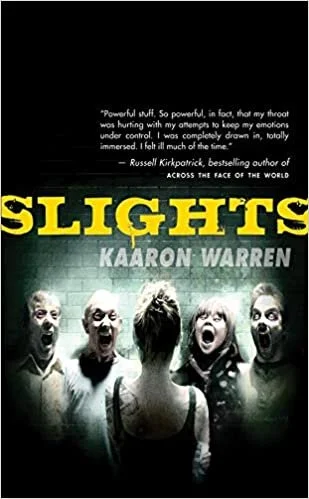
Book Review: SLIGHTS

May 9, 2022 Anthony Cardno

TITLE: SLIGHTS

AUTHOR: Kaaron Warren

528 pages, Angry Robot Books, ISBN 9780857660077 (paperback, also available in e-book, audio)


DESCRIPTION: (from Goodreads): STEVIE IS A KILLER.

But she brings her victims back to life to demand of them: "WHAT DO YOU SEE?"

Now she's about to find out for herself...

After an accident in which her mother dies, Stevie has a near-death experience, and finds herself in a room full of people - everyone she's ever annoyed. They clutch at her, scratch and tear at her. But she finds herself drawn back to this place, again and again, determined to unlock its secrets. Which means she has to die, again and again. And Stevie starts to wonder whether other people see the same room... when they die.


MY RATING: 5 out of 5 stars


MY THOUGHTS: Most of the horror in Kaaron Warren’s Slights is subtle – hints at dreadful things that have happened, the occasional more solid sensory description – because the main character doesn’t allow herself to really experience/process the things she’s doing/seeing/learning. That doesn’t make the horrific aspects of the story any less compelling. In fact, it makes them almost insidious as the hints and sensory descriptions slowly work in the back of the reader’s brain. There are bits and pieces of Stevie’s story that are lingering with me long after I’ve finished the book (it has taken me a while to finally write this review, for which I apologize to the author), little things that pop back into my head because of something I see in my peripheral vision or half-hear because I’m concentrating on something else. And isn’t that the way the best psychological horror works, planting itself in your hindbrain until something brings it out in stark relief?

I say “most of the horror” because there are several scenes of disturbing body horror sprinkled in during each of Stevie’s near-death experiences in the “room” with the people she’s “slighted.” The damage these figures do to Stevie is more graphically presented, but there’s still a psychological aspect: is this really happening, or is it her subconscious attacking her for the things she knows she’s done but can’t bring herself to consciously acknowledge? Most of the “slights” she believes she’s paying penance for in the room are minor things that the “slighted” individuals probably don’t even remember – but the people she’s really harmed don’t seem to show up, or at least not as often and not as brutally. And we’re never sure what Stevie’s victims see, lending weight to the question of what’s really happening. I think disparate readers will interpret what’s going on here differently, a tribute to Warren’s talent.

Stevie herself meets my criteria for an “unreliable narrator.” Whether she’s talking about her own current circumstances, her childhood, or the lives of her parents and their siblings, there are always details she omits or shares and then recants. There are also the things other people say to her that jog the reader into realizing that Stevie doesn’t remember events the same way as others who were present. This forces the reader to pay attention, to start connecting dots on their own. I am a fan of “unreliable narrators,” so it should come as no surprise that I loved this aspect of the book. I enjoy trying to figure out what the narrator is hiding (whether she’s doing it intentionally to mislead the reader, or honestly doesn’t realize she’s doing it at all). I found Stevie’s voice – wistful yet agonized, firm yet shadowy – compelling throughout the book.

Slights is also an excellent crime novel – not only the aspect of whether Stevie will get caught for the thing’s she’s done (she’s a killer – that’s not a spoiler because it’s right there in the book’s tagline), but also the slow unraveling of the truth of her family’s life before her father, a policeman, died in the line of duty. That truth explains a lot about Stevie and her brother and their relationship which is as much at the core of the book as Stevie’s obsession with the room and the people she’s slighted.

In BOOK REVIEWS Tags book review, horror, kaaron warren, 2022 TBR Challenge
Comment

SUNDAY SHORTS: Two from The Deadlands

May 8, 2022 Anthony Cardno

I love short fiction, and Sunday Shorts is the feature where I get to blog about it. Posts will range from flash to novellas. At some point, I might delve into individual stories/episodes of anthology formats in other media, like television and comics, but for the time being, I’m sticking to prose in print and audio.


I don’t think I’ve yet done a Sunday Shorts about The Deadlands, a relatively new (just a year old) online speculative fiction magazine focused on the Afterlife – or afterlives, more accurately. Stories, poems, and non-fiction about grieving, about ghosts, about what happens after, or sometimes as, we are shuffling off this mortal coil, plane of existence, etc. The Deadlands is published by Sean Markey and E. Catherine Tobler is the editor-in-chief. Here are my thoughts on the two fiction pieces in the latest issue.


In KT Bryski’s “This is I,” Elaine, the Lady of Shalott, crosses paths via a magic mirror with a woman she comes to know as “Gug,” but who is really poet/artist Elizabeth Siddal, wife of Dante Gabriel Rosetti. In a story that blurs not only the lines of reality but also of narrative voice (with sections alternating between first, second, and third person points-of-view), Bryski delves into the ways in which men control women and alter the courses of their lives. Elaine has the curse on her that if she stops weaving in her high tower and looks out over Camelot, Camelot will fall, and she will be cursed. “Gug” has been used as a muse, been manipulated into marriage, and told her womanly nature means she can’t create art the same way a man can. Bryski also plays with the various versions of “The Lady of Shalott” that Tennyson wrote, plus interpretations by others. It took me a page or so to understand what the author was doing with the alternating POVs, but then I settled in, and the story flowed towards a perfect ending.


Maria Haskins’ “The Morthouse” focuses on a mother who has lost her teenage son to a horrific winter illness and who is so distraught she cannot do anything but haunt the village “morthouse,” where the bodies of those who die during winter are held until the ground is soft enough to dig graves, with occasional trips to the church she might no longer believe in, and the fields around the village. She regrets not asking the midwife who brought her child into the world during a problematic birth for help in keeping him alive, and eventually goes to ask for help in bringing him back to life. The midwife sets the grieving mother three tasks to gather items that might help. The mother’s grief is palpable throughout, as is her estrangement from her church and from her husband. The author also nicely explicates the traditional distrust in religious communities for anyone who works with nature to cure illness instead of just relying on God, without going the traditional route of showing the midwife (in this case) being abused by other members of the community. The story takes its time before coming to a satisfying, emotional, conclusion.

In READING, BOOK REVIEWS Tags sunday shorts, The Deadlands, KT Bryski, Maria Haskins, fantasy, horror, short stories, Short Fiction
Comment

Book Review: THE MIDDLING AFFLICTION

May 6, 2022 Anthony Cardno

TITLE: The Middling Affliction (Conradverse Chronicles #1)

AUTHOR: Alex Shvartsman

240 pages, CAEZIK SF & Fantasy, ISBN 9781647100544 (paperback, also available in e-book, audio)


DESCRIPTION: (from Goodreads): What would you do if you lost everything that mattered to you, as well as all means to protect yourself and others, but still had to save the day? Conrad Brent is about to find out.

Conrad Brent protects the people of Brooklyn from monsters and magical threats. The snarky, wisecracking guardian also has a dangerous secret: he’s one in a million – literally.


Magical ability comes to about one in every 30,000 and can manifest at any age. Conrad is rarer than this, however. He’s a middling, one of the half-gifted and totally despised. Most of the gifted community feels that middlings should be instantly killed. The few who don’t flat out hate them still aren’t excited to be around middlings. Meaning Conrad can’t tell anyone, not even his best friends, what he really is.
Conrad hides in plain sight by being a part of the volunteer Watch, those magically gifted who protect their cities from dangerous, arcane threats. And, to pay the bills, Conrad moonlights as a private detective and monster hunter for the gifted community. Which helps him keep up his personal fiction – that he’s a magical version of Batman. Conrad does both jobs thanks to charms, artifacts, and his wits, along with copious amounts of coffee. But little does he know that events are about to change his life…forever.


When Conrad discovers the Traveling Fair auction house has another middling who’s just manifested her so-called powers on the auction block, he’s determined to save her, regardless of risk. But what he finds out while doing so is even worse – the winning bidder works for a company that’s just created the most dangerous chemical weapon to ever hit the magical community.

Before Conrad can convince anyone at the Watch of the danger, he’s exposed for what he really is. Now, stripped of rank, magical objects, friends and allies, Conrad has to try to save the world with only his wits. Thankfully though, no one’s taken away his coffee.


MY RATING: 5 out of 5 stars


MY THOUGHTS: The Middling Affliction kicks off a new urban fantasy series, The Conradverse Chronicles, steeped in the tropes of the genre but also subverting/tweaking them. The mix of standard UF components – snarky but genuine narrator, city’s character playing a key role in the way the story unfolds, lead and supporting characters with secrets to reveal – with Shvartsman’s trademark humor make for a package that feels familiar but new at the same time.

The Middling Affliction is humorous, but it’s not a spoof. It has its comedic moments, but none are at the expense of the genre. This is a writer who very clearly loves urban fantasy. (I’m of a mind to compare it to Seth McFarlane’s SF television series The Orville, which I’m finally watching (currently mid-season two), and in which the creator’s love for Star Trek is clear.)  The charm of Shvartsman’s writing is that he takes his characters, their settings, and their situations as seriously as non-humor writers, and then finds ways to work the humor into the whole. And that humor never punches down or plays on stereotypes. Readers familiar with New York City will find some of the jokes/references a bit more pointed than those less familiar, but again the jokes come from a place of love for the city. There are also a lot of punny pop culture references, which is totally my sense of humor, but they aren’t as constant or over-done as in some urban fantasy series.

The magic system Shvartsman has created for this series, in which magic users can be enormously powerful indeed, but in which “middlings” are disdained/targeted for death or abuse, is different enough from other such series that I was immediately intrigued by the implications and wanted to know more.

The pacing of the book is swift, another pleasant change from the norm. In other hands, the fact that Conrad is hiding his “middling” status from even his closest friends and co-workers would have stretched over the first several books of the series with lots of “oops, almost got found out that time” moments. But as the book description makes clear, Conrad is found out in this first book. We get enough scenes to see just how good he is at using artifacts, charms, and quick thinking to fake being a more powerful magic-user, and then the cat is out of the bag – which leads to some interesting twists and expansions on the way magic works that I really loved but which I won’t spoil in this review.

I really came to like Conrad and his supporting cast, including at least two characters you are absolutely supposed to love to hate. I’m hoping The Middling Affliction sells well enough to greenlight sequels.

The Middling Affliction releases in print, e-book, and audio on May 31st, 2022. I read an Advance Reading Copy provided by the author in exchange for an honest review.

In BOOK REVIEWS Tags book review, urban fantasy, alex shvartsman
Comment

Book Review: SEASONAL FEARS

May 4, 2022 Anthony Cardno

TITLE: Seasonal Fears (Alchemical Journeys Book 2)

AUTHOR: Seanan McGuire

475 pages, TorDotCom Publishing, ISBN 9781250768261 (hardcover, also available in e-book and audio)


DESCRIPTION: (from Goodreads): The king of winter and the queen of summer are dead. The fight for their crowns begins!

Melanie has a destiny, though it isn’t the one everyone assumes it to be. She’s delicate; she’s fragile; she’s dying. Now, truly, is the winter of her soul.

Harry doesn’t want to believe in destiny, because that means accepting the loss of the one person who gives his life meaning, who brings summer to his world.

So, when a new road is laid out in front of them—a road that will lead through untold dangers toward a possible lifetime together—walking down it seems to be the only option.

But others are following behind, with violence in their hearts.

It looks like Destiny has a plan for them, after all….

"One must maintain a little bit of summer even in the middle of winter." —Thoreau


MY RATING: 5 out of 5 stars


MY THOUGHTS: Seasonal Fears, the second book in Seanan McGuire’s “Alchemical Journeys” series, is in many respects a classic genre road-trip novel: the lives of the main characters are upended, everything they thought they knew about their world thrown into confusion, because of a supernatural event, after which they must make their way across the country, pursued by evil/adversarial forces, to solve the mystery/finish the quest/find their destiny. Along the way, the characters face their own insecurities and their perceptions of themselves and their friends are challenged (and confirmed or altered).

I had no problem ‘feeling’ the stakes of the journey (even though I was quite sure I knew what the outcome of the journey would be), because of how well McGuire establishes Melanie and Harry from the very first time we meet them, which is several years before the main action of the book. Fans of McGuire’s Wayward Children and Up-and-Under series know how well she writes pre-teens and teens, and that skill is on full display here both when we meet the characters briefly at age six or seven (first or second grade) and when we meet them again as seniors in high school. I instantly believed Harry and Mel’s feelings for each other and the way each navigates the world based on their family life (Mel with a single father and deceased mother and twin sister; Harry with a loving set of parents who also happen to be very rich). Their relationship is not possessive in either direction but is equal in all ways: Harry’s concern for Mel’s physical health is matched by Mel’s concern for what Harry will do after she dies. Each is the other’s anchor. This is even more true once the events of the novel, the road trip to the Labyrinth where the new King(s) or Queen(s) of Summer and Winter will be crowned, commence. Without the emotional anchors of Harry and Mel, Seasonal Fears might have been just another fantasy/horror road trip novel. And I would be remiss if I didn’t admit that several times in the novel, I teared up at how much Mel and Harry love each other, and the lengths they’re willing to go through to protect each other even before things get weird.

The book is also populated with a number of interesting supporting characters and antagonists who complicate things along the way. As mentioned, I was never really in doubt as to the outcome, but several times along the way, I found myself thinking “Okay, this is Seanan, we’re pretty much guaranteed a happy ending, but I can’t wait to see how Harry and Mel survive encountering [XXX].” (I don’t believe in spoiling major plot points, so I’m not going to even name the characters I’m thinking of here.) And because this is Seanan, the antagonists in question do have personality and agency and a deep belief that they deserve what they want – they are far from the one-dimensional roadblocks one often finds in fantasy/horror road-trip novels.

Then there’s the alchemical underpinnings/world-building, which is deep and wonderful and thought-provoking and provides an interesting spin on the traditional “human avatars of natural forces” concept. It is clear that McGuire has put a great deal of thought into how all this works, and she makes every effort to explain it clearly multiple times in the book. Like Harry, I initially struggled a bit with wrapping my brain around the concepts – but also like Harry, I eventually “got it.” Supporting characters Jack and Jenny serve as the author’s mouthpieces when the alchemical stuff needs explaining to Harry and Mel and to the reader.

Seasonal Fears is set it the same world as McGuire’s previous novel Middlegame, which also featured heavy alchemical underpinnings. While this book takes place after the events of Middlegame, it is not a direct sequel. Seasonal Fears builds on Middlegame thematically, for sure, and I don’t think it’s a spoiler to say that characters from Middlegame do show up in Seasonal Fears – but their roles are purely supporting and their time “on stage” is relatively brief. Still, it was good to see them.

I am highly confident Seasonal Fears will appeal not just to Seanan McGuire fans, but to fans of fantasy/horror road-trip stories and fans of books about alchemy operating in the fringes/underneath the natural world. And I very much hope it sells well enough that book three in the series gets greenlit sooner rather than later. McGuire, of course, already knows where she wants the story to go, and I can’t wait to go there with her.

I received an advance reading copy of this book for free from the publisher via NetGalley in exchange for an honest review. This does not affect my opinion of the book or the content of my review. Seasonal Fears published on May 3, 2022, so I’m only a day late!

In BOOK REVIEWS Tags book review, Seanan Mcguire, TorDotCom, fantasy, alchemy, Middlegame
Comment

Book Review: AN INDIGENOUS PEOPLES' HISTORY OF THE UNITED STATES

April 13, 2022 Anthony Cardno

TITLE: An Indigenous Peoples’ History of the United States

AUTHOR: Roxanne Dunbar-Ortiz

296 pages, Beacon Press, ISBN 9780807057834 (softcover, also available in hardcover, e-book, audio)


DESCRIPTION: (from Goodreads): Today in the United States, there are more than five hundred federally recognized Indigenous nations comprising nearly three million people, descendants of the fifteen million Native people who once inhabited this land. The centuries-long genocidal program of the US settler-colonial regimen has largely been omitted from history. Now, for the first time, acclaimed historian and activist Roxanne Dunbar-Ortiz offers a history of the United States told from the perspective of Indigenous peoples and reveals how Native Americans, for centuries, actively resisted expansion of the US empire.

With growing support for movements such as the campaign to abolish Columbus Day and replace it with Indigenous Peoples’ Day and the Dakota Access Pipeline protest led by the Standing Rock Sioux Tribe, An Indigenous Peoples’ History of the United States is an essential resource providing historical threads that are crucial for understanding the present. In An Indigenous Peoples’ History of the United States, Dunbar-Ortiz adroitly challenges the founding myth of the United States and shows how policy against the Indigenous peoples was colonialist and designed to seize the territories of the original inhabitants, displacing or eliminating them. And as Dunbar-Ortiz reveals, this policy was praised in popular culture, through writers like James Fenimore Cooper and Walt Whitman, and in the highest offices of government and the military. Shockingly, as the genocidal policy reached its zenith under President Andrew Jackson, its ruthlessness was best articulated by US Army general Thomas S. Jesup, who, in 1836, wrote of the Seminoles: “The country can be rid of them only by exterminating them.”
 
Spanning more than four hundred years, this classic bottom-up peoples’ history radically reframes US history and explodes the silences that have haunted our national narrative.


MY RATING: 4 out of 5 stars


MY THOUGHTS: Squeezing the entire documented history of all the Indigenous Nations of North America, from pre-colonization through the present, into a single book is a daunting, perhaps impossible, task. Roxanne Dunbar-Ortiz does about the best job achievable, I think, hewing as close to a chronological account as one can when trying to cover a large swath of overlapping peoples, events, causes, and effects. The book is a mostly high-level look at several hundred years’ worth of history, concentrating on the “big events” (including but not limited to the Trail of Tears, Little Big Horn, Wounded Knee) and the various declared and undeclared wars against Indigenous nations right up to the end of the 1800s, while still paying attention to the effect of those wars, as well as genocide and relocation, on Indigenous populations.

The book covers a lot of material I remember studying in elementary school, high school, or both (I feel like the colonial period was covered more generally in elementary school, but then with a greater focus on New York State history at some point) in the 1970s and early ‘80s, but from the point of view of indigenous peoples rather than the white/Eurocentric prevailing view. I know I learned about the Iroquois Confederacy and its influence on the United States Constitution; I know we studied the events of the Trail of Tears, Little Big Horn, and Wounded Knee (although I guess I’m just young enough that the 1973 Wounded Knee Occupation wasn’t something I was aware of until reminded about it here), as well as the Plymouth and Jamestown settlements. I recall learning about the Navajo “code-talkers” contributions to Allied efforts during World War Two. What I don’t remember learning about at all is the systematic shrinking of the reservations and the horrors of the residential school system. To me as a kid/teen, the reservations were some kind of weird “nations with our nation” with unknown boundaries, and I don’t think I knew anyone of actual Indigenous descent until I was well into adulthood. Dunbar-Ortiz’s work has just confirmed for me that there’s a lot I never learned about the Indigenous people of even the area where I grew up (the lower Hudson Valley), never mind the rest of the country.

An Indigenous Peoples’ History of the United States is not just a history book. It is also a critique: of the Doctrine of Discovery, of the way the legend of the founding and growth of the United States glosses over, if not outright erases, the destruction of autonomous Indigenous nations, of how our current military’s language and methodology continues to place Indigenous peoples as “the other”/the enemy. The last few chapters are light on history and heavy on sociopolitical commentary regarding the then-current US (published in 2014) and its near-future, and of how reparations are/are not being made equitably to the Indigenous nations that still survive.

If nothing else, Roxanne Dunbar-Ortiz’s work has inspired me to read more about the Indigenous populations of the areas I grew up, went to college, worked, and currently live: the lower Hudson Valley, western New York state, Roanoke Virginia, and northwest New Jersey. This book also made me want to read the rest of the titles in Beacon Press’s “Revisioning History” series.

In BOOK REVIEWS Tags non-fiction challenge, 2022 TBR Challenge, TBR Challenge, american history, indigenous culture
Comment

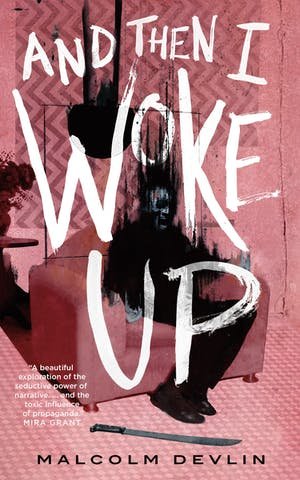
Book Review: AND THEN I WOKE UP

April 11, 2022 Anthony Cardno

TITLE: And Then I Woke Up

AUTHOR: Malcolm Devlin

176 pages, TorDotCom Publishing, ISBN 9781250798077 (paperback, also available in e-book)


DESCRIPTION: (from the back cover): In a world reeling from an unusual plague, monsters lurk in the streets while terrified survivors arm themselves and roam the countryside in packs. Or perhaps something very different is happening. When a disease affects how reality is perceived, it’s hard to be certain of anything…

Spence is one of the “cured” living at the Ironside rehabilitation facility. Haunted by guilt, he refuses to face the changed world until a new inmate challenges him to help her find her old crew. But if he can’t tell the truth from the lies, how will he know if he has earned the redemption he dreams of? How will he know he hasn’t just made things worse?


MY RATING:  5 stars out of 5


MY THOUGHTS: I love a good unreliable narrator, and Spence, the narrator of And Then I Woke Up, absolutely fits that description. Of course, being unreliable isn’t really his fault: his world has been turned upside down twice thanks to the latest plague, and sometimes his understanding of events is a bit muddled between what really happened and what he thinks happened. Reliable or not, Spence’s voice is captivating, pulling the reader along as he jumps between his present (returned to Ironside, as we find out in the opening pages of the book), his recent past (time spent outside the facility locating a fellow inmate’s plague-victim “crew”), and his earlier life (as a member of a different plague-victim “crew”). It’s not often I pronounce that a book is “unputdownable.” As much as I love novellas, I usually end up taking at least two sittings to read one of this length. But And Then I Woke Up turned out to be “unputdownable” for me, and I suspect it will also for many of my friends who love horror.

While I enjoy apocalyptic and post-apocalyptic fiction that takes time to explain the scientific or political underpinnings of whatever plague/crisis the world is facing, I really appreciated that author Malcolm Devlin did not spend any time on that aspect of world-building here. The nature of the plague, exactly how it works, is as unclear to the reader as it is to the character narrating the story. Spence is not a scientist, a reporter, a politician: he’s an average guy who has held down a number of jobs and is working as a dishwasher when the plague breaks loose. He doesn’t understand epidemiology; he just understands that suddenly some people are zombies, and some people aren’t, and that he needs to do whatever he needs to do to survive this zombie apocalypse.

Except that, as the book description above points out, it’s not actually the zombie apocalypse, but rather a distortion in how people perceive reality. This is a horror novel that is more-than-topical, taking on the rise of “false news” and the societal effect of the mindset that everyone’s opinion is as valid, if not more valid, than actual fact. Throughout the novella, Devlin touches on how just a few “true believers” can sway the perceptions of “followers” as well as how tenuous “deprogramming” efforts can be even when someone voluntarily leaves the cult (or in this case, the “crew”) when they start to question the beliefs they’re following.

While there is plenty of bloodshed and death in the book, it is not described in excruciating detail. This is not gross-out horror; it’s more psychological, as both the reader and Spence come to terms with the things he and others have done while subject to the plague. Concentrating on the psychological aspect, on Spence’s unsurety about certain events and absolutely certainty of others (along with hints that what he’s certain about may not be what actually happened), gives the book the narrative drive that kept me engaged from first page to last.

Absolutely recommended for folks who want their horror to be thought-provoking along with being disturbing and bloody.

I received an advance reading copy of this book for free from TorDotCom Publishing via NetGalley in exchange for an honest review. This does not affect my opinion of the book or the content of my review.

In BOOK REVIEWS Tags horror, Science Fiction, TorDotCom, post-apocalyptic fiction, book review
Comment

SUNDAY SHORTS: Three From Giving The Devil His Due

March 27, 2022 Anthony Cardno

Header art by Scott Witt

I love short fiction, and Sunday Shorts is the feature where I get to blog about it. I’ve considered promising to review a short story every day, but that’s a lot of pressure. And while no one will fault me if I miss days, I’ll feel guilty, which will lead to not posting at all. So better to stick to a weekly post highlighting a couple/three stories, as I’ve done in the past.


Three From GIVING THE DEVIL HIS DUE

Giving The Devil His Due, edited by Rebecca Brewer, is a charity anthology published by the Pixel Project comprised of stories in which the men who abuse and kill women and girls get their just desserts, usually through supernatural means. There are 16 stories in the anthology. Here are my thoughts on a few of them:

Nisi Shawl’s “The Tawny Bitch” is an epistolary story with endnotes, one of my favorite types of stories to read. Belle is imprisoned by her paternal cousin John after she has “inappropriate liaisons” with a female classmate at school. She writes letters she knows her lost lover may never see, telling of her abuse, neglect, and sexual assault by her cousin and the married couple he hires to mind her. A tawny-colored female dog plays a key role in the story. The “end-notes” are those of a later historian trying to piece together the true identities of the people Belle mentions. This is a classically Gothic story: lost love, a woman locked in a dark tower room, a slight supernatural vibe. Shawl pulls all those elements together with a narratorial voice that is warm and inviting and which never makes us doubt the experiences the narrator is relating. (I also enjoyed the mention of a visiting doctor named Hesselius and the implication that someone is impersonating the “real” man by that name whose adventures were made famous by author Sheridan Le Fanu.)

In Kelley Armstrong’s “Happy Birthday Baby,” Lisette meets her friend Roger for dinner to celebrate the birthday of Lisette’s late sister. The sister has been dead for three years and the police have not been able to prove that her estranged abusive husband was the one who killed her. Lisette tells Reggie she’s hired a private investigator, has uncovered the truth of that night, and is ready to murder her sister’s killer since the police can’t seem to catch him. Of course, there are more twists to the story – and it’s a fair-play type of story in that the clues to what’s really going on are well planted from the very beginning. The story is wonderfully paced, moves very fast, and hits all the right “revenge on the killer who got away” vibes and notes. It’s one of the few stories in the anthology in which the supernatural element is almost non-existent until the key moment, which also makes it stand out from the crowd.


“The Moon Goddess’s Daughter” by Lee Murray is described by the author as a “prose poem.” The language used is poetic; I’m inclined to describe it as ethereal. Even concrete details are given a certain weightlessness, or perhaps dreaminess is a better descriptor, by the way the words are used. This makes this story of a young woman in an abusive marriage different from the more direct and detailed looks at surviving abuse that surround it in the anthology – but no less, and perhaps even more, powerful. Stories that are ethereal/dream-like are not necessarily lacking in impact, as this story clearly demonstrates. Also interesting is the structure of the story, using the phases of the moon as a chart for the protagonist’s journey. The story is based on a legend of the Chinese moon goddess Princess Chang’e, and thus leans more into the fantasy side of the supernatural than the horror side that the previous two stories dwell in.


Giving The Devil His Due is still available as an e-book. Other authors featured in the anthology include Kaaron Warren, Stephen Graham Jones, Angela Yuriko Smith, Jason Sanford, Linda D. Addison, and Christina Henry.

In BOOK REVIEWS, READING Tags sunday shorts, horror, fantasy, short story challenge
Comment

Sunday Shorts: Two By Octavia E. Butler

March 13, 2022 Anthony Cardno

header art by Scott Witt

I love short fiction, and Sunday Shorts is the feature where I get to blog about it. I’ve considered promising to review a short story every day, but that’s a lot of pressure. And while no one will fault me if I miss days, I’ll feel guilty, which will lead to not posting at all. So better to stick to a weekly post highlighting a couple/three stories, as I’ve done in the past.

First released in e-book form in 2014, Unexpected Stories collects two previously unpublished Octavia E. Butler stories discovered among her papers after her untimely passing in 2006. I finally read the book, in the beautiful hardcover edition released by Subterranean Press, in February of this year.

“A Necessary Being” takes place in an alien culture that is based on societal caste and skin coloration. The Hao are revered and installed as rulers of each tribe/village, often whether they like it or not. If a tribe is lacking a Hao, they are willing to kidnap one from someplace else and torture/mutilate them to keep them from escaping, which is what happened to Tahneh’s father, the Hao of the Rohkahn. Tahneh has been unable to produce a Hao heir, so when a Hao named Duit and his companions stumble into their drought-ruined domain, a plan is put in place to keep this Hao from returning to his own people. Butler’s deft interplay of the conflicting wants and needs of Tahneh, Duit, and the people who surround them is absolutely wonderful and thought-provoking. There are no absolute good guys or bad guys here – the antagonist is the moral conflict, if that makes sense. In other hands the reader might be guided to take Tahneh’s side over Duit’s, simply because we are introduced to her and get a feel for her quandry first, but Butler makes sure that we understand and feel for Duit’s situation just as much as Tahneh’s. The story really touches on how societal blinders (“this is the way it’s always been,” “these are the things we need and our needs come first,” etc.) can sometimes keep us from seeing a path forward out of danger and into relative safety. Sometimes complacency is deadly and the ability to change is what enables us to survive.

The author herself described “Childfinder,” the second and much shorter story in Unexpected Stories, as pessimistic, and I can’t really disagree with her. Set in a bleak near future on Earth where The Organization recruits kids with potential for psionic ability, main character Barbara has left the Organization to find the pre-psionic kids The Organization doesn’t want – which means low-income kids of color. The story starts with her encounter with one such kid, and we can see that she really cares about their development and that they don’t get lost or chewed up by a system weighted against them. Of course, The Organization comes looking for her, understanding what their former employee is up to – and Barbara has to make a hard, one might even say brutal, decision. We see the immediate effect of that decision, but never get to see the long-term results. However, the quotes that bookend the story do imply that it doesn’t go as well as Barbara hopes. This is a much darker story than “A Necessary Being,” and yes, it feels pessimistic. It also leaves me hoping for more “Barbaras” (regardless of gender) helping low-income and other marginalized youth in our own world.

Unexpected Stories is available in e-book. Subterranean Press’s limited edition hardcover is currently sold out.

In BOOK REVIEWS Tags sunday shorts, book review, 2022 TBR Challenge
Comment
← Newer Posts Older Posts →

Photo credit: Bonnie Jacobs

1463659_10152361827714045_1412287661_n_opt.jpg

Anthony’s favorite punctuation mark is the semi-colon because thanks to cancer surgery in 2005, a semi-colon is all he has left. Enjoy Anthony's blog "Semi-Colon," where you will find Anthony's commentary on various literary subjects. 

CATEGORIES

Book Reviews.jpg
Interviews.jpg
Ramblings.jpg
Writing.jpg

Copyright 2017 Anthony R. Cardno. All Rights Reserved.