Starting up my series of interviews with creative folks again, and branding it “Writer Wednesday,” although it won’t always be writers who are featured.
Today, I welcome my friend Don Simpson to the blog. After seeing Don’s work in comics dating back to the 80s, I got to know him in person through PulpFest, the annual pulp magazine and vintage paperback show held in Cranberry, PA each August (the 2027 show will be August 5-8). Over the past few years we’ve had plenty of great conversations about comics, creativity, and King Kong and so it felt right to re-inaugurate this series with a chat with Don.
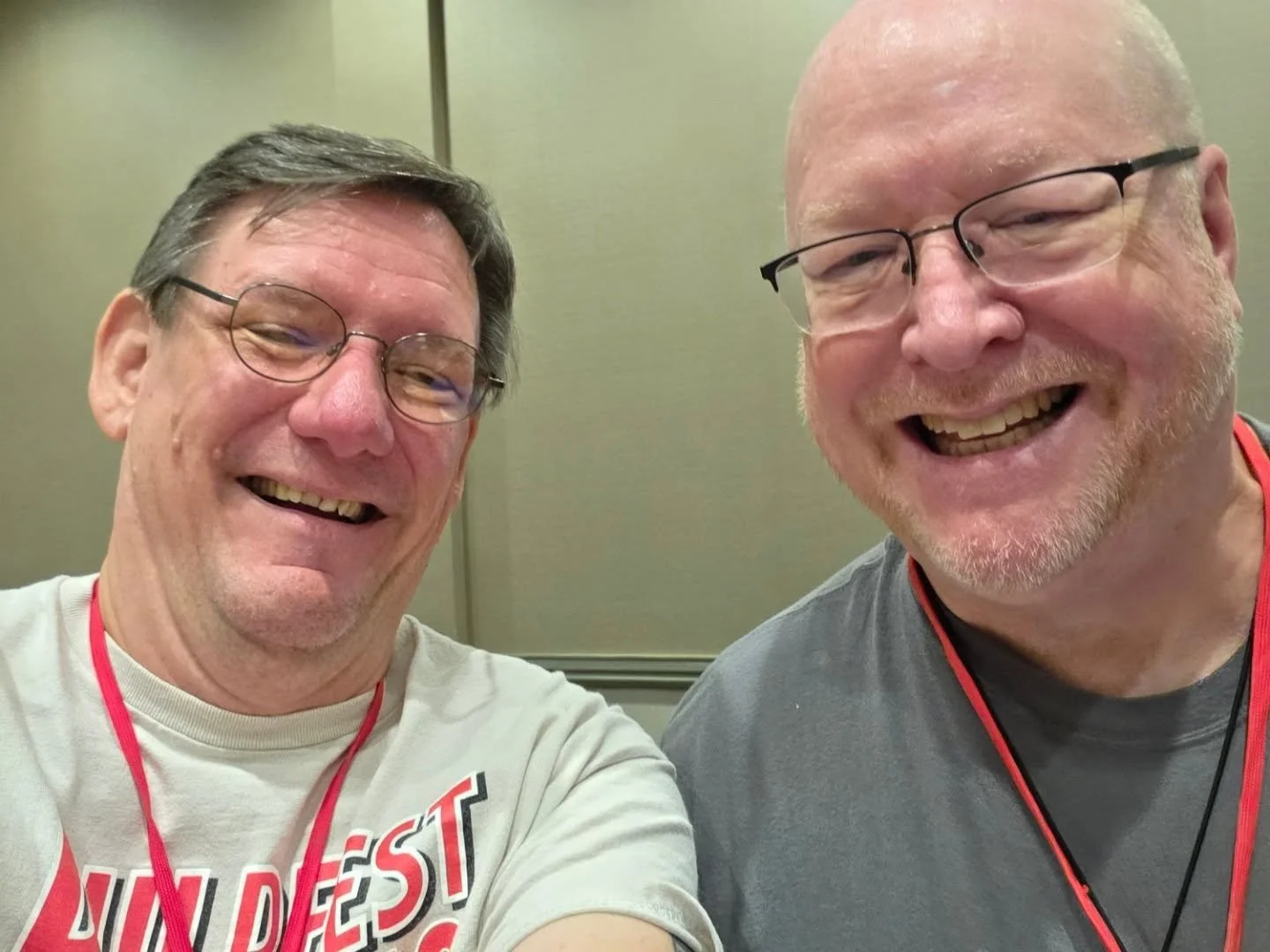
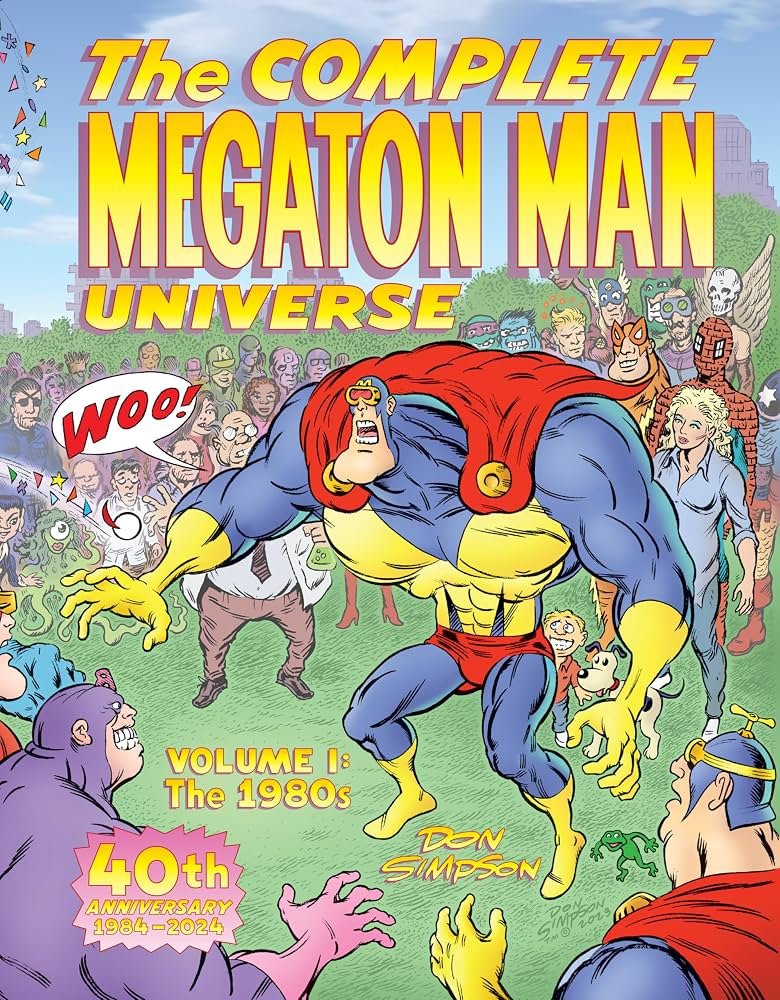
Don is probably most well known as the creator of Megaton Man, Border Worlds, and Bizarre Heroes. He also drew an adaptation of the original King Kong, and provided illustrations for Al Franken’s book Lies And The Lying Liars Who Tell Them. His recent releases include The Complete Megaton Man Universe Volume 1: The 1980s, Megaton Man; Microbus, The Lost Art of Don Simpson and X-Amount of Comics 1963: (When Else?!") Annual. Don can be found on Facebook, Instagram, his blog, Substack, and Bluesky.
Q: Hi Don! Thanks for taking some time to “chat” with me.
A: My pleasure, Anthony.
Q: I’m sure you’ve answered this question a million times, but for any of my readers who may not be familiar: how did Megaton Man come to be?
I was preparing to be a “serious” superhero penciler from the time I first started reading comics in the spring of 1972, at the age of ten. I read mostly Marvels at the time, and gravitated to undergrounds and Heavy Metal and European bandes dessinées by the time I was in the late teens and early twenties. Of course, I also always read the daily comic strips in The Detroit News and Peanuts and Funky Winkerbean, and of course Mad magazine and later National Lampoon and so on, so I was always a fan of humor as well. I would always draw funny comic strips for my school newspaper from time to time, and was featured on the choir bulletin board in high school. So I always had a sense of humor, I like to think.
So, like I say, I was submitting stories to Heavy Metal and getting rejection slips from (art director) John Workman, which were still encouraging, and rejections from Jim Shooter at Marvel and Dean Mullaney at Eclipse Comics. I wasn’t giving up on science fiction or superheroes, dramatic comics, as it were, but I also roomed with Mike Kazaleh, an aspiring humor cartoonists and animator—he later had success working for everyone from Ralph Bakshi on a Mighty Mouse revival to Matt Groening on the early Simpsons when it was on the Tracey Ullman show to John Kricfalusi on Ren and Stimpy. He would draw Ren and Stimpy for quite a long run at Marvel. Anyway, we were a couple of undiscovered geniuses getting nowhere in Detroit, and we shared an apartment where our drawing boards were in the kitchen.
One day we got to arguing about the relative difficulty of doing drama versus humor in cartooning, which is an absurd discussion to have—many of the greats were facile with both—Crumb, Kurtzman, Wally Wood, and so on. So we made this kind of friendly bet to try the opposite genre. Mike tried serious superheroes and gave up within a matter of hours; I tried doing funny stuff and it was just awful, but I kept at it. Finally, I drew the over-muscled beach bum with bikini-clad chicks draped all over his massive arms. I showed it to Mike and it was the first thing that got a laugh from him. I thought maybe I had something.
I kept at it and gave him a costume with a big “M” on his torso. I tossed around names with my other roommate, Brian Gabel, and one of us tossed out “Megaton Man,” and it just clicked. The whole concept sprang from that and it has really been a process of elaborating on it ever since.
Q: I’m always interested in the creative process. How do you approach page layout, lettering, etc. for a given project?
A: In the old days, I would start with a scribble in a sketchbook, a thumbnail rough, or maybe I would draw directly on 11" x 17" Bristol board. Today, I’m much more likely to type out a full script on a word processor. But I still can go back and forth. If it is a cover or a one-pager, and I can draw it all out in one sitting, I may just go with the inspiration. If it is a longer story, I’m going to type out plot notes, then start to hear dialogue, then add scenic (visual) descriptions. My full scripts can be quite elaborate—who is in the foreground, who is in the background, who is entering from the left side of the panel, and so on. I include psychological notes about the characters’ states of mind, if necessary.
I’m much more comfortable writing out my thoughts fully because I’ve learned if I have to set a project aside for any length of time, I can read back what I’ve written and recall my state of mind and what it is I want to draw. If I just make a scribble and then set it aside, if I don’t get to it right away, I have no idea how to decipher it later. And an unfinished drawing runs the risk of going stale. I used to draw every day so I ran into that less often. But as I’ve gotten older and life is more complicated, I find writing it out is better in case life intervenes and I can’t finish it all in a few days or weeks.
Sometimes the full-script approach leads to wordy dialogue, but it’s easier to cut dialogue at the drawing board—the fact that I still hand-letter is a big inducement to trim! And if a scene goes stale or no longer serves a purpose, I find it easier to cut writing than to cut finished art. It can be painful to have to cut finished comics pages that no longer serve any purpose in the story.
Q: What are your preferred tools for each step of your process (pencils, inks, letters, colors)? And have those preferences changed over the course of your career?
A: I’m still blue pencil—light blue Col-Erase, although they’ve discontinued them, the bastards—and graphite pencil, Hunt #102 crowquill and sable brush, Rapidographs for lettering, although pigment markers are more convenient nowadays. I scan my art into the computer and color in Photoshop. We used to use Cel-Vinyl colors on greylines—state-of-the art in the 1980s, but that is very primitive now.
Q: As a lifelong King Kong fan, I am particularly interested in how you came to work on the comic book adaptation and what that process was like.
A: I grew up with the movie on TV, of course. It was thrilling. It’s still thrilling today. The artistry really hasn’t been surpassed. The acting was atrocious, but the artistic vision, what is conveyed through stop-motion animation and set design and so on still holds tremendous power.
Fantagraphics approached me. I had done In Pictopia (from a script by Alan Moore) and Gary Groth was always fond of Border Worlds. I also know Tom Powers, a young guy from Detroit who became an assistant editor with Fantagraphics. Gary had been after the Kong license for quite some time—I’m sure you know the ownership of the Kong trademark and copyright—the film versus the screenplay and novelization—has long been a tangled mess.
They lined up six superstar covers by Dave Stevens, Al Williamson, Mark Schultz, William Stout, and Ken Steacy, and they needed someone cheap to do the adaptation and artwork. I was one-stop shopping, I suppose, and we agreed upon a page rate that wasn’t exactly Marvel or DC, but it compared favorably to Kitchen Sink Press, with whom I had just severed ties. So I got a used paperback copy of the Delos W. Lovelace novel—we didn’t have rights to use the RKO imagery, and I cartooned away.
It’s not a job I would have asked for or tried out for. I never thought I was doing the definitive interpretation of King Kong—just a workmanlike effort. I certainly put a lot into it. We were able to restore the giant spider scene and add a few other touches—I have a kid reading a Doc Savage novel in 1931, which is slightly anachronistic, but there you go. At the time it came out, my version didn’t get much love, but I think it has aged rather well. It has a fairly avid following now, especially at a venue like Pulpfest. I’ve sold several comics and a few pieces of original art there.
(Illustrator) Joe DeVito has had the Kong rights tied up for a long time and has refused to collect mine. I think Kong collectors would like to see the six issues collected into a mass-market graphic novel. I numbered all the pages from 1 to 130 for that purpose. Someday, Joe will be out of the picture and not be in a position to hold up the show anymore. I look forward to that.
Q: You’ve got two successful Kickstarters under your belt. Any advice for people looking to do a Kickstarter project? Things to do, and things to avoid?
A: Don’t cheat yourself on foreign postage. Not only are there customs—thank Emperor Tariff—but also filling out the forms is time-consuming. The big thing is not to overpromise and to fulfill promptly. Have your project already in the can and ready to send to the printer before you launch your campaign, and give yourself an extra three months. Also, don’t post pictures of the boxes being delivered, because then your backers will want to know why you haven’t mailed it out already, three days later. You’re not Amazon, so give yourself ample time.
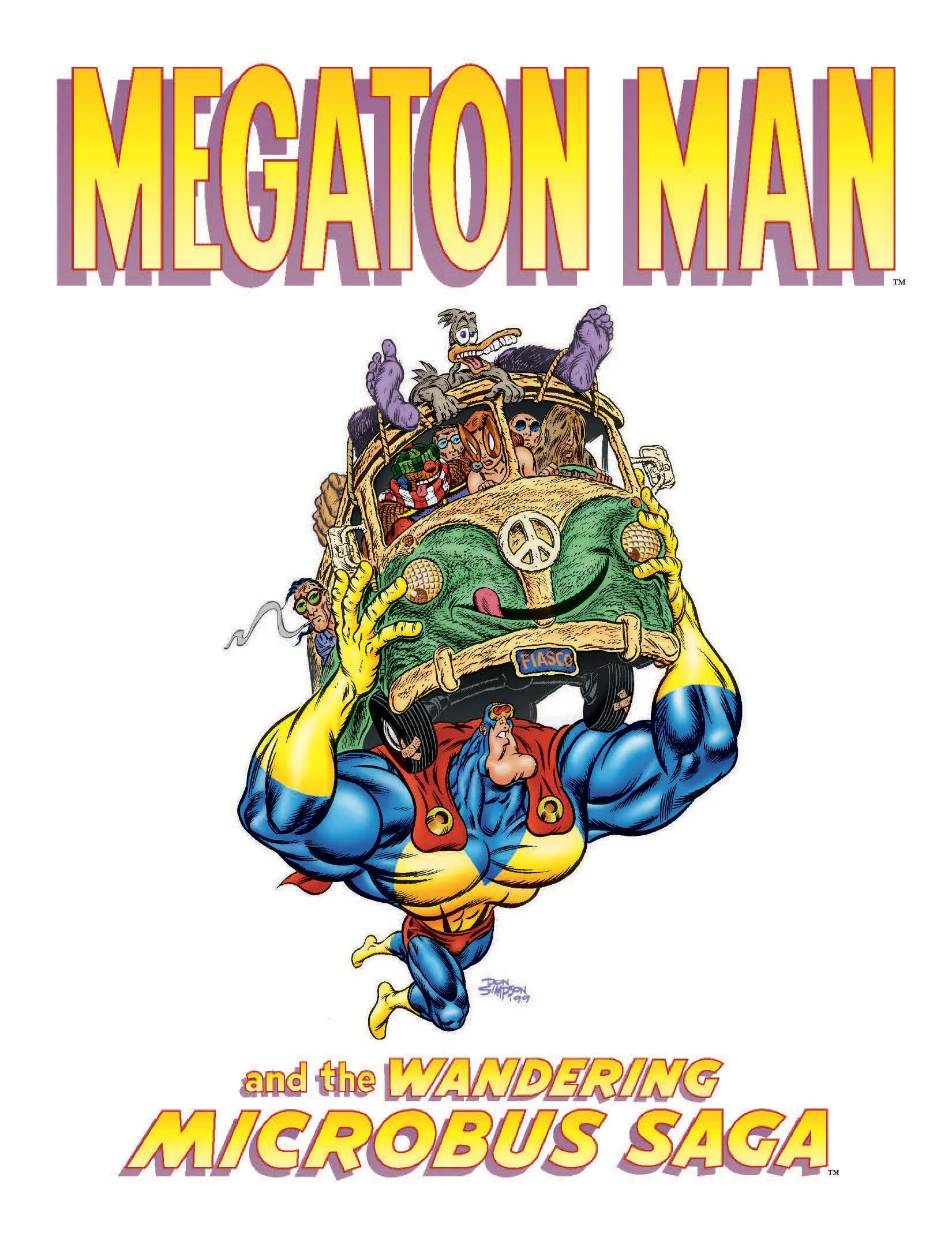
Q: Your most recent successful Kickstarter was for the Megaton Man: Microbus collection, which brought together all of the weekly Megaton Man serials from 1996 to 2001, plus some other material. And before that, you funded The Lost Art of Don Simpson. What’s your next Kickstarter project, and when does it launch?
A: I’ve been working on Megaton Man: Megatropolis, my “9/11” graphic novel, for twenty-five years. I’m finishing the coloring. I’m preparing to launch very shortly, I hope. Watch the skies!
Q: And my standard final question: What is your favorite book?
A: I prefer a lot of nonfiction. I’m not a voracious reader. I think I’ve read maybe twenty Doc Savages, back when I was a teenager. I’ve read one or two since, and they are tough sledding. But I’ve read the opening chapters to Doc Savage: His Apocalyptic Life, by Philip José Farmer, any number of times. For a while there, every spring I’d read the opening chapters, where he summarized the supersagas and talk about Henry Miller and E.E. “Doc” Eddison, and William S. Burroughs, and talk about telling a “rattling good story” and driving the literati up a wall. I found it thrilling and inspirational. More recently, I discovered the Barsoom trilogy of Edgar Rice Burroughs, which I think I prefer to Tarzan. There’s just something magical about A Princess of Mars—I bought the Library of America edition at Pulpfest this past summer. It’s just uncanny. It’s just words on paper, but I feel transported. I know people who are voracious readers and more widely read than I’ll ever be, but I’d rather read a few good examples of writing more than once. I’ve read Another Roadside Attraction by Tom Robbins twice, and it holds up. Henry Miller’s Tropic of Capricorn does not hold up, but the excerpts Farmer mentions in Apocalyptic Life are still thrilling.
A Catcher in the Rye is terribly dated now, and Wicked has to the most over-rated book in the past century.
