Reading Round-Up: February 2020

Continuing the monthly summaries of what I’ve been reading and writing.


BOOKS

To keep my numbers consistent with what I have listed on Goodreads, I count completed magazine issues and stand-alone short stories in e-book format as “books.” I read or listened to 12 books in February: 11 in print, 1 in e-book format, and 0 in audio format. They were:

1.       Lightspeed Magazine #117 (February 2020 issue), edited by John Joseph Adams. The usual fine assortment of sf and fantasy short stories. This month’s favorites for me were Victor LaValle’s “Ark of Light,” Kij Johnson’s “Noah’s Raven,” Daniel Jose Older’s “A Stranger At the Bonchinche,” and Maria Romasco-Moore’s “Dying Light.”

2.       The Golden Key by Marian Womack. A gothic-supernatural novel that takes place mostly in a London experiencing an upswing in interest in the occult thanks to the death of Queen Victoria. Told from the points of view of three characters: a man with a mysterious past, a woman who covers her deductive abilities with a veneer of the supernatural, and a young governess in the town the man is from. Full Review Here.

3.       The Midwinter Witch (The Witch Boy Book Three) by Molly Knox Ostertag. The third in Ostertag’s tales of Aster, a boy who has a talent for witchcraft even though all of the boys in his family are supposed to be shapeshifters. This time, Aster has to decide if it’s time to show off his growing prowess at the family reunion/midwinter celebration or he should heed his protective mother’s advice and stay hidden a while longer. I love every installment of this series.

4.       The Black God’s Drums by P. Djèlí Clark. Alternate history/steampunk/Afrofuturism novella that takes place in an independent New Orleans under siege by several outside forces including the Confederacy and the Union. The main character, a young girl who serves as a conduit for a powerful Orisha, must figure out how to save her city with the aid of a smuggler, the smuggler’s airship crew, a feral child and a pair of odd nuns. Full Review Here.

5.       LaGuardia (LaGuardia Vol 1) by Nnedi Okorafor, Tana Ford and James Devlin. In Okorafor’s future where aliens are immigrating to Earth, New York City’s LaGuardia Airport is still a hot mess for passengers arriving and departing. This topical piece of SF takes on immigration, acceptance vs. tolerance, and politics. The art by Ford and Devlin is realistic and expressive. Looking forward to seeing where the story goes.

6.       Arrow of God (Africa Trilogy #2) by Chinua Achebe. I set a goal to read all of Achebe’s Africa Trilogy last year after reading Things Fall Apart in 2018. I didn’t make the goal, so I set it again this year. This middle volume of the story only peripherally mentions events from the first book, but continues to focus on the conflict between local custom and new rules during the British colonization of Nigeria, this time with particular attention to religious belief. Powerful work.

7.       The Shape of Friendship (A Lumberjanes Original Graphic Novel) by Lilah Sturges and Polterink. The second Lumberjanes original graphic novel (as opposed to trade paperbacks collecting the monthly comics run) focuses on the friendship between April and Jo, and how that friendship morphs/changes with the arrival of Barney, who Jo went to came with before attending the Lumberjanes camp. April’s devotion to and protectiveness of her childhood best friend is beautiful, and the story doesn’t go in the expected/trope-y directions. This might also be the first Lumberjanes book to make explicit the fact that Jo is transgender, and it is wonderfully handled.

8.       The Ballad of Black Tom by Victor LaValle. I read this before I found out it was a response to/reworking of a specific H.P. Lovecraft story I’ve never read. It is a fantastic story on its own, with deep character work for the three main characters and plenty of both cosmic and every-day horror to go around. When compared to the very racist, very not-scary Lovecraft original, it becomes even more impressive. Longer Review coming soon.

9.       Parable of the Sower by Octavia E. Butler. One of my “To Be Read” Challenge books for 2020, this is only the second Butler I’ve read in my life. More SF than horror, it shares some similarities with Butler’s Fledgling in that the author pulls no punches and hides no trauma. I found myself intrigued by the Earthseed belief system the main character develops, and caught up in how Butler extrapolated, in the 90s, a near-future that feels even more real right now.

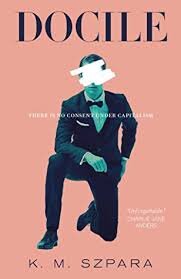
10.   Docile by K.M. Szpara. As I said in the Full Review I Posted Recently, Szpara’s debut novel joins Sabrina Vourvoulias’ Ink, and Butler’s Parable of the Sower, on a shelf of near-future SF that is not only believable given our current climate but harrowing and hopeful at the same time. Be warned though: there are all kinds of sexual and emotional abuse and assault front and center throughout the book, and lots of explicit sex. This book is not for the squeamish.

11.   The Dream-Quest of Vellit Boe by Kij Johnson. Another Lovecraftian novella that builds off of and responds to a specific Lovecraft story (in this case “The Dream-Quest of Unknown Kadath,” which I read many years ago and have some vague memories of). Johnson gives us a strong female professor setting out across the Dreamlands to find a missing student. It’s more fantasy than horror, and takes on the nature of dreams, reality, and the way the machinations of those who are more powerful affect those who have little or no power. Longer Review coming soon.

12.   Imaginary Numbers (InCryptid #9) by Seanan McGuire. The newest InCryptid novel finally places cousin Sarah Zallaby, who has been recuperating since overusing her powers in the second novel, at the front of the action, along with cousin Artie. Even having read the back-cover description, the book didn’t go where I thought it was going to, with some very pleasant surprises along the way. There’s also a bonus novella that bridges the action of the previous novel (which focused on Antimony Price) and this one.


STORIES

I have a goal of reading 366 short stories (1 per day, essentially, although it doesn’t always work out that way) this year (because it’s a Leap Year). Here’s what I read this month and where you can find them if you’re interested in reading them too. If no source is noted, the story is from the same magazine or book as the story(ies) that precede(s) it:

1.       “Ark of Light” by Victor LaValle, from Lightspeed Magazine #117 (February 2020 issue), edited by John Joseph Adams.

2.       “How We Burn” by Brenda Paynado

3.       “Dying Light” by Maria Romasco-Moore

4.       “The Gamecocks” by JT Petty

5.       “Noah’s Raven” by Kij Johnson

6.       “A Stranger at the Bochinche” by Daniel Jose Older

7.       “Toxic Destinations” Alexander Weinstein

8.       “A Statement in the Case” by Theodora Goss

9.       “All That Glitters” by Seanan McGuire, on the author’s Patreon page.

10.    “Journal” by Jim Butcher, from The Jim Butcher Mailing List, edited by Fred Hicks

11.   “Emergent” by Rob Costello, from The Dark #57 (February, 2020), edited by Silvia Moreno-Garcia and Sean Wallace

12.   “Holoow” by Michael Wehunt

13.   “Ngozi Ugegbe Nwa” by Dare Segun Falowo

14.   “Live Through This” by Nadia Bulkin

15.   “The Best Horses Are Found in the Sea, and Other Horse Tales To Emerge Since The Rise” by Beth Cato, from Daily Science Fiction February 14, 2020 edited by Michele-Lee Barasso and Jonathan Laden

16.   “The Horror at Red Hook” by H.P. Lovecraft, in stand-alone ebook format, editor unknown

17.   “Follow The Lady” by Seanan McGuire, new novella published as back-matter for the novel Imaginary Numbers.


So that’s 17 short stories in February. Way under “1 per day,” so I’m behind for the year so far. (February 29th was the 60th day of 2020.)


Summary of Reading Challenges:

“To Be Read” Challenge: This month: 1 read; YTD: 2 of 14 read.

366 Short Stories Challenge: This month:  17 read; YTD: 43 of 366 read.

Graphic Novels Challenge:  This month: 3 read; YTD: 4 of 52 read.

Goodreads Challenge: This month: 12 read; YTD: 31 of 125 read.

Non-Fiction Challenge: This month: 0 read; YTD: 3 of 24 read.

Read the Book / Watch the Movie Challenge: This month: 0; YTD: 0 read/watched.

Complete the Series Challenge: This month: 1 books read; YTD: 5 of 16 read.

                                                                Series fully completed: 0 of 3 planned

Monthly Special Challenge: February was Black History Month and Women in Horror Month, so my goal was to read primarily authors from Africa or of African descent and female horror writers. Of the twelve books read in February, five were by authors from Africa or of African descent; three were horror or horror-adjacent works by female authors (Octavia E. Butler counted in both categories, but I did not count Seanan McGuire as a female horror writer because the book of hers I read this month was not part of her horror output.)

March is Women’s History Month, so my goal is to read primarily women authors across various genres and formats.
Black History Month: Black Genre Authors

February is Black History Month. In honor, I thought I’d put up a list of some of my favorite black genre writers, folks whose work really just blows me away. Note: as usual with this kind of thing, I do not intend this to be an exhaustive list. As I’m posting this kind of off-the-cuff as it were, I’m sure I’ll accidentally leave some wonderful creators out. It’s not intentional at all, and certainly not meant to be a slight.

Maurice Broaddus: I first became aware of Maurice thanks to his Knights of Breton Court trilogy, a modern-urban-gang-warfare take on the Arthurian mythos. His short story collection Voices of Martyrs is brilliant. His two most recent works are the middle-grade novel The Usual Suspects, and the steampunk alternate history Pimp My Airship. He’s also co-edited a number of anthologies including Dark Faith from Apex.

Nnedi Okorafor: Nnedi’s Binti novellas, hard SF mixed with fantasy, sheer blew me away, as did her post-apocalyptic novel Who Fears Death. Her short stories are great as well, and I’m about to read her graphic novel with Tana Ford, LaGuardia.

Tananarive Due: I should be embarrassed that I’ve yet to read one of Tananarive’s novels, based on how much I’ve enjoyed her short stories in various magazines and anthologies over the past few years. Ghost Summer: Stories is a few years old now, but it’s a great place to start on her short fiction.

Nalo Hopkinson: Another author whose short stories I love and whose novels I should have read long since. Some of Nalo’s best stories can be found in Skin Folk: Stories. She’s also the writer of the brilliant addition to DC Comics’ “Sandman Universe” called House of Whispers.

Nisi Shawl: Nisi’s alternate history Everfair, about the creation of an independent African state during King Leopold’s conquest of the Congo, is amazing and thought-provoking, and refreshing in that it’s alternate history that doesn’t center the US Civil War or World War Two. She’s also a great editor (New Suns: Speculative Fiction by People of Color, among others) and the co-author with Cynthia Ward of the non-fiction book Writing the Other.

Victor LaValle: Victor’s short stories are gut-punches of detail and emotion. His novella The Ballad of Black Tom takes on Lovecraft. He’s also a talented editor, most recently of A People’s Future of the United States with John Joseph Adams.

P. Djèlí Clark: The Black God’s Drums is another piece of amazing alternate history that combines steampunk with the supernatural. His other short fiction is great as well.

Nane Kwame Adjeh-Brenyah: Friday Black: Stories was one of my favorite short story collections of last year. Nane’s stories had me thinking about societal forces and systemic racism in ways I hadn’t done so before.

Octavia Butler: No list of black genres authors is complete without her. Parable of the Sower is coming up on my reading list during my next business trip, and as I said last week, Fledgling still disturbs me.

Tade Thompson: I just read Tade’s evocative supernatural poem “Komolafe” in the sixth issue of Occult Detective Magazine. I need to read more by him. A lot more.

Gary Phillips: Like many of the folks on this list, Gary writes in a number of genres, but I’m most familiar with him as a writer of “new pulp” adventure, in anthologies like The Green Hornet Casefiles (edited by Joe Gentile and Win Scott Eckert) and the recent From Sea to Stormy Sea (edited by Lawrence Block).


Okay, your turn readers. There are a lot of black genre writers I’ve read who aren’t on this list, sins of omission based on a deadline and work-loads and such, but there are also plenty out there I’ve never read. Who do you think I should be reading? Give me names in the comments!

SERIES SATURDAY: Silverblade

This is a series about … well, series. I do so love stories that continue across volumes, in whatever form: linked short stories, novels, novellas, television, movies. I’ve already got a list of series I’ve recently read, re-read, watched, or re-watched that I plan to blog about. I might even, down the line, open myself up to letting other people suggest titles I should read/watch and then comment on.

silverblade covers.png

Not long ago, I re-read (for the first time in many years) and wrote a Series Saturday post about the two Nathaniel Dusk mini-series written by Don McGregor, drawn by Gene Colan, and published by DC Comics. That, along with reading the first three volumes of Tomb of Dracula: The Complete Collection back in November, made me want to re-read more of the Gene Colan work I loved, starting with the Cary Bates-scripted, Colan-drawn maxi-series Silverblade.

Silverblade is the story of reclusive former movie star Jonathan Lord and his co-stars in the movie that shares the maxi-series’ title. At the height of his career, the “Lord of Sunset Boulevard” matched Errol Flynn and Tyrone Power as a screen star; in the waning years, Lord’s career parallels Boris Karloff, to an extent. In the then-present-day of 1987, Lord is long-since retired and is bitter and cranky. He spends most of his time watching his own old movies while being waited on by Bobby Milestone (who co-starred in “Silver Blade” as a young boy in need of rescue) and avoiding phone calls from several of his ex-wives (including Sandra Stanyon, the great love of his life, who also co-starred in “Silver Blade”). An ancient bird spirit, manifesting as a falcon, grants Lord the ability to transform into any of his former film roles (gaining whatever powers are inherent with each role), because the bird-spirit needs a human avatar to help battle the return of another ancient spirit called The Executioner. Returned to his prime (in his role as the hero of “Silver Blade”), Lord re-emerges into Hollywood society pretending to be his own son, Jonathan Lord Junior, going on auditions for a science-fictiony “Silver Blade” remake and falling in lust with a well-known reporter. All of which distracts him from the mission, to the falcon’s displeasure.

The story winds its way from there over twelve issues, delving into the characters’ shared past (other major characters include Brian Vane, who played the villain in “Silver Blade,” and Vincent Vermillion, the young boy who was Bobby Milestone’s stunt double on the film and holds a grudge) and slowly unveiling what the battle between the Falcon and the Executioner is all about. There are plenty of interesting twists and turns, and very cool use of the types of characters an actor who started out as a Flynn and ended as a Karloff would have played: there’s the swashbuckling hero, the disgruntled private eye, the turns as Dracula and the Mummy. Two of the issues have end-text that list every movie Jonathan Lord made, and several are named after classic DC properties. I really would have loved to see Bates and Colan’s take on Jonathan Lord as The Viking Prince or Sarge of “Gunner and Sarge,” but I suspect that list was created well after the main story was plotted out, and fitting every character Lord ever played into the main story would have been a bit too much. But I have to admire Bates’ dedication to giving us Lord’s full filmography and a look at the actor’s one turn on Broadway.

For the first three-quarters of the story, what we get is something that I think falls firmly into the realm of “urban fantasy.” There’s magic at play, forces that normal humans can’t comprehend; there’s a plucky band of main characters who are in the know, willingly or not, and working to save the day; and the city of Hollywood and its history play a major role in the proceedings (I’m not sure it could have been told the same way if Jonathan Lord had retired to, say, Chicago, or if his successful career had been centered on Broadway instead of the movies). There’s never a mention of other super-heroes, and the few moments where the supernatural is revealed to the greater public are usually written off as some kind of mass hallucination, which make it a lot easier to think of this story as taking place in “the world outside our window” (to steal a phrase from the great Philip Jose Farmer). Up to issue nine, Silverblade is a straight-forward “guy must save the world” story.

The final third of the story is where things get really weird. Metaphysics is a subject I’ve never been able to fully grasp, and Bates lays it on think. As a late teenager when the issues originally came out, I have to admit I didn’t really get it; I think I understood more of what he was attempting while rereading at age 53, but I’m still not totally sure. There’s a major change to the characters’ world introduced in issue #9 that allows Bates to move the story from straight-up urban fantasy to a treatise on the nature of reality.  Is there more than one? How “true” is “the real world” versus its celluloid imitations? In the first eight issues, Lord deals with some of this as he transforms from character to character and explores where the line is drawn between private actor, public persona, and character (including being killed and brought back to life as Dracula). But thanks to the big shift in issue 9, every character has to consider the question of what is real and whether one is ever truly “whole,” either in inter-personal relationships with or within oneself. Ruminations on Reality and Wholeness lead into the twin ideas of Truth and Perception, questions about whether anyone can truly know everything about us, and whether our personal truth is one that others can recognize and accept. Which leads me to a slight digression: I had completely forgotten about the scenes featuring the newly-introduced characters of “Alfie York” and “Jeremy Lago,” forgotten about how clearly a May-December couple they are when we first see them and how later in the book as reality reasserts itself we find one of them at least uncomfortable with being forced to play that relationship. I’m torn between giving Bates kudos for even attempting to give us a gay couple in a mainstream comic in the mid-80s and being unhappy with the reveal that they’re not only not a couple but that one of them expresses their discomfort in a somewhat homophobic way (although I don’t think the lines were meant by Bates to be interpreted that way, they certainly can be) that might be more upsetting to the other character than he lets on (I think, without spoiling much, an argument could be made that that particular character is closeted throughout the book and only in the final third does he finally get a chance to live as himself).

(I also have to admit, the introduction of a spirit guide who takes corporeal form as a cartoonish leprechaun might have had something to do with me not taking part of the “big theme” seriously back in 1987.)

Colan’s art is, of course, brilliant through-out. His style lends itself to the more metaphysical aspects of this story as much as it does to the gothic storytelling of Tomb of Dracula or the noir of the Nathaniel Dusk books, showing just how versatile the man was without compromising what made him unique. He’s inked here by Steve Mitchell (except for the first issue, on which Klaus Janson did the inking, and which looks a bit like the issues of Daredevil that Janson inked over Frank Miller). Mitchell isn’t quite the perfect match for Colan that Tom Palmer was on Tomb of Dracula, but he’s still quite good. And occasionally we do get to see, as we did on Nathaniel Dusk, art shot straight from Colan’s pencils, in terms of movie posters and photos that appear as part of the end-matter.

Since Jonathan Lord and Sandra Stanyon have appeared in DC’s animated Young Justice series (at least according to Wikipedia; Young Justice is another cartoon I need to eventually watch), I assume the rights to Silverblade rest with the publisher and not with Bates and Colan (or Colan’s estate). I think Silverblade would lend itself excellently to a one-and-done 10- or 12-episode series on Netflix of Amazon Prime. (I have long pictured Derek Jacobi as the older Jonathan Lord; the “younger” Lord needs to be someone swashbucklingly handsome … while I’d love to cast Freddie Highmore because I think he’s that damned talented, he’s also still got a baby-face at almost 30, so I think the studios would have to use someone like Aaron Taylor-Johnson or Nicholas Hoult. I think Colin Firth would be perfect as Bobby Milestone… I might have to do a separate post with a “dream cast.”)

I also realize that DC seems to have a weird process for deciding which older books (meaning 40s-80s) get collected (and how they get collected: hardcover or softcover? Full color or black-and-white?), but since they collected Colan and Marv Wolfman’s Night Force run from around this period, one can dream that Colan’s other mid-80s work for the company (particulary Silverblade, Nathaniel Dusk, and J’Emm Son of Saturn) will also get the hardcover full-color treatment one of these days.)

Women In Horror Month

February is “Women in Horror” Month. In honor, I thought I’d put up a list of some of my favorite female horror writers. Note: this is not an exhaustive list. As I’m posting this kind of off-the-cuff as it were, I’m sure I’ll accidentally leave some wonderful creators out. It’s not intentional at all, and certainly not meant to be a slight.

Damien Angelica Walters: While Damien’s short stories may cross genres, her novels have been pretty solidly horror: Ink was about possessed tattoos, Paper Tigers about a possessed photo album, and her most recent, The Dead Girls Club, is about storytelling and the ways in which real-life and sleepover-story horrors relate and interact. Her two short story collections, Sing Me Your Scars and Cry Your Way Home, contain a number of psychological and supernatural horror stories.

Lucy A. Snyder: I haven’t checked out any of her novels (yet), but Lucy writes some of the most disturbing short stories I’ve ever read. “Magdala Amygdala” is one of the few zombie stories I will intentionally reread, knowing it is going to gross me out. Check out her collection Soft Apocalypses.

Mira Grant: Sure, some of the short fiction Seanan McGuire publishes under her own name contains horror elements, usually more on the “dark fantasy” side. But when she writes as “her own evil twin sister,” Mira Grant, the horror takes center stage and the other genre elements (science fiction and fantasy) are extra flavor. The Newsflesh novels (zombies); the Parasitology trilogy (medicine gone amok); ); and a string of novellas from Subterranean Press that cover mermaids, slashers, plagues, and Lovecraftian horror (including Rolling in the Deep, Final Girls, In the Kingdom of Needle and Bone, and In The Shadow of Spindrift House) are among my favorite horror books ever.

Elizabeth Hand: Just on the strength of Wylding Hall alone, Elizabeth Hand is one of my favorite horror writers. I need to read more of her longer work.

Sabrina Vourvoulias: Sabrina’s stories co-mingle Latinx life and legends with alternate history or every-day life, but her near-future novel INK is a horror potentially unfolding in front of us on a daily basis, and everyone should read it. Check out her short fiction in various magazines and anthologies as well.

Kaaron Warren: I reviewed Kaaron’s most recent novella, Into Bones Like Oil, a few days ago here on the blog. Every story of hers I’ve read had snuck into my hind-brain and stayed there.

Silvia Moreno-Garcia: From the near-future vampires of Certain Dark Things to the music-based magic of Signal to Noise and everywhere in between, Silvia writes some of the most compelling horror out there. She’s also the editor of The Dark magazine, cultivating horror from marginalized voices.

Shirley Jackson: The Haunting of Hill House. We Have Always Lived in the Castle.The Lottery.” Of course Jackson is on any list of favorite horror writers I might compile.

Octavia Butler: I am not sure how many years it’s been since I read Fledgling and I still can’t get certain scenes out of my mind. Butler is an author I long-since should have read more of, and I’m working to correct that.

Caitlín R. Keirnan: Caitlín’s short fiction, collected in volumes like The Very Best of Caitlín R. Kiernan, is phenomenal. Her novel The Drowning Girl haunted me for months after finishing it.

Ellen Datlow: Okay, Ellen is not an author. But she curates, both in anthologies like The Best Horror of the Year series and as a novella editor for Tor.com, a wide range of horror from the explicit to the classic to the subtle. No list of “women in horror” would be complete without Ellen’s name on it.


Okay, your turn readers. There are a lot of female horror writers I’ve read who aren’t on this list, sins of omission based on a deadline and work-loads and such, and plenty who I’ve never read. Who do you think I should be reading? Give me names in the comments!

SUNDAY SHORTS: Into Bones Like Oil

Sunday Shorts is a series where I blog about short fiction – from flash to novellas. For the time being, I’m sticking to prose, although it’s been suggested I could expand this feature to include single episodes of anthology television series like The Twilight Zone or individual stories/issues of anthology comics (like the 1970s DC horror or war anthology titles). So anything is possible. But for now, the focus is on short stories.

into bones like oil cover.jpg

Kaaron Warren’s moving novella Into Bones Like Oil is about the ghosts, both literal and figurative, that haunt us. The characters and the setting are equally haunted by the sins of their pasts, and in some cases their present actions as well.

Every person who enters the Angelsea rooming hours is broken in some way. Dora, the main character, cannot sleep because of guilt over the death of her daughters; Luke has PTSD from his military service; a resident called the Doctor almost seems to regret the crimes he committed against his patients. Property manager Roy is obsessed with learning the secrets possessed by the ghosts of a nearby shipwreck, to the point he is willing to abuse his tenants to get what he wants. While there are a few disreputable and thoroughly unlikeable characters in the boo, Roy is the worst – but also the only one not willing to admit that he has done – scratch that, is doing – something reprehensible.

Warren’s language is elegiac, wistful and dream-like. The whole story is permeated with a sense of loss, regret, decay, of being stuck in a limbo created by an individual’s choices despite where else they may wish to place the blame. There are some truly uncomfortable moments as different characters’ faults and failures come to the fore – but they are all necessary for the characters, and the reader, to find catharsis. This is most especially true for Dora, who needs to process her own culpability in her daughters’ deaths and also in the current goings-on at the Angelsea. Dora, Luke, and several other residents are on a path of possible redemption, but each must make their own choices regarding how or whether to pursue it.

Warren beautifully illustrates how guilt immobilizes some and motivates others while also asking whether forgiveness can ever truly come from outside if it doesn’t begin within.

SERIES SATURDAY: ARROW (2012-2020)

This is a series about … well, series. I do so love stories that continue across volumes, in whatever form: linked short stories, novels, novellas, television, movies. I’ve already got a list of series I’ve recently read, re-read, watched, or re-watched that I plan to blog about. I might even, down the line, open myself up to letting other people suggest titles I should read/watch and then comment on.

Arrow logo.jpg

Just about two weeks ago (by the time this is posted), fans said “goodbye” to The CW’s Arrow, the flagship show in what has become an expansive, if not always consistent, television adaptation of the DC Comics Universe. Along the way, Arrow (and its spin-offs The Flash and DC’s Legends of Tomorrow, and connected shows Supergirl and Black Lightning) have thrilled and sometimes infuriated comics fans. For every fan who loved a character appearance or storyline adaptation, there was an equal and opposite reaction from another fan – and I’m sure this will continue now that the “Arrowverse” has moved beyond the big “Crisis on Infinite Earths” crossover and united all of the CW shows (plus, one assumes, the short-lived live-action and cartoon Constantine and Vixen series) on a single Earth. I’m of the opinion that no live-action movie or series adaptation of a comic book is ever going to be perfect, that storyline and character alterations to make the story work in a live-action format are necessary and should be expected, and thus there’s always been more to like than to complain about in Arrow and the rest of the “Arrowverse.” Your mileage may vary, of course.

Now normally when I do a “Series Saturday” post, it’s for a series I’ve recently read or watched (or re-read/re-watched), and so my thoughts are fresher. But I’m not in a position right now to do an 8-season long rewatch in short enough order to get a post written while the series finale is fresh in people’s minds, so this post is going to be a bit more nostalgia-based. There may be things I don’t remember, episodes/seasons I think were better/worse than they really were, etc. Bear with me.

I maintain that when Arrow was good, it was really, really good. And when it was not good … well, every long running show has at least one season that is a slump compared to the others, and every season is bound to have a stinker episode or two. And, as I said, I think in the end the really-really-good outweighed the stinker-bad.

WARNING: FROM HERE ON OUT, HERE THERE BE SPOILERS! If you haven’t watched all eight seasons of Arrow and you continue reading, I cannot be held responsible for anything you learn that you didn’t want to!

I came to Arrow about a season late; friends had watched season one and recommended it. I was skeptical, wasn’t too thrilled that the show was a complete relaunch (as opposed to giving us Justin Hartley’s Green Arrow spinning off from Smallville (which turned out to be a good thing for everyone, given co-star Alison Mack’s issues and that Justin has gone on to greater success with This Is Us, a show I should probably watch eventually)), and wasn’t really looking to add another hour-long show to my already long list of shows to watch. So it was as season two was starting that I finally decided to watch season one on DVD. My friends were right that I’d like it. I was hooked.

I think season one was the most tightly-plotted, and perhaps best, season of the show. There was a clear through-line: the producers knew where they wanted to be at the end of season one and got there without too much meandering (given the 23-episode length of the season). John Barrowman was a great “big bad” as the Black Archer, and I loved the development of the relationship between Oliver and John Diggle. The addition/development of the Queen family took some getting used to, but I came to really like both Susannah Thompson and Willa Holland. I liked the nod to comics history in making future (or so we thought at the time) Black Canary Laurel Lance’s father a cop, although I wasn’t crazy about Paul Blackthorne’s accent as Quentin Lance (it always felt a bit forced to me). I liked the way Roy Harper was eventually introduced, and I enjoyed watching Felicity grow from a guest to a supporting character to a co-star. I even found the flashbacks intriguing and for the most part connected to the current-day goings on. If there was anything I didn’t like about season one, it was the way the writers leaned so heavily into Oliver killing everyone on his List, and that (similar to Smallville) Oliver was given the first of a ridiculous number of nicknames before finally becoming Green Arrow, “the Hood” being about the worst of them. I also didn’t really connect with Katie Cassidy as Laurel at all, and thought she was better suited romantically to Tommy than to Oliver.

Season two was, I thought, almost as strong as season one. The flashbacks still connected strongly to the present day material. Manu Bennett was brilliant as the pre- and post-Mirakuru versions of Slade; the addition of Caity Lotz as the not-as-dead-as-we-thought Sara Lance / Black Canary was one of the best decisions the creators of the show ever made; and the show made good use of returning villains/anti-heroes like Huntress, Deadshot, and Bronze Tiger. I enjoyed enough of the season that I was able to overlook the complete misuse of Brother Blood. (Okay, full disclosure: I’m looking at the Arrow pages on IMDB as I write this, and I had completely forgotten Sebastian Blood was even a part of this season; when I think of season two, I think of Deathstroke, Sara, and the introduction of Grant Gustin as Barry Allen.) Oh, and I enjoyed the addition of Bex Taylor-Klaus as Sin (a character significantly aged-up from the comics) and wish they’d done more with her in subsequent seasons. Downside to the season: Laurel’s alcoholism storyline just didn’t work.

Season three, I struggled with. Partly because R’as al-Ghul is one of my favorite Batman villains and I initially thought Matt Nable was badly mis-cast. Partly because I hated that the season started off by killing Sara. Yes, I know, she got better, but “let’s kill the bisexual just to motivate the hero” is not a good look in this day and age. Thankfully, the powers-that-be brought her back to lead the Legends of Tomorrow. Positives to the season: the additions of Charlotte Ross as Mama Smoak, Katrina Law as Nyssa, Brandon Routh as Ray Palmer, and Vinny Jones as Brick, and Alex Kingston’s brief turn as Dinah Lance; the first “crossover” between Arrow and Flash. Downsides: the mishandling of classic comics character Ted (Wildcat) Grant; Laurel’s time as an assistant district attorney; the Hong Kong flashbacks, which had fewer real connections to the current storyline (other than introducing Tatsu and Maseo) and which felt painfully slow.

Season four: I’m going to just admit it: I loved watching Neal McDonough chew the scenery as Damien Darkh. But they really dropped the ball on exploring his connection to the League of Assassins, which had been hinted at multiple times in the previous season. Positives: the Diggle Brothers storyline gave David Ramsay some great stuff to work with; we got Tom Amandes as the Calculator, Megalyn Echikunwoke as a live-action Vixen, and Echo Kellum as Curtis Holt. Negatives: the flashbacks started to feel like interminable space-fillers that the producers were including only because that’s what the show’s format demanded (a problem that started to plague LOST about this point in that show’s run). If there was one positive to the flashbacks this season, it’s that they brought Matt Ryan’s Constantine officially into the Arrowverse. Oh, and the first “big” crossover introduced us to Vandal Savage, Hawkman, and Hawkgirl as a lead-in to the mid-season debut of DC’s Legends of Tomorrow. I liked Katie Cassidy’s work as Laurel in this season – just in time for them to kill her off, of course.

Season five: Possibly the tightest-plotted complete season since season two. The misdirect about who Adrian Chase is was set up and played out brilliantly (and Josh Segara was great as Chase). The flashbacks were more connected to the main goings-on again, bringing us full-circle to the pilot episode and giving us reasons for Oliver’s early bloodthirstiness. David Nykl, although not credited as such, was practically a full regular cast member as Anatoly, and became one of my favorite characters of the entire run. Dolph Lundgren as Kovar in the flashbacks was a credible threat and really fun. Katie Cassidy’s recurring appearances as Earth-Two’s Laurel (aka Black Siren) convinced me that my dislike of her in the earlier seasons was likely more due to bad writing. Willa Holland and John Barrowman got to do some wonderful work together exploring the Thea-Malcolm relationship. Joe Dinicol as Rory Regan/Ragman and Lexa Doig as Talia al-Ghul, both of whom I really liked, joined the cast, as well as Rick Gonzalez and Juliana Harkavy as Wild Dog and the newest Black Canary, who I was a bit ambivalent toward. And of course, we got the INVASION crossover, bringing Supergirl officially into the fold.

Season six: I had hopes for this, the first flashback-less season, after the overall solid season five. I was … disappointed. The Deathstroke-searches-for-his-son two-parter was strong. Roy coming back, Thea leaving, Quentin dying all had emotional impact. David Nykl and Katie Cassidy do great work as Anatoly and Black Siren throughout. The Earth-X crossover was possibly the best-written to date. But the glaring misuse/underuse of Michael Emerson as Cayden James, the unending and illogical “splitting of Team Arrow,” and the show’s sudden obsession with making Ricardo Diaz a much bigger bad than he really deserved to be all worked against the season as a whole.

Season seven: And that slump continued through at least the first half of this season: the Oliver-in-prison portion of the season just went on for way too long, Diaz’s continued billing as a “big bad” continued to irk me (I’m not sure I’ve ever cheered a villain’s death quite so loudly), Adrian Paul (like Michael Emerson the season before) is largely wasted, the reveal that Emiko Queen is the real “big bad” of the season was lackluster (This is not to say that Sea Shimooka didn’t do some wonderful work as Emiko; she did within the confines of a less-than-startling storyline), and the flashfowards felt like an unnecessary reversion to the format the show was supposed to be leaving behind. The flashforwards also didn’t really connect with the present day goings on, as we never got the big reveal of what “the vigilantes” did that turned Star City into a future crime-ridden hell-hole. That said, if anything good came out of the flashforwards, it has to be Ben Lewis as the adult William Clayton Queen. I’ve rarely seen such a good job of adult and teen actors matching each others’ mannerisms and vocal ticks as Lewis did matching Jack Moore. This was also the season of the Elseworlds crossover which was more notable for introducing Batwoman, The Monitor, and Lois Lane than for any real quality of storytelling.

Season eight: I’m glad Stephen Amell agreed to do one more short season and wrap things up, because I think the show went out mostly on a high note. The writers got a chance to revisit a number of old favorites (characters and locations). We got closure for a lot of characters, and the shortened episode order forced the writing to be tight and concise (despite the presence of the flash-forwards, which are redeemed only because The Monitor brings the kids back to the present, giving Amell and Lewis and Kat McNamara a chance to do play some wonderful scenes together – in particular William’s coming-out to the father he thought he’d lost long before coming out). We also got the “Crisis” crossover, followed by an embedded-pilot for a spin-off starring Mia Queen and the Canaries. And, of course, that final episode, which was about as good as it could have been: a flashback that actually told a complete story focused on Oliver and Diggle in season one, and graveside appearances by almost everyone who mattered to Oliver. My only complaint about the finale was the absence of Charlotte Ross as Mama Smoak, and Manu Bennett and Michael Jai White as Slade and Bronze Tiger (the two villains Oliver actually managed to help redeem themselves over the course of the series). I know scheduling and price-tags (and maybe the supposed bad blood between Bennett and the producers) kept these from happening, but I wish something could have been worked out.

The biggest complaint I have about the show as a whole (and pretty much all of the “Arrowverse” shows) is that the ostensible star of the show rarely got to be the capable independent hero that the comics version is. The CW seems, with the exception of Legends, to be stuck in this rut that the title character MUST have a team of voices telling him/her what to do and how to do it. The Flash and Supergirl are particularly affected by this, and even Batwoman and Black Lightning have someone talking into their ears (Lucas Fox and Peter Gambi, respectively). I wish all of the shows would do a little less of that.

But in the end, complaints aside, I’ve enjoyed my time with Arrow. Stephen Amell, David Ramsay and Emily Bett Rickards kept me engaged every week even when the writing was not so great or the storylines took ridiculous turns (don’t get me started on the idea of a nuclear missile wiping out a whole American city with almost no repercussions).