Today Writer Wednesday welcomes another old friend, P. Jo Anne Burgh, who I’ve known since I was a junior in high school. We hadn’t seen each other in a long time but reconnected a few years before she released her first novel, State V. Claus, and I’m so glad we did.

P. JO ANNE BURGH is a long-time Connecticut resident who lives with five senior cats. Her short stories have won awards and appeared in a variety of publications. She has also written a novella, My Brother, Romeo, and two novels, State v. Claus and Becoming Mrs. Claus. The final book in the Claus trilogy, The Claus Heir, was published on November 10, 2026. You can visit Jo Anne at her author website (pjburgh.com), on Facebook (P. Jo Anne Burgh, Author), on Bluesky (@pjoanneburgh) or on Instagram (@pjoanneburgh). In addition, you can find out more about buying her books and attending her in-person events at Tuxedo Cat Press’s website (tuxedocatpress.com), as well as on TCP’s Facebook page (Tuxedo Cat Press) and on Instagram (@tuxedocatpress).
Hi Jo Anne! Thanks for joining me for this Writer Wednesday.
Thanks so much for having me, Anthony!
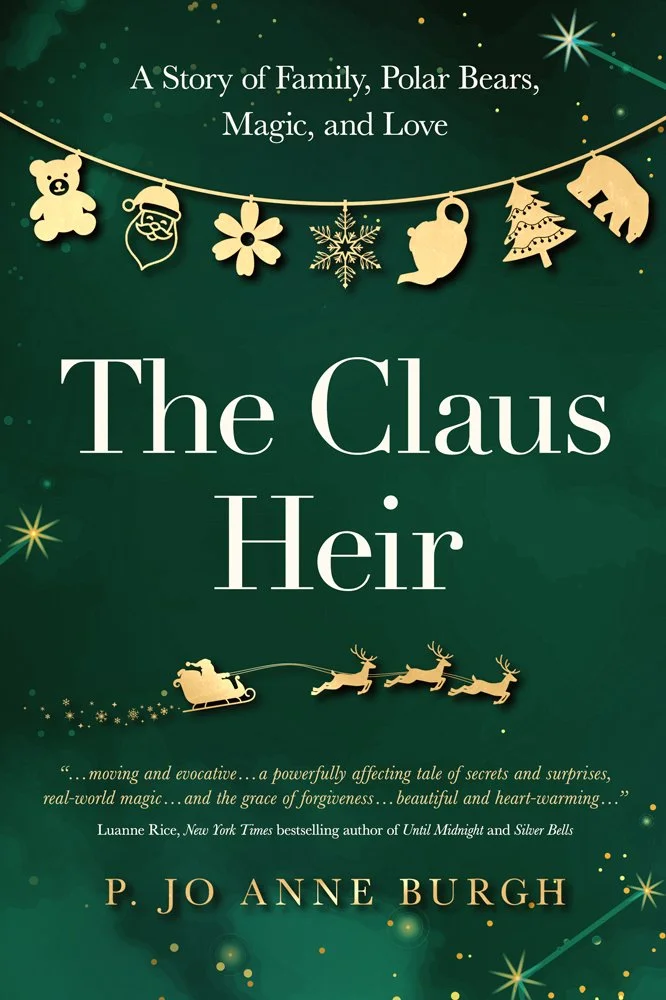
The Claus Heir is the third book in the series that started with State v. Claus and continued in Becoming Mrs. Claus. Tell us about your initial inspiration for these characters and world.
A long time ago—easily fifteen or twenty years ago—I stumbled upon a Christmas special called “Snow.” It was about a young Santa Claus who comes down to California in search of a missing reindeer. Naturally, while he’s trying to rescue the reindeer from some evildoer, he falls in love with an equally young woman who happens to be a wildlife professional of some sort. They work out everything with the reindeer, and then Santa announces that he’s in love with her and wants her to go back to the North Pole with him. For a moment, it seems as if it’ll be a typical happily-ever-after ending, except that she doesn’t leap at the invitation. Instead, her response is essentially, “But what about my life?” She has a career and people and a life, and she’d have to leave all of it to be with him. (Spoiler: she eventually does.)
Afterward, I started thinking about that question, i.e., what would it take to leave everything for someone? And especially if that someone claims to be a mythical figure so that being with him would basically mean abandoning your entire life and never looking back. So I started playing around with these ideas, just to see what might happen. It took a long time with lots of false starts, in part because the more I pondered, the more questions I ran into. The first two books were originally going to be one book, but in the end, there was far too much material. I had to keep slowing down to answer more questions before I could reach the point where it seemed plausible that Meg might believe that Santa could be real.
That’s also one of the reasons I made Meg a lawyer—I figured that a person who lives by logic, reason, and evidence would be enormously skeptical. Before she could be convinced, the evidence would need to be pretty compelling and the pieces would have to fit. Also, you know how they say to write what you know? Turns out, the real reason for that advice is so you don’t have to do as much substantive research while you’re also trying to figure out how to construct a coherent sentence. There were plenty of things I needed to research, such as life in prison, but at least the courtroom scenes were easy.
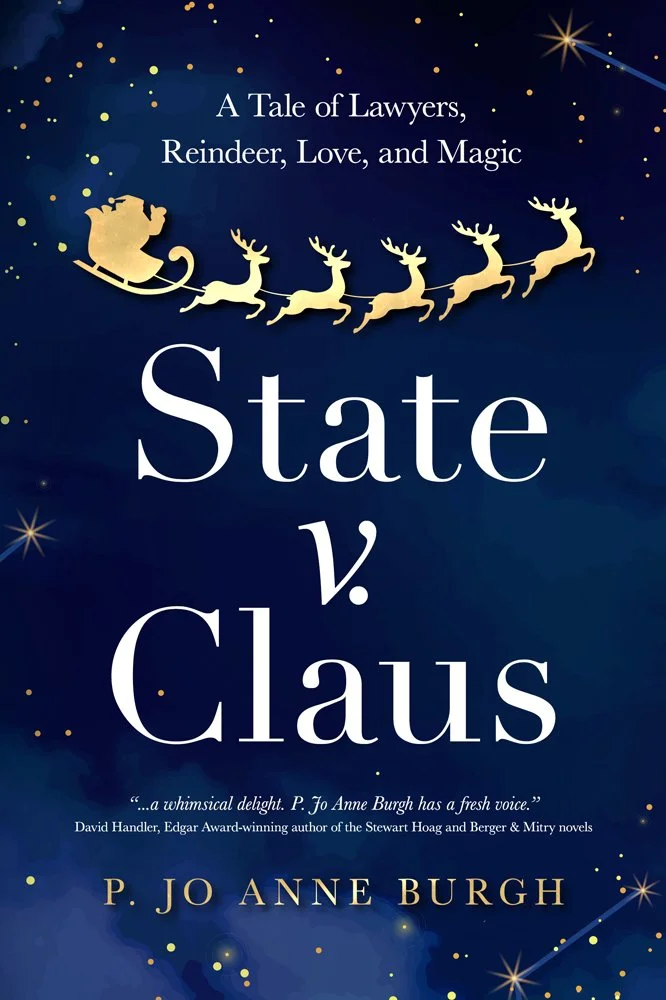
What is it about these characters and world that keeps you coming back to them?
Simply put, I like them. One of my favorites is Ralph’s youngest brother, Mitch, because he’s fiercely loyal to Meg and Ralph, and at the same time, he’s willing to deck his big brother if he thinks it’s necessary. You’ve got to love a guy like that.
Also, one of the fun things about a series is that even though you’re in a familiar setting (which saves you the work of creating a new world), you get to explore different characters at different times. For instance, in State v. Claus, Phil’s wife, Isabella, barely had any screen time, and Phil was only talked about. This meant that when I was working on Becoming Mrs. Claus, these two were a blank slate and I could do whatever I chose with them. Granted, Phil was somewhat limited because he was a Claus, but everything about Isabella was wide open. For the new book, I considered having Mitch fall in love, but in the end, it was just too much story and it went too far afield. There’s a limit to how much can happen in a single book. Otherwise, readers can’t tell what’s important, and they get bored and/or lost.
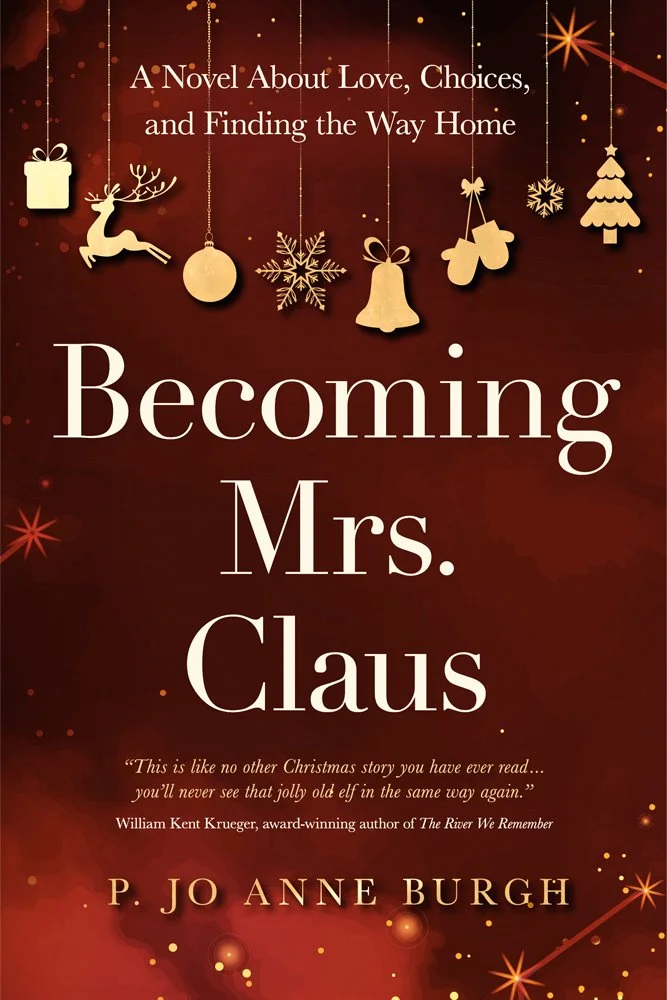
I know it’s hard to advertise a third book without spoiling the first two. What can you tell us about the newest installment?
I’m actually terrible about spoilers. If you think about it, the title of the second book spoils the first, and the title of the third spoils the other two. So, my apologies for anything I’ve already spoiled.
That said, I can tell you that the new one does not go the way some people might expect. To be honest, it didn’t go the way I expected, either. Suffice to say that things also don’t go the way Meg and Ralph think they will, and one of the major questions is how they will handle various unexpected happenings and what effect those happenings will have on them, individually and as a couple.
Who are your biggest inspirations? What influenced you to become a writer?
Taking the inspiration question first: I’m not certain what it means to say that someone is my inspiration, but there are writers whose work I’ve read and I think, “Yes. That’s what writing is supposed to be.” The one who comes immediately to mind is Laurie Colwin, who wrote with grace and inventiveness. She was the queen of the perfect turn of phrase—she would use an unexpected modifier, and you knew immediately what she meant, all the layers and nuances, just from that one word or phrase. In one of her food essays, she was describing how to make a particular dish. She said that you should do this, and this, and this, and you’d have a side dish fit for a visiting dignitary from a country whose politics you admire. I love that line so much. I could sit in front of my computer for a year and never come up with anything half that precise. When I first started writing in my forties, I could always tell whether I’d been reading Laurie Colwin by how lyrical my prose was.
As to what influenced me to become a writer, certainly not my college years. I’d spent most of my life writing, and teachers had praised and encouraged me. Then, in my junior year of college, I endured a truly awful workshop experience which deterred me from creative writing for the next twenty-five years. I wrote at work; in fact, practically every job I’ve ever had has eventually morphed into a writing gig in some way. Nearly thirty years(!) ago, I opened my present practice where I provide research and writing services to others. Of course, that kind of writing is very safe. You’re not exposing your heart when you write an appellate brief. All the judges care about is whether you’re making sense, and all the client cares about is winning. Nobody’s interested in how exquisite your prose is.
What finally started me writing fiction in my mid-forties was fan fiction. I’d discovered Bonanza just as it went off the air in 1973 and I loved that family, so I started writing my own stories about them. Fast forward to February 2006, I stumbled upon a Bonanza fansite which had a library of stories fans had written. I didn’t expect much, but one I found was very well-written, which woke something in me. All at once, I remembered how much I’d loved writing those stories, and without planning it, I started to write one. A few months later, I gathered all my nerve and posted my first story. To my amazement, people loved it. Over the next two years, I wrote dozens of stories. Because the main characters and the setting were established, I could work on other aspects of craft, from plotting and pacing to themes and language. It was the best place to practice, because there was a built-in readership, and they were generous with their praise. If someone thinks they’d like to try writing a story but they have no idea where to start, I recommend trying fan fiction.
What is your writing process like? Has it changed at all between writing the first book and now?
I’m a discovery writer, also known as a “pantser,” which means that I discover the story as I write. When I first started writing short fiction, I wrote scenes out of order as they occurred to me, and then I added the connective tissue. To a certain extent, I still do this with novels, but it’s much harder because they’re so unwieldy. With a novel, I need at least a vague sense of where the story is headed to avoid drowning in a sea of unrelated scenes. With State v. Claus, I knew approximately where Meg was going to land on the issue of belief, but I didn’t know how she’d get there. If I knew how the whole story worked before I started, I probably wouldn’t bother.
One thing that remains consistent with writing novels—with all my creative writing, really—is that the first draft is very bare-bones. It’s barely more than a script—dialogue and a bit of stage direction. For instance, in the first draft, John walks into a room and sits down. In the second draft, he enters the living room, and he sits in a chair. In the third draft, the chair is an armchair, and he flops into it in a way that shows how tired he is. By the fourth draft, he sits in an overstuffed red leather chair that used to belong to his father, and even though it clashes with everything else in the room, he won’t get rid of it because in his opinion, it’s the only comfortable chair in the room, which reveals something about John. And so on, until it’s time to start editing out whatever doesn’t ultimately serve the story.
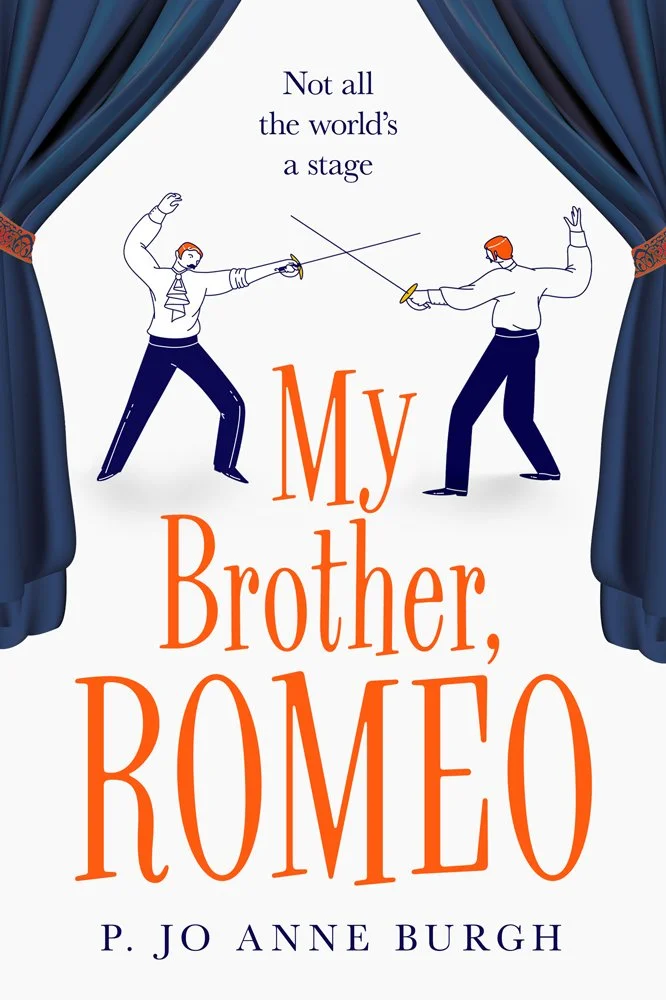
You’re also the author of the novella My Brother Romeo, which is not a Christmas romance. Since I consider November to be “Novella November,” I think this is the perfect time for you to tell us about that story and what inspired it.
My Brother, Romeo started as Bonanza fan fiction. I was working one day and I jotted a note: “Adam directs a play.” I don’t recall what prompted me to choose Romeo and Juliet as that play, but it turned out to be perfect for the story. As you know, I have the tiniest bit of experience in being a clueless person directing a play, so the story was great fun to write, especially when the narrator was in over his head.
*cough* I have NO idea what you could be alluding to about being a clueless director. (Reader, as mentioned above, see tomorrow’s Theatre Thursday post for how I once wanted to be an actor. Jo Anne plays a part in that story!) Another question that is hard to answer without spoilers, but one must ask: are you planning any further Claus books or a return to the Romeo characters?
As to the Clauses, I have no plans at the moment. In fact, I’ve been advertising The Claus Heir as the final book in the trilogy. I suppose it’s possible that someday I could go back and write Claus: The Next Generation, but right now, the chances are remote.
As to the Hunter family from My Brother, Romeo, I’ve thought of importing other fan fiction into their world and seeing whether I could make it work. I have one in particular that I’d love to convert, but I don’t know if it would work. For one thing, Romeo was humorous, and this one isn’t. I haven’t spent enough time with the Hunter family in the past few years to have a solid handle on how an original story might go, but I’m not ruling that out.
What else are you writing these days?
Appellate briefs. To-do lists for the launch party for The Claus Heir. Marketing materials. Reminders to pick up the cat’s prescription.
Actually, I recently wrote a story for my library’s Spooky Glastonbury contest, mainly because once I was finished with The Claus Heir, I needed something to write. The last few weeks had been so intense that once I finally approved and uploaded the book, it scared me to have nothing to work on. So when the library announced this contest, I dove in even though I’d never written anything spooky. The deal is that there are three age groups (6-11, 12-18, and 19+), with one winner in each group, and all the stories will be put into an anthology that will be available at the library. I had a few false starts before I found my narrator, but once I knew who she was and what motivated her, the story clicked right along.
And my usual final question: What is your favorite book, and why?
This is such a hard question because the answer changes depending on my mood. I used to say it’s To Kill a Mockingbird because I love Scout’s voice, but the publication of Go Set a Watchman changed my view of Atticus so much that I can’t look at Mockingbird the same way anymore.
Since I need something gentle in these stressful times, today I’m pick The Bachelor Brothers’ Bed and Breakfast, by Bill Richardson. If you haven’t read it and you’re also inclined toward something gentle, it’s perfect. It’s about a middle-aged pair of fraternal twins, Hector and Virgil, who run a bed and breakfast on a lightly populated island off the west coast of Canada. The B&B is for people who want to spend their vacation reading. The book is funny and insightful and perfectly lovely, and I wish I could escape to a place like that B&B. So for the moment, that’s my favorite.
Thanks again for letting me pick your brain!
Thanks so much for including me in your interview collection!
Quisque iaculis facilisis lacinia. Mauris euismod pellentesque tellus sit amet mollis.