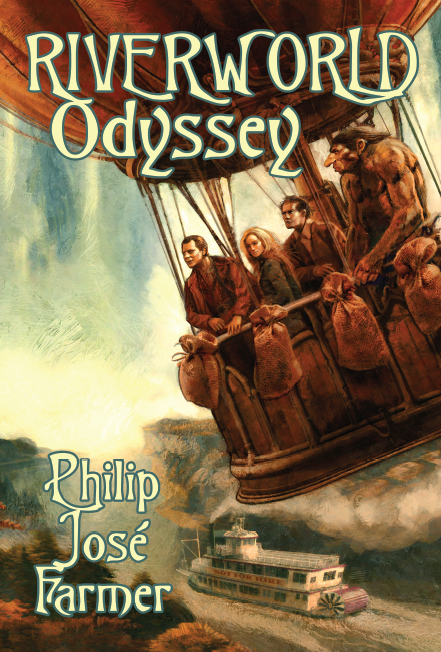
TITLE: Riverworld Odyssey
EDITOR: Michael Croteau
600 pages, Meteor House Press
MY RATING: Highly Recommended
REVIEW: With Riverworld Odyssey, Meteor House Press continues its excellent series of books focused on the developmental history and cultural impact of Philip Jose Farmer’s work. As the title implies, this latest volume traces the path of the Riverworld series from concept to final installment. That path meanders, bends, and doubles back as much as the Great River of the world on which the books take place.
For those who may be unfamiliar with Riverworld: the basic concept is that every person who ever lived on Earth, from pre-history through 1983, finds themselves resurrected on the banks of an 18-million-mile-long River. They are all in perfect health and twenty-five years old regardless of how old they were when they died on Earth (except if they died at a younger age; then they’re resurrected at the age they were when they died). There is a mysterious technology (eventually called “grails”) that provide food and drink to each individual multiple times per day. Otherwise, technology is limited to pre-Industrial Revolution levels due to the Riverworld’s lack of metal and ores. Also, death simply results in another resurrection elsewhere on Riverworld. Farmer mixes real historical figures (Sir Richard Francis Burton, Alice Hargreaves, Mark Twain, Herman Goering) with fictionalized versions of himself and his family members (his stand-in is Paul Jarius Frigate; his great-great-grandfather Andrew Paxton Davis appears in several short stories) to a few completely made-up characters (the most consistently appearing of which is “Joe the Caveman,” a human from pre-history).
It is not the intent of this review to rehash the backstory of how Farmer came to write the original, unpublished (and as far as we know, lost) short novel Owe For the Flesh, which eventually after many iterations and over many hurdles became the beloved Riverworld series. “Hinterland,” Paul Spiteri’s wonderful introduction to the volume, covers that ground far more capably and in greater detail than I could here. Suffice to say, the behind-the-scenes publishing machinations are fascinating. Spiteri’s introduction is further enhanced throughout the book by letters from Farmer and his various editors and publishers with intended outlines (and even an indication of who Farmer wanted to complete the Riverworld series if he passed away before he did so). The intent of this review is to tell you whether Riverworld Odyssey, as a stand-alone book, is worth the price of admission.
Short answer: YES. Unequivocally yes.
Firstly, it is amazing to be able to track the genesis and development of the concept in so much detail and in essentially “real time” with various drafts and Farmer’s letters and essays. While that original short novel is likely lost completely (although there’s always a spark of hope that some Farmer fan will trip across it in a long-lost lockbox somewhere), this collection does start with “River of Eternity,” the second draft of the story. All of the core ideas of the series, and most of the series’ eventual main characters, appear in “River,” including Sir Richard Francis Burton, about whom Farmer wrote a biography (A Rough Knight For the Queen, also available from Meteor House), and Mark Twain, although both appear under other names (a choice which Farmer explains in one of his essays). The entire tale is told in roughly 137,000 words, by the end of which the entire mystery of Riverworld has been solved. This alone would be worth the cover price (copies of the Phantasia Press hardcover release from 1983 are going for almost as much as this volume costs, and this volume has an additional 400-ish pages!).
Fiction-wise, we also get the version of the novella “Day of the Great Shout” that appeared in Worlds of Tomorrow magazine and eventually became, with some changes, the first half of the first Riverworld novel, To Your Scattered Bodies Go, as well as the novelette “Riverworld” which first appeared in the same magazine, and what I believe are the first reprintings of the short stories Farmer wrote for the paperback anthologies Tales of Riverworld and Quest to Riverworld, and a large section of text that was cut from the novel The Dark Design (here entitled “Riverworld War,” featuring of all things a war between riverboats that is one of the most action-packed and chaotic fights Farmer ever wrote). I should note: this anthology does NOT include any of the stories from the anthologies that were written by authors. It would be wonderful if those could be brought back into print at some point, but I’m sure the rights are a bear to wrangle.
In the non-fiction pieces written by Farmer himself, we get so much insight into how Farmer’s creative mind worked, how he strung ideas together and developed characters. I wish he’d written a book about writing or a memoir (or both!) before his death.
In addition to the letters from Farmer to various publishers and editors, Riverworld Odyssey also includes erudite and informative essays about Farmer’s and Riverworld’s influence, from writers Mary A. Turzillo (who wrote a book about Farmer), Bruce Sterling, John Gregory Betancourt, Tracy Knight, Alex Berman, and editor Michael Croteau.
At 600 pages of $29 (trade paperback)/$75 (hardcover), Riverworld Odyssey is, as stated above, well worth the price of admission, whether you’re already of fan of Riverworld and want to do a deeper dive into the series’ history or you’re a fan of other Farmer works and are just now delving into one of his greatest works.
The other books Meteor House Press has released doing deeper dives into specific Farmer series or interests are Savageology (covering everything Farmer wrote connected to Doc Savage) and The Man Who Met Tarzan (covering everything Farmer wrote regarding Tarzan, of course).
Riverworld Odyssey as well as The Man Who Met Tarzan and Savageology can be ordered from Meteor House’s website. If you’re near Pittsburgh PA, they will also have a table at Pulpfest July 30th - August 2nd!
*I have moved away from a star-based rating system here on the blog (I can’t avoid using stars on Goodreads, NetGalley, and the various bookseller sites). Instead I am switching to ranking books as “highly recommended,” “recommended,” “satisfactory” and “not right for me.” I may add other levels as I refine this concept.
