Series Saturday: the Philip Marlowe novels

This is a blog series about … well, series. I love stories that continue across volumes, in whatever form: linked short stories, novels, novellas, television, movies, comics.

Marlowe Cover Banner.png


In 2019, I realized after several conversations with my friend Dave (our conversations often lead to me identifying something I haven’t read or seen) that I had never read a Philip Marlowe novel (or likely anything else by Raymond Chandler). I mean, I knew who Marlowe was, and I knew Chandler’s influence on the mystery genre overall and noir in particular. So how was it that I could not recall every having read a single Marlowe book? It was time to fix that!

As with so many of the reading and/or viewing challenges I set myself, it took a while for this one to play out. I listened to the first Marlowe novel, The Big Sleep, in late 2019, and then decided to motivate myself by making the Marlowe books a part of my “Complete the Series” Challenge for 2020. I made a game start at the beginning of the year thanks to several long work trips with lots of driving, then dropped the ball until Noirvember when I read the final two books written or co-written by Chandler.

The long gap between the first six books and the final two influenced my experience of the series as a whole. Another influence was experiencing the series in three different forms. I listened to the first two novels narrated by Ray Porter. When I went to purchase book three, I discovered that it was not available with narration by Porter – nor were the rest of the books. That left me with either listening to abridged editions narrated by Elliot Gould or full-cast recording from the BBC starring Toby Stephens. As I really wanted to continue the experience of hearing Chandler’s actual words, I chose the Gould abridged editions. When it came time for book seven? Only the full-cast BBC version was available. I switched to print for the final two books, which partially explains the seven months gap as the last book (started by Chandler but completed after his death by Robert B. Parker) was harder to track down than I expected it to be.

Overall, I loved this series. So much of what Chandler did is consider trope now – but I believe he was the first to do it, or at least the first to do it well enough to influence others.

His characterization of Marlowe – world-weary, introspective, a bit of a horn-dog, chivalrous and chauvinistic in equal measure, aware of his own prejudices and not always able to stop himself from acting on them – set a standard for disgruntled, distrusting protagonists. And the characterization isn’t quite static. In some books, he’s far more introspective and fatalistic while in others he’s just cynical and snarky. (Okay, he’s snarky in every single book. It’s part of his charm.) The heaviest introspective moments, the moments that gave noir its enduring rep, seem to come in the second through fifth books. In the first book, Marlowe is thoughtful but not full-out depressing. In the later books, Marlowe seems to have mellowed a little. He’s still world-weary but he seems to have accepted it and ruminates less on it. Or at least, he spends fewer words ruminating on it.

Chandler’s formula was to have Marlowe take on a case that then connects to one or more other cases. I may be mistaken, but I don’t think he varied from that basic formula throughout the books (and it’s especially evident in the final book, Playback). Most of the time, he’s hired by someone rich who is condescending at best and occasionally downright hostile. And these rich folks usually get some kind of come-uppance even when they’re not the actual bad guy of the story. In terms of the mysteries, Chandler is usually good about providing the reader with enough hints of what’s going on that the reveal doesn’t come out of nowhere. Marlowe’s interactions with the police are always interesting and not always antagonistic (I’d say it’s about 50/50 over the series). It’s also sort of fun trying to figure who Marlowe is going to go to bed with and when (and occasionally even if – he doesn’t always let his hormones win over common sense).

One of the things that did surprise me was how few continuing supporting characters there are. I expected Marlowe’s former boss, introduced in the first book, to appear or at least be mentioned more than once. Likewise, some of the cops; I realize Los Angeles was a big city even in the 1940s and that some of the action rolls outside of LA proper (even down to San Diego and into Mexico), but we rarely see an officer of the law a second time. (Parker does bring one of them back in Poodle Springs, but I have to wonder if Chandler would have done so had he written more than four chapters before passing away). Nowadays, the idea of a detective character without a regular supporting cast, including a regular antagonist of some kind, is unthinkable. Then again, the idea of a series lead without a serious romantic interest is also unthinkable these days, and it’s only in the final three books that we see Marlowe make a serious commitment (even if we don’t realize he’s making the commitment until the end of Playback and the opening of Poodle Springs). I personally thought Anne Riordan from Farewell, My Lovely, had the makings of a perfect non-romantic Girl Friday and would have added a lot to later books.

So how did the various listening/reading formats affect my experience?

I really loved Ray Porter’s interpretation of the character, gruff-voiced but still relatable, and that set the tone for me. He plays with Chandler’s language the way someone who really enjoys lush descriptions does. He’s clearly invested in the role and having fun with it, and every word has appropriate weight. I really wish the entire run was available narrated by Porter (who has narrated a LOT of other stuff, and I’m never disappointed with his work when I get to listen to it).

Elliot Gould is well known for playing Marlowe in 1973’s film version of The Long Goodbye, and he’s a great reader who also really gets the character – but the abridged audiobooks feel rushed. There are no chapter breaks, the action running from one scene to another without the pause such breaks afford the reader. More than once I found myself confused because of contradictory back-to-back statements (it’s midnight, and then suddenly it’s noon, for instance) that a simple intonation of “Chapter Six,” or even a ten second pause, would have broken up. My theory, which I haven’t checked, is that the Gould-narrated books (including the first two, which I didn’t listen to) were recorded at a time when audiobooks were on cassette (and the more cassettes a publisher had to produce, the higher the price) or early CDs (when the discs couldn’t hold as much data as they do now). Then there’s the fact that they’re advertised as “abridged,” which means something deemed inconsequential by someone was removed to make the narration fit into the allotted cassette or CD space. I’m still wondering what I missed by not just reading the actual novels of these five books.

Reading, instead of listening to, Playback and Poodle Springs allowed me to merge the best parts of Porter and Gould’s performances in my head. Although thanks to the cover art on Playback my mental image of Marlowe was Robert Mitchum. (It’s not Mitchum on the cover – it just looks a lot like him.) It felt appropriate to be in the home stretch with Marlowe on my own, turning yellowed pages (one paperback, one hardcover, both from used bookstores) and savoring Chandler’s descriptions of places and people.

I can imagine rereading the entire series one day, especially because I’ll always have that nagging question of what the abridged audiobooks cut out. But for now, I’m glad I finished this challenge this year!

The Marlowe Books, in order, are:

·       The Big Sleep (1939)

·       Farewell, My Lovely (1940)

·       The High Window (1942)

·       The Lady in the Lake (1943)

·       The Little Sister (1949)

·       The Long Goodbye (1953)

·       Playback (1958)

·       Poodle Springs (unfinished by Chandler at his death in 1959; completed by Robert B. Parker in 1989)

Parker did write another sequel completely on his own, which I decided not to include in this particular challenge. And there have been several other Marlowe prequels and sequels in the past few years that sound like they might be worth seeking out.

Series Saturday: Monsterland

This is a blog series about … well, series. I love stories that continue across volumes, in whatever form: linked short stories, novels, novellas, television, movies, comics.

monsterland logo.png


Monsterland

1 season (so far), eight episodes

Annapurna Television, Two & Two Pictures

Hulu, 2020


Synopsis: (from the IMDb page) Encounters with Gothic beasts, including fallen angels and werewolves, broken people are driven to desperate acts in an attempt to repair their lives, ultimately showing there is a thin line between man and beast.


My Thoughts: Monsterland, an episodic anthology show with a horror bent, debuted on Hulu in October 2020. Based partially on Nathan Ballingrud’s fantastic short story collection North American Lake Monsters (reissued under the title Monsterland to coincide with the show), the show is more psychological horror than slasher flick or fantasy horror. Which isn’t a bad thing – but may surprise some viewers expecting more traditional horror from the series description.


Tonally, Monsterland feels like the horror equivalent of the few Black Mirror episodes I’ve seen. Episodes are claustrophobic and weather-beaten (in a good way to this viewer). Close-ups of characters, tight two-shots, and slightly-out-of-focus backgrounds in wider shots contribute to the claustrophobic “it’s just the viewer and the character” tone; for many of these episodes I really felt like I was in the room/environs with the characters. Regional climates saturate every episode: the humidity of Port Fourchon and New Orleans, the winter chill of Eugene Oregon and Newark New Jersey, the stark cold of backwoods Iron River Michigan, and the salt-air wet of Palacios Texas are as much as a character as the humans who populate the stories set there. Likewise, the man-made suburban false security of Plainfield Illinois and the tightly spaced urban modernity of New York, New York take a toll on the characters in those episodes.

Although the series is, as mentioned, nominally adapted from Nathan Ballingrud’s short stories, several episodes are original to the series. To help make them feel of a whole, episode titles are simply the city and state where the story takes place. This also contributes to the overall series concept that monsters can be found anywhere, from the rural to the urban.

And that’s really the thematic connective tissue of the series: that as much as it would be nice to think monsters are supernatural and fully evil, the truth is any one of us has the potential to be a monster to someone or something. People are selfish. People are manipulative. People make bad decisions which have greater impacts than they realize in the moment. Some of those decisions are made intentionally, some inadvertently. Some results are immediate, some take years to echo out. But ultimately, these are stories about how horrible people can be to each other and to the environment.

The “actual” monsters presented are often incidental – or at least are the inciting incident rather than the point of the episode. Meeting a shape-changing serial killer in Port Fourchon sets Toni on a path she can’t come back from; a demon in New Orleans forces Annie to see what she’s been hiding from herself for over a decade; a shadow-being exposes an already down-trodden teen in Eugene to the controlling vitriol of online conspiracy theorists; urban legends about haunted woods alter the life course of three teens in Iron River; fallen angel-like beings in Newark skirt the periphery of Brian and Amy’s personal tragedy . There are a few episodes where the supernatural element is more prevalent and central to the narrative, however: an encounter with a mermaid helps an injured Palacios fisherman reclaim his sense of self-worth, a religious epiphany emotionally and physically impregnates a New York oil executive, and a lesbian couple in Plainfield face a very real case of life-after-death.

There is a bit of lip-service paid to these episodes taking place in the same world: Kaitlyn Dever’s Toni appears in several episodes under different aliases, the oil spill at the heart of the New York episode is background to the Palacios Texas episode, and I think a couple of other background characters turn up or are mentioned more than once. It all felt a bit unnecessary. Anthology shows like this don’t really need to have recurring characters shuffling through the background except for the writers/directors to give a little wink-wink to the viewers. Had the recurring appearances of Toni led somewhere (perhaps in a potential season two?), I might have felt differently.

The performances of the leads in each episode are roundly excellent. Full credit to Kaitlyn Dever, Nicole Beharie, Kelly Marie Tran, Mike Cotton and Adepero Oduye, Trieu Tran, Taylor Schilling and Roberta Colindrez, Charlie Tahan and Ben Rappaport, Bill Camp and Michael Hsu Rosen. The supporting casts of each episode are also solid, but the intimate focus of each episode puts the burden of the story on the one or two leads, even in party scenes.

It should be noted that a few of these episodes touch heavily on topics that may be emotional triggers for people who have gone through similar struggles. I’m thinking in particular of the “Plainfield, Illinois” episode, which hinges heavily on a not-particularly nuanced portrayal of bipolar disorder and depression. It was a hard episode for me to watch, and I’m “only” depressed, not bipolar. Other episodes deal with child molestation, child abandonment, and child disappearances.

I don’t believe a second season pick-up has been announced, but I am hoping for more of Monsterland, including more direct adaptations of Ballingrud’s short stories.

Series Saturday: The Führer and the Tramp

This is a blog series about … well, series. I love stories that continue across volumes, in whatever form: linked short stories, novels, novellas, television, movies, comics.

cover art by Dexter Wee

cover art by Dexter Wee


The Führer and the Tramp, published by Comics Experience and Source Point Press, 2020

Writers: Sean McArdle and Jon Judy

Pencils and Inks: Dexter Wee

Letters and Colors: Sean McArdle

Editor: Andy Schmidt


Synopsis: Charlie Chaplin – comic, filmmaker, and raconteur – didn’t become the world’s biggest star by courting controversy, but when he comes face-to-face with the horrors of Hitler, he feels compelled to get off the sidelines and get involved. And then Charlie is approached by FDR himself with a special assignment. His mission, if he chooses to accept it: create a propaganda film to drum up public support for joining the war in Europe.

And so Charlie goes from movie maker to provocateur, traveling the world and dodging danger to complete his film. With the help of undercover agent Hedy Lamarr, her handler Errol Flynn, and British patriot Alfred Hitchcock, Chaplin faces down American fascists, Nazi spies, and his own massive self-doubt to complete his masterpiece.

But just because the film is done doesn’t mean the mission is, and little tramp and great dictator go toe-to-toe, Charlie and Adolph, one-on-one, mano a mano in a rip-roaring climax that fully delivers on the promise of the premise.


My Thoughts: I ordered this series through my local comic shop partially because the concept sounded fun, but mostly on the strength of Dexter Wee’s art. I got to know Dexter’s work on the webcomic Cura Te Ipsum, in which Dexter and writer Neal Bailey “Tuckerized” me in a few scenes. I’ve always found Dex’s work to be fluid, expressive, and full of action. So I was not surprised at how well he captured Chaplin’s antic physicality, Lamarr’s intelligent sexiness, Hitchcock’s imperious posture, and Flynn’s swashbuckling stature. He also manages to lampoon Hitler and the Nazi rank-and-file without being cartoony, not always an easy line to walk when one is trying to tell a funny story that doesn’t deflate the seriousness of the threat the Third Reich posed. Wee moves effortlessly from panoramic establishing shots to multi-panel action sequences to intimate close-ups. The things he closes in on aren’t always faces – another way he drives home each character’s personality (for instance, the focus on Chaplin’s legs on the first page of the first issue, as Charlie is confronted by a Nazi soldier who mistakes him for a German Jew lacking a star and papers conveys Chaplin’s aggravation at not being recognized, anger at the way Jews are being treated, and nervousness at possibly being arrested – all accomplished without a single facial expression in evidence). And his visual representations of very real people, from Chaplin to FDR to some surprise cameos in book five that are too fun to spoil here, are spot on. I’m pretty sure most folks would recognize each historical person even without dialogue or captions.

Wee’s art brought me to the book, but Sean McArdle and Jon Judy’s story and dialogue kept me invested through all five issues. They balance the comedy, drama, and action elements perfectly throughout, never allowing the comedic or fanciful sequences to subvert the very real seriousness of the Nazi threat. Of course, the series is intended to be, first and foremost, comedy. That comedy swings between physical slapstick (Chaplin naked and spilling iodine in FDR’s lap) and Noel Coward-esque banter (especially between Flynn and Lamarr), with some more subtle humor sprinkled throughout. The dialogue, whether comedic or serious, captures the vocal ticks and mannerisms unique to each character, matching how well Wee’s art captures their physical likenesses without sliding into cliché or pastiche. All three creators really did their homework, is what I’m saying. The pace is also near perfect: I can’t imagine this story feeling as complete if it had run fewer than five issues, but I can certainly imagine how bloated it would have felt at six or more.

Being a story that purports to tell “the truth behind the true events,” there’s a lot of stuff the creators admit isn’t historically accurate (it’s unknown whether Chaplin actually ever met FDR, for instance) and bits that trade off of urban legend (this is not the first time its been suggested that Lamarr and/or Flynn were employed by the US government as spies/operatives). The fun is in imagining that this all could have happened and been highly classified all this time. McArdle, Judy and Wee roll with that sense of fun throughout … and even hint that maybe this wasn’t the only time Charlie Chaplin got suckered into a high-stakes adventure alongside Lamarr and Flynn. I can only hope there’s another miniseries in the near future from this creative team.

I believe the individual print issues of The Führer and the Tramp are sold out from the publisher, so your local comic shop may have a hard time getting them for you. But there’s always the secondary market and the ebooks, until the trade paperback collection comes out in 2021.

Series Saturday: Universal's Frankenstein movies

This is a series about … well, series. I do so love stories that continue across volumes, in whatever form: linked short stories, novels, novellas, television, movies. I’ve already got a list of series I’ve recently read, re-read, watched, or re-watched that I plan to blog about. I might even, down the line, open myself up to letting other people suggest titles I should read/watch and then comment on.

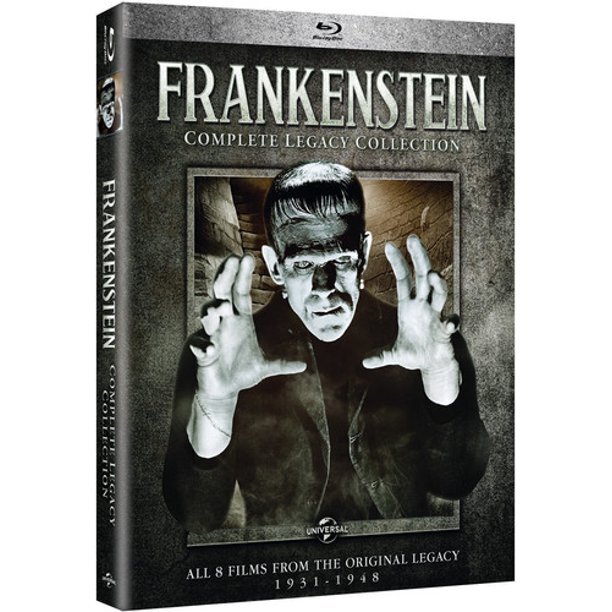
Frankenstein Legacy Collection.jpeg

I’ve been a fan of the original Universal Studios Monsters franchise for as long as I can remember, but it’s been quite a while since I’ve done any kind of intentional rewatch of most of them. This year I thought, being in the midst of a pandemic and all, that maybe I’d have time to revisit most of the rest, via the Legacy Collection DVDs I’ve had for ages. For various reasons, I only got through the Frankenstein movies.

There are eight movies in the original Universal Frankenstein series (or seven, if you’re one of those folks who discounts Abbott and Costello Meet Frankenstein):

·         Frankenstein (1931)

·         The Bride of Frankenstein (1935)

·         Son of Frankenstein (1939)

·         Ghost of Frankenstein (1942)

·         Frankenstein Meets the Wolf Man (1943)

·         House of Frankenstein (1944)

·         House of Dracula (1945)

·         Abbott and Costello Meet Frankenstein (1948)

The Universal Monsters “universe” was perhaps the earliest cinematic universe in terms of characters overlapping, but the attention to continuity wasn’t like it is today with the Marvel Cinematic Universe and such fare. The Frankenstein movies as a whole hold together better than some of the other sub-franchises in the UMU (I’m looking at you, sequels to Dracula!). Still, there are lots of discrepancies: in Frankenstein, Henry Frankenstein’s tower lab is some distance from Manor Frankenstein and the town it is a part of; in Bride, the tower is a lot closer, and in Son, the tower is right next door to what is now Castle Frankenstein, which overlooks the village. The interior sets of the Manor change quite a bit between Frankenstein and Bride, as well. Sometimes the same character is played by different actors across the franchise, and sometimes the same actors show up as multiple characters. I doubt many audience members at the time cared, as long as they got a good story, but I don’t think it would fly today.

For the most part, we do get solid stories with compelling characters. Although not very similar to the novel on which it is based, Frankenstein gives us Colin Clive’s brilliant performance as the obsessed and conflicted Henry Frankenstein and Boris Karloff’s poignant confused and lost Monster, supported by the always-eerie Dwight Frye as the hunchbacked assistant Fritz and the understated Edward Van Sloan as Doctor Waldman. The only weak point in the main cast, to me, is Mae Clarke as Elizabeth; her performance is a bit too “stagey” as compared to the rest of the cast (and perhaps is the reason the role was recast for Bride?). As unlike the source material as it may be, it’s still a tightly-told and well-acted tale directed by James Whale with great mood and tension throughout.

Karloff and Clive return as the Monster and his creator in The Bride of Frankenstein under Whale’s continued direction, with Elsa Lancaster as both Mary Shelley and the Bride. Valerie Hobson replaces Mae Clarke as Elizabeth. I love this movie almost as much as the original and Son, but man is the tone just all over the place. Whale can’t seem to decide if he’s making a pathos-filled character piece or a slapstick comedy. Una O’Connor’s Minnie (maid to Elizabeth? Housekeeper? I’m still unsure after multiple viewings exactly what her job is) takes up way more screen-time than comic relief should in a film like this, and O’Connor’s shrill over-the-top delivery makes almost every scene she’s in hard to watch. The scene where Doctor Pretorius (Ernest Thesiger) produces his Homunculi also feels out of place, between the bawdy comedy between the Homunculi and the fact that Homunculi are never seen or mentioned again. Karloff is at his best as the Monster here, learning to talk and feel, and Clive matches him turn-for-turn as Henry grows desperate to just be done with creating life and return to his wife. If not for the Una O’Connor scenes and the Homunculi bit, Bride would be pretty perfect and perhaps even better than the original.

Son of Frankenstein, directed by Rowland V. Lee, was Karloff’s last turn as the Monster. Karloff does more acting here with his eyes than most actors do with their whole bodies, but he feels wasted. The Monster’s ability to talk is inexplicably gone. He’s not given much to do other than rampaging. Basil Rathbone takes over the lead spot as Henry’s son Wolf and does a great job as a man conflicted between forging his own path and following in his father’s footsteps. Bela Lugosi is brilliant, and almost unrecognizable, as the hunchback Ygor, stealing every scene he’s in.  Lionel Atwill makes his first appearance in the franchise as the one-armed Col. Krogh (in a scene that gets sent-up expertly by Mel Brooks in Young Frankenstein). There are still some awkward humorous moments, mostly involving Wolf and Elsa (Josephine Hutchinson)’s toddler son Peter (Donnie Dunagan), but they’re not as prevalent or as distracting as the Minnie scenes in Bride. Had the franchise ended as a trilogy, it might rank as one of the best horror trilogies ever.

Ghost of Frankenstein moves the action from the town of Frankenstein to the town of Vasaria (where it will remain for pretty much the rest of the franchise). Lugosi returns as Ygor, Lon Chaney Jr. takes over as the Monster (not much more than a weapon of destruction, although in the early scenes there’s an attempt at emotion as the Monster once again bonds with a little girl and the crowd reacts out of fear for her safety), Sir Cedric Hardwicke plays both Ludwig Frankenstein (younger son of Henry) and Henry’s ghost, Evelyn Ankers appears as Ludwig’s daughter Elsa (not to be confused with Wolf’s wife), and Lionel Atwill plays his second character in the franchise, the not-so-nice Doctor Boehmer. It’s a solid movie, building tension as the various non-Monster leads jockey for whose brain they’re going to transplant into the Monster. There’s even a bit of a return to the Monster as he was in Bride, able to speak towards the end of the movie. But it almost feels like director Erle C. Kenton and the writers are trying too hard to be surprising and sneaky. I still love it, just not as much as the previous three.

Frankenstein Meets the Wolf Man puts Lon Chaney Jr. back where he’s best (in hair and fangs), and puts Bela Lugosi in the Monster’s make-up. A sensible move given Ygor’s brain ends up in the Monster at the end of Ghost, except that behind-the-scenes machinations removed any scene where the Monster actually speaks, so Lugosi is as wasted as Karloff felt in Son (perhaps even more so). Elsa Frankenstein is now played by Ilona Massey (with an accent the previous Elsa didn’t have), and dialogue lets us know this is Ludwig’s daughter and not Wolf’s wife. She’s the first Frankenstein featured in the franchise who isn’t a scientist and really has nothing to do with the Monster. Lionel Atwill is back as his third character in the franchise, the Mayor of Vasaria. This is far more of a Wolf Man movie than it is a Frankenstein. Sans dialogue, the Monster is a weapon of mass destruction to be unleashed and defeated.

House of Frankenstein and House of Dracula are “everything and the kitchen sink” approaches to combining several of the Universal Monsters. To this day, I’m not sure why the Mummy and the Invisible Man weren’t invited to the parties. Both movies are pretty disjointed, especially in integrating Dracula into the rest of the action. Concentrating on just the Frankenstein elements: In House of Frankenstein, Glenn Strange takes over as The Monster; Lionel Atwill plays yet another character, Inspector Arnz; there’s a new hunchback played by J. Carrol Naish; and Boris Karloff returns to the franchise as a very different mad scientist, Doctor Neimann. Karloff is brilliant and Naish is excellent, but the Monster himself just lumbers and kills and is “killed.” In House of Dracula, Strange continues as the Monster; Lionel Atwill plays character #5 in the franchise, Police Inspector Holtz; the hunchbacked assistant is a woman (Jane Adams); and the mad scientist is now Doctor Edelmann, played by Onslow Stevens (the closest the Universal Monsters franchise ever really gets to incorporated a version of Doctor Jekyll and Mister Hyde, at least until the Abbott and Costello movies). House of Dracula is again far more of a Wolf Man (and perhaps a Jekyll/Hyde or even Dracula) movie than it is a Frankenstein movie. The Monster is mostly there for mayhem, but at least the Wolf Man gets a happy ending.

There are a lot of people who don’t consider Abbott and Costello Meet Frankenstein as a valid part of the Frankenstein (or larger Universal Monsters) franchise. I am most emphatically not one of them. While I’m not sure where it should fit in the overall sequence (since I like to think that Larry Talbot gets to keep his Happy Ending from House of Dracula), I think it treats the monsters who appear (Bela Lugosi back as Dracula, Glenn Strange as the Monster, Lon Chaney Jr. as the Wolf Man, Lenore Aubert as the requisite “mad scientist,” and a cameo by Vincent Price as The Invisible Man) with great respect. They’re played as the serious monsters they are, not for laughs. The comedy that comes from Abbott and Costello’s reactions to the Monsters fits much better than that provided by Minnie in Bride or Peter Frankenstein in Son. And Glenn Strange actually gets to speak as the Monster! The only thing that would have made this movie more perfect would have been if Lionel Atwill had still been alive to play one more random police officer or mad scientist. Unfortunately, he’d passed away in 1946. Still, it’s a fitting end-cap to the franchise.

Except…

For my own part, I also include Mel Brooks’ Young Frankenstein as a coda or grace note to the franchise. I included it in this rewatch, even though it’s not in the Legacy DVDs because it was released by a different studio. Brooks and Wilder’s love for the original movies is so evident in every frame of their film. They poke fun at the original movies’ inconsistencies and quirks, while still keeping the tone and using some of the original set pieces. There’s even a theory (espoused by my good friend Chuck Loridans among others) that “Froederick” Frankenstein is actually … Peter Frederick Frankenstein, Wolf’s son! (Who would have be a bit amnesiac to not remember meeting the original Monster and a one-armed policeman as a boy, but the blond hair, the expressive eyes, the sense of wonder… it fits!)