Series Saturday: The Führer and the Tramp

This is a blog series about … well, series. I love stories that continue across volumes, in whatever form: linked short stories, novels, novellas, television, movies, comics.

cover art by Dexter Wee

cover art by Dexter Wee


The Führer and the Tramp, published by Comics Experience and Source Point Press, 2020

Writers: Sean McArdle and Jon Judy

Pencils and Inks: Dexter Wee

Letters and Colors: Sean McArdle

Editor: Andy Schmidt


Synopsis: Charlie Chaplin – comic, filmmaker, and raconteur – didn’t become the world’s biggest star by courting controversy, but when he comes face-to-face with the horrors of Hitler, he feels compelled to get off the sidelines and get involved. And then Charlie is approached by FDR himself with a special assignment. His mission, if he chooses to accept it: create a propaganda film to drum up public support for joining the war in Europe.

And so Charlie goes from movie maker to provocateur, traveling the world and dodging danger to complete his film. With the help of undercover agent Hedy Lamarr, her handler Errol Flynn, and British patriot Alfred Hitchcock, Chaplin faces down American fascists, Nazi spies, and his own massive self-doubt to complete his masterpiece.

But just because the film is done doesn’t mean the mission is, and little tramp and great dictator go toe-to-toe, Charlie and Adolph, one-on-one, mano a mano in a rip-roaring climax that fully delivers on the promise of the premise.


My Thoughts: I ordered this series through my local comic shop partially because the concept sounded fun, but mostly on the strength of Dexter Wee’s art. I got to know Dexter’s work on the webcomic Cura Te Ipsum, in which Dexter and writer Neal Bailey “Tuckerized” me in a few scenes. I’ve always found Dex’s work to be fluid, expressive, and full of action. So I was not surprised at how well he captured Chaplin’s antic physicality, Lamarr’s intelligent sexiness, Hitchcock’s imperious posture, and Flynn’s swashbuckling stature. He also manages to lampoon Hitler and the Nazi rank-and-file without being cartoony, not always an easy line to walk when one is trying to tell a funny story that doesn’t deflate the seriousness of the threat the Third Reich posed. Wee moves effortlessly from panoramic establishing shots to multi-panel action sequences to intimate close-ups. The things he closes in on aren’t always faces – another way he drives home each character’s personality (for instance, the focus on Chaplin’s legs on the first page of the first issue, as Charlie is confronted by a Nazi soldier who mistakes him for a German Jew lacking a star and papers conveys Chaplin’s aggravation at not being recognized, anger at the way Jews are being treated, and nervousness at possibly being arrested – all accomplished without a single facial expression in evidence). And his visual representations of very real people, from Chaplin to FDR to some surprise cameos in book five that are too fun to spoil here, are spot on. I’m pretty sure most folks would recognize each historical person even without dialogue or captions.

Wee’s art brought me to the book, but Sean McArdle and Jon Judy’s story and dialogue kept me invested through all five issues. They balance the comedy, drama, and action elements perfectly throughout, never allowing the comedic or fanciful sequences to subvert the very real seriousness of the Nazi threat. Of course, the series is intended to be, first and foremost, comedy. That comedy swings between physical slapstick (Chaplin naked and spilling iodine in FDR’s lap) and Noel Coward-esque banter (especially between Flynn and Lamarr), with some more subtle humor sprinkled throughout. The dialogue, whether comedic or serious, captures the vocal ticks and mannerisms unique to each character, matching how well Wee’s art captures their physical likenesses without sliding into cliché or pastiche. All three creators really did their homework, is what I’m saying. The pace is also near perfect: I can’t imagine this story feeling as complete if it had run fewer than five issues, but I can certainly imagine how bloated it would have felt at six or more.

Being a story that purports to tell “the truth behind the true events,” there’s a lot of stuff the creators admit isn’t historically accurate (it’s unknown whether Chaplin actually ever met FDR, for instance) and bits that trade off of urban legend (this is not the first time its been suggested that Lamarr and/or Flynn were employed by the US government as spies/operatives). The fun is in imagining that this all could have happened and been highly classified all this time. McArdle, Judy and Wee roll with that sense of fun throughout … and even hint that maybe this wasn’t the only time Charlie Chaplin got suckered into a high-stakes adventure alongside Lamarr and Flynn. I can only hope there’s another miniseries in the near future from this creative team.

I believe the individual print issues of The Führer and the Tramp are sold out from the publisher, so your local comic shop may have a hard time getting them for you. But there’s always the secondary market and the ebooks, until the trade paperback collection comes out in 2021.

Series Saturday: Universal's Frankenstein movies

This is a series about … well, series. I do so love stories that continue across volumes, in whatever form: linked short stories, novels, novellas, television, movies. I’ve already got a list of series I’ve recently read, re-read, watched, or re-watched that I plan to blog about. I might even, down the line, open myself up to letting other people suggest titles I should read/watch and then comment on.

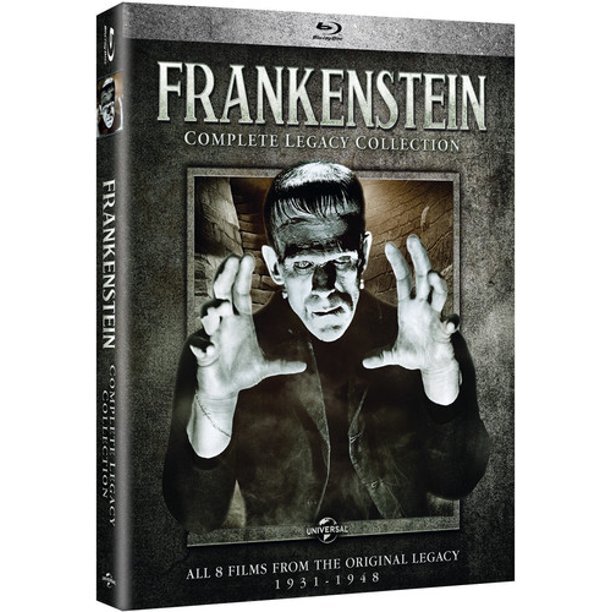
Frankenstein Legacy Collection.jpeg

I’ve been a fan of the original Universal Studios Monsters franchise for as long as I can remember, but it’s been quite a while since I’ve done any kind of intentional rewatch of most of them. This year I thought, being in the midst of a pandemic and all, that maybe I’d have time to revisit most of the rest, via the Legacy Collection DVDs I’ve had for ages. For various reasons, I only got through the Frankenstein movies.

There are eight movies in the original Universal Frankenstein series (or seven, if you’re one of those folks who discounts Abbott and Costello Meet Frankenstein):

·         Frankenstein (1931)

·         The Bride of Frankenstein (1935)

·         Son of Frankenstein (1939)

·         Ghost of Frankenstein (1942)

·         Frankenstein Meets the Wolf Man (1943)

·         House of Frankenstein (1944)

·         House of Dracula (1945)

·         Abbott and Costello Meet Frankenstein (1948)

The Universal Monsters “universe” was perhaps the earliest cinematic universe in terms of characters overlapping, but the attention to continuity wasn’t like it is today with the Marvel Cinematic Universe and such fare. The Frankenstein movies as a whole hold together better than some of the other sub-franchises in the UMU (I’m looking at you, sequels to Dracula!). Still, there are lots of discrepancies: in Frankenstein, Henry Frankenstein’s tower lab is some distance from Manor Frankenstein and the town it is a part of; in Bride, the tower is a lot closer, and in Son, the tower is right next door to what is now Castle Frankenstein, which overlooks the village. The interior sets of the Manor change quite a bit between Frankenstein and Bride, as well. Sometimes the same character is played by different actors across the franchise, and sometimes the same actors show up as multiple characters. I doubt many audience members at the time cared, as long as they got a good story, but I don’t think it would fly today.

For the most part, we do get solid stories with compelling characters. Although not very similar to the novel on which it is based, Frankenstein gives us Colin Clive’s brilliant performance as the obsessed and conflicted Henry Frankenstein and Boris Karloff’s poignant confused and lost Monster, supported by the always-eerie Dwight Frye as the hunchbacked assistant Fritz and the understated Edward Van Sloan as Doctor Waldman. The only weak point in the main cast, to me, is Mae Clarke as Elizabeth; her performance is a bit too “stagey” as compared to the rest of the cast (and perhaps is the reason the role was recast for Bride?). As unlike the source material as it may be, it’s still a tightly-told and well-acted tale directed by James Whale with great mood and tension throughout.

Karloff and Clive return as the Monster and his creator in The Bride of Frankenstein under Whale’s continued direction, with Elsa Lancaster as both Mary Shelley and the Bride. Valerie Hobson replaces Mae Clarke as Elizabeth. I love this movie almost as much as the original and Son, but man is the tone just all over the place. Whale can’t seem to decide if he’s making a pathos-filled character piece or a slapstick comedy. Una O’Connor’s Minnie (maid to Elizabeth? Housekeeper? I’m still unsure after multiple viewings exactly what her job is) takes up way more screen-time than comic relief should in a film like this, and O’Connor’s shrill over-the-top delivery makes almost every scene she’s in hard to watch. The scene where Doctor Pretorius (Ernest Thesiger) produces his Homunculi also feels out of place, between the bawdy comedy between the Homunculi and the fact that Homunculi are never seen or mentioned again. Karloff is at his best as the Monster here, learning to talk and feel, and Clive matches him turn-for-turn as Henry grows desperate to just be done with creating life and return to his wife. If not for the Una O’Connor scenes and the Homunculi bit, Bride would be pretty perfect and perhaps even better than the original.

Son of Frankenstein, directed by Rowland V. Lee, was Karloff’s last turn as the Monster. Karloff does more acting here with his eyes than most actors do with their whole bodies, but he feels wasted. The Monster’s ability to talk is inexplicably gone. He’s not given much to do other than rampaging. Basil Rathbone takes over the lead spot as Henry’s son Wolf and does a great job as a man conflicted between forging his own path and following in his father’s footsteps. Bela Lugosi is brilliant, and almost unrecognizable, as the hunchback Ygor, stealing every scene he’s in.  Lionel Atwill makes his first appearance in the franchise as the one-armed Col. Krogh (in a scene that gets sent-up expertly by Mel Brooks in Young Frankenstein). There are still some awkward humorous moments, mostly involving Wolf and Elsa (Josephine Hutchinson)’s toddler son Peter (Donnie Dunagan), but they’re not as prevalent or as distracting as the Minnie scenes in Bride. Had the franchise ended as a trilogy, it might rank as one of the best horror trilogies ever.

Ghost of Frankenstein moves the action from the town of Frankenstein to the town of Vasaria (where it will remain for pretty much the rest of the franchise). Lugosi returns as Ygor, Lon Chaney Jr. takes over as the Monster (not much more than a weapon of destruction, although in the early scenes there’s an attempt at emotion as the Monster once again bonds with a little girl and the crowd reacts out of fear for her safety), Sir Cedric Hardwicke plays both Ludwig Frankenstein (younger son of Henry) and Henry’s ghost, Evelyn Ankers appears as Ludwig’s daughter Elsa (not to be confused with Wolf’s wife), and Lionel Atwill plays his second character in the franchise, the not-so-nice Doctor Boehmer. It’s a solid movie, building tension as the various non-Monster leads jockey for whose brain they’re going to transplant into the Monster. There’s even a bit of a return to the Monster as he was in Bride, able to speak towards the end of the movie. But it almost feels like director Erle C. Kenton and the writers are trying too hard to be surprising and sneaky. I still love it, just not as much as the previous three.

Frankenstein Meets the Wolf Man puts Lon Chaney Jr. back where he’s best (in hair and fangs), and puts Bela Lugosi in the Monster’s make-up. A sensible move given Ygor’s brain ends up in the Monster at the end of Ghost, except that behind-the-scenes machinations removed any scene where the Monster actually speaks, so Lugosi is as wasted as Karloff felt in Son (perhaps even more so). Elsa Frankenstein is now played by Ilona Massey (with an accent the previous Elsa didn’t have), and dialogue lets us know this is Ludwig’s daughter and not Wolf’s wife. She’s the first Frankenstein featured in the franchise who isn’t a scientist and really has nothing to do with the Monster. Lionel Atwill is back as his third character in the franchise, the Mayor of Vasaria. This is far more of a Wolf Man movie than it is a Frankenstein. Sans dialogue, the Monster is a weapon of mass destruction to be unleashed and defeated.

House of Frankenstein and House of Dracula are “everything and the kitchen sink” approaches to combining several of the Universal Monsters. To this day, I’m not sure why the Mummy and the Invisible Man weren’t invited to the parties. Both movies are pretty disjointed, especially in integrating Dracula into the rest of the action. Concentrating on just the Frankenstein elements: In House of Frankenstein, Glenn Strange takes over as The Monster; Lionel Atwill plays yet another character, Inspector Arnz; there’s a new hunchback played by J. Carrol Naish; and Boris Karloff returns to the franchise as a very different mad scientist, Doctor Neimann. Karloff is brilliant and Naish is excellent, but the Monster himself just lumbers and kills and is “killed.” In House of Dracula, Strange continues as the Monster; Lionel Atwill plays character #5 in the franchise, Police Inspector Holtz; the hunchbacked assistant is a woman (Jane Adams); and the mad scientist is now Doctor Edelmann, played by Onslow Stevens (the closest the Universal Monsters franchise ever really gets to incorporated a version of Doctor Jekyll and Mister Hyde, at least until the Abbott and Costello movies). House of Dracula is again far more of a Wolf Man (and perhaps a Jekyll/Hyde or even Dracula) movie than it is a Frankenstein movie. The Monster is mostly there for mayhem, but at least the Wolf Man gets a happy ending.

There are a lot of people who don’t consider Abbott and Costello Meet Frankenstein as a valid part of the Frankenstein (or larger Universal Monsters) franchise. I am most emphatically not one of them. While I’m not sure where it should fit in the overall sequence (since I like to think that Larry Talbot gets to keep his Happy Ending from House of Dracula), I think it treats the monsters who appear (Bela Lugosi back as Dracula, Glenn Strange as the Monster, Lon Chaney Jr. as the Wolf Man, Lenore Aubert as the requisite “mad scientist,” and a cameo by Vincent Price as The Invisible Man) with great respect. They’re played as the serious monsters they are, not for laughs. The comedy that comes from Abbott and Costello’s reactions to the Monsters fits much better than that provided by Minnie in Bride or Peter Frankenstein in Son. And Glenn Strange actually gets to speak as the Monster! The only thing that would have made this movie more perfect would have been if Lionel Atwill had still been alive to play one more random police officer or mad scientist. Unfortunately, he’d passed away in 1946. Still, it’s a fitting end-cap to the franchise.

Except…

For my own part, I also include Mel Brooks’ Young Frankenstein as a coda or grace note to the franchise. I included it in this rewatch, even though it’s not in the Legacy DVDs because it was released by a different studio. Brooks and Wilder’s love for the original movies is so evident in every frame of their film. They poke fun at the original movies’ inconsistencies and quirks, while still keeping the tone and using some of the original set pieces. There’s even a theory (espoused by my good friend Chuck Loridans among others) that “Froederick” Frankenstein is actually … Peter Frederick Frankenstein, Wolf’s son! (Who would have be a bit amnesiac to not remember meeting the original Monster and a one-armed policeman as a boy, but the blond hair, the expressive eyes, the sense of wonder… it fits!)

Page To Screen: Evening Primrose

Page to Screen is a series of blog posts where I read a book or story and then watch a movie based on said book or story. It will be intermittent, I’m sure, like most of my “regular” features. The first, unofficial Page to Screen entry was my review of The Bitter Tea of General Yen and the classic movie adapted from it.

Evening Primrose banner.png

Okay, so this one is technically a little backwards from the intent, because I first saw the television musical version of Evening Primrose at the Museum of Television Arts in New York City back in the late 90s. I had not seen it since then. When I discovered that the episode was on DVD and that the short story it was based on was available in print, I decided it was time to read the original story and rewatch the movie. WARNING: HERE THERE BE SPOILERS, FOR BOTH THE STORY AND THE TELEVISION EPISODE. I can’t talk about the differences between the two without spoiling stuff.

STORY REVIEW

“Evening Primrose” by John Collier is a brief twelve pages, an “accidentally found manuscript” type of story. The story purports to have been found scribbled in a pad of Highlife Bond paper bought by a customer at Bracey’s Giant Emporium. What the purchaser of the notepad (a Miss Sadie Brodribb) thinks of the tale she’s accidentally purchased, we never learn. As is the nature of people, she probably thought it was some kind of practical joke by the store employees (akin to finding a “help, I’m being held prisoner in a fortune cookie factory” note in your fortune cookie). The story itself is the first person account of Mr. Charles Snell, a poet who decides the real world is no longer for him and that he’ll live in Bracey’s. He’ll hide during the day, and eat/drink/write poetry at night, deftly avoiding the store’s night watchman. He quickly discovers he’s not alone in living in the store, that this is a thing people do in stores large and small all across the city – people who for one reason or another have eschewed normal society. The community in Bracey’s has a hierarchy, at the top of which sits the regal Mrs. Vanderpant, and at the bottom of which sits a teen serving girl named Ella. Charles is warned that people who betray the community are sentenced to removal by the Dark Men, who turn the offendees into mannequins. Charles falls in love with the servant girl, who is in love with the night watchman (who remains oblivious to the community living around him). Charles decides to respect Ella’s love for another man and to help them meet and escape. Only in his emotional despair over Ella not loving him, he spills the beans to a community member he trusts. The story ends with Ella trussed up for the Dark Men and Charles determined to find the night watchman and rescue her. Charles’ final lines indicate his plan to leave his notes where a customer might find them, in case his plan to rescue Ella results in himself and the watchman also being killed. 

It’s a tightly-told story, and Collier builds the mystery of the community and threat of the Dark Men smoothly throughout the story – but the ending feels just a bit too abrupt. Charles declares his love, gets rebuffed, accidentally betrays Ella, and sets his plan to rescue her all within the final two pages of the story. I wish Collier had built the suspense of what would happen to Ella and Charles just a little bit more before the end. Regardless, I enjoyed the concept, the mood, the reveal of Charles’ character, the development of the Bracey’s community (and their relationship to communities in other stores) and eerie threat of the Dark Men.

“MOVIE” REVIEW

The television episode “Evening Primrose” first aired on November 16, 1966 as a part of the ABC Stage 67 anthology series. I would have been a whole three months old. I have no clue whether my parents watched it. Given their love of television and my father’s love of musicals, I’m going to guess they did. It starred the perfectly cast Anthony Perkins as misanthropic poet Charles Snell and Charmaine Carr as innocent, uneducated Ella Harkness, with Dorothy Stickney as more dotty-than-regal Mrs. Monday (a renamed Mrs. Vanderpant).

It’s a musical, with music and lyrics by Stephen Sondheim and book by James Goldman and directed by Paul Bogart. The creators and cast do a wonderful job translating the mood of the story to the screen – all the “free but still sort of trapped” sensibility, the rigidness of the Paul Stern (renamed from Bracey’s) store community, the threat of the Dark Men is there in the staging, dialogue, lyrics and instrumental music – and hey fix the pacing issue I had with the story, giving the romantic relationship more time to develop and giving space to the real threat of the Dark Men at the end. The songs start out character-centric and then become plot-propelling. Charles’ song “If You Can Find Me I’m Here” is one of the best misanthropic “you don’t like my art, screw you” songs ever written, while Ella’s “I Remember Sky” is a wistfully beautiful piece. The duet “When” moves their relationship along and incorporates their fears of being found out, while the duet “Take Me to the World” is the point at which the plot turns towards the big denouement.  

There are a couple of significant changes to the story, as often happens in page-to-screen adaptations. Ella is now an adult (to remove the ickiness of a poet in his late twenties falling in love with a sixteen-year-old, I assume) and her mistreatment at the hands of the older community members is made more explicit (including that they have never taught her to read, write, or do math, and force her to live in the store basement). Instead of unrequited love, Ella falls as much in love with Charles as he does with her. And in what I think is a very sensible change that heightens the drama of the last act, the couple is found out not through Charles intentionally revealing his feelings to his ‘trusted friend’ Roscoe, but because Charles accidentally turns on the store’s speaker system while they are singing “Take Me To The World” and unknowingly lets the entire store community know what they are planning (the night watchman hears too, thus revealing that there are people living in the store even if he can’t manage to find them, which puts him in danger without having to work in the awkward love triangle).

The final act is a wonderful game of cat-and-mouse through the store as Mrs. Monday and Roscoe try to delay Charles and Ella long enough for the Dark Men to catch them. The fate of the characters implied by the structure of Collier’s story is made explicit in the final scenes of the episode. I always thought it was a delightfully dark ending, and I’m glad Goldman and Sondheim didn’t decide to change it for television.

Interesting trivia: while the television episode originally aired in color, the only print remaining is in black and white. And I actually think that adds to the mood and thus effectiveness of the production. I’m kind of glad the color print isn’t available (the DVD has some test footage of Anthony Perkins in Stern Brothers and it just feels too bright for the story being told).

FINAL COMPARISON

While I liked Collier’s story well enough and I want to read more of his short stories, I think I prefer the musical in this instance.

The Collier story can be found in his collection Fancies and Goodnights. The Sondheim-Goldman musical is available on DVD and Prime Video.