Review of Neon Yang's TENSORATE novellas

THE BLACK TIDES OF HEAVEN, isbn 9780765395412, 237 pgs, $15.99 (print)
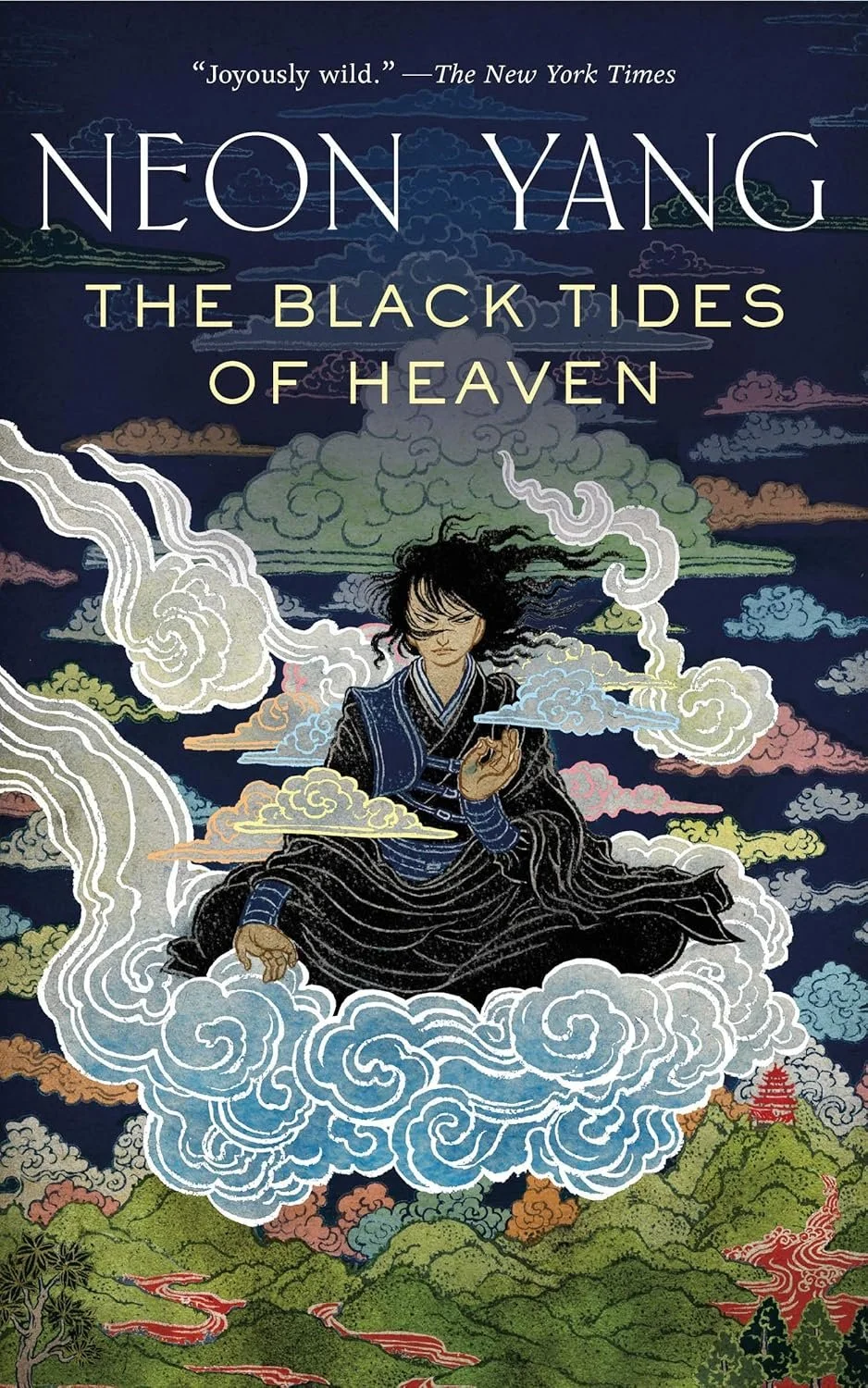
THE RED THREADS OF FORTUNE, isbn 9780765395399, 213 pgs, $15.99 (print)

PREMISES: (From Goodreads.com)

BLACK TIDES: Mokoya and Akeha, the twin children of the Protector, were sold to the Grand Monastery as children. While Mokoya developed her strange prophetic gift, Akeha was always the one who could see the strings that moved adults to action. While his sister received visions of what would be, Akeha realized what could be. What's more, he saw the sickness at the heart of his mother's Protectorate. A rebellion is growing. The Machinists discover new levers to move the world every day, while the Tensors fight to put them down and preserve the power of the state. Unwilling to continue to play a pawn in his mother's twisted schemes, Akeha leaves the Tensorate behind and falls in with the rebels. But every step Akeha takes towards the Machinists is a step away from his sister Mokoya. Can Akeha find peace without shattering the bond he shares with his twin sister?

RED THREADS:  Fallen prophet, master of the elements, and daughter of the supreme Protector, Sanao Mokoya has abandoned the life that once bound her. Once her visions shaped the lives of citizens across the land, but no matter what tragedy Mokoya foresaw, she could never reshape the future. Broken by the loss of her young daughter, she now hunts deadly, sky-obscuring naga in the harsh outer reaches of the kingdom with packs of dinosaurs at her side, far from everything she used to love. On the trail of a massive naga that threatens the rebellious mining city of Bataanar, Mokoya meets the mysterious and alluring Rider. But all is not as it seems: the beast they both hunt harbors a secret that could ignite war throughout the Protectorate. As she is drawn into a conspiracy of magic and betrayal, Mokoya must come to terms with her extraordinary and dangerous gifts, or risk losing the little she has left to hold dear.


MY RATING:  Four stars out of five (for each books)


MY THOUGHTS:  The two novellas that comprise the introduction to The Tensorate, Neon Yang’s new Asian-inflected fantasy world, could just as easily have been published as a single 400+ page novel with shifting POV, but the decision to publish the material as two stand-alone long-ish novellas allows the reader to be fully immersed in the point of view character for each part of the story. Despite the fact that The Red Threads of Fortune clearly follows The Black Tides of Heaven in chronological order, one could read Red Threads before Black Tides and not be at a loss for character background or world-building.

The novellas are immediately immersive; the characters understand how their world works (both the magic and the politics), and there is no “gateway” character innocent of this information to operate as reader-stand-in. Therefore, the world-building is subtle. Vital background information is imparted by inference, forcing the reader to do the heavily lifting of figuring out how the pieces fit together to make the world run. The hard work is rewarding. “The Slack,” the in-world magic system, is given just enough detail for the reader to understand how the Slack works but not so much that the magic feels like science: the Slack has several aspects interlinked (water-nature, fire-nature, forest-nature and the like), and manipulating those natures allows talented individuals to accomplish amazing tasks. Likewise, the politics of the Tensorate (which most of the characters call The Protectorate instead), are explicated just enough for the reader to understand that a) this realm is a largely despotic monarchy, b) at least one religious order lies outside of that monarchy’s control even while being located within the physical boundaries of the realm, c) there’s a tentative, mutual-beneficial alliance between monarchy and religious order, and d) there are other lands outside of the Protectorate that may come to play more heavily in future installments of the series.

Oh, and that separate religious order, The Grand Monastery? Led by Head Abbot Sung and later by Head Abbot Thennjay, they include a group of warrior-monks called Pugilists, who use the Slack to become incredible fighting machines. The Pugilists are mostly background-worldbuilding for now, but every time they were mentioned I could not help but flash back to Sunday afternoons watching poorly-dubbed black-and-white “wire fu” movies as a kid. I sincerely hope Yang will give us an installment of this series really showing us what the Pugilists can do. But I digress.

The first section of Black Tides is largely told through the POV of Head Abbot Sung, and sets the stage for all that is to come. The circumstances of the twins Moyoka and Akeha’s birth are laid out as well as their early formative years.  There are massive time-jumps – in less deft hands, this would be a detriment to the story flow but Yang is adept at feeding us what little we need to know about the intervening years and not bogging us down with details that would be nice to know but remain unimportant to the story being told. But then the majority of the action follows Akeha moving out into the world and discovering the political tensions that exist within the Protectorate. There are street fight scenes (wonderfully described), use of Slackcraft, romance, and familial tensions intricately intertwined.  Red Threads picks up after Black Tides and references the events of the first novella, but shifts the focus to Mokoya’s point of view. How does an ex-prophet and spouse of a Head Abbot navigate political tensions and grief to find a new place in the world?

The non-binary nature of Mokoya, Akeha and their friends and family is important on both the world-building and character-building levels. This is a world where gender is not assigned at birth, and characters remain gender-neutral (using the singular They as common pronoun) until they declare/confirm a gender. Some do it early (Thennjay, by all indications, and other minor characters), some later (Sonami is a late teen, Mokoya and Akeha are well into adulthood when they choose) and some don’t choose at all (Rider, for example, but also almost Akeha), while some declare gender but don’t go to the Confirmation Doctors to be physically altered (Yongcheow). How Mokoya and Akeha in particular decide on their genders is a function of their struggles to maintain their twin-bond as well as Akeha’s feelings about being the unexpected/unwanted/unplanned-for child. And both twins’ decisions are a part of the fall-out of the manipulations and other horrible things their mother, the Protector, does.

These two novellas introduce us to a host of intriguing characters I’m eager to watch develop. I don’t believe Mokoya and Akeha’s stories are done yet, alone or together. And I believe there are as many stories to tell about this world as there are threads in the weave of fortune.  I look forward to exploring it all in future installments.

FEBRUARY 2017 READINGS

A few days ago I posted about my writing accomplishments in February. Today’s post is about my reading.

I set myself several reading challenges each year, (and at some point I’ll write about this year’s unique challenges in an upcoming post. For now, here’s a look at the two I do every year, and how I’m progressing as the second month of the year has come to an end:

BOOKS

I set myself an annual goal over on Goodreads of 100 books. I track books the same way GR does, so self-published short stories in ebook format count, as do magazines if I read the entire issue and not just a story or two. January’s books read were:

  1. Black Knight: The Fall of Dane Whitman Volume 1, by Frank Tieri, Luca Pizzari and Kev Walker.  I’ve always been a huge fan of Marvel Comics’ Black Knight character, but this latest graphic novel collection felt like it just repeated story beats for the character we’ve already seen when he was an active member of The Avengers and Excalibur.
  2. Lightspeed Magazine #81 (February, 2017), edited by John Joseph Adams. Another fine selection of original and reprint SF and fantasy shorts. This month’s favorites for me were A. Merc Rustad’s “Later, Let’s Tear Up The Inner Sanctum,” Seanan McGuire’s “Lady Antheia’s Guide to Horticultural Warfare,” Brian Stableford’s “The Elixir of Youth,” and Ashok Banker’s “The Six-Gun Vixen and the Dead Coon Trashgang.”
  3. Full of Briars, by Seanan McGuire. Another novella in McGuire’s October Daye urban fantasy series, this one narrated by Quentin Sollys, Toby’s squire, who harbors a few secrets of his own. I loved that this was a quiet, “day in the life” type story, something rare in the Daye-verse, and I loved Quentin’s voice — totally his own but with hints of Toby’s influence.
  4. Ghost Girl in the Corner (A Shadowshaper novella), by Daniel Jose Older.  Focusing on a few of the supporting characters from the Shadowshaper novel, Older gives us a missing girl / dead girl pair of mysteries (with satisfactory “fair play” solutions) and further insight into how the Shadowshaper world works.
  5. Sinner Man, by Lawrence Block. Block’s first crime novel, long out of print since it was first published under a pseudonym, is classic noir Block: the main characters may be unlikeable, but you have to find out how it all comes out. (Reviewed Here on my Blog)
  6. Latin@ Rising: An Anthology of Latin@ Science Fiction and Fantasy, edited by Matthew David Goodwin.  An excellent collection of genre stories by writers of Latin descent or from Latin American countries, including Daniel Jose Older, Junot Diaz, and Sabrina Vourvoulias. (Reviewed Here on my Blog)
  7. Locke and Key Volume 2: Head Games, by Joe Hill and Gabriel Rodriguez. The second installment of the graphic novel series expands the mythology and ups the stakes for the characters in intriguing and disturbing ways.
  8. Undertow, by Jordan L. Hawk. This novella set in Hawk’s “Whyborne and Griffin” Lovecraftian universe shifts the focus to two supporting characters: secretary Maggie Parkhurst and Whyborne’s Ketoi twin sister. Still the same fun adventure, Lovecraftian worldbuilding and same-sex romance Hawk always expertly delivers.
  9. Norse Mythology, by Neil Gaiman. Gaiman solidly and smoothly retells the Norse myths that influenced him, often with the voice one would expect to hear if the tale were being told around a campfire on a cold winter’s night.
  10. The Prisoner of Hell Gate, by Dana I. Wolff.  I picked this up because as a kid born in Queens NY and growing up just north, the Hell Gate bridge scared the hell out of me, and the idea of that part of the river combined with the story of Typhoid Mary into a kind of literary slasher-flick intrigued me. It didn’t really work for me though, despite some interesting character moments and the tying-in of other East River tragedies.

So: ten books read in February, and Goodreads tells me I’m still on track for the year.

SHORT STORIES

I also set myself a goal each year of reading 365 short stories: 1 per day, theoretically, although it doesn’t always work out quite that way. (366 in leap years, of course)

I didn’t quite hit the “one per day” goal in January, but I more than made up for it in February. here’s what I did read and where you can find them if you’re interested in reading them too (with some short notes for stories that really stood out to me). If no source is noted, the story is from the same magazine or book as the story(ies) that precede(s) it:

  1. “Optimistic People” by Chris Drangle, from One Story magazine for December 31, 2016. Two teens get caught up with a drifter when they rescue him from being buried alive. Really great character work.
  2. “We Blazed” by David Farland, from an ebook perk via a Kickstarter reward. Cool world-building mixes fantasy and SF.
  3. “Starship Day” by Ian R. MacLeod, from Lightspeed Magazine #31. Hearbreaking.
  4. “Later, Let’s Tear Up The Inner Sanctum” by A. Merc Rustad. Fantastic super-hero world-building.
  5. “Lady Antheia’s Guide To Horitcultural Warfare” by Seanan McGuire. Disturbing and Victorian and also a bit funny.
  6. “The Last Garden” by Jack Skillingstead
  7. “Probably Still The Chosen One” by Kelly Barnhill
  8. “The Memorial Page” by K.J. Bishop
  9. “Six-Gun Vixen and the Dead Coon Trashgang” by Ashok Banker. Violent and creative mix of SF, westerns and bible-thumping.
  10. “The Elixir of Youth” by Brian Stableford. A retelling of The Prodigal Son takes a very dark turn.
  11. “Taklamakan” by Bruce Sterling.
  12. “Mortensen’s Muse” by Orrin Grey, from Children of Lovecraft.
  13. “Oblivion Mode” by Laird Barron, from Children of Lovecraft.
  14. “The Devil’s Apprentice” by Premee Mohamed, from No Shit, There I Was!
  15. “Blush Response” by E. Catherine Tobler, from No Shit, There I Was! Loved the noir-ish world-building of this story of enforcers and “shine girls.”
  16.  “Full of Briars” by Seanan McGuire. The above-reviewed Quentin Sollys novella.
  17. “Ghost Girl in the Corner” by Daniel Jose Older. The above-reviewed Shadowshaper novella.
  18. “The Road to Nyer” by Kathleen Alcala, from Latin@ Rising: An Anthology of Latin@ Speculative Fiction. A wonderful, ethereal, haunting ghost story.
  19. “Code 51” by Pablo Brescia.
  20. “Uninformed” by Pedro Zagitt.
  21. “Circular Photography” by Pedro Zagitt. Amazing detail that stayed with me long after this bit of flash fiction was over.
  22. “Sin Embargo” by Sabrina Vourvoulias. Words, and translations, mean everything.
  23. “Accursed Lineage” by Daina Chaviano.
  24. “Coconauts in Space” by Adal.
  25. “Cowboy Medium” by Ana Castillo.
  26. “Flying Under the Texas Radar with Paco and Los Freetails” by Ernest Hogan. Music-infused prose.
  27. “Monstro” by Junot Diaz.
  28. “Room For Rent” by Richie Narvaez.
  29. “Artificial” by Edmundo Paz Soldan.
  30. “Through the Right Ventricle” by Steve Castro.
  31. “Two Unique Souls” by Steve Castro
  32. “Caridad” by Alex Hernandez
  33. “Difficult At Parties” by Carmen Maria Machado. Hearbreaking.
  34. “Death of a Businessman” by Giannina Braschi
  35. “Burial of the Sardine” by Giannina Braschi
  36. “Entanglements” by Carlos Hernandez
  37. “The Drain” by Alejandra Sanchez.
  38. “Red Feather and Bone” by Daniel Jose Older
  39. “A Science Fiction” by Carl Marcum
  40. “Scifi-Kill” by Carl Marcum
  41. “Traditions” by Marcos S. Gonsalez
  42. “An Oral History of the Next Battle of the Sexes” by Lucas Schaefer, from One Story magazine for February 21, 2017. Told entirely in quoted interviews from those who saw or were part of the title boxing match between a stellar woman boxer and an obvious male patsy.

So: forty-two short stories for February, which was more than one-per-day and which put me ahead of target (February 28th was the 59th day of the year).