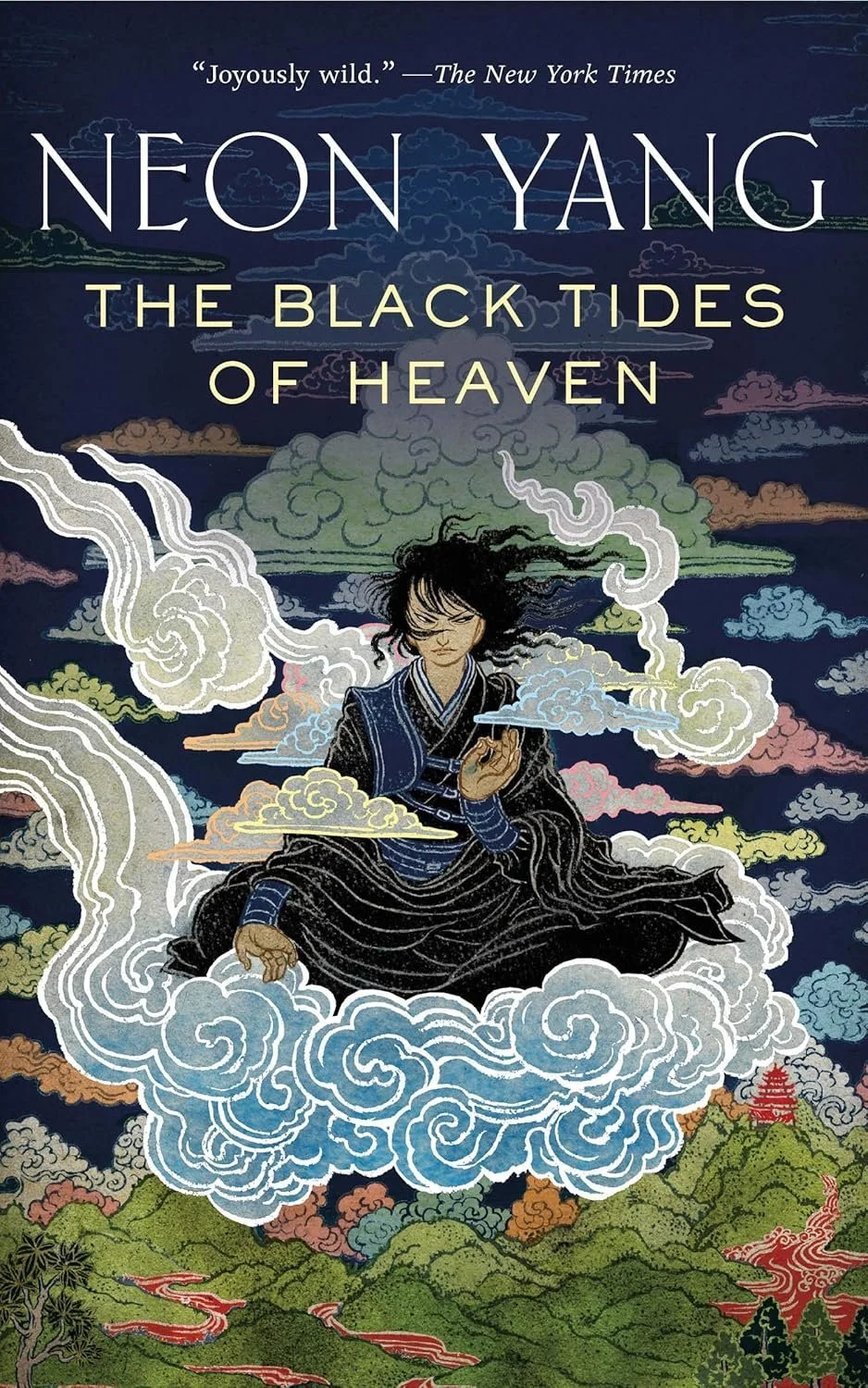
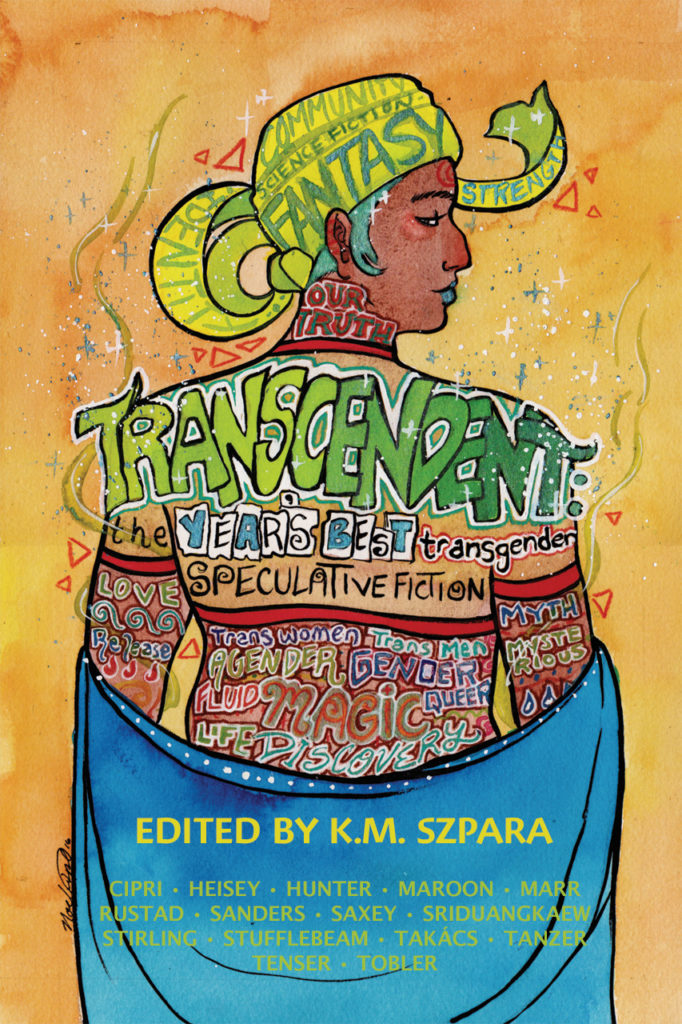
Review of Neon Yang's TENSORATE novellas

THE BLACK TIDES OF HEAVEN, isbn 9780765395412, 237 pgs, $15.99 (print)

THE RED THREADS OF FORTUNE, isbn 9780765395399, 213 pgs, $15.99 (print)

PREMISES: (From Goodreads.com)

BLACK TIDES: Mokoya and Akeha, the twin children of the Protector, were sold to the Grand Monastery as children. While Mokoya developed her strange prophetic gift, Akeha was always the one who could see the strings that moved adults to action. While his sister received visions of what would be, Akeha realized what could be. What's more, he saw the sickness at the heart of his mother's Protectorate. A rebellion is growing. The Machinists discover new levers to move the world every day, while the Tensors fight to put them down and preserve the power of the state. Unwilling to continue to play a pawn in his mother's twisted schemes, Akeha leaves the Tensorate behind and falls in with the rebels. But every step Akeha takes towards the Machinists is a step away from his sister Mokoya. Can Akeha find peace without shattering the bond he shares with his twin sister?

RED THREADS:  Fallen prophet, master of the elements, and daughter of the supreme Protector, Sanao Mokoya has abandoned the life that once bound her. Once her visions shaped the lives of citizens across the land, but no matter what tragedy Mokoya foresaw, she could never reshape the future. Broken by the loss of her young daughter, she now hunts deadly, sky-obscuring naga in the harsh outer reaches of the kingdom with packs of dinosaurs at her side, far from everything she used to love. On the trail of a massive naga that threatens the rebellious mining city of Bataanar, Mokoya meets the mysterious and alluring Rider. But all is not as it seems: the beast they both hunt harbors a secret that could ignite war throughout the Protectorate. As she is drawn into a conspiracy of magic and betrayal, Mokoya must come to terms with her extraordinary and dangerous gifts, or risk losing the little she has left to hold dear.


MY RATING:  Four stars out of five (for each books)


MY THOUGHTS:  The two novellas that comprise the introduction to The Tensorate, Neon Yang’s new Asian-inflected fantasy world, could just as easily have been published as a single 400+ page novel with shifting POV, but the decision to publish the material as two stand-alone long-ish novellas allows the reader to be fully immersed in the point of view character for each part of the story. Despite the fact that The Red Threads of Fortune clearly follows The Black Tides of Heaven in chronological order, one could read Red Threads before Black Tides and not be at a loss for character background or world-building.

The novellas are immediately immersive; the characters understand how their world works (both the magic and the politics), and there is no “gateway” character innocent of this information to operate as reader-stand-in. Therefore, the world-building is subtle. Vital background information is imparted by inference, forcing the reader to do the heavily lifting of figuring out how the pieces fit together to make the world run. The hard work is rewarding. “The Slack,” the in-world magic system, is given just enough detail for the reader to understand how the Slack works but not so much that the magic feels like science: the Slack has several aspects interlinked (water-nature, fire-nature, forest-nature and the like), and manipulating those natures allows talented individuals to accomplish amazing tasks. Likewise, the politics of the Tensorate (which most of the characters call The Protectorate instead), are explicated just enough for the reader to understand that a) this realm is a largely despotic monarchy, b) at least one religious order lies outside of that monarchy’s control even while being located within the physical boundaries of the realm, c) there’s a tentative, mutual-beneficial alliance between monarchy and religious order, and d) there are other lands outside of the Protectorate that may come to play more heavily in future installments of the series.

Oh, and that separate religious order, The Grand Monastery? Led by Head Abbot Sung and later by Head Abbot Thennjay, they include a group of warrior-monks called Pugilists, who use the Slack to become incredible fighting machines. The Pugilists are mostly background-worldbuilding for now, but every time they were mentioned I could not help but flash back to Sunday afternoons watching poorly-dubbed black-and-white “wire fu” movies as a kid. I sincerely hope Yang will give us an installment of this series really showing us what the Pugilists can do. But I digress.

The first section of Black Tides is largely told through the POV of Head Abbot Sung, and sets the stage for all that is to come. The circumstances of the twins Moyoka and Akeha’s birth are laid out as well as their early formative years.  There are massive time-jumps – in less deft hands, this would be a detriment to the story flow but Yang is adept at feeding us what little we need to know about the intervening years and not bogging us down with details that would be nice to know but remain unimportant to the story being told. But then the majority of the action follows Akeha moving out into the world and discovering the political tensions that exist within the Protectorate. There are street fight scenes (wonderfully described), use of Slackcraft, romance, and familial tensions intricately intertwined.  Red Threads picks up after Black Tides and references the events of the first novella, but shifts the focus to Mokoya’s point of view. How does an ex-prophet and spouse of a Head Abbot navigate political tensions and grief to find a new place in the world?

The non-binary nature of Mokoya, Akeha and their friends and family is important on both the world-building and character-building levels. This is a world where gender is not assigned at birth, and characters remain gender-neutral (using the singular They as common pronoun) until they declare/confirm a gender. Some do it early (Thennjay, by all indications, and other minor characters), some later (Sonami is a late teen, Mokoya and Akeha are well into adulthood when they choose) and some don’t choose at all (Rider, for example, but also almost Akeha), while some declare gender but don’t go to the Confirmation Doctors to be physically altered (Yongcheow). How Mokoya and Akeha in particular decide on their genders is a function of their struggles to maintain their twin-bond as well as Akeha’s feelings about being the unexpected/unwanted/unplanned-for child. And both twins’ decisions are a part of the fall-out of the manipulations and other horrible things their mother, the Protector, does.

These two novellas introduce us to a host of intriguing characters I’m eager to watch develop. I don’t believe Mokoya and Akeha’s stories are done yet, alone or together. And I believe there are as many stories to tell about this world as there are threads in the weave of fortune.  I look forward to exploring it all in future installments.
FEBRUARY 2017 BY THE NUMBERS

I did a horrible job of posting to my own blog in 2016. My intent is to do better this year, by at the very least tracking my own writing and reading. Hopefully some of these posts will inspire folks to comment and chat a bit. Today’s post is basically a “by-the-numbers” accounting of my writing, editing, submitting and sales in February.

WRITING

At the end of 2016, I set myself a challenge for 2017: write at least 5 days a week, and write 1,000 words a day. I’m using a pretty simple spreadsheet to track “new words written” by day and week, with a column for notes (about projects worked on, totals for week/month, etc.). I’m tracking my writing week as Sunday to Saturday.

February started in the middle of a week, so:

February 1 – 4: I wrote on three days, and totaled 2,639 words.

The first full week of February: I wrote on five days, and totaled 4,696 words.

The second full week of February: I wrote on four days, and totaled 5,224 words.

The third full week of February: I wrote on six days, and totaled 5,358 words.

February 26 – 28: I wrote one day, and only 300 words.

I decided, after advice from various writer friends who weighed in, to give credit to some editing time as writing time: if I in fact, during edited, wrote new paragraphs into a story (regardless of how many words I may have deleted at the same time), then I count those paragraphs as writing time. For instance, the 300 words on February 28 were added to a story I was editing from the previous month.

Each month’s goal is roughly 20,000 words (1,000/day x 5 days/week). In February I wrote 18,217 words. That’s a few thousand up from January’s total, which is a good thing. In the process, I completed two stories that had stalled in 2016, wrote a brand new story from scratch, and started another brand new story (that I’m still working on in March).

EDITING

I did a much better job of working in editing time in February than I did in January. Part of that was because I allowed myself to count some of the editing time (when I found myself adding entirely new paragraphs or scenes) as writing time. And part of it was the realization that if I don’t go back and revise/edit my first drafts, then they’ll never be ready to send out to editors.

According to my notes, I did fairly heavy editing on two different stories, including the one I mentioned last month that had received detailed feedback as part of a rejection letter from a very busy editor.

SUBMISSIONS

On average, I had 6 stories out at any given time throughout the month of February, which was a step up from January. My goal by the end of March is to have 10 stories out making the rounds at any one time, reprints included. I have nine stories out on submission right now, including the two I spent part of February editing.

SALES

No sales made in February, although there were a few very nice personal rejection letters that make me think maybe I got close.

And that’s about it for February’s writing, editing, submissions and sales numbers.

2016 WRAP UP POST

A couple of folks have asked, so I’m finally putting together my wrap-up post for 2016: what I wrote, what was published, and what I read.

WRITING

Not much to report on this front. 2016 was not my most consistent year for creating new content. I didn’t blog much, and I didn’t really track how much writing I was doing, other than knowing that there were a majority of months where I didn’t write or edit at all. I finished a couple of stories, including “Chasing May” which sold to the anthology Kepler’s Cowboys from Hadrosaur Productions. I sent out a few attempts at getting reprints sold, as well, but not much came of that. (Admittedly, I didn’t make the strongest effort I could possibly have made.)

PUBLISHING

2016 saw the release of three anthologies with my work included:

  • “Threshold” appeared in One Thousand Words For War from CBAY Books
  • “Stress Cracks” appeared in Galactic Games from Baen (My first professional-rate story sale!)
  • “Yeti” appeared in Robbed of Sleep, Volume 4 from Troy Blackford.

I also sold one story, the aforementioned “Chasing May,” which releases in just a few weeks from this writing.

READING

I set myself a variety of reading challenges in 2016. I managed to complete a few of them.

On Goodreads, I challenged myself to read 100 books. I read 105.

Here’s the breakdown of what I read:

  • Fiction: 97 books
    • 4 anthologies
      • 1 noir
      • 2 horror
      • 1 fantasy
    • 1 single-author collection (1 urban fantasy)
    • 17 graphic novels
      • 11 super-hero
      • 4 YA adventure
      • 1 YA comedy
      • 1 comic strip collection
    • 12 magazines (all issues of Lightspeed magazine)
    • 43 novels
      • 1 crime
      • 1 mystery
      • 1 noir
      • 1  Fantasy
      • 1 historical fiction
      • 1historical fantasy
      • 2historical romance
      • 3historical urban fantasy
      • 3alternate history
      • 3 horror
      • 1 literary
      • 4  pulp adventure
      • 2 science fiction
      • 13 urban fantasy
      • 1 YA urban fantasy
      • 1 YA science fiction
    • 8 novellas
      • 2 horror
      • 3 fantasy
      • 1 science fiction
      • 1 urban fantasy
      • 1 mystery
    • 1 picture book
    • 1 playscript
    • 10 short stories published as stand-alone ebooks
      • 4 urban fantasy
      • 3 mystery
      • 1 modern romance
      • 1 thriller
      • 1 historical fantasy
  • Non-Fiction: 8 books
    • 5 Memoir/biography
    • 2 History
    • 1 Writing Advice

Other Book Stats:

# of Authors/Editors: 86 (including graphic novel artists); 34 of these were female authors. (I didn’t do a good job of tracking other sub-group metrics, such as writers of color, queer writers, etc. I’m going to make a better effort this year.)

Shortest Book Read: 20 pages (Forbid the Sea by Seanan McGuire)

Longest Book Read: 496 (Feedback by Mira Grant)

(Interesting that the shortest and longest read were by the same author, albeit one under a pen-name.)

Total # of pages read: 24064

Average # of pages per book: 229

Format Summary:

  • 4 audiobooks
  • 28 ebooks (5 Nook, 23 Kindle)
  • 73 print
    • 17 hardcovers
    • 56 softcovers

On my Livejournal, I challenged myself to read 365 short stories (1 per day, basically), but I only managed 198 this year. I did not read as many anthologies or single-author collections cover-to-cover as I have in previous years.

Those 198 stories appeared in:

  • 5 Magazines
    • Asimov’s
    • Cemetary Dance
    • Daily Science Fiction
    • Disturbed Digest
    • Magazine of Fantasy & Science Fiction
    • Lightspeed Magazine
    • One Story
    • One Teen Story
    • The Dark
    • The Strand
    • Three Slices
    • Unbound
  • 10 Anthologies
    • Candle in the Attic
    • Clockwork Phoenix 5
    • Christmas at the Mysterious Bookshop
    • Dark and Dangerous Things III
    • Ghost in the Cogs
    • In Sunlight or in Shadow (Stories based on the paintings of Edward Hopper)
    • Robbed of Sleep Vol 4
    • Shattered Shields
  • 1 Single-Author Collection
    • Two Tales of the Iron Druid by Kevin Hearne
  • 8 Stand-alone (self-pubbed or publisher-pubbed in e-format)
    • Seanan McGuire (mostly from her website)
    • Jordan L. Hawk (email newsletter)
    • Lawrence Block (purchased in e-format via Amazon)

Those 198 stories were written by 166 different authors. 82 of those were women (again, didn’t do a good job of tracking any other author-identifying metrics). The work was published by 26 different editors, roughly (there were a few for whom I’m not sure who the editor was / who to credit).

So there you have it: my writing, publishing and reading, by the numbers, for 2016. (I was going to include other media consumed, like music, movies, and television, but I didn’t do as good of a job compiling those numbers in 2016. Oh well!)


JANUARY 2017 BY THE NUMBERS

I did a horrible job of posting to my own blog in 2016. My intent is to do better this year, by at the very least tracking my own writing and reading. Hopefully some of these posts will inspire folks to comment and chat a bit. Today’s post is basically a “by-the-numbers” accounting of my writing in January.

WRITING

At the end of 2016, I set myself a challenge for 2017: write at least 5 days a week, and write 1,000 words a day. I’m putting together a blog post about why I made this particular challenge, and why the same challenge might not work for anyone else.

I’m using a pretty simple spreadsheet to track “new words written” by day and week, with a column for notes (about projects worked on, totals for week/month, etc.)

The first week of January I wrote 3 out of 5 days, and managed 2,198 new words.

The second week of January I did no writing at all.

The third week of January I wrote 3 out of 5 days and managed 4,833.

The fourth week of January I wrote 5 out of 5 days and managed 5,225, words.

In the three days of January 29-31 I only wrote 1 day, but wrote 2,580 words.

Each month’s goal is roughly 20,000 words (1,000/day x 5 days/week). In January I wrote 14,836 words. In the process, I completed a previously stalled short story and wrote a complete second story.

I’m feeling pretty good about those numbers, given how little I wrote in the second half of 2016.

EDITING

Where I’ve dropped the ball in January is in editing/rewriting. I have three stories that I received really valuable feedback on from beta-readers/critiquers in Nov/Dec., and those stories are still waiting to be reworked with that feedback in mind. (One of them, the feedback was actually part of a rejection letter. Not a “revise and resubmit,” but still very personalized feedback fromvery busy editor!).  And of course, I now have the two stories written in January that will need editing/revising. First drafts are great, but they’re rarely ready to send out.

I clearly need to find a balance between the writing time and the editing time. I’m going to work harder on that in February, as I continue to work on that writing goal mentioned above.

SUBMISSIONS

I have three stories out on submission right now, one of them something I co-wrote with a more well-known author. I could have more, but I was as bad about submitting stuff in the second half of 2016 as I was about writing or editing. Hey, at least I’m consistent.

SALES

A few days ago, the ToC for KEPLER’S COWBOYS, edited by David Lee Summers and Steve B. Howell for Hadrosaur Productions, was announced. I’m very glad to be able to say that my story “Chasing May” is included, alongside work by authors like David L. Drake, Jaleta Clegg, Gene Mederos and others. You can preorder the Kindle version here, or the print and other ebook versions here. I loved Summers and Howell’s previous anthology, A KEPLER’S DOZEN, and anticipate this new anthology will be just as fun.

And that’s about it for January on the writing front. A separate post about January’s reading will follow tomorrow.