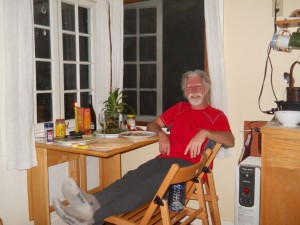
STEVE B. HOWELL, Author - Interview

In June, Hadrosaur Productions published A KEPLER’S DOZEN: Thirteen Stories About Distant Worlds That Really Exist, a science fiction anthology co-edited by Steve B. Howell and David Lee Summers.  In this second of two interviews, I talk to co-editor Steve B. Howell about the anthology and about the actual Kepler Mission.

Dr. Steve B. Howell is currently the project scientist for the NASA Kepler Space telescope. Kepler was launched in 2009 with a goal to discover planets orbiting other stars – exoplanets – using the transit technique. Dr. Howell is a highly distinguished astronomer having worked in the field for over 25 years. He has been a university professor, built instruments for the NASA Space Shuttle, worked as a scientist at the Kitt Peak National Observatory, and now is the science head for NASA’s most scientifically and publicly visible mission, Kepler. He is the author of over 600 scientific publications, numerous popular and technical articles, and has written and edited 8 books on astronomy and astronomical instrumentation. Dr. Howell is highly involved with informal and formal scientific education for kids to adults and as an entertaining speaker, he is often asked to talk as various functions both professionally and publically. He currently lives in Redwood City, CA where he loves to hike, prepare gourmet meals, and play blues music.

ANTHONY: What is your current role with the Kepler mission?

STEVE: I am the Project Scientist for the Kepler mission. As project scientist, it is my job to get the most science out of the Kepler mission. The job is a sort of overseer of the science for the entire mission. The work includes science for both exoplanets and work on stars themselves.

Stellar astrophysics using Kepler data, for example, studies of interacting binary stars, pulsating stars, rotations of stars as measured by watching starspots on their surface, has been very exciting as well. I work at such tasks as getting astronomers around the world involved in using the data we have collected for a variety of science purposes and to make sure we get the funding we need from NASA to accomplish our goals.
ANTHONY: Can you tell us a little about the original intent and time-span of the mission?

STEVE: The mission was designed to determine the frequency of Earth-size planets orbiting stars similar to our sun. The mission life time was originally 3.5 years but was extended to 4 years.

ANTHONY: How does the camera function?

STEVE: The camera is a 16 million pixel large format array of digital detectors. The array is about 16 inches on a side and consists of 42 separate large charge-coupled detectors. These are similar to the cameras in a cell phone only much, much better quality and tremendously larger. Kepler states at one field of view in the sky all the time. The camera has no shutter so reads out the images constantly. At NASA Ames Research Center, where I work, we use sophisticated software and a supercomputer to search all the data to look for small drops in light from any star that might indicate an exoplanet has passed in front of the star (a transit event).

ANTHONY: It seems like there’s the potential for an exorbitant amount of data to be collected. How is that all transferred back to Earth?

STEVE: There is indeed a tremendous amount of data collected and sent back to Earth. Once a month, the spacecraft turns to point an antenna toward the earth and we use about 20-24 hours of time to transfer all the data back to the ground.

ANTHONY: What’s involved in analyzing the data? I guess I’m asking how you know what’s going on in each of the systems you’re investigating.

STEVE: Each star we observe, over 150,000 of them, has its light curve examined in great detail. A light curve is simply a measure of the star brightness over time. We observe each star every 30 minutes and produce a record of that stars brightness every 30 minutes for days to weeks to years. Each measurement is looked at by our software system to see if there is a chance that the star has dimmed just enough and in the correct way to indicate a possible transit by a planet orbiting that star.

ANTHONY: How many exo-planets have been identified since the mission started?

STEVE: Kepler has found over 3500 exoplanet candidates, of which we believe that 90-90% are certainly real exoplanets. They range in size from about that of our moon to larger than Jupiter. Most are small in the 2-5 earth radius size range.

As we examine more of the data, smaller planets, similar to Earth-size, will be discovered and we expect to end up with hundreds of exoplanets near the size of our earth.

ANTHONY: There’s a distinct naming convention for stars and planets identified through the mission, correct?

STEVE: Yes, it is simple. The first planet we found that we could absolutely confirm as a planet we called Kepler 1b. The next was Kepler 2b and so on. The “b” is used to designate that we are talking about the planet in orbit about a star and not the star itself. So far, we are up to naming over 100 confirmed exoplanets.

ANTHONY: One of the things I liked about the format of A Kepler’s Dozen was the introduction to each story, which included hard data on the stars and planets the authors set their stories on or near. How much input did you provide to authors in terms of choosing stars to write about?

STEVE: The book had one firm rule – each story had to be about a real Kepler discovered and confirmed exoplanet. The authors were given the details of the planets they choose to write about and had to stay scientifically true to those data in their story. I believe this is the first such science fiction book that uses real exoplanets.

Steve B. Howell

Steve B. Howell

ANTHONY: I think that’s correct. Was there any thought of including even more planetary or system data with the stories?

STEVE: Each author was free to include whatever data they wished about the planet or planets they chose for their story. Some stories simply name the planet as a destination others use more information to develop the story.

ANTHONY: Tell us a bit about your own story in the collection, “A Mango and Two Peanuts.”

STEVE: Well, that story formed in my head soon after David and I agreed to work on this anthology. Kepler 37 was just discovered and we were really busy working on the science paper to announce it. There was a sort of race as to what would come out first – the science paper or the Anthology? The science paper won by 3 weeks.

The hard part was the ending. If you read the story you may see that a number of possible endings are possible. I think I choose a rather unusual one, certainly one that fits me well. I tried to integrate a number of favorite topics, persons, and other information into the story using them as spring boards toward the story line.

ANTHONY: I identified a bit with several of the characters in the story, the ones who know they are part of something bigger but don’t really understand the science behind the mission. Do you find that’s a normal thing when dealing with missions the size of most NASA projects?

STEVE: Yes, this is a realistic view of some of the players in real missions. The work on a space mission in very complex and involves hundreds of people from engineers to software programmers to astronomers like me. At each stage, each person’s contribution is important and taken together they make it all work. Some folks are more in tune with the science and some are not, but all are crucial parts of the whole. I am blessed to have such a great team working on the Kepler mission

ANTHONY: The mission has faced some challenges with the craft’s reaction wheels. How does this impact the mission going forward?

STEVE: Indeed! In fact, as of May 2013, just about when our book was released, Kepler lost its second of four reaction wheels. The collection of science data may be finished for the exoplanet part of the mission, but we are exploring ways to revive the reaction wheels and to look at what other science mission the telescope might be able to do. This work in on-going and we should know the answers by end of summer.

ANTHONY: What do the reaction wheels do, and what makes them particularly hard to fix?
STEVE: Reaction wheels are used to point the Kepler telescope very precisely. This precise pointing allows us to collect very precise photometry, giving us the ability to detect the small (<1%) drop in light from a star as a planet passes in front during a transit.

ANTHONY: And my usual closing question: What is your favorite book, and what would you say to someone who hasn’t read it to convince them that they should?

STEVE: Wow! This is tough. I read a lot and on many different topics. I’ll stick to Sci Fi for this answer. My favorite Scifi Book (so far) is The Invisible Man by H. G. Wells (1897) because he used real physics principles and the possibility of what we might be able to do with them to create his “monster”. It was one of my early scifi reads as well and that probably adds to the interest. I think the simplicity of the principle and the human condition story that ensues are good elements to make one think as they read along.

You can learn even more about the Mission at NASA’s Kepler Website. You can order print copies of A KEPLER’S DOZEN directly from Hadrosaur Productions, or find the ebooks on Smashwords.

And you can read my interview with Steve’s co-editor, David Lee Summers, by clicking on the little link at the bottom of this post that takes you to the previous interview.

OOOPS, I DID IT AGAIN - Britney Spears Cover

Yeah, I did. Another cover video.

This time, it’s to fulfill a promise I made to the good folks at Crossed Genres (Kay Holt and Bart Leib) for their Kickstarter for the LONG HIDDEN anthology to be edited by Rose Fox and Daniel Jose Older.  They had reached their initial funding goal, but were really trying to reach a stretch goal that would enable them to include artwork for every story in the anthology. To motivate people to contribute, Bart promised to die his long dark locks all the colors of the rainbow, and I promised that if they hit the stretch goal, I’d record another cover video, of an artist of their choice. Of course, they chose Britney Spears.

So this weekend it was back to DisGraceLand studio, home of The Dalliance with producer Darrell Long, a.k.a. Floopjack, to record and film. This one was tougher than the Bieber. The song as written (and when you’re using karaoke tracks for the instruments and backing vocals, you have to sing it as written) doesn’t really sit comfortably in my range, but I muddled through and near the end even give my full falsetto a work-out.  There are some awkward notes, but as Darrell pointed out: a) it’s all for fun, so let the warts show through and b) it proves that it’s all me.

So, whether you donated to the Long Hidden Kickstarter or not, here it is: my cover of Britney’s “Ooops, I Did It Again,” minus the awkward skit interlude about the diamond necklace…

NEXT BIG THING - Anthony Cardno Works In Progress

This blog post is part of the NEXT BIG THING meme. No, not Radio Disney’s Next Big Thing — I know a number of former contestants on that (Hollywood Ending, Kicking Daisies, Matt Johnson, Palaye Royale (back when they were “Kropp Circle”)), but that’s a music competition, and this NBT is about writing. The idea here is to talk about a book you’re working on, to generate interest in it and perhaps jumpstart your creativity a bit. I was tagged to be a part of this by my friend Shay Darrach, who in turn was tagged by our friend Sabrina Vourvoulias, and our friend Kay Holt has taken part as well. Our other friend Day al Mohamed was also tagged by Shay, and when she posts her installment, I’ll add the link to this.  They are all wonderful writers who regularly blow my mind, so check their blogs out for what they’re working on.  And then scroll down the bottom to see who I’m going to tag (and if/when they post their responses, I’ll link to those from here as well).

But first, my responses to the 10 questions asked of every Next Big Thing participant:

1.What is the working title of your next book?

THE MANY TORTURES OF ANTHONY CARDNO

2.Where did the idea come from for the book?

Last year, Brian White ran Kickstarters for each individual issue of FIRESIDE magazine. Among the “perks” for backing was the chance to be tuckerized into an author’s story as one of the main characters – not just a one line mention, but an actual part of the story. I chose this option for all three issues, and ended up in stories by Christie Yant, Damien Walters Grintalis and Mary Robinette Kowal. In the fall of 2012, Brian was teasing me and said that if I backed enough projects, we could put together a whole anthology of such stories. I thought the idea was so good that I asked a bunch of other authors if they’d be willing to play along and donate their stories so that the proceeds from the book could be donated to the American Cancer Society’s Relay For Life, in honor of author Jay Lake. This was before Jay officially got his terminal diagnosis, of course.

3.What genre does your book fall under?

Short Stories. Haha. That may seem like a cop-out answer, but the stories in the book are covering almost every genre – time-travel, horror, crime, hard sf, fantasy, even “literary fiction.”

4.What actors would you choose to play the part of your characters in a movie rendition?

Oh man. That would depend on the story.

In my own contribution, “I’m” a teenager, and I’d have to choose Austin MacDonald, whose most recent credit is as a teen serial killer on the episode of HANNIBAL that NBC famously pulled in the wake of the Boston bombings, as “me” and Brandon Tyler Russell (from the movie SMITTY) as the other main character.  In other stories? I see John Krasinski as the “me” in Damien Walters’ Grintalis’ story (as a husband who is largely clueless about what his wife is going through), and Neil Patrick Harris as the “me” in Christie Yant’s (a drunk in a “dry” town in the California of the late 1800s). I think Mary Robinette Kowal’s story would call for someone a bit more pompous, John Laroquette, maybe (an egotistical actor partaking in an “extreme dining” adventure), while Sabrina Vourvoulias’ version of me conjures up images of Robert Carlyle (a US government operative in Central America who has seen things one shouldn’t see). In Jay Lake’s story of a young man drawn back to the ocean he was forced to leave as a child, I picture Freddie Highmore. In Joseph Pittman’s latest Todd Gleason crime story, Stephen Fry would be perfect. I could go on.

5.What is the one-sentence synopsis of your book?

To paraphrase Parke Godwin: “Who you are depends on who’s telling your tale, and boy do these authors have tales to tell about me.”

6.Will your book be self-published or represented by an agency?

Self-published in e-book format only so that we can get the largest number of stories into the book. I’d love to be able to do a run in print, but that’s going to be expensive (unless some lovely publisher reading this would like to donate a small print run as a collector’s item…). I currently have folks donating their time to do the e-book formatting and such to help me out.

7.How long did/will it take you to write the first draft of the manuscript?

Technically, it’s been over a year since Christie’s story appeared in Fireside #1, but really the idea came into focus in November of 2012 and I anticipate offering the book for sale in September of 2013, so about a year.

8.What other books would you compare this story to within your genre?

I’m not really sure.  There’s been a push lately, with anthologies like Neil Gaiman and Al Sarrontonio’s STORIES and magazines like Fireside, to move away from “genre” boundaries and just publish good stories across the spectrum. This anthology falls in line with that goal.

9.Who or what inspired you to write this book?

If I was going to do this, it wasn’t going to be a self-aggrandizing attempt to make money for myself. I knew immediately the proceeds would go to cancer research, in honor of not only Jay Lake, but so many other friends and relatives who are battling or have been lost to cancer: my friends Karen Jenkins, Kristin Meyer, and M. Denise Barnoski, all taken too soon. My cousins Chrissy and Jimmy Hajkowski and my almost-sister Michelle Moklebust, amazing fighters. And of course my parents and maternal grandparents, all lost to one form of cancer or another. Folks like Jay and my cousins inspire me with their willingness to share the details of their fight, even the bad times, and how they do their damnedest to not let cancer rule them.

10.What else about the book might pique the reader’s interest?

Hopefully, it’s the variety of authors involved that will bring people in, as well as the good cause. Jay Lake, Mary Robinette Kowal, Christie Yant, Damien Walters Grintalis, David Lee Summers, Sabrina Vourvoulias, Joseph Pittman and Kaaron Warren are the most well-known among the authors who have already sent stories, as well as songwriters Barry Mangione (of The Dalliance and Apply The Graft) and Frank Dixon. It occurs to me that with Kaaron and Frank in the mix, we’ve got authors from two different continents involved, another nice selling point.

I don’t typically do the “I tagged you, so you HAVE to play” thing. However, there are a few authors I hope will play along. I’m not giving them specific dates to post, either.

1. Dennis Miller, author of  ONE WOMAN’S VENGEANCE, a wonderful Western with a female protagonist who, yes, starts out as a victim but who does not allow the label of “victim” to become her identity. Dennis’ book is brutal and beautiful at the same time.

2. Sidney Bristol, author of UNDER HIS SKIN and other erotica. Sidney is one of the “Crazy Writer Ladies of DFW” who I adore, and her work is so completely different from mine and Dennis’ that I cannot resist tagging her.

3. Bryan Thomas Schmidt, author of THE DAVI RHII SAGA, a great space opera based on the story of Moses. Again, someone completely different in style and tone from the preceeding two authors.

I hope all three authors will play along!