TAYLOR HAY - Actor Interview

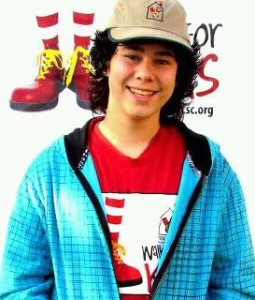
Today, I welcome young actress and cancer awareness activist (and cancer survivor!) Taylor Hay.
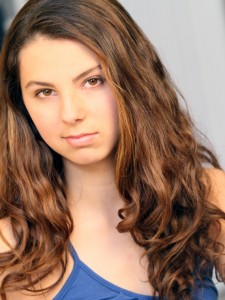
Taylor Hay

Taylor Hay

Born in San Diego, CA, Taylor hay began acting at the age of four when she was cast in the first commercial she ever auditioned for. She was introduced to the industry by her mother, actress Debbie Britt-Hay, but was the driving force to making this profession her life’s work. She worked steadily, building her body of work, until she was diagnosed with cancer at the age of nine. With that news, everything came to a halt. Once she regained her health, Taylor plunged back into her career, excited to be working again.

In a short time, Taylor booked her first voiceover role, Yes, Virginia, in addition to several web and television projects. She adding singing to her dancing background and is working hard on incorporating those skills into her acting portfolio.

Aside from acting, Taylor is a nationally titled equestrian, winning titles in multiple disciplines in the Arabian breed. In 2011, she added six national Top Tens to her existing titles, all before the age of thirteen.

ANTHONY: Hi, Taylor! Thanks for taking the time to answer some questions!

TAYLOR:  Thanks for talking with me!

ANTHONY: When did you start acting, and what was your first professional gig?

TAYLOR:  I started acting when I was about 4 and I went on my first audition for a Peter Piper Pizza commercial and that was the first thing I booked. Ever since then I have been hooked  I booked a feature not to long after the commercial called The Blue Rose plus a period movie called Hurricane Hunters. Now I’m fortunate to be doing some TV. I love it too!

ANTHONY: You did voice work for the animated film YES VIRGINIA. What was that experience like? What sort of tricks did you use to voice your character?

TAYLOR:   I loved working on Yes, Virginia! They were all so nice to me and took me to a behind the scenes of the making of the Macy’s balloons, which was totally cool. I was in the box for about two hours. They started out just using me in a small part but when I got there and they worked with me a little, they gave me more lines which was amazing. I loved the VO work. I hope I will get the chance to do more in the future. They allowed me to play around with the lines a bit and when I did something that they really liked, they let me know so I could tweak it to exactly what they wanted. I even surprised them by finding a way of saying a line they hadn’t thought of but really liked, so that was fun. I didn’t really have any tricks. I just played with my voice a little and tried to follow their direction until we all found what worked.

ANTHONY:  What have you worked on recently, and where can people see your work?

TAYLOR: I was working a lot before I got sick, and then everything stopped dead because of that. I have spent the last year rebuilding my career and my body of work. So I just got back on my feet and I have a lot coming up. I have a web series called The Day In The Life that I start filming this month and a pilot called The Road Less Traveled that’s coming up. I also have a small role in a Morgan Freeman movie coming out this year. I’m also excited about an anti-bullying PSA that will be released soon through Seng2KX Productions.

ANTHONY:  I can imagine breaking “back into” the business after such a life-changing event can’t be easy. How have you worked at rebuilding your career? Do you take acting classes, work with a coach? 

TAYLOR:  It was pretty hard at first. I kept going on audition after audition with no callbacks or bookings because no one remembered me and I’d lost a lot of the contacts I’d built. I felt like we were doing it for nothing sometimes–like no one was interested anymore. But my mom and reps kept saying to be patient, that it would take time again. Then in November, I booked five things in seven weeks. Things have been pretty steady since then so I feel really fortunate. I work really hard at staying sharp. I train every week except when I’m working and I really try to network as much as I can. I’ve been told I’m pretty good at it. I also work with a singing coach and am learning to play the guitar for the role in the TV series I’m shooting in April. That’s been pretty cool.

ANTHONY:  Has your cancer experience changed the way you approach auditions and creating a character?

TAYLOR:  Yeah, I think so. I lean toward drama and I find it easy to kind of get in touch with my emotions and all. I guess I have a lot to draw from for a kid my age. I think my coach, Amy, has taught me to draw from inside me and the things I’ve gone through to find the heart of the character and to keep it real. I like comedy, but I really like drama. I’d love to be on Criminal Minds or Bones or Grey’s Anatomy some day. That would be amazing.

ANTHONY:  You’re also a nationally titled equestrian! Congratulations. Where have you competed recently?

TAYLOR: Thanks! I have been doing a lot of auditioning and events lately so I haven’t had the chance to ride as much as I’d like, so the last time I showed was at Youth Nationals last year. But I am hoping to go to a show in March. But that may not happen because I haven’t gotten on my horse because of the rain 

ANTHONY: What specific style of equestrian events do you do?

TAYLOR: I do a lot of different events. I show English Pleasure, Country Pleasure, Halter, Native Costume, Sidesaddle, Show Hack, Hunter Pleasure, Dressage, Sport Horse In Hand and Under Saddle, Saddleseat Equitation, and have even shown reining. My mom is my trainer and has been doing it for years so she makes sure I’m very well rounded. It’s a blast doing all the different events and keeps me motivated!

ANTHONY: I know that equestrian showing is as demanding, if not more demanding, than acting. How do you balance your two loves?

TAYLOR:  I’m in a modified homeschool program so what I do is I get home and go out to ride so if I do have something that night I got my riding done and then I can put all my energy getting ready for the event and not freaking out that I didn’t ride that day. It’s a lot of commitment but I wouldn’t trade it for anything.

 ANTHONY: Like me, you’re a cancer survivor. What type of cancer did you have, how was it discovered, and how long have you been cancer-free / in remission?

 TAYLOR: I had a rare type of non-hodgkins lymphoma. It was discovered by Childrens Hospital and my friend at UCSD. I was the only kid at Rady at the time to have it. I have been in remission for almost two years now and am so grateful I’m here to give back as much as I can. 

ANTHONY: Congratulations on two years of remission! That’s fantastic. I know you do a lot to raise awareness of, and raise funds for, cancer research and cancer care. I’ve been teasing you on Twitter about your fund-raising battle with Sam Lant. Tell my readers about the Walk For Kids, and what they can do to help you and your team meet your fundraising goal.

TAYLOR: Well my friend Sam Lant put together a team for the Walk for Kids and I was invited to join it. The Walk For Kids is a fundraising walk for the Ronald McDonald House of Pasadena. The Ronald McDonald House provides care for the families of patients that have life threatening illnesses. You can make a difference by donation to our team Those Crazy Kids Next Door. We’re hoping to raise $10,000 to help the house.

ANTHONY: What other causes are important to you?

TAYLOR: I am also really involved with Make-A-Wish, Leukemia and Lymphoma Association, and Rady Childrens Hospital of San Diego. I’ve been an ambassador for both Make A Wish and LLS and was the Girl Of The Year for LLS in 2009. I got involved with these charities when I got sick and they did so much for me so now that I’m healthy again (which has been for the last 2 years) I want to give back in any way I can. It helped my family so much and I know how much it means to those kids. My total fundraising so far for the three organizations is about $250,000. I also do a lot of public speaking and singing at fundraisers and events that help to raise money for these charities. I also did a video for Hats Off For Cancer that can be seen on YouTube.

ANTHONY: All great causes! Now for my usual closing question: What is your favorite book, and what would you say to someone who hasn’t read it to convince them that they should?

TAYLOR:  Oh, well I don’t have a favorite book but I do have a favorite book series. The Hunger Games series is by far my favorite. If you haven’t read it you HAVE TO! It’s absolutely amazing. There are so many twists and turns. I am also really looking forward to the movie based on the book!!

ANTHONY: Thanks again, Taylor!

You  can follow Taylor on Twitter as @TayHay12, and you can see her resume on her IMDb page.

JENNIFER HOLLIDAY, Actor - Interview

Wow, that title sounds fancy, doesn’t it?

Anthony Cardno With Jennifer Holliday

Anthony Cardno With Jennifer Holliday

It’s December 31. I am hanging out, as I do every New Years Eve, with my college friends/adopted siblings. Jon & Cindi (and their son Xavier) are hosting, as always. Scott & Margaret are here with son and daughter Jared and Morgyn. Peggy is here with her son Max. Plus there are two dogs, a cat, a rabbit. Assorted local family and friends will drop in, too. It’s always a dual celebration, as Jon’s birthday is January 1.

Typically, this is not the ideal setting for long rambling thoughts about the past year. But we’re having a lull at the moment. Three of the four kids are reading quietly. So are half of the adults. So now seems to be the time.

I’ll admit it’s been a rough year. Car problems, financial problems, lots and lots of work travel bouncing me all over the country (especially these last few months). I’ve been a real cranky-pants at times, so the first order of business is thanking everyone who has put up with that crankiness, and everyone who helped me deal with what at times felt like insurmountable problems. They are too numerous to list here: if you are among them, you know who you are and I thank you.

On the writing side of things, the year was a mixed bag. I didn’t manage to complete either AMBERGRIN HALL or CHRISTMAS GHOSTS, my long-simmering novel and novella. Both are so close to completion it almost hurts, and I’ve made progress on untangling the plot knots of the first and filling in the hole in the plot of the second, but still … didn’t finish them. That is a goal for 2012. On the positive side, I sold my first genre short story, a science fiction tale for the SPACE BATTLES anthology edited by Bryan Thomas Schmidt and due out mid-2012. That felt terrific. Also, it seems like this year’s sales of THE FIRFLAKE were better than last year’s. This is an guess on my part, but it feels like I had more emails and tweets telling me “I’m buying your book” this year than I did last. It might have helped that I joined Goodreads in an effort to help advertise the book, and that I spent more time posting on the book’s Facebook page.

Reading-wise, having joined Goodreads has helped me keep even better track of what I read and what I thought (although I’m still behind on writing reviews of some of what I read, and likely won’t get those done before tonight’s festivities start). I’ll wait until later this week to post my “Favorites of 2011” final list. Between office and on-line bookclubs, and writing book reviews for ICARUS and CHELSEA STATION magazines, I’ve also read a lot of authors I’d never read before as well as revisiting old favorites.

Probably the biggest accomplishment of 2011 has been the increased use of this website. I added a second short story (“Canopus,” joining “Invisible Me”), and I made the decision to start blogging regularly. When I made that decision, I had no idea I would end up developing an almost-weekly Interview feature. It’s all Anthony Garguila‘s fault. Although his didn’t end up being the first interview I ran (that honor went to author Evelyn Lafont), it was meeting him at a high school band reunion he attended with his mother that instigated the whole “interviewing creative people” thing. I’ve had the honor of interviewing up-and-coming authors like Bryan Thomas SchmidtLinda PoitevinChad Helder and Christie Yant; genre pros like Jay Lakeand Jeremy C. Shipp; friends Dennis Miller and Joseph Pittman; and career authors like Lawrence Block. I’ve interviewed artists (Lynn Bennett-MacKenzie), editors (Ellen Datlow), webcomics creators (NamesakeSchool SpiritCura Te IpsumMultiplex), actors (Brandon Tyler Russell) and musicians ranging from indy artists like Casey Stratton and Matt Lande to teen pop-rockers Burnham and Hollywood Ending. I’ve learned a lot about interviewing, and I’ve learned a lot about the creative process as it manifests in different fields.

2012 looks to get off to a good start for interviews as well. Carolyn Gray (author of A Red-Tainted Silence and Long Way Home) and actors Austin MacDonald and Sarah Desjardins and Brad and Todd Mann are all due up in January. Author Kaaron Warren, editor John Joseph Adams and singer Jennifer Holliday will be along in February.

What I’m loving about the interviews is that they’re fun. This isn’t my day job, it’s a hobby I’m enjoying quite a bit. One of the things that has helped me interview so many interesting people has been Twitter. I’m grateful for the friends I’ve made through that site, including but not limited to the folks named in the preceding few paragraphs, as well as Marianne BurnhamHelen MacDonaldDesiree RussellLeigh GeraghtyNina DiamondTomatito AdamsSabrina Vourvoulias and too many others to name them all.

Bringing things full circle: despite the rough patches of the year, my health has been largely good and the travel has enabled me to spend far more time with the friends and family scattered around the country than I would have otherwise. As always, I end the year thankful for my health and for the love that continues to lift me up. Whether you’re a friend for decades or someone I’ve just gotten to know thanks to social media: thank you.

Here’s to a 2012 that is full of love, fun, health, peace and prosperity for all of us. Catch you next year!

JOHN JOSEPH ADAMS - Editor Interview

This week’s guest is editor John Joseph Adams, whose latest book is UNDER THE MOONS OF MARS, new short stories celebrating the 100th anniversary of Edgar Rice Burroughs’ classic hero John Carter of Mars.

John Joseph Adams

John Joseph Adams

John Joseph Adams  is the bestselling editor of Wastelands, The Living Dead (a World Fantasy Award finalist), The Living Dead 2By Blood We Live, Federations, The Improbable Adventures of Sherlock Holmes, Brave New Worlds, The Way of the Wizard, and Lightspeed: Year One. Forthcoming anthologies include The Mad Scientist’s Guide to World Domination (Tor Books) and Armored (Baen Books). In 2011, he was nominated for two Hugo Awards and two World Fantasy Awards. He has been called “the reigning king of the anthology world” by Barnes & Noble.com, and his books have been lauded as some of the best anthologies of all time. He is also the editor of Lightspeed Magazine, and is the co-host of The Geek’s Guide to the Galaxypodcast.

ANTHONY:   John, thanks for taking a few moments to chat with me about UNDER THE MOONS OF MARS. How did the project come about?

JOHN:  I’d heard that Disney was going to be adapting A Princess of Mars into a movie, and it sounded like–at LAST–the adaptation was finally going to happen. There had been a number of false-starts over the years, but it seemed like this one was finally going to happen, thanks in no small part to the success of (and SFX technological advancement provided by) Avatar. Being a fan of the original books, I was quite excited, and the idea of doing the “new adventures” of John Carter sprang to mind. It seemed like a good, marketable idea, and a book that would be a hell of a lot of fun, so I started putting together a proposal and recruiting authors for it. Once I started reaching out to people, the number of folks who were excited about it really reinforced my thought that it would be a great project, and luckily Simon & Schuster agreed and published the anthology.

ANTHONY:  The book features a fantastic line-up. Was there an open submission process or was it invitation only? Are there any authors you’d hoped would take part who weren’t able to?

JOHN:  The book was invitation-only; unfortunately, I had to keep it that way because I was under orders to keep the project secret basically until it was done being assembled; the publisher wanted to wait to announce it until we had a table of contents to show off. Also, I had recruited a pretty large number of authors for the book in the proposal stage, and I knew it would be unlikely that I’d have much extra room for anything beyond that. Plus, for a book like this one, which is a VERY specific topic, I knew if I did an open call for submissions, a lot of writers would end up with stories that they probably wouldn’t be able to sell anywhere else. Although the Barsoom stories are public domain, most short fiction venues are unlikely to run a story set in another author’s milieu.

Neil Gaiman and Michael Moorcock were both initially interested but ultimately couldn’t contribute due to their schedules, so that was disappointing. And there were a number of authors I would have loved to have on board who said no at the proposal stage for one reason or another. One contributing factor to this was that the anthology had to be put together on a pretty short timeline if we were going to have the book ready to publish to coincide with the release of the John Carter film.

Under The Moon of Mars

Under The Moon of Mars

ANTHONY:  The preview for the book on Amazon mentions a number of great artists, like Charles Vess and Mike Kaluta, contributing story illustrations. How did you decide which artist to pair with which stories for the illustrations?

That was mostly decided by Lizzy Bromley & Tom Daly at Simon & Schuster and my agent, Joe Monti. I was consulted, and I could have taken a more active role in those decisions, but I’m no art director, and I don’t really have a lot of connections to many artists, so I was happy to have someone else take the lead. I was pleased to see Mike Cavallaro participate, as I’m a huge fan of the graphic novel he did with Jane Yolen called Foiled. Likewise John Picacio, who I’ve been a fan of for years, and, of course, it’s an honor and a privilege to have work by Charles Vess. And it was also really cool, of course, to be exposed to artists I wasn’t as familiar with previously.

You can actually view all of the illustrations on the anthology’s website, johnjosephadams.com/barsoom.

ANTHONY:  John Carter is easily Edgar Rice Burroughs’ second most popular creation after Tarzan, even though Burroughs didn’t write anywhere near as many books about Carter and in fact half of the Barsoom novels focus on other characters. What do you think is the enduring appeal of John Carter in particular and Barsoom in general?
JOHN:  On the most basic level, the Barsoom stories are just great adventure stories, and so they’re sort of inherently appealing. But they also cross all kinds of genre boundaries. They’re obstensibly science fiction, but they feel a lot like fantasy, and there are elements from other genres as well, certainly romance and western fiction to name a few.

I think that as kids, we all wanted to be able to travel to Mars, and wouldn’t it be great if we could and it turned out to be the fantastical place with strange and interesting aliens and beautiful princesses? And a lot of us still have such dreams–so I think that’s a large part of what makes it so appealing–and enduring.

ANTHONY:  2012 is also Tarzan’s 100th anniversary, and Burroughs’ Pellucidar series hits 100 in 2014. Are you involved at all in anniversary anthologies for those books?

JOHN:  I’m not–at least not at the moment! For Tarzan, it would be too late to do anything to celebrate the anniversary, obviously, but Pellucidar…who knows!

ANTHONY:  What other books do you have coming our way this year?

JOHN:  As we’ve discussed, Under the Moons of Mars: New Adventures on Barsoom just came out.

Coming up in April, I have Armored, an anthology of stories about mecha and power armor, from Baen. It includes stories by Jack Campbell, Brandon Sanderson, Tanya Huff, Daniel H. Wilson, Alastair Reynolds, Carrie Vaughn, and others.

I’m also currently wrapping up work on two reprint anthologies. One is an anthology of epic/high fantasy fiction to be called Epic, which will be coming out from Tachyon Publications this fall. And due out this summer from Night Shade Books is Other Worlds Than These, an anthology of portal fantasies and parallel worlds stories. And, as usual, I’ve got a couple of other things in the works that I can’t officially talk about yet, but I hope to be able to announce soon.

Then, in February 2013, I’ll have The Mad Scientist’s Guide to World Domination, from Tor. That one features stories by Carrie Vaughn, Alan Dean Foster, Daniel H. Wilson, David Farland, Seanan McGuire, and Naomi Novik, among others, plus an original short novel by Diana Gabaldon.

ANTHONY:  And my usual closing question: What is your favorite book, and what would you say to someone who hasn’t read it to convince them that they should?

JOHN:  The Stars My Destination by Alfred Bester. When I read that book, it BLEW MY MIND. After reading it, my reading life became all about finding other books like that one. Up to that point, I’d read a number of sf novels that I liked a great deal, and still to this day remember fondly, but it wasn’t until The Stars My Destination that I realized the heights that science fiction was capable of attaining, and it wasn’t until then that I narrowed my reading focus almost exclusively to sf in my efforts to find more books that effected me in that same way.

There’s a paragraph in the book from the early part of chapter one that describes “common man” protagonist Gully Foyle’s state of mind. He’s been stuck, as the lone survivor, on a spaceship for 170 days, and watches as another ship approaches his, ignores his distress call, and leaves him to die:

He had reached a dead end. He had been content to drift from moment to moment of existence for thirty years like some heavily armored creature […] but now he was adrift in space for one hundred and seventy days, and the key to his awakening was in the lock. Presently it would turn and open the door to holocaust.

So that’s the key to Gully’s awakening. I think of The Stars My Destination as mine.

ANTHONY: Thanks again, John! Always a pleasure!

You can follow John Joseph Adams on Twitter as @JohnJosephAdams and you can see more about all of his books by visiting his website.

SAM LANT - Actor Interview

Today I welcome young actor and fundraiser Sam Lant.

Sam Lant

Sam Lant

Sam was born in Truckee, California. He spent his primary years growing up on the North Shore of Lake Tahoe, learning to ski and wake-board depending on the season. Sam’s break through in acting came at IMTA New York in 2006. Realizing acting was Sam’s big dream, his family made the move to Los Angeles, along with his dog, Capone, and a fighting fish named Sapporo. In his free time Sam enjoys riding his mountain bike, taking Tae Kwon Do and spending time camping with his Boy Scout Troop.

ANTHONY:  Hi, Sam. Thanks for taking the time to chat.

SAM:  Thank you for having me.  I am excited to chat with you and get the word out about my upcoming projects as well as the Ronald McDonald Walk for Kids.

ANTHONY:  How long have you been acting, and what was your first professional credit?

SAM:  I have been acting professionally in Los Angeles for 5 years.  I started out taking classes in Reno, NV and was approached about competing at IMTA in New York.  I went to New York and won pre-teen actor of the year 2006.  Which brought me to Los Angeles to audition with many agents and managers who were interested in working with me.  I commuted from Tahoe for the first 3 years but then officially moved out here in 2009.  I worked a bunch of student films and did background work when I moved to learn about being in front of a camera.  I would say my first real professional credit was when I worked on the game show Destroy Build Destroy.  It might be a game show, but there was a lot of behind the scene stuff going on to help pump up our energy.  It was a great project to work on even though my brother’s team ended up winning.  My favorite part of the project was when I was howling at the moon for fun and one of the producers saw me, he came running over and said to do it again for the camera.  They ended up using that footage in the commercials promoting my episode “Big Bros vs. Lil Bros”.

ANTHONY:  You’re in the cast of the upcoming PROJECT X. Tell us a little about the movie, and your role.

SAM:  Project X is about 3 high schoolers who throw a party because they think it is their last chance to become cool before they graduate.  Things get way out of hand.  The party gets so big that Jimmy Kimmel reports on it during his opening monologue.  It is pretty funny stuff.  I play Dave.  He is a freshman trying to sneak into the party.  He keeps getting caught and thrown out.  You will have to watch and see if he is eventually successful or not.  

ANTHONY:  The movie looks just a little bit … insane. What was filming like?

SAM:  The movie is more than a bit insane.  HA.  Scott Budnick and Nima Nourizadeh were amazing to work with because they were very encouraging.  In fact, all the crew were awesome.  One of the days we filmed, it was my birthday, and they all wished me a Happy Birthday.    But filming for me wasn’t that bad because I am a minor and they couldn’t film some of the scenes around me.  So, the days I worked were pretty tame.  The final scene was a lot of fun though because I had to dance with this really hot girl.  When I got to set I found out it was going to be Anna Sophia Berglund, who Hugh Hefner’s current girlfriend.  All the guys on set that night were very jealous of me.

ANTHONY:  Your other recent project is “too perfect.” How did you get involved in that project, and where can people see it?

SAM:  I got involved with “too perfect” through LA Casting and over skype.  The director, Julie Rubio, contacted my mom after my mom submitted me for the role on LA Casting.  My mom actually didn’t realize the project was filming in San Francisco when she submitted me.  I then auditioned over Skype and Julie thought I would be perfect as Skylar.  We did several table reads and rehearsals where I was skyped in to follow along since I lived in Los Angeles.  I went to San Francisco to film for 9 days.  It was a lot of fun.

You will be able to find “too perfect” on netflix and blockbuster sometime this year.

ANTHONY:  You also seem to be the only one of the main 5 cast-members whose character is not named after himself. How did you manage that?

SAM:  Originally, the story was written about 5 friends in real life.  Unfortunately, Skylar couldn’t film so Julie put out a notice on LA Casting to see if someone else fit the role.  The other 4 kids who filmed with me are all friends and go to school together.  I met the real “Skylar” the night of the premiere and he congratulated me on doing a great job acting like him.  Now we are all friends on Facebook.

ANTHONY:  You’ve done a few short films. What do you see are the differences between working on a short film and a feature film?

SAM:  I guess the main difference would be how long you are filming for, short films can be shot in a weekend or even a day sometimes where feature films need a lot longer to get all the scenes filmed.  Another difference is the craft services – bigger productions have the budget for more food and bring in catering companies to cook main meals.  My favorite thing about being on set besides acting is the amazing food.  ha ha ha

ANTHONY:  I know the job search for teen actors is just as difficult as it is for adults, possibly moreso because there are fewer “big” venues for kid actors — if you’re not involved in a Nick or Disney series, options for regular tv work are definitely smaller — so how do you get your name and face out there for casting directors to see?

SAM:  My agent and manager are great about pitching me out to casting directors for upcoming projects.  Also a lot of shows have guest starring roles for kids such as Criminal Minds and CSI, so the opportunity is there.  Another way I network is at casting director workshops which allow me to meet casting directors I haven’t before while also learning something new or building on previous knowledge.  And, every year in November there is an event called Actorfest which has casting director meet and greets, and holds training workshops hosted by top professionals in the business.  I try to network at events like these to get my name out there.

ANTHONY:  What kind of prep do you do for auditions? Are you working with an acting coach, taking classes?  Do you ever think “man, there are just SO many of us trying for the same few parts, maybe I should do something else for a living?”

SAM:  I am taking classes with the amazing and talented Amy Lyndon who is teaching me the 15 main guidelines for cold read and booking a role.  When I prep for an audition, I have a work sheet Amy gave me that I use to break down a script.  Then I work on it until I feel I have the character just right.  It is all about a choice.  My choice might not be the same as someone else, so it is up to the casting director to see who made the best choice to bring the writer’s vision to light.  As far as doing something else, I act because I love it not for the money.  I really can’t see myself ever giving up something I love doing.  Although, I am planning to get an aeronautical engineering degree in college because I would also like to be an astronaut.

ANTHONY:  Speaking of classes — how do you balance auditioning/being on-set and school work?

SAM:  I home school, actually go to a year-round charter school, so I only go to class twice a week for an hour to take tests.  Because I do my work at home, I can do my school around my audition schedule.  Sometimes, I do homework in the morning and when I have had a hectic schedule preparing for auditions then I will do it at night.  Since I go to a year-round school I am actually working faster than being in regular school and should graduate a year early.  Being on set is a even easier, because the law requires me to do 3 hours of school each day we are working.

ANTHONY:  Okay, let’s talk about causes. I know you’re doing a Ronald McDonald House fundraiser at the moment. Why this cause, and how did you get involved?  What can my readers do to help you and your Walk For Kids team?

walk-for-kids-255x300.jpg

SAM:  I was filming a short film called “Tears Asunder” and the location was about 5 houses down from Ronald McDonald House Pasadena.  We walked past it everyday on our way to set and I asked my mom what it was.  She explained what they did and I thought that was really cool because when I was little I had very bad asthma and often was hospitalized.  We lived in a small town so my mom was able to stay in the room with me but I know that isn’t always possible in larger cities.  I was glad to have my mom close because it was very scary sometimes.  I got involved with Walk For Kids last year when one of my friends invited me to join her team.  I raised $400 last year and want to raise even more this year.  I decided to start my own team this year because I wanted to be more active in helping Ronald McDonald House.

People can help our team by donating any amount, even $1 will help us reach our goal of $10,000.  My favorite thing to say is…can you give up your morning latte today and donate that $5 to our fundraiser.  A lot of people don’t realize if they just cut one specialty item out of their schedule they would have enough to help a child have their mom close by if they get scared.

Here is the link to my donation page —  My goal is $1000 but I would like to raise even more than that if possible.

ANTHONY:  What other causes are important to you, and how involved are you with those?  

SAM:  I am working with several organizations.  Last year I donated my birthday to Project Night Night.  They give security totes to kids whose families have become homeless due to the economy or loss of job.  Each tote has a blanket, teddy bear or stuffed animal, and a bedtime story.  On my 15th birthday, I asked my guests to bring one or more of these things to donate to the tote bags.  We were able to stuff over 75 totes for kids ages 0-12 years old.  I was over whelmed with how generous everyone was to help these kids.  I am doing the same again this year for my 16th birthday.  I don’t have a lot but there are people out there who have a lot less and it feels good to help those people.

Another project I am working on is a Freeline Skate team which will be going around to different charity events to teach kids to Freeline skate who might not have opportunity to learn.  We are going to work with the Boys and Girls Club, Autism Talks, Make a Wish, Starlight Foundation and anyone else who is interested in having a fun time learning to skate.

ANTHONY:  And my usual final question:  What is your favorite book, and what would you say to someone who hasn’t read it to convince them that they should?

SAM:  My favorite book right now is “The Hunger Games”.  Which is really actually a series of books.  I read the first one in a single day because it grabbed my attention and I didn’t want to put it.  The plot had a really great twist at the end which surprised me.  I think a lot of kids would really enjoy reading these books.  I am excited for the movie to come out and plan on seeing it the very first day it comes out.  

ANTHONY: Thanks again, Sam!

SAM:  Thanks for the interview.  These were some fun questions and I enjoyed answering things I hadn’t been asked before.  OH…and thanks for your donation to Walk For Kids.  YOU ROCK!!!!

ANTHONY: As I said on Twitter: “Curse you, Sam Lant! Stop ruining my reputation as a big ol’ meanie!”

You can follow Sam on Twitter as @ActorSamLant, check out his Facebook fan page, his IMDb page, and his freeline skate team’s YouTube channel. And of course donate to his Ronald McDonald House fundraiser!

JERRY ORDWAY, Comic Book Creator - Interview

Sometimes I get to interview my friends, sometimes I get to interview folks whose work I’ve stumbled across recently and enjoyed, and sometimes I get to interview my creative heroes. This week, I’m talking with comics creator Jerry Ordway, who definitely falls into the “heroes” category.

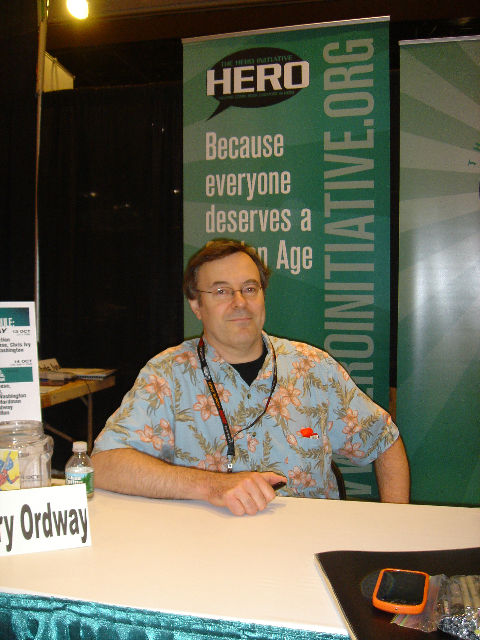
Jerry Ordway

Jerry Ordway

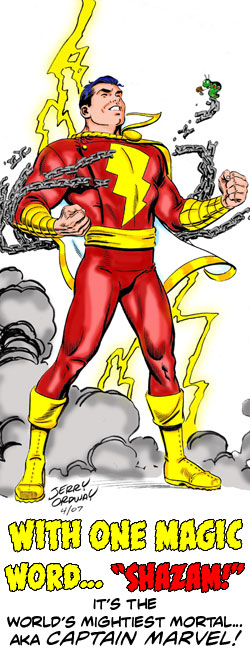
Jerry Ordway has been working professionally in comics since 1980. He had a long run as finisher and then full artist on DC’s ALL-STAR SQUADRON, which is where I first encountered him. He co-created the original INFINITY INC, had a eight-year run on the SUPERMAN family of titles, and a fantastic four year run redefining THE POWER OF SHAZAM. He’s also done work for Marvel Comics.

ANTHONY: Hi, Jerry. Thanks for agreeing to let this long-time fanboy pester you for a while.

JERRY: No problem, happy to chat.

ANTHONY: DC Comics recently announced a black-and-white SHOWCASE reprint edition of the early issues of All-Star Squadron. I couldn’t find a contents listing on Amazon. How much of your work on the series will be seen in this first volume?

JERRY: I assume you’ll see the finishes I did on Buckler, as well as those on Adrian Gonzales in issues 1-14, including the first annual. Maybe they’ll include the Justice League portion of the JLA-JSA crossover. Not sure what the page counts is, on those collections.

ANTHONY: You started out inking Rich Buckler, who I’ve had the pleasure of meeting at a couple of New York Comic-Cons, but he eventually left the book and you shifted to pencilling duties. Was there any pressure to mimic Rich’s style in the beginning, or did the editors just let you jump right in?

JERRY: Well, since I was doing finishes on All Star Squadron from the beginning, the editor felt that my “veneer” so to speak, was the selling point, especially since I was working over Adrian Gonzales’s work from around issue #6(?) until I started pencilling. In fact, I had been wanting to pencil from the start, but doing the monthly All Star book was something DC didn’t want to mess with, or derail. By the second year, Roy Thomas had me doing so many art changes, I was frustrated. I decided to take up an offer to draw an 8 page Creeper back-up in Flash, and quit the book. But Len Wein, the editor told me I could pencil All Star, instead. Not wanting Adrian to lose work was my concern, and he was apparently happy to shift over to Arak, instead of drawing a dozen costumed heroes in a period backdrop:) So, no pressure to have to follow any style but my own.

ANTHONY: I have to say that I think part of my enduring love for the Golden Age Flash, Green Lantern and Starman over and above their more modern counterparts has to do with your take on them back in the Squadron days. Why do you think Jay Garrick, Alan Scott, Ted Knight and even the original Captain Marvel still have such a fan-base 70 or more years after they debuted?

JERRY: Well, I think they are all compelling characters in their own right, of course, but I think in the case of the JSA-ers, that Roy, with some help from me, imbued them with personalities that didn’t exist in earlier incarnations. Roy lived and breathed those characters, and that is what made the JSA characters special in our time frame, via All Star Squad, and also Infinity Inc in the mid 1980’s. That material directly inspired the Goyer and Robinson (later Geoff Johns) material, much as the 1940’s to 1970’s stuff inspired Roy and myself.

ANTHONY: You got to redesign some WW2 characters and create some brand-new characters for All-Star Squadron. Looking back, what was your favorite costume design, and who would you like to have (re)designed given the chance?

JERRY: Again, at Roy’s insistence we gave Tarantula new life, outside of being a Sandman clone. That costume is a favorite of mine. Amazing Man was a new creation, though also a fun design, an attempt to design as if it was 1940 instead of 1980. I was never compelled to redesign any of the classic ones, though. I felt I could make them work in the drawing, if they appeared a bit clunky, as Alan Scott’s 1940’s outfit was. That one had every color in the paintbox, but worked fine if you drew it consistent.

ANTHONY: When you wrote and drew The Power of Shazam!, including painting the series covers, you gave the book a look that seemed to sit squarely between the cartoony look of creator CC Beck and the realistic look Don Newton used in the short Adventure Comics run he did. Was this a conscious decision, or just a function of how your own style had developed at that time?

JERRY: Well, I was a fan of Don Newton’s work overall, from his Charlton days on the Phantom, and I also respected C.C. Beck’s vision. To me, the only way Captain Marvel ever looked correct, was when he was on model with the Beck head design. I’ve always tried to make my heroes different in subtle ways, for storytelling clarity, and with Cap, that was the iconic look, much as Joe Shuster and Jack Burnley’s golden age Superman was the correct model for that hero.

ANTHONY: How has your creative process changed over the years? Do you still use basically the same tools, or have you switched completely to digital? And how do you think digital tools have affected the style of newer artists in the field?

JERRY: I work with paper and pencils, ink and pens. I scan work and do digital touch-ups, but the appeal for me isn’t in inking or drawing digitally. It’s a tactile experience, feeling the pen tip on the paper. Digital is an improvement in many ways, allowing for color separations to be done better, and I’ve seen painted work that looks great digitally, but the training is the same, learning to draw, learning to use color, or black and white.

ANTHONY: You’ve worked extensively for DC, you’ve done some work for Marvel. Is there any character out there you haven’t had a chance to work on that you’d still like to take a crack at?

JERRY: I love drawing Captain America, and also always wanted another shot at the Fantastic Four. I grew up a Marvel reader, so those characters connect me to my childhood, you know? But sometimes, you are better off not working on material that you love to much at the start, because it hampers your vision, in a way. I learned to love Superman, as well as Captain Marvel, and I think I did my best work on them because I could be objective about what worked and what didn’t.

ANTHONY: What are you currently working on?

JERRY: I just finished a 6 page Alfred story for the Bat-books, with a Halloween theme, so I suppose that will go into inventory for next year> Also I have 5 pages in the second issue of the new Thunder Agents series, drawing a 1960’s flashback, which was fun. I have a couple of projects lined up, but can’t spill the beans just yet. The first is a new take on a 1960’s era DC book, which is all I can tease.

ANTHONY: You’ve been auctioning original art on e-bay. Is there any piece of your own work that you would never ever part with?

JERRY: I have a hard time parting with most stuff, which is why I’ve been selling prelims and sketches for the most part. Each drawing represents a day or two of my life, you know?

ANTHONY: Thanks again, Jerry!

You can find Jerry all over the web. He’s on Twitter as @JerryOrdway, he’s on Facebook, he blogs on Ordster’s Random Thoughts, and there’s still content up on his website as well.

ELLEN DATLOW, Author - Interview

This week, I’m happy to be interviewing another one of my personal favorites, editor Ellen Datlow.

(From her website:) Ellen Datlow has been editing science fiction, fantasy, and horror short fiction for almost thirty years. She was fiction editor of OMNI Magazine and SCIFICTION and has edited more than fifty anthologies, including the horror half of the long-running The Year’s Best Fantasy and Horror. Ellen is currently tied with frequent co-editor Terri Windling as the winner of the most World Fantasy Awards in the organization’s history (nine). Ellen was named recipient of the 2007 Karl Edward Wagner Award, given at the British Fantasy Convention for “outstanding contribution to the genre.” She lives in New York.

ANTHONY: Between April and September of 2011, you’ve had four anthologies hit the market. That’s a lot of pages in a short period of time! Are you planning on resting any time soon?

ELLEN: Those anthologies were finished more than a year before they were published, and Naked City was essentially finished two years before it came out. I should have only had three original anthologies published in 2011 (I also had The Best Horror of the Year volume three) but Naked City was delayed by a year as I awaited a promised story that never came in (by a BIG name). Publicizing four anthologies within a six month period became very complicated. It was difficult for me to remember which writers were in which book. Honestly. I occasionally screwed up and set up two different signings for which I asked the wrong writers to participate—embarrassing.

I’m currently only working on one original anthology plus The Best Horror of the Year volume four so have it relatively easy this year as far as editing goes. But overall, I’d much rather be editing more than less.

ANTHONY: The anthologies seem to work in pairs. For instance, NAKED CITY: New Tales of Urban Fantasy from St. Martin’s Griffin and SUPERNATURAL NOIR from Dark Horse. From the titles, a casual browser might assume both feature gritty city-based detective tales with a supernatural angle. Aside from different publishers, what distinguishes these two books from each other?

ELLEN: The two anthologies aren’t meant to be related at all. Naked City is mostly comprised of stories reflecting the traditional definition of urban fantasy as written by John Crowley, Ellen Kushner, Peter Beagle, and Delia Sherman—fantasy that takes place in cities, with the city almost always crucial to the action. It mostly includes fantasy and some dark fantasy.

Supernatural Noir is a horror anthology-combined with the flavor of the film noir of the 40s-50s. In my guidelines I made it clear that I didn’t want only detectives as main characters and that in fact I’d prefer that writers avoid that kind of set-up. And mostly they did.


Blood & Other Cravings

ANTHONY: I can ask the same question of TEETH: Vampire Tales from Harper and BLOOD AND OTHER CRAVINGS from Tor. Both are, on the surface, books about vampires. One thing that distinguishes these two books from each other is the target audience. TEETH is aimed directly at the YA market, BLOOD is for the adult reader. What else separates them?

ELLEN: Teeth is a young adult anthology in which vampires play a major role. Every story has an actual blood-sucking vampire in it.

Blood and Other Cravings is an adult anthology focusing on vampirism, the concept rather than the creature, even if there are vampires in some of the stories. It’s a follow up to my two vampirism anthologies from 1989 and 1991: Blood is Not Enough and A Whisper of Blood (both recently brought together in one big beautiful new hardcover edition titled A Whisper of Blood from the Barnes & Noble imprint Fall River Press).

ANTHONY: Only one of your four recent anthologies has been with a co-editor: TEETH, with long-time editing partner Terri Windling. What are some of the key differences between solo editing and co-editing?

ELLEN: With co-editing, some of the material might include stories that one editor loves more than the other. When I’m editing solo it’s completely my taste. We both approach writers and wrangle them (to get the stories in on time). We both read and choose the stories. We split some of the tasks. Terri writes our meaty introductions, I put together the bios of each contributor and compile the front matter. Depending on how strongly one of us feels about a particular story we want to buy, either Terri or I will work with the writer on the substantive editing. I do most of the line editing.

ANTHONY: You’ve worked with Terri quite often, but I think you’ve had other co-editors as well. Is there a quantifiable difference between working with Terri and, say, Nick Mamatas?

ELLEN: I’ve worked with Terri on six young adult anthologies, two adult anthologies, and three middle-grade anthologies. (For our Year’s Best Fantasy and Horror we each chose our halves independent of one another.) They were all fantasy.

The only other editor I’ve worked with has been Nick Mamatas. Nick and I worked on Haunted Legends, a horror anthology, together. Nick knows a different pool of writers than Terri and I do so it was interesting to work with some of “his” authors. Since it was our first anthology together it was also a little worrisome at the beginning as to whether we’d be on the same wavelength. Luckily we were and I’d be happy to work with him again.

ANTHONY: You’ve occasionally been accused of having a sort of stable of writers: “If this is a Datlow anthology, I don’t even have to look at the ToC, I know Authors A, B, C and D will be included.” And I’m sure other editors receive similar accusations. Do comments like that have any influence on your story choices?

ELLEN: I don’t consider having a stable of writers an negative, and it’s certainly not a limitation. It’s a fact of editing over a long period of time. One works with writers whose work one enjoys and who produces great stories –on time. So of course the editor will keep buying stories from those writers over the course of time, as long as she can –see my note in the next paragraph. I have a huge stable of writers from my seventeen years at OMNI Magazine, my almost six years at SCIFICTION, plus the twenty-five Best of the years I’ve edited.

In every original and reprint anthology I edit there are some writers whose work I use repeatedly, but there are always other writers I’ve only rarely or never before published in my anthologies. This is especially true in my best of the year anthologies. Just in the last two years of The Best Horror of the Year I published twelve stories by writers I’d never worked with before—some of whom I’d never even read before. The crucial thing to know about writers is that they often stop writing short stories once they publish their first novel, so to me it’s important to use their best short fiction while they‘re still writing it. Very few of the hundreds of writers I published in OMNI write many if any short stories today. So yeah. I’m delighted to be able to continue to publish writers like Jeff Ford, Kathe Koja, Kaaron Warren, Laird Barron, and Richard Bowes as long as they continue to produce great stories. I’d be stupid not to.

ANTHONY: We’ve talked in the past (mostly on your livejournal) about the importance of story placement, especially in the lead-off and concluding positions of an anthology. Is there ever pressure from a publisher to ensure Author X gets the lead-off, even if you personally feel the story is more appropriate for the middle of the book in relation to the rest of the stories you’ve accepted?

ELLEN: No –that’s generally my decision. Twice, in-house editors have suggested a switch, but when that happened it had nothing to do with who the writer was but the feeling that a different story would work better as the lead. And thinking it over I concurred.

ANTHONY: How intimately do you work with writers before a story is officially accepted? Have you ever initially accepted a story and then through the editing process realized that it wasn’t going to work out?

ELLEN: I never accept a story before I’m certain that it will work out. If I love a story but feel it needs too much work to buy outright, I’ll ask the writer if she’s willing and able to work with me on it (setting out what I see are the problems). If she is, I’ll make it clear that until we’re agreed on the revisions and I see the rewrite I can’t commit to taking the story (giving specific suggestions and asking specific questions about the trouble spots). But if I and the writer put that much time into rewrites I know that ultimately I will take the story.

When I was a lot newer to editing I had a few experiences in which I requested rewrites but the writers didn’t “hear” what I was saying–they made changes I didn’t ask for and in so doing made their story worse. Which is why I’m much more careful now how I ask for rewrites and try to be very specific.

Also, because I’m not working on a magazine/webzine with a slush pile, I usually work with writers whose work I’ve solicited. That means I’m familiar with their work and hope we’re on the same wave length. Going back to your questions about “stables”–that’s the advantage of working with writers you’ve worked with before. You know that you can work with them, saving a lot of time and energy on both sides.

ANTHONY: You’ve said in recent interviews that all of your anthologies are “invitation only.” I can’t resist asking: how does one go about getting invited? Or, to phrase the question more seriously: what catches Ellen Datlow’s attention these days that might cause you to invite a writer to a future anthology?

ELLEN: By me noticing your fantastic stories when I read for The Best of the Year. And since I skim so many sf/f/h/mystery short stories (and some non-genre) being published in a given year, I’m pretty aware of new writers as well as the more established ones.

ANTHONY: Speaking of the future. I see that one of your and Terri’s classic anthologies, SNOW WHITE, BLOOD RED, was recently reissued. Are there any plans to continue the Adult Fairy Tale series?

ELLEN: We’re very pleased that Snow White, Blood Red has always done so well. It sold 72,000 in mass market pb which is amazing for an anthology. It was in print for over ten years and it’s great that it’s in print again from Fall River Press.

I grew tired of reading so many re-told fairy tales after six volumes of adult tales and three of middle grade (for children). The sub-genre exploded after we did ours. I don’t know if there’s much of a market for new anthologies on the theme any more– I’m not convinced we could sell a new one these days. Black Thorn, White Rose, and Ruby Slippers, Golden Tears are both currently in print from Wildside Books. What we’d love is for the last three volumes to be reissued, as they’ve been out of print for awhile.


ANTHONY: What else are you working on at the moment?

ELLEN: Terri and I recently finished a young adult anthology called After: Dystopian and Post-apocalyptic Tales that will be published by Hyperion next fall. And we’re working on an adult Victorian Fantasy anthology for Tor. And of course, The Best Horror of the Year volume four, my bête noir.


ANTHONY: Finally, can you tell my readers about the Fantastic Fiction readings at KGB in New York City?

ELLEN: It’s a monthly reading series started in the late 1990s by writer Terry Bisson and Alice K. Turner (former fiction editor at Playboy), originally pairing genre and mainstream writers at the KGB Bar, an east village institution (in New York City). I took over for Alice in spring 2000 and when Terry Bisson left for the west coast in 2002, Gavin J. Grant began co-hosting with me. Matthew Kressel took over for Gavin in 2008 and we’ve been co-hosting ever since.

ANTHONY: Thank you for taking the time to chat, Ellen! Always a pleasure!

* * * * * *

I somehow managed to not ask Ellen my usual closing question (“What is your favorite book and what would you say to convince someone who hasn’t read it that they should?”), so I’ll mention that my favorites of Ellen’s anthologies are The Beastly Bride, co-edited with Terri Windling, and Naked City.

You can go to Twitter to follow @ellendatlow, and you can find Ellen on her own website.

I’m also happy to announce my first Interview Giveaway! Ellen and her publisher, Dark Horse Books, have been kind enough to provide me with a copy of SUPERNATURAL NOIR to give away in conjunction with this interview.


Supernatural Noir

SUPERNATURAL NOIR is a “masterful marriage of the darkness without and the darkness within … an anthology of original tales of the dark fantastic from twenty modern masters of suspense,” including Gregory Frost, Paul G. Tremblay, Caitlin R. Kiernan, Elizabeth Bear, and Joe R. Lansdale.

To be entered to win the book, leave a comment on this post sharing the name of your favorite Ellen Datlow-edited (or co-edited) anthology. Winner will be picked at random from all comments left here by midnight Tuesday, November 29th. That’s one week from today, folks! Comments are screened, so you won’t show up on the post right away, but rest assured I will approve all comments that are not obviously spam (and I do seem to get a lot of that) and chose from all eligible comments!

PATTY JANSEN, Author - Interview

This week’s guest is author Patty Jansen, as part of the Blog Tour she’s doing to promote her latest book.

The Icefire Trilogy by Patty Jansen

The Icefire Trilogy by Patty Jansen

Patty Jansen lives in Sydney, Australia, where she spends most of her time writing Science Fiction and Fantasy. She publishes in both traditional and indie venues. Her story This Peaceful State of War placed first in the second quarter of the Writers of the Future contest. Her futuristic space travel story Survival in Shades of Orange will appear in Analog Science Fiction and Fact.

Her novels (available at ebook venues, such as the Kindle store) include Watcher’s Web (soft SF), The Far Horizon (SF for younger readers), Charlotte’s Army (military SF) and books 1 and 2 of the Icefire Trilogy Fire & Ice(http://www.amazon.com/dp/B005TF1B9K) and Dust & Rain (post-apocalyptic steampunk fantasy).

Patty is a member of SFWA, and the cooperative that makes up Andromeda Spaceways Inflight Magazine, and she has also written non-fiction.

Patty is on Twitter (@pattyjansen), Facebook, LinkedIn, goodreads, LibraryThing, google+ and blogs at: http://pattyjansen.com/

Patty Jansen

Patty Jansen

ANTHONY:  Hi, Patty! Thanks for stopping by to chat. You’re about to release book three of your IceFire Trilogy. Give my readers a little overview of the series so far, if you will.

PATTY:  On a strange world in a land without a name, a relic of a long-dead society causes a lethal radiation called icefire. The people who live close to this thing, called the Heart of the city, have become immune to it, but the Imperfects, always born with parts of limbs missing, can bend it to their will. Fifty years ago, such a person became king and used icefire to cut out people’s hearts, turning them into ghostly servitors who terrorised the population in the king’s name.

This lasted until the Eagle Knights, flying on the back of giant birds, killed the king and ousted his family. But in the fifty years since, the Eagle Knights have led a cruel witch hunt against  those who happened to be born Imperfect. Many families have lost children, and the tide is turning the other way.

The old king’s grandson, Tandor, has grown up in neighbouring Chevakia and he wants only one thing, revenge. His grandfather’s diaries tell him how to increase the beat of the Heart, and with the resulting higher level of icefire, he plans to re-take the throne.

However, to do so, he needs the help of the Imperfect children whom he’s saved from death, and the Eagle Knights have discovered their hiding place.

So starts a frantic rush to find the children, or to find other Imperfects, and without giving too much away, I can say that once you start meddling with icefire, it takes on a mind of its own. This is a destructive, evil force.

The rest of the series involves how refugees and people from the neighbouring country (who will die once icefire reaches certain levels) piece together the only way to undo the damage.

ANTHONY: Sounds exciting and intriguing! So many fantasy trilogies these days seem to grow into quadrologies or longer. Is IceFire a real trilogy, a “done in three” deal?

PATTY:  It’s a complete story, so if ever there were any other books in this world, they wouldn’t be part of the trilogy.

ANTHONY:  I recently talked to Andrew P. Mayer about his “Society of Steam trilogy.” We talked about how the first book was a mystery but the second book is more of an action-romance, and how the tenor of individual books in a series can change while still being true to the whole. How did you approach crafting the IceFire Trilogy? Is it one massive story told in three parts, like the Lord of the Rings, or does each book have its’ own personality and purpose?

PATTY:  It is a massive story told in three parts. It grew out of me trying to write it as one book, and failing miserably. There are various aspects to it. Book 1 takes place entirely in one locality, until something dramatic happens at the end. Book 2 deals with the fallout from that event, and book 3 brings the threads together as the characters must find a way to deal with the disaster that is acceptable to all, and learn that every good is also evil, and every evil is also good.

ANTHONY:  How did you plot/pace the Trilogy? Was it tightly-plotted from the beginning, or did you allow room for tangents and new ideas? (Isn’t that a nice way of rephrasing the “are you an outliner or a pantser” question? haha)

PATTY:  I am a pantser extra-ordinaire. That said, I always knew where I wanted the book to end up. The bits in between are never clear until I write them, but the ending always is.

ANTHONY:  In addition to the trilogy, you’ve got stand-alone novels and a plethora of short stories/novellas available through Smashwords. I know you’ve blogged about your love for Smashwords on your own blog, but I want to play devil’s advocate and ask: what are the pitfalls to electronic self-publishing?

PATTY:  Doing it too early, before you have a clue about writing, about what’s hot and what’s not, before anyone who is not a friend or relative has read and commented (read: shredded) on your book. You should develop some writing chops before you wade into the giant self-publishing pool. Get a few short stories published. Submit to agents for a while. If you get regular requests for the full manuscript, that is when you can self-publish.

ANTHONY:  Jay Lake often talks about an author’s “span of control.” What’s your most comfortable working length for fiction?

PATTY:  I honestly don’t have one. A story is as long as it needs to be.

ANTHONY:  As you know, I’m a bit obsessed with short stories.  Do you approach the writing of a short story any differently than you approach writing a novella or novelette?  What factors into deciding something will be a story versus a novella?

PATTY:  A lot of my longer works started out as short stories. I think any short story can be made into a novel by adding extra layers or expanding the plot (the short story plot usually ends up being a secondary thread). This is what I seem to be doing a lot recently. The trilogy started life as a short story. The story covered a tiny part of the plot, and in the novel, I ended up turning it upside down.

ANTHONY:  It seems like your standard short story page length is around 50 pages, which is about 40 pages longer than my average short story. I’m fairly new to the e-reader scene, but do you find that working at that length makes it easier to re-brand / market your shorter works for the Kindle, Nook, etc? What are the challenges of taking a story that’s been published (print or online) in a magazine or anthology and then putting it out as a stand-alone ebook?

PATTY:  No, not really, but if a short story is less than 5000 words, I like to tack something else onto it. Also, some of my short stories (especially the freebies) have a sample chapter attached.

ANTHONY:  What other projects, short or long, are you working on?

PATTY:  I write a fair bit of hard SF, and once I finish the trilogy, I will be working on a novel in the same world as my novellettes His Name In Lights and Luminescence and the novella Charlotte’s Army.

ANTHONY:  And my usual final question: What is your favorite book, and what would you say to convince someone who hasn’t read it that they should?

PATTY: C.J. Cherryh’s Foreigner series. These books are social Science Fiction that describes relationships between aliens and humans living on a planet where humans are refugees, in the minority and not in power. The aliens are human enough for interactions, but alien enough so that you never really know what they will do next. The depth in these books is astounding, the immersion in the character incredible.

ANTHONY:  Thanks, Patty!


2011 WRITING GOALS - Anthony R Cardno

I think it is absolutely time to state some broad writing goals for this year.  I’ve been in a bit of a slump writing-wise since before the holidays, but am slowly coming out of it.

Part of coming out of the slump is thanks to taking Jeremy C. Shipp’s Yard Gnome Army Fiction Writing Boot Camp (Winter session).  Jeremy is a fun writer to read, and an even more fun writer to work with. He’s been encouraging to even the slowest-writing students (read: ME), and his feedback has definitely improved the story “Thumbsucker” already. I’m interested to see his feedback on the second draft, and am hopefully that a third pass through the material will have it ready to start being submitted.

The story-submission horse is one I definitely need to get back on.  My goal, in the first half of this year, is to revisit all of my existing unpublished short stories and do polishes on them with the intent of getting them back in the world.

The other big assignment for Jeremy’s class is the first chapter of a novel. I’m plugging away slowly at that. It’s due soon, and I think I have something. We’ll see just what it is.

Check out the link to Jeremy’s own website in the Links section to see his work and learn a bit more about him.

The other large motivating factor, today, was Jay Lake’s post on his blog about his writing goals for the coming year. I read it, and I realized: I need to do that. I know there’s a school of thought that insists sharing goals with the greater public actually works against accomplishing them. In this case, I disagree. I need to get these goals in front of me, and this space is one good place to do that (the other being the bulletin board above my desk).

So, the 2011 writing goals are:

Ongoing: rework the unpublished short stories and get them on the rounds again.

March 2011: finish the first draft of Ambergrin Hall, the mystery-thriller set on the Croton College campus.  The whole manuscript needs tightening, but that can only happen when the first draft is finished.

April 2011: finish the first draft of Christmas Ghosts. Not as much to do to finish this one, but I’m sure a second pass will bring plot holes and inconsistencies to light.

June 2011: Plot out and begin Tarasque, the swords-and-planets novel in the vein of John Carter Mars, Carson of Venus, and Adam Strange.

I’ve also, on the non-fiction side, embarked on writing book reviews for ICARUS magazine, which is published by Lethe Press. Paying book review gigs are always a good thing.

So, as Jay said in his post: there are my upcoming goals. What are your plans?

ANTHONY R. CARDNO, Author - Interview

Yesterday I had the older group of kids who are my nieces and nephews interview me. Today we continue with the younger crowd, starting with my niece Renee, to whom THE FIRFLAKE is dedicated.

The Firflake, Anthony R Cardno

The Firflake, Anthony R Cardno

RENEE (age 11): What inspires you the most?

ANTHONY: Yesterday I talked about how inspiration for writing comes from a lot of different places: people I’ve seen, places I’ve been too, things I’ve read. But what inspires me as a person, every day, is love. I’m blessed to have so many amazing people in my life, and that love and support inspires me to be a better writer and also a better person. And hugs. Hugs are important. As you know.

RENEE: Are you going to make another Christmas story for me and Vinnie?

ANTHONY: There is another Christmas story coming. CHRISTMAS GHOSTS isn’t written for you and Vin the way THE FIRFLAKE was, but I still want you to read it! And who knows… maybe Christmas Eve I’ll have a new story to tell you guys, and that might someday become another book!

JARED (age 11): What inspired you to become a writer?

ANTHONY: Yesterday, I said “comic books.” Of course, it wasn’t just comic books that did it. It was also teachers and other adults who encouraged my creativity. Mrs. Bleakly and Mrs. Vezina at Austin Road Elementary; Mr. and Mrs. DelCampo and Ms. Burgh at Mahopac High School; the professors at Elmira. When I mentioned the cousins on Long Island whose house I used in my super-hero stories? Aunt Terry used to read everything I wrote while I was visiting, and then she’d ask questions and make suggestions about how to improve it. All of that encouragement helped, and continues to help.

JARED: Are your characters in your stories based on people you know?

ANTHONY: Sometimes yes, sometimes no. The main characters are very rarely based on any one person. For instance, in CHRISTMAS GHOSTS, the character of Collum McCann has bits and pieces of the personalities of lots of sixth graders I’ve known over the years. It’s hard to base a main character on a specific person because there’s always the chance that person will be insulted or upset at the way you portray them, despite the fact that the story is fiction. I find it’s easier to use friends and relatives as supporting characters, so they can be happy they got included but I don’t have to worry about how they’ll feel about their portrayal. CHRISTMAS GHOSTS is a good example: between students, teachers and coffee shop workers, there are a LOT of familiar names and little “winks” at family and friends. Who knows … YOU might even be in that one!

JARED: What’s your favorite kind of writing and is it the same as what your favorite kind of reading is?

ANTHONY: Hmmmm. They are probably not the same thing. I read a lot of science fiction and fantasy, but I haven’t really written that much science fiction or fantasy so far other than the super-hero stuff I wrote for the Super-Team Amateur Press Alliance (STAPA). I can say that I read a lot of short stories (at least 365 every year) and that’s the story length I like to write too. Novels are hard work!

MORGYN (age 8): How do you like to elaborate with your stories? I’m learning to elaborate with mine right now.

ANTHONY: I’m glad your teachers are teaching you how to elaborate on your ideas! You know, the first draft of the THE FIRFLAKE was a lot shorter. There was a lot less detail about the kids and how they were a part of the storytelling tradition of the family. So when I wrote later drafts, I added more sense detail: smells, sights, etc., and I gave the kids more to do. And then in one of the last drafts, your Uncle Jon said “there’s still something missing. What is it? Elves. Santa. Snow. Presents. Waitaminnit! Where’s the reindeer??” And a whole new scene got written. So sometimes I elaborate by asking “what is it the characters are seeing, hearing, touching, smelling, tasting, doing.” And sometimes I elaborate because someone says “hey, did you ever think about including a scene where…”

MORGYN: How do you decide on a topic to write on?

ANTHONY: Mostly it’s whatever strikes me when I sit down to write. It might be a new idea that popped into my head while I was driving, or it might be a scene in a story I’m already working on but I’ve been struggling with it. Story ideas come from all over the place, but it’s really rare that I have an idea and immediately start working on it. I usually let ideas sit in my head a while, until I’ve thought them over and they seem ready to be written. I call that “letting them percolate.”

MORGYN: If you could interview someone you haven’t interviewed yet, who would you pick?

ANTHONY: I can’t give just one answer to this question. So I’m going to divide it up by category, okay?
Authors: Rick Riordan. Neil Gaiman. Seanan Maguire. Ellen Kushner & Delia Sherman.
Musicians/Singers (adult): Rosanne Cash. Dennis DeYoung. Adam Levine. Kalan Porter. Pentatonix.
Actors (adult): Nathan Fillion (Castle). Colin Morgan (Merlin). John Glover. John Lithgow.
Comic Book Writers/Artists: Gail Simone. George Perez. Bill Willingham.
Musicians/Singers (teens): Kropp Circle. Cody Simpson. The Feaver. And I know you and Renee would love it if I could interview Big Time Rush.
Actors (teen): Sterling Beaumon. Zach Mills. Jeanette McCurdy. Molly Quinn.

XAVIER (age 8): What inspired you to write the book?

ANTHONY: Well, Xave, like your mother I have always loved Christmas. And I’ve always loved the animated television specials like Rudolph, The Year Without a Santa Claus, and Santa Claus Is Coming To Town. So those cartoons were part of the inspiration. Reading The Grinch and Polar Express and ‘Twas The Night Before Christmas to Vinny and Renee when they were very little was another inspiration. And then there’s the tradition of wishing on the first snowflake of winter, and what magic that snowflake carries. All of that came together to become THE FIRFLAKE you know and love.

JACK (age 10): Who is your favorite Harry Potter character? (even though I already know)

ANTHONY: Well, since you already know, I don’t have to answer, do I? haha. Okay, since other people probably want to know, too: Remus Lupin. He reminds me a lot of me. My second favorite character would be Ron Weasley,who also reminds me a lot of me.

JACK: Which is your favorite Harry Potter book?

ANTHONY: They’re all so good, but if I had to choose one … Harry Potter and the Prisoner of Azkaban. It’s exciting, it introduces Remus and Sirius (my favorite character and your father’s favorite!), and Buckbeak is just really cool.

JACK: What was the most exciting part of your favorite Harry Potter book?

ANTHONY: Oh, the whole scene in the Shrieking Shack where Harry, Ron and Hermione are facing off with Sirius and Lupin, and we find out Scabbers is not really a rat, and then Snape shows up … the first time I read the book I couldn’t put it down through that whole sequence.

JOEY (age 7): Have you read any books about the Titanic?

ANTHONY: I have! I read Walter Lord’s A NIGHT TO REMEMBER when I was in high school. I haven’t read any recently though. It’s an incredible story, though, isn’t it?

JOEY: Have you ever written a humongous paragraph?

ANTHONY: I think the longest paragraph I’ve ever written was one full page long when I typed it up. That’s probably not really “humongous,” since there are some writers who write paragraphs that go on for 10 pages!

JOEY: What’s your favorite book?
XAVIER: What is your favorite book?

ANTHONY: I don’t have just one favorite book, so it’s a good thing you both asked me this question. And, since it’s the same question I ask at the end of every interview I do, it’s the perfect final question for this post too! So here’s my two favorite books, and what I would say to recommend them to someone who hasn’t read them yet:

Dracula by Bram Stoker. I’ve read this book every couple of years since high school. It wasn’t the first vampire novel ever written, but it is the most famous. What I love about the book is that while Dracula is the title character, he’s not the narrator. In fact, you very rarely get a look into what Dracula is thinking. He’s frightening because of the way the other characters talk about him.

A Christmas Carol by Charles Dickens. I read this one every year around Christmas. Even when I’ve been having a bad day or week or year, the story of Scrooge reminds me that anyone can change and be a better person, if they want to be. It’s just that some of us (like Scrooge) need someone else to remind them why being a better person is important. And the narrator tells the story as though he were a favorite uncle telling the story to kids in front of the fireplace on Christmas Eve, which reminds me just a little bit of me!

* * * * *
I want to thank all of my real and adopted siblings for letting their kids take part in this: my sister Lorraine Bostjancic, Margaret and Scott Witt, Jon and Cindy Cornue, Jim and Liz Leahey, Tom and Hilda Werder, Frances and Grant Price, Nina O’Reilly, Judy Kiddoo, and Romykay Hajkowski. I’m hoping to do this again in about 6 months and get the rest of the nieces and nephews who missed this one to take part. I think all of the kids (and the not-so-kids like Danny, Laura, and Jake) asked some great questions, making me a proud uncle!