Sunday Shorts: The Horla

Sunday Shorts is a series where I blog about short fiction – from flash to novellas. For the time being, I’m sticking to prose, although it’s been suggested I could expand this feature to include single episodes of anthology television series like The Twilight Zone or individual stories/issues of anthology comics (like the 1970s DC horror or war anthology titles). So anything is possible. But for now, the focus is on short stories.

the horla cover.jpg


TITLE: The Horla
AUTHOR: Guy de Maupassant
79 pages, Melville House Publishing, ISBN 9780976140740 (softcover)


DESCRIPTION: (from Goodreads): This chilling tale of one man’s descent into madness was published shortly before the author was institutionalized for insanity, and so The Horla has inevitably been seen as informed by Guy de Maupassant’s mental illness. While such speculation is murky, it is clear that de Maupassant—hailed alongside Chekhov as father of the short story—was at the peak of his powers in this innovative precursor of first-person psychological fiction. Indeed, he worked for years on The Horla’s themes and form, first drafting it as “Letter from a Madman,” then telling it from a doctor’s point of view, before finally releasing the terrified protagonist to speak for himself in its devastating final version. In a brilliant new translation, all three versions appear here as a single volume for the first time.

MY RATING: 5 out of 5 stars

MY THOUGHTS: Guy de Maupassant’s The Horla is another horror classic I should have read long ago, but if it was ever assigned in high school or college I have no memory of it. Considering it reads similar to my favorite Edgar Allen Poe stories (“The Cask of Amontillado” and “The Tell-Tale Heart”), I would hope I’d have remembered reading it before now. It’s a study of a man slowly descending into insanity while the reader watches, and as with Poe, the signs of the narrator’s madness are evident to the reader early on even though the main character remains somewhat unaware until it’s too late. However, this story differs from my favorite Poe stories in that de Maupassant’s narrator is not revenge- or guilt-driven; there may be an actual external cause, an actual supernatural entity possessing his home. The evidence for this presented in first person by journal entries could be authentic or could completely be in the main character’s mind. If the latter, the final events of the story are even more tragic.


What’s interesting about this Melville House re-issue is the inclusion of two earlier versions of the story. “Letter From A Madman” puts the narrator’s words in the form of a short letter to a doctor. The feel is less growing paranoia and more direct. In the alternate version of the story also titled “The Horla,” the protagonist tells his story to a board of doctors. The level of tension is somewhere between the well-known journal version and the letter version.


Each version has its positives (“Letter,” for instance, would make a great actor’s monologue, while the “board of doctors” version could easily be adapted and performed by an old-style radio troupe like Leonard Nimoy’s Alien Voices group) but the more well-known journal-entry version is the most compelling and involving of the three.

Series Saturday: Whyborne & Griffin

Series Saturday is a series about … well, series. I do so love stories that continue across volumes, in whatever form: linked short stories, novels, novellas, television, movies. I’ve already got a list of series I’ve recently read, re-read, watched, or re-watched that I plan to blog about. I might even, down the line, open myself up to letting other people suggest titles I should read/watch and then comment on.

whyborne griffin covers.png


Two book series that I absolutely love for their detailed genre-mashup world-building and strong character development came to an end in 2019. The first was E.Catherine Tobler’s 6-book Folley & Mallory series, which I discussed in last week’s Series Saturday post. The other is Jordan L. Hawk’s 11-book Whyborne & Griffin series.

The Whyborne & Griffin series mashes up Lovecraftian Mythos with urban fantasy and three different romance sub-genres: historical, paranormal, and m/m. The setting is late 1800s New England (the town of Widdershins, north of Boston); the title characters are a socially-awkward museum professor (Percival Endicott Whyborne, late of Miskatonic University) and a retired Pinkerton Detective who has moved to town to work as a private investigator (Griffin Flaherty, late of Chicago and before that the rural Midwest). Opposites immediately attract but their meet-cute is complicated in the first book, Widdershins, by murder, theft, and supernatural shenanigans that involve not only both men’s personal histories but the history of the town of Widdershins itself.

Whyborne and Griffin are endearing first-person narrators throughout the run of the series. It’s fun, if sometimes frustrating, to witness relationship, and other, misunderstandings from both characters’ POV. (This is something Hawk excels at and employs to good use in his Spirits and Hexworld series as well.) The reader often has a clearer idea of what’s really going on than either of the characters do, which I actually enjoy provided the characters eventually come to the same realizations the reader has. And they usually do, although often it’s slightly too late in terms of the dangers being faced. (I should note: I don’t always expect the story to go where I think it should go; that’s different from the characters realizing things the other characters and reader have already been made aware of. Hawk often surprises me with plot twists I didn’t see coming but which make perfect sense in retrospect.) Their relationship grows and deepens across the eleven books and several adjacent short stories and novellas in the series.

They also have a wonderful primary supporting cast that grows as the series progresses. From the very beginning, Whyborne’s Egyptologist coworker Doctor Christine Putnam is involved in the action. Strong-willed, fighting the attitudes towards professional women endemic to the time-period, Christine is as compelling a character as the leads and gets her own character arc that also eventually includes romance with an adventurer named Iskander. Whyborne’s family is often front-and-center in the action, and often at odds with our heroes (particularly his father Niles and older brother Stanhope). Griffin’s estranged adoptive and birth families come into the action eventually, as do Whyborne’s distant relatives on his mother’s side of the family tree. There’s also a fun set of tertiary characters who add color and a sense of life in Widdershins: Whyborne and Christine’s fellow staff at the Ladysmith Museum, the local undertaker and police force, and the Librarians at the Museum, who have a distinct devotion not only to the city of Widdershins but to Whyborne.

Hawk is faithful to the Mythos genre in general, capturing the tone of Lovecraft/Derleth/et al without being slavish to those authors’ penchant for florid descriptiveness. And as befits a series such as this, the Mythos elements are not only prevalent, they build on each other and become more important as the series approaches its apocalypse-level finale. Hawk also adds to the Mythos, spinning some new creatures and twists on old favorites into the mix to keep things fresh. (The author has also posted a list on his Patreon of the Lovecraft stories that influenced/inspired the various books in this series.)

Likewise, Hawk is faithful to the primary tenet of the urban fantasy genre: Widdershins itself is as much of a character as Whyborne and Griffin and their supporting cast. From the very start of the first book, the city’s layout and history are important to the storyline as opposed to being just the place events occur. But the series avoids the inherent claustrophobia of the setting by occasionally veering outside the city. Trips to the mining town of Threshold in Appalachia, Alaska, Egypt, a rural Kansas farming town called Fallow, and coastal England build on the core mythology and present new and growing challenges for the characters that eventually follow them back home to Widdershins. Each of the remote locations is as well-developed as Widdershins.

I feel like I should also mention that most of the books and stories in the series have one or more explicit sex scenes. Readers who don’t like erotica may be caught surprised when they encounter such scenes. I also feel like I should mention that they are very easily skipped over if one doesn’t enjoy reading such material; in fact, as the series progressed I found myself only skimming the sex scenes. They do include little bits of character development (for instance, Whyborne becoming a little less “vanilla” as his confidence in their relationship grows) but nothing that can’t be gleaned from the rest of the scenes in the book.

The Whyborne and Griffin series includes:

·         Widdershins

·         “Eidolon” (short story)

·         Threshold

·         Stormhaven

·         “Carousel” (short story)

·         “Remnant” (short story crossover with KJ Charles’ Simon Feximal series)

·         Necropolis

·         Bloodline

·         Hoarfrost

·         Maelstrom

·         Fallow

·         Undertow (novella)

·         Draakenwood

·         Balefire

·         Deosil

(The link leads to the author’s website, which includes purchase options.)

Although the Whyborne & Griffin series has concluded, Hawk has announced a spin-off series centering on the Widdershins Librarians. I’m excited to see other aspects of the town and its history being explored.

READING ROUND-UP: October, 2019

Better late than never! Continuing the monthly summaries of what I’ve been reading and writing.


BOOKS

To keep my numbers consistent with what I have listed on Goodreads, I count completed magazine issues and stand-alone short stories in e-book format as “books.” I read or listened to 15 books in September: 10 in print, 3 in e-book format, and 2 in audio. They were:

1.       Lightspeed Magazine #113 (October 2019 issue), edited by John Joseph Adams. The usual fine assortment of sf and fantasy short stories. This month’s favorites for me were Isabel Yap’s “Windrose in Scarlet,” Ray Nayler’s “The Death of Fire Station 10,” and Sam J. Miller’s “The Beasts We Want To Be.”

2.       Shadow of Doubt by Linda Poitevin. I love Poitevin’s “Grigori Legacy” urban fantasy series. She writes equally fun and compelling romantic thrillers. This one is about a local Canadian cop who falls in with an on-the-run US customs agent to solve who framed him and why.

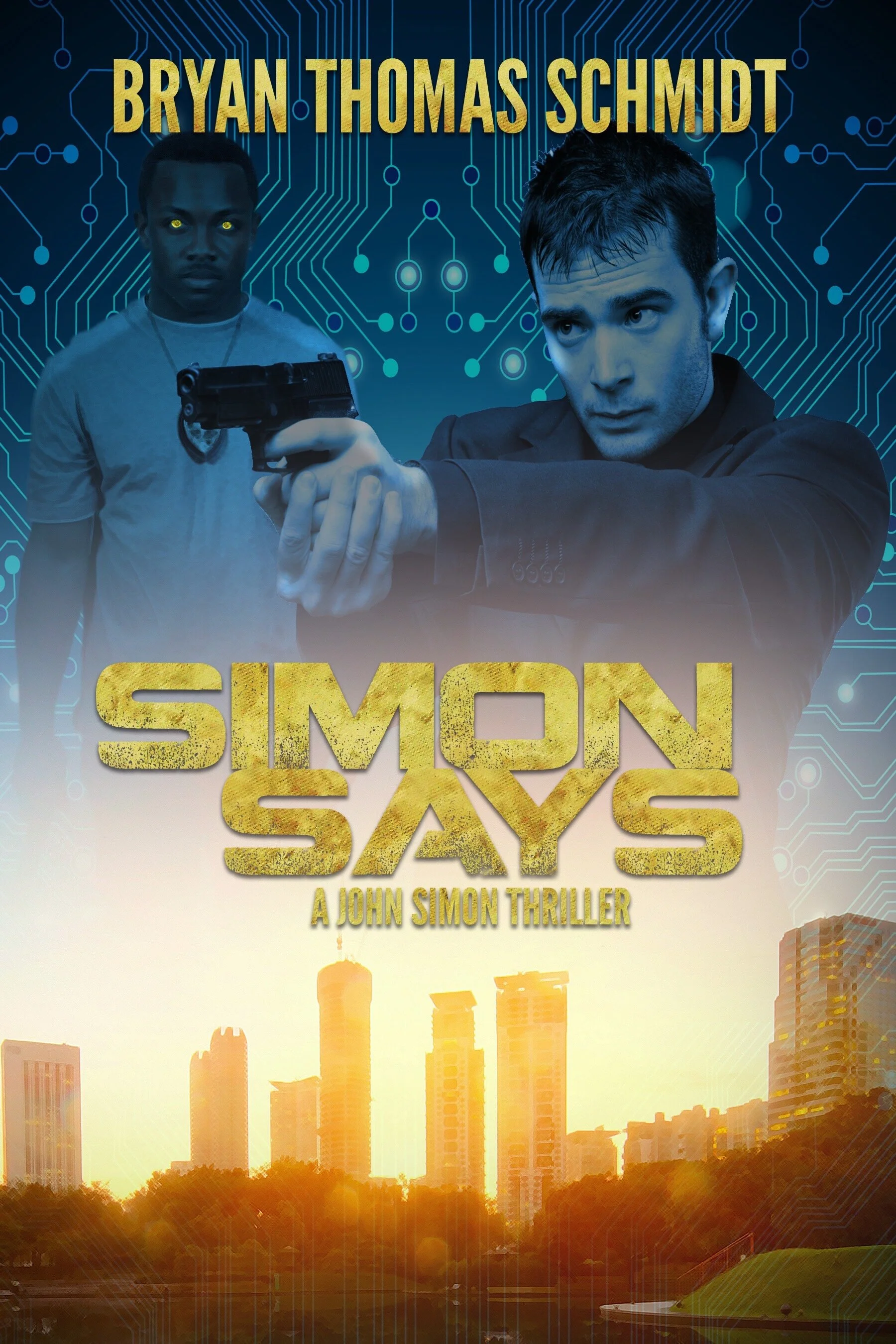
3.       Simon Says (John Simon Thrillers #1) by Bryan Thomas Schmidt. Schmidt’s new near-future police procedural thriller is a fun ride full of car chases, gun fights, and solid character development. Read my longer review HERE.

4.       Tomb of Dracula: The Complete Collection Volume 1, by Marv Wolfman, Gene Colan, Tom Palmer and more. Tomb of Dracula is my favorite horror comic of all time, and possibly my favorite comic overall. Despite a rotating group of writers and artists, the early issues collected here set the stage for the great character developments that would come later. And for the first time, I think, the black-and-white Dracula Lives! Magazine stories are folded in close to publication order.

5.       The Girl on the Porch by Richard Chizmar.  A really compelling horror novel about a family dealing with the possibility that a missing girl rang their doorbell in the middle of the night and then disappeared again. High tension throughout.

6.       The Horla by Guy de Maupassant. Melville House’s re-issue of the horror classic includes two earlier versions of the story written by the author. An excellent study in how an idea develops in different iterations.

7.       Tomb of Dracula: The Complete Collection Volume 2, by Marv Wolfman, Gene Colan, Tom Palmer and more. Continuing the reprints of both the color Tomb of Dracula comic and the black-and-white Dracula Lives! Magazine.

8.       Deosil (Whyborne & Griffin #11) by Jordan L. Hawk. Another series I’m sad to see end with this installment. Hawk’s blending of Lovecraftian horror with gay paranormal historical romance has been pitch-perfect throughout the run, and this final volume wraps up all the major and supporting plots satisfactorily.

9.       Rosemary and Rue (Tenth Anniversary Edition) by Seanan McGuire. My first re-read of the very first October Daye installment proved to me just how much of the series McGuire had planned from the beginning. Almost every chapter has some wink or nod towards things that will be revealed later on. There’s also a new novella at the back of this hardcover re-release, in which we finally get to see how Toby became a Knight in the service of Sylvester Torquill and how she found the Queen’s new Knowe, both events having occurred before the events of this first novel.

10.   Wylding Hall by Elizabeth Hand. A perfect novella for the Halloween season: the story of a band and the haunted house they spend a summer in, told in a “Behind the Music” talking heads documentary style. I can’t believe this one hasn’t been adapted to movie form given the obvious overlap of music and the supernatural. I just realized there’s a multi-reader audiobook version that I’ll be listening to as soon as possible.

11.   Tomb of Dracula: The Complete Collection Volume 3, by Marv Wolfman, Gene Colan, Tom Palmer and more. Continuing the reprints of both the color Tomb of Dracula comic and the black-and-white Dracula Lives! Magazine.

12.   Come Tumbling Down (Wayward Children #5) by Seanan McGuire. McGuire returns to the Portal world of the Moors in a story that builds on elements from the first and second books in the series. The Moors is my favorite of the Portal worlds the author has created for this series, and I was not disappointed to return there. I read an ARC. The book is due out in early January 2020. My Full Review HERE.

13.   Absolution (Serena Darkwood Adventures #1) by Charles F.  Millhouse. This is a really enjoyable new “dirty SF” book – meaning we get immersed in the criminal underbelly of this new interstellar world Millhouse has created. The main characters are engaging, the alien races intriguing, and the audiobook a fun listen. Looking forward to more of Serena’s adventures.

14.   Songs of Giants by Mark Wheatley. Editor Mark Wheatley gathers a variety of poems written by Edgar Rice Burroughs, Robert E. Howard and H.P. Lovecraft for various pulp magazines and adds his own original and stunning artwork that brings the poems to life.

15.   A Night in the Lonesome October by Roger Zelazny. My annual re-read of the battle between Openers and Closers for the fate of the world, narrated by a demon in dog form who becomes best friend with a cat. Featuring a lot of recognizable horror and mystery characters. Just a fun read, and I always pick up on a new or somehow forgotten detail.


STORIES

I have a goal of reading 365 short stories (1 per day, essentially, although it doesn’t always work out that way) each year. Here’s what I read this month and where you can find them if you’re interested in reading them too. If no source is noted, the story is from the same magazine or book as the story(ies) that precede(s) it:

1.       “The Beasts We Want to Be” by Sam J. Miller, from Lightspeed Magazine #113 (October 2019 issue), edited by John Joseph Adams.

2.       “Nesting Habits of Enceladen Beetles” by Eli Brown

3.       “Revival” by WC Dunlap

4.       “The Death of Fire Station 10” by Ray Nayler

5.       “The Valley of the Wounded Deer” by E. Lily Yu

6.       “<<Legendaire.>>” by Kai Ashante Wilson

7.       “Windrose in Scarlet” by Isabel Yap

8.       “The Words of Our Enemies, The Wards of Our Hearts” by Merc Fenn Wolfmoor

9.       “Take The Shot” by Seanan McGuire, on the author’s Patreon page.

10.   “Strangers in Court” by Seanan McGuire, included in the hardcover 10th Anniversary edition of Rosemary and Rue.

11.   “On Full Moon Nights” by Idza Luhumyo, from The Dark #53, October 2019, edited by Silva Moreno-Garcia

12.   “Every Exquisite Thing” by Lynda E. Rucker

13.   “Authentic Zombies of the Caribbean” by Ana Maria Shua, translated by Andrea G. Labinger

14.   “The Demon L” by Carly Holmes

15.   “The Maw” by Nathan Ballingrud, from Nightmare #85, October 2019, edited by John Joseph Adams

16.   “Some Kind of Blood-Soaked Future” by Carlie St. George

So that’s 16 short stories in October, keeping me way ahead for the year so far. (October 30th was the 303rd day of 2019.)


Summary of Reading Challenges:

“To Be Read” Challenge: This month: 0 read; YTD: 3 of 14 read.

365 Short Stories Challenge: This month:  16 read; YTD: 364 of 365 read.

Graphic Novels Challenge:  This month: 3 read; YTD: 26 of 52 read.

Goodreads Challenge: This month: 15 read; YTD: 118 of 125 read.

Non-Fiction Challenge: This month: 0; YTD: 5 of 24 read.

Read the Book / Watch the Movie Challenge: This month: 0; YTD: 0 of 10 read/watched.

Complete the Series Challenge: This month: 0 books read; YTD: 0 of 16 read.

                                                                Series fully completed: 0 of 3 planned

Monthly Special Challenge: I may not do something like this every month but October’s mini-goal was Horror, Horror, Horror!. I did pretty well: 7 of the titles I read I would count as part of the horror genre (possibly 8, as the Whyborne and Griffin series, while technically paranormal historical romance, has Lovecraftian horror elements to it).

November’s mini-goal of course is: Crime/Mystery/Noir because it is Noirvember!

Sunday Shorts: Faux Ho Ho

Sunday Shorts is a series where I blog about short fiction – from flash to novellas. For the time being, I’m sticking to prose, although it’s been suggested I could expand this feature to include single episodes of anthology television series like The Twilight Zone or individual stories/issues of anthology comics (like the 1970s DC horror or war anthology titles). So anything is possible. But for now, the focus is on short stories.

faux-ho-ho cover.jpeg


TITLE: Faux Ho Ho
AUTHOR: ‘Nathan Burgoine
152 pages, Bold Strokes Books, ISBN 9781635557596 (ebook)


DESCRIPTION: (from Goodreads): Silas Waite doesn’t want his big-C Conservative Alberta family to know he’s barely making rent. They’d see it as yet another sign that he’s not living up to the Waite family potential and muscle in on his life. When Silas unexpectedly needs a new roommate, he ends up with the gregarious (and gorgeous) personal trainer Constantino “Dino” Papadimitriou. Silas’s parents try to brow-beat him into visiting for Thanksgiving, where they’ll put him on display as an example of how they’re so “tolerant,” for Silas’s brother’s political campaign, but Dino pretends to be his boyfriend to get him out of it, citing a prior commitment. The ruse works—until they receive an invitation to Silas’s sister’s last-minute wedding. Silas loves his sister, Dino wouldn’t mind a chalet Christmas, and together, they could turn a family obligation into something fun. But after nine months of being roommates, then friends, and now “boyfriends,” Silas finds being with Dino way too easy, and being the son that his parents barely tolerate too hard. Something has to give, but luckily, it’s the season for giving—and maybe what Silas has to give is worth the biggest risk of all.

MY RATING: 5 out of 5 stars

MY THOUGHTS: As with most things written by ‘Nathan Burgoine, I was sucked into Faux Ho Ho from the start. The story has real romantic and dramatic stakes, and main characters you want to see overcome them. And all told in a tidy 150-ish pages, so there’s not a wasted word or superfluous scene.


I found Silas and Dino both endearing, the kinds of guys I’d love to hang around with – although like Silas I would be initially intimidated by Dino’s size and athletic ability – and I would certainly love to read more about both of them. Their interplay, as friends and more, is just downright adorable. (And I admit, I might have developed just a little bit of a fictional crush on Silas.) Despite the character descriptions, this is not just another “insecure nerd / cocky jock” romance with stock types; each man has his own insecurities and distinct personality traits and, perhaps more importantly, commonalities that play against the nerd/jock stereotypes.


The development of their relationship, from awkward roommate interview to friends to more, felt natural and real. I’m a fan of books that alternate past and present chapter-by-chapter, and here the alternating chapters heighten the tension of Silas and Dino’s pretense while providing deep insight into the relationship’s background. I think the book would have suffered with a more linear presentation of events; the “twin openings” (for lack of a better term) give us a sense of the dramatic stakes (the drama of Silas rushing to find Dino and make amends for something we’re not yet aware of) and the comedy we can expect (half-naked Dino “meeting” Silas’ parents for the first time via Skype and setting the whole story into motion) in a way a linear progression wouldn’t have been able to.


The author also does a great job of juxtaposing the characters’ very different familial experiences: Dino’s family has clearly always been completely accepting and loving, while Silas’s (with the exception of his sister) has grudgingly accepted their gay son/sibling provided he doesn’t embarrass them and provided he remains politically useful as a ‘good gay’. It’s nice to see more than one part of the spectrum of familial acceptance represented, and also great that through Silas’s sister and her fiancée, Burgoine explores the idea that not every family member reacts/feels the same way about a family member’s sexuality. (Reading Burgoine’s previous Christmas romance novella Handmade Holidays along with Faux Ho Ho really expands this exploration, as the family of the main character of HH completely abandoned him upon coming out.) Like Handmade Holidays, Faux Ho Ho also explores the idea of “found family,” the people who are like siblings and parents to us without any genetic or legal connection.


Unlike Handmade Holidays, in Faux Ho Ho Christmas itself is not much more than a plot point, a reason for delayed travel to keep our main characters out of touch with the wider world for a stretch of hours. (I actually to find this to be true of many Christmas romances (gay, straight, or Hallmark variety) that don’t hinge on actual Christmas Magic as opposed to the ”magical” feel of the season, but that’s a digression worthy of its own blog post). In fact, Halloween gets a bit more “pride of place” in terms of the holiday’s effect on the growing relationship between Silas and Dino, as does Thanksgiving. The family visit / wedding that triggers most of the drama could take place at any time of year. This is not a negative, as it makes the story all the more universal in tone, but readers going in expecting scenes of caroling and gift exchanges might be slightly disappointed.


This story is also a part of the wider world of Burgoine’s fiction, interconnecting not only with Handmade Holidays (with references to characters and specifically to the “Misfits Christmas” tradition at the center of that book) but also with other denizens and locations of Burgoine’s gay Village as seen in his short story collection Of Echoes Born.


For slow-build awkward romance, tweaking family expectations, and adorable characters, check out Faux Ho Ho.

Series Saturday: Folley & Mallory

This is a series about … well, series. I do so love stories that continue across volumes, in whatever form: linked short stories, novels, novellas, television, movies. I’ve already got a list of series I’ve recently read, re-read, watched, or re-watched that I plan to blog about. I might even, down the line, open myself up to letting other people suggest titles I should read/watch and then comment on.


folley mallory covers.png


E. Catherine Tobler’s six-book Folley & Mallory is one of those series that is hard to categorize, an interesting blend of genres. There are alternate history (a recognizable but still different late 1800’s setting) and steampunk aspects (airships that are more than traditional dirigibles, tech that allows a character to have fully-working metal prosthetic arms), shapeshifters (main character Virgil Mallory is revealed as a werewolf early on), Egyptian mythology (the gods Anubis and Horus play significant roles), spy intrigue (Mallory works for an international spy outfight called MISTRAL that has internal intrigues and subdivisions); time travel (to an ancient Egypt that is both like and unlike what we know), historical and sociological commentary (about why Egypt fell to the Romans and about the unsavory nature of archaeological digs in Egypt in the 1800s), and romance (between the title duo of Eleanor Folley and Virgil Mallory, and between a pair of supporting characters). That’s a quick summary of the genres that co-mingle in these books. I may be missing one or two. There’s a lot going on here.


And because this is E. Catherine Tobler, it all melds wonderfully. The steampunk aspects of the narrative enable the time travel as much as the Egyptian mythological aspects; the mythology informs Folley’s family history; the time travel and shapeshifting are sensible roadblocks to the culmination of the romance; the subterfuge of MISTRAL and its sister organization affect the mythological and time-travel adventures. Nothing feels out of place or shoe-horned in.


The arc of the series is instigated by archaeologist Eleanor Folley’s search to discover what really happened to her missing mother. Eleanor’s father claims she’s dead, but Eleanor knows something weird happened when their Egyptian dig was attacked by unknown assailants just as her mother discovered a legendary artifact, “the hand of the Lady.” Now an adult, Eleanor pushes against her father’s constraint to give up the search for her mother. At the same time, MISTRAL agent Virgil Mallory is assigned to protect the Folleys from possible attack by rogue/enemy agents who want to know what Eleanor and her father know about the artifact and the associated “rings of Anubis.” Of course, complications arise that put them in great danger while allowing them to overcome initial distrust. And Eleanor’s search, combined with Virgil’s personal history, will have potentially history-altering consequences as Anubis’ plan becomes more obvious and closer to fruition.


The romance between Eleanor and Virgil is not the primary point of the series. But it is a vital sub-plot as they grow from that initial distrust and miscommunication through to a mutual if unrequited attraction and then to an actual relationship. Their connection helps them to survive some pretty drastic situations that each might not have survived alone. The progression of their relationship feels natural and is not at all smooth. They also discover they have more in common than they thought and that their lives have overlapped even before they ever met.


Eleanor’s life, her family’s history and connection to ancient Egypt, Queen Hatshepsut, and the god Anubis are at the center of everything that happens; to say too much about the family tree, especially her mother’s side, would be to spoil a great deal of what happens in the second half of the series. Suffice to say, we’re very invested in how and what Eleanor’s matrilineal line has done to enable the events depicted. Virgil and the other MISTRAL agents are essentially along for the ride for a good portion of the series. But throughout, we get a lot of background on Virgil: how he became a werewolf and how it affects his daily life, his previous romantic history, certain of his previous cases as an agent that turn out to be connected to his assignment to protect Eleanor. Eventually we also get a bit of detail on fellow agents and distant lovers Cleo and Auberon. Anubis also becomes more fully fleshed out and less of a plot device as the series goes on.


Most of the volumes in the series run around 250-300 pages. These are concisely written books that don’t ramble on about the background world-building. While it would be nice to know more about the history of the MISTRAL agency and the other shadowy groups encountered, none of that is necessary to the plot or progress of this story. (Maybe Tobler will give us adventures of other MISTRAL agents in the future, and that would be wonderful.) The Folley & Mallory series, in order, is:
• The Rings of Anubis
• The Glass Falcon
• The Honey Mummy
• The Clockwork Tomb
• The Quartered Heart
• The Ebon Jackal

(The link leads to the author’s website, which has purchase options listed.)


This is a complete story in six volumes. While there are hints at future adventures Folley, Mallory, and their friends could have, The Ebon Jackal capably and satisfactorily wraps up the main plot and all of the important sub-plots. So those of you who insist on waiting until a series is concluded before you invest in it? You have no excuse here: go get these books, in print or ebook, and get started!