• HOME
  • ABOUT
  • BIBLIOGRAPHY
    • INVISIBLE ME
    • CANOPUS
    • PARADISE FEARS
  • BLOG
  • CONTACT
Menu

ANTHONY R. CARDNO

Street Address
City, State, Zip
Phone Number
Anthony R. Cardno is an American novelist, playwright, and short story writer.

Your Custom Text Here

ANTHONY R. CARDNO

  • HOME
  • ABOUT
  • BIBLIOGRAPHY
  • FREE STORIES
    • INVISIBLE ME
    • CANOPUS
    • PARADISE FEARS
  • BLOG
  • CONTACT

ERLE STANLEY GARDNER'S "TURN ON THE HEAT" - BOOK REVIEW

November 29, 2017 Anthony Cardno
Turn on the Heat cover.jpg

TITLE: Turn On the Heat

AUTHOR: Erle Stanley Gardner

292 pages, Hard Case Crime, ISBN 9781785656170 (Print)


PREMISE: (back cover copy)   Erle Stanley Gardner was not just the creator of PERRY MASON – at the time of his death, he was the best-selling American author of all time, with hundreds of millions of books in print. Among those books were the 29 cases of the brash, irresistible detective team of Bertha Cool and Donald Lam. Last year, Hard Case Crime brought out the first new Cool and Lam novel in decades, THE KNIFE SLIPPED, lost for 77 years after Gardner’s publisher refused it. Now, we’re bringing you the book Gardner wrote to replace it, often considered the best in the series: TURN ON THE HEAT.

Hired by a mysterious “Mr. Smith” to find a woman who vanished 21 years earlier, Donald Lam finds himself facing a sadistic cop, a desperate showgirl, a duplicitous client, and one very dogged (and beautiful) newspaper reporter – while Bertha Cool’s attempts to cut herself in on this lucrative opportunity land them both hip-deep in murder…


MY RATING: 4 out of 5 stars


MY THOUGHTS: As familiar as I am with the name Erle Stanley Gardner thanks to the television version of his famous creation Perry Mason, I have to confess this is the first Gardner novel I’ve ever read, and my first introduction to his long-running investigative team of Bertha Cool and Donald Lam. I can safely say it won’t be the last Gardner, or the last Cool & Lam, book I read. If you’re looking for a fun, twisty-turny noir book, Turn On the Heat is a great choice.

The story starts as a straight-up missing persons case: Cool and Lam are hired to track down a divorcee missing for 21 years. Lam quickly discovers there’s a lot more going on: bitter divorce cases, changed identities, political machinations, coercion by crooked cops, all leading eventually to at least one murder if not more. This turns the book into a rollercoaster ride of rising and falling fortunes for Lam, his money-hungry employer Bertha Cool, and for the beautiful small-town reporter Marion Dutton who has staked her big-city dreams on Lam’s connections. It’s a fun ride. While one or two of the twists felt predictable, there were plenty I didn’t see coming.

The character interactions are an equally fun part of the novel. Donald Lam is obviously a more top-notch investigator than his employer gives him credit for. Anything that goes right with this case, any leads that break, are strictly Lam’s doing – although he also gets equal blame for the things that go wrong. Lam may be smart and savvy, but he’s also fallible, which makes him a really enjoyable lead character. Bertha Cool, on the other hand, is thoroughly unlikeable but a compelling presence nonetheless. Almost anything that goes wrong in the second half of the book is because Bertha puts the idea of a big payoff ahead of any real consequences. It’s a character flaw that is far from endearing in a series lead, but does create added tension and mounting stakes. Where in the first half of the book I found Bertha overblown and annoying, in the second half I relished finding out what blunder she would commit next to make matters worse for everyone involved. Marion Dutton, by contrast, makes her mistakes out of an innocent earnestness to leave small town life behind, and in the end proves to be just as talented a manipulator as Lam and Cool. They’re an interesting trio to watch circle each other trying to solve the multi-layered case they’ve become entangled in.

The title itself is multi-layered. “Turn on the heat” could be referring to the pressure the blackmailers are putting on “Mr. Smith,” or the mounting pressure on Lam to solve the case before he gets arrested for things he didn’t do, or to the building romantic/sexual tension between Lam and Marion. I’m sure Gardner, or whoever titled the book, did that on purpose.

Gardner published 29 Cool & Lam novels in his lifetime. According to various sites, Turn on the Heat was the second and has been out of print for 50 years. This re-release continues Hard Case Crime’s fine tradition of bringing out of print noir and crime classics back to print. It’s the third Cool & Lam book they’ve published, following 2011’s re-release of Top of the Heap and last year’s release of The Knife Slipped (the lost Cool & Lam case). I enjoyed Turn on the Heat so much I’m moving those previous releases up on the “to be read” pile, and hope that HCC will bring more of Gardner’s Cool & Lam books back into print in the near future.

Note: I did receive an advanced reading copy courtesy of the publisher in exchange for an honest review. Website problems prevented me from posting the review before the novel’s publication date, which was this week.

In BOOK REVIEWS Tags hard case crime, book review, erle stanley gardner
Comment

Review of George Mann's WYCHWOOD

November 4, 2017 Anthony Cardno
Wychwood Cover.jpg


TITLE: Wychwood

AUTHOR: George Mann

349 pages, Titan Books, ISBN 9781783294091 (Print)/ 9781783294107 (ebook)

DESCRIPTION: (back cover copy)  After losing her job and her partner in one fell swoop, journalist Elspeth Reeves is back in her mother’s house in the sleepy village of Wilsby-under-Wychwood, wondering where it all went wrong. Then a body is found in the neighbouring Wychwoods: a woman ritually slaughtered, with cryptic symbols scattered around her corpse. Elspeth recognizes these from a local myth of the Carrion King, a Saxon magician who once held a malevolent court deep in the forest. As more murders follow, Elspeth joins her childhood friend DS Peter Shaw to investigate, and the two discover sinister village secrets harking back decades.

MY RATING: 4 out of 5 stars

MY THOUGHTS: George Mann’s Wychwood is one of those hybrid creatures: 90% straightforward murder mystery, 10% possible supernatural thriller. It’s a style I particularly enjoy when done well, and George Mann does it well. Although different in focus and authorial style, Wychwood reminded me very much of Stephen King’s Cujo: was the titular dog really possessed by the spirit of an executed serial killer or was it just rabid? I found myself asking the same question here: is the serial killer really employing supernatural means for some, if not all, of the kills, or does the killer only think the supernatural aspect is working? By the mid-point of Wychwood, the answer becomes apparent to the reader if not to the investigating characters.

The investigators are that very typical British pair: the intrepid reporter and the rule-bending Detective Sargeant. Elspeth Reeves has barely had time to settle into a between-jobs visit to her hometown when she stumbles upon a murder scene practically in her mother’s back yard being investigated by DS Peter Shaw, who happens to be a childhood friend she’s fallen out of touch with. It’s a meet-cute (or remeet-cute, if you will) the author thankfully gets out of the way early in the book, so the characters and reader can concentrate on the series of murders that need investigating.

It’s no surprise that Elspeth is the most well-developed character in the novel; at least 80% of it is told from her point-of-view with occasional break-aways for a peek into the mind of the killer or the victims. Elspeth is a strong, capable lead, with an engaging personality and clear investigative chops, but also with the kind of impulsiveness necessary to launch her into the dangerous situations and crime-scene misunderstandings this type of story requires. To Mann’s credit, these scenes never feel forced – there’s a reason for every questionable decision Elspeth makes, and they all work. Peter Shaw is somewhat less well-developed: his role mostly seems to be to feed Elspeth details she shouldn’t otherwise know, to drive her from place to place, and to provide an awkward potential love-interest for Elspeth to write off and other characters to comment on. In those terms, he performs the role well and does what’s needed of him to keep the plot moving and the excitement high.

The suspects and ancilliary characters are diverse and suburb-colorful: local newspaper staff, local theatrical troupe, local business owners who all provide clues to what’s going on whether they realize it or not (and also of course provide a fair number of red herrings for the reader and the main characters). Some are fun (stage manager / newspaper columnist Rose), some are infuriating (thriller author Mick Williams) and some are harmlessly pretentious (bookstore owner Philip Cowper).

The clues to solving the mystery are parceled out fairly; the reveal and resolution don’t come from out of left field. This is partially and very effectively because of the cutaway scenes to the killer’s POV providing hints that Elspeth and Peter don’t have access to, provided in such a way that the reader doesn’t become aware of the killer’s identity too far ahead of the main characters.

The background world-building is also wonderfully rich. The murders are based around a local legend of the Carrion King and his ragtag court. Like the hints about the killer’s identity, the details of the legend are slowly revealed throughout the novel. I believe Mann created this legend from whole cloth, but it’s so well-crafted I keep expecting to find it in an old collection of Anglo-Saxon tales. And Mann also takes full advantage of the fact that stories change depend on whose telling them. The details of the Carrion King’s life and end vary as Elspeth reads old sources (a childhood book of legends), consults local experts (bookstore owner/author Cowper and college professor Byron Miller each have different takes), and talks to those whose work is influenced by the legends (thriller author Williams and playwright David Keel). The varying details in each recounting enhance the overall mystery, providing clues and fake-outs both.

The novel ends with a thriller-type chase through dark woods (naturally, given the book’s title and the legend’s setting) straight out of the type of books the Williams character is famous for writing, another nod to the hybrid nature of Wychwood as a whole.

Wychwood is a fun read, with something for fans of the cozy mystery, the thriller, and the supernatural investigation genres.


Note: I did receive an advanced reading copy courtesy of the publisher in exchange for an honest review. Website problems prevented me from posting the review before the novel’s publication date.

In BOOK REVIEWS Tags semicolon blog, Book Review, george mann, wychwood

FOREVER HAUNT - Book Review

August 26, 2017 Anthony Cardno
Forever-Haunt-cover-200x300.jpg

TITLE: Forever Haunt (The Jimmy McSwain Files #5)

AUTHOR: Adam Carpenter

287 pages, MLR Press, paperback and e-book formats, ISBN 978-1944770587

DESCRIPTION: (from the back cover): For Hell’s Kitchen private detective Jimmy McSwain, his father’s death has defined him, defied him, and denied him his chance at happiness. But the shooting death of a young officer named Denson Luke has re-ignited the investigation into the mysterious Blue Death conspiracy. But Jimmy still must earn a living, so he cannot ignore a family in distress.

New neighbors Carmen Ramirez and her young son, Sonny, are clearly running from danger. Overnight, their case becomes one involving a missing father, a Chinese crime syndicate, and an abduction which threatens to overwhelm Jimmy’s mission of solving his father’s case. His relationship status with Frank Frisano on and off again, Jimmy tries to do double duty, jeopardizing his own safety.

It’s only when another murder occurs that Jimmy finally finds the path that has eluded him. His investigation finally leads him back home, where a devastating family secret overshadows all he’s learned, and the cost to the McSwain family may never be repaid. Jimmy realizes the blood on his hands will forever haunt him.

MY RATING: FIVE out of FIVE STARS

MY THOUGHTS: Adam Carpenter has successfully and satisfactorily brought this first arc of Jimmy McSwain mysteries to a conclusion with Forever Haunt, weaving together hints and threads from each of the four previous novels and answering the series’ longest-running question: who orchestrated the death of Jimmy’s father?

The third book in the series, Stage Fright, represented a low-point for Jimmy: distracted by clues regarding his father’s long cold case, he dropped the ball on a client’s case and was beaten to the solution by someone else. The fourth book, Guardian Angel, saw Jimmy a bit more back on his game, and that trend continues here: Jimmy is paying attention, making connections, not letting his life’s unanswered questions distract him from helping others – and not letting other people solve the crimes he’s investigating.

Jimmy’s character arc across the series has been a realistic one, with setbacks in his love life because of work and his work and family life because of work. Setbacks abound in this final volume, but with some interesting twists. Jimmy learns secrets that have been hinted at in the previous four books: about his parents, his neighbors, his mentor, and his adversaries and friends on the police force.

Because everyone has secrets, so many secrets you almost need a score-card to keep track. Some of the secrets are explosive (just how much did Jimmy’s mother know or suspect, and how exactly was Jimmy’s father’s partner (and Jimmy’s mentor) involved in what happened?). Some of the secrets revealed are more personal (Jimmy’s sister Mallory comes to a hard decision, following one of the funniest “drunk siblings” scenes I’ve ever read).  Long-standing questions are definitively answered, with no ambiguity. And as I’ve said, the answers we get are satisfactory: there’s a sense of “fair play” between author and reader at work here. The reveals make sense, nothing comes completely out of left field. Carpenter also seems to wink at other theories readers may have had, acknowledging that being fair and generous with clues doesn’t preclude the author from throwing a few red herrings into the mix of possibilities.

Carpenter intended from the beginning for this to be a tight five-book journey for Jimmy McSwain, and he’s held to his original plan. There’s something to be said for an author who sticks to an original plan (and releases the planned installments in a timely manner) even when the popularity of a series might inspire the publisher to want more books. A different writer might have strung these reveals out for three or five or ten more books, diluting the impact as storylines stagnate until the final book is scheduled. The good news is: while this particular arc is over, Jimmy McSwain will be back in future books. But that’s a matter to discuss later in this review.

Every McSwain File has had two storylines running concurrently. Sometimes the mystery of Jimmy’s father’s death takes a secondary role to the other storyline, and sometimes Carpenter reverses it. This time the new case is the secondary mystery. It involves Jimmy’s new neighbor Carmen and her missing son, and if it’s not quite as compelling as the mysteries Jimmy has investigated in the previous books, that’s okay.

In this book, the secondary mystery serves two purposes. The first is to distract Jimmy at key points, so that his focus is split between helping himself and helping people who can’t help themselves.  As authorial as well as in-story distractions, I don’t feel like we got quite the same depth of character for the Ramirez clan that we’ve gotten for the characters in those previous cases. They’re not cardboard place-holders; there’s still enough depth that they feel real. It helps that just as they’re new to the reader, they’re also new to the neighborhood. Jimmy’s getting to know them at the same time as we are, and so first impressions are enough. This secondary mystery is not padding, though — it has its own arc and mostly satisfactory conclusion, its own internal consistency. And that enables it to serve its second purpose.

Carpenter has said there are plans to come back to Jimmy McSwain, his boyfriend Frank Frisano, and the rest of the recurring characters in a new arc. Without spoilers, I can say that the secondary mystery gives us the motivation for that new arc. It’s not a motivating factor I was particularly happy to read (in fact, I tweeted the author a rather indignant “I think I hate you now” moments after finishing the book), but it does the job it needs to do, giving author, reader, and characters a reason to return. I do think the Jimmy McSwain Files could have continued on without the need for a new “season arc,” ala characters like Lawrence Block’s Bernie Rhodenbarr or MC Beaton’s Hamish Macbeth. But I can also see the allure of a an arc to run through however many books will comprise Jimmy’s “second season,” since the main arc of this first “season” worked so well.

I’ll miss Jimmy and his cohorts between now and when the next series starts. And while we wait, I recommend to folks who like gritty NYC PI stories with a touch of erotic content: find the first book in this series, “Hidden Identity,” and get caught up.

In BOOK REVIEWS Tags Forever Haunt, Adam Carpenter, Book Review
2 Comments

BANNERLESS - Book Review

August 26, 2017 Anthony Cardno
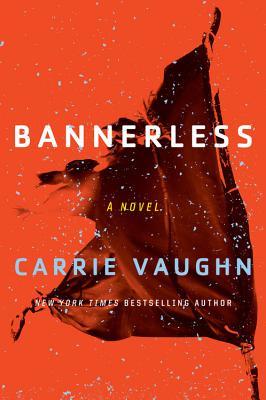
bannerless-cover.jpg
 

TITLE: Bannerless

AUTHOR: Carrie Vaughn

352 pages, John Joseph Adams books, ISBN 9780544947306

Publication Date: July 11, 2017 (I received an uncorrected proof ARC in exchange for an honest review)

DESCRIPTION: (from the back cover): A mysterious murder in a dystopian future leads a novice investigator to question what she’s learned about the foundation of her population-controlled society.

Decades after economic and environmental collapse destroys much of civilization in the United States, the Coast Road region isn’t just surviving but thriving by some accounts, building something new on the ruins of what came before. A culture of population control has developed in which people, organized into households, must earn the children they bear by proving they can take care of them and are awarded symbolic banners to demonstrate this privilege. In the meantime, birth control is mandatory.  Enid of Haven is an Investigator, called on to mediate disputes and examine transgressions against the community. She’s young for the job and hasn’t yet handled a serious case. Now, though, a suspicious death requires her attention. The victim was an outcast, but might someone have taken dislike a step further and murdered him?  In a world defined by the disasters that happened a century before, the past is always present. But this investigation may reveal the cracks in Enid’s world and make her question what she really stands for.

MY RATING: FIVE out of FIVE STARS

MY THOUGHTS: I first encountered the post-apocalyptic world Carrie Vaughn reveals to us in such great detail in her new novel Bannerless in a short story of the same title back in 2015. That story, which introduced not only the world of the Coast Road communities but also lead character Enid, appeared in the anthology The End Has Come, part of John Joseph Adams and Hugh Howey’s Apocalypse Triptych. Readers interested in seeing an older, more experienced Enid should seek out that anthology, or head over to Wired.com to read the story for free. You don’t need to have read the original story to understand Enid or the world she lives in. This novel shows us a younger Enid, discovering who she is and how she’s going to survive as an Investigator.

Let’s talk about the world-building first.

In this not-too-terribly-distant future, civilization as we know now it has collapsed due not to a single Extinction Level Event but a combination of “smaller” catastrophic events that build on each other the way a solid combination punch does in professional boxing: climate change combined with disease combined with overpopulation stagger humanity’s ability to cope and recover. But humanity never goes completely down for the count, and a generation or so later we have the Coast Road society: tied to the earth, supremely aware of how susceptible they are to drastic weather, depletion of natural resources, and the possibility of over-population. As a whole, at least in this particular region, humanity is hanging in there and still fighting. But as we see multiple times in this novel: those who don’t learn the lessons of the past are doomed to repeat them. Life in this near future is not easy, despite the content home lives of most of the characters. Fishing, hunting, harvesting, trading … all come with the threat of injury or death attached, and the world no longer has the medical-pharmaceutical-surgical capabilities it once did. Vaughn drives this home repeatedly: the world post-apocalypse will be lacking much of currently keeps people alive. The only difference between the world of Bannerless and, say, the medieval or Renaissance world is whether people know what they don’t have – and the characters in Bannerless are painfully aware (and frequently reminded) of what’s been lost.  That’s part of what I loved about the short story and the novel: this world is not so far in the future that our own “modern” world has been relegated to myth, but there are clear indications it is headed into that territory. This is important to the way resources, including the ability to have children, are allocated.  This future society’s approach to population control – enforced birth control until a household earns a banner and thus the right to conceive and raise a child – is likely to be the subject of many reviews of the book. Is the system Vaughn posits a fair one? Probably not, but then again many of our current laws aren’t either. Does it make sense in the context of the world Vaughn has built? Absolutely. I can easily imagine that fear of a return to overpopulation and the depletion of natural resources and increased diseases caused by it would lead to some extremes. But the author also makes it clear: birth control is being used to control population growth rather than some Puritanical “abstention from sex except when trying to procreate” rules. Sex in the world of Bannerless is natural and expected and exists in all its wide varieties and combinations of partners. No one is shamed or cast out because of it.

We explore this fascinating world and the selfless and selfish characters who inhabit it, through the eyes of Enid. Vaughn has structured the book so that alternating chapters show us Enid in her present, as a beginning Investigator encountering her first big complicated case, as well as Enid in her past, as a curious young woman experiencing Coast Road society outside of her home town. Of course, the past is prologue to the present; flashback details bleed over into the present the way they should when handled in a format like this. We the readers are essentially experiencing two mysteries at once: the possible murder of a loner in the present, and the question of how Enid became an investigator in the past.

In the past, Enid falls heavily in love with a traveling musician named Dak and decides to leave Haven to experience the world with him. This Enid is a bit more head-strong, a bit less likely to take stock of a situation, a bit more likely to let her emotions lead her actions. And Dak enables this behavior with his charm and wit. These chapters are full of details that reveal not all Coast Road towns or homesteads are the same, showing Enid that not everyone is as comfortable (if that word can be used in this world) as her town of Haven is. Vaughn also drops hints as to what lies beyond the Coast Road, and it is my fervent hope that these distances will be explored more deeply in future installments because the small views we got were tantalizing. In these chapters, the characters Enid encounters (such as Petula house-head Fisher, her son Stev, and their town-mate Xander) help expand, or expound upon, the world-building.

In the present, Enid journeys with fellow Investigator, and childhood friend, Tomas, to the town of Pasadan. They’re answering a summons to investigate a mysterious death, but it quickly becomes obvious that internal town politics and failure to learn the lessons of the past are going to complicate what should be a fairly straightforward case. In these chapters, the world-building becomes less centered and more subtle as the author introduces the characters involved in, and spools out the details of, a fair-play, multi-suspect murder mystery. And it is very “fair play,” the kind of mystery, sans post-apocalyptic setting, I can imagine Sherlock Holmes or Hamish Macbeth solving. If the “possible suspects” are bit more archetypal (the battling town council members Philos and Ariana; the possible young lovers Miran and Kirk; even the disliked outcast victim Sero) and a bit less nuanced than the characters of the flashbacks, it can be accepted as part of the genre Vaughn is importing. They each do their job in providing clues and red herrings for the mystery as well as propelling Enid’s character arc. By the end of the novel, we can see shades of the older Enid of the short story.

What ties the alternating chapters together is the consistencies in Enid’s character. At both ages, she is willful and head-strong, apt to let emotions lead her. If the older Enid is more able to tamp anger down in service to the greater good, the younger Enid’s impetuousness serves that greater good almost as effectively. And at any age, Enid is a great listener and avid learner, which draws the reader into the world around her. She’s a character I’m interested in spending a lot more time with.

In BOOK REVIEWS Tags Bannerless, Carrie Vaughn, Book Review

SUNDAY SHORTS: TRANSCENDENT - Book Review

August 24, 2017 Anthony Cardno
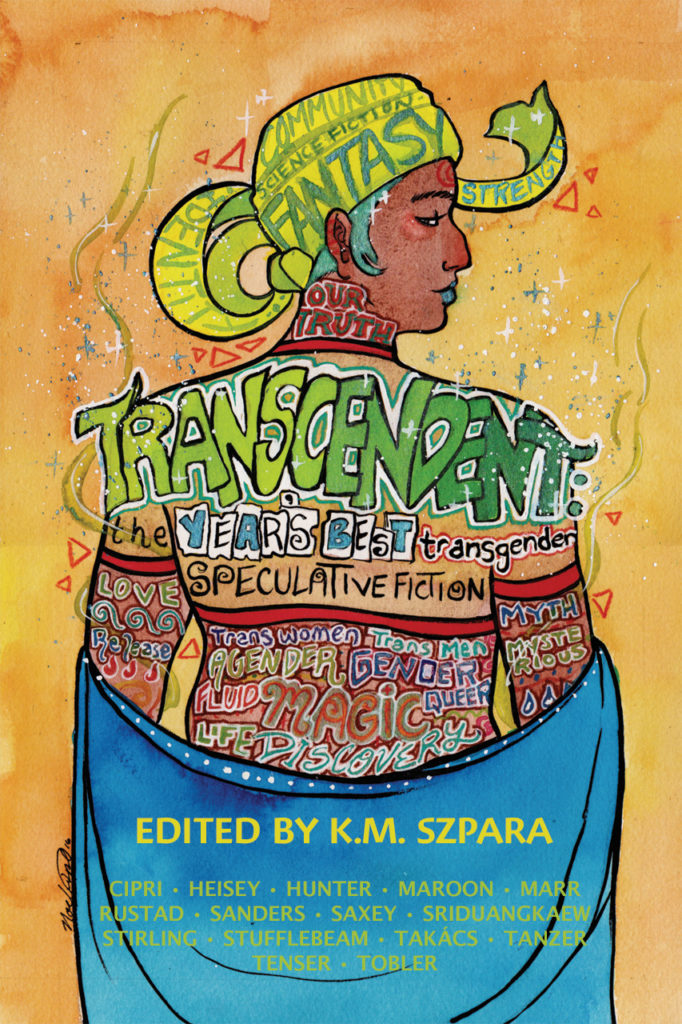
Transcendent-Cover-682x1024.jpeg

In today’s “Sunday Shorts,” we’ll take a look at a couple of the stories from:

TITLE: Transcendent: The Year’s Best Transgender Speculative Fiction

EDITOR: K.M. Szpara

195 pages, Lethe Press, paperback and e-book formats, ISBN 9781590216170

DESCRIPTION (from the back cover):  There are fantastical stories with actual transgender characters, some for whom that is central and others for whom that isn’t. And there are stories without transgender characters, but with metaphors and symbolism in their place, genuine expressions of self through such speculative fiction tropes as shapeshifting and programming. Transgender individuals see themselves in transformative characters, those outsiders, before seeing themselves as human protagonists. Those feelings are still valid. But though the stories involve transformation and outsiders, sometimes the change is one of self-realization. This anthology will be a welcome read for those who are ready to transcend gender through the lens of science fiction, fantasy, and other works of imaginative fiction.

MY RATING: FIVE out of FIVE STARS

MY THOUGHTS: There are sixteen stories in the inaugural edition of Transcendent (the sophomore volume will be out later in 2017, edited by Bogi Takács). They are all roundly wonderful, entertaining and instructive in so many ways. But the purpose of “Sunday Shorts” is to focus on a story or two rather than reviewing the entire book. So:

“The Shape of my Name” by Nino Cipri starts the collection. It’s a time-travel story in which the ability to time-travel follows essentially the matrilineal lines of a family, But what happens to that process when a child born female identifies as male? The main character navigates his relationship with his mother, father, distant uncle and distant cousin, all complicated by the vagaries of the way time-travel works for this particular family. Cipri’s use of sensory detail at the start of each main section (“2076 smells like antiseptic gauze,” “1954 tastes like Kellogg’s Rice Krispies in fresh milk”) helps ground the reader in familiarity before spinning off into details of time-travel and cause-and-effect. I enjoyed the story so much that I read it twice through back-to-back, and then again when I was done with the anthology. I can safely say the time-travel rules are clearly consistent and intriguingly parceled out to the reader. You may not understand how they work at the start of the story, but you will at the end. The voice of the main character is assured and confident but still recovering from old wounds and slights, especially in relation to his mother. That relationship motivates all of the time-travel the main character does, in search of answers and closure – something I’m sure all of us who travel in linear time are also always looking for. This is a fantastic start to a great anthology.

“The Need For Overwhelming Sensation” by Bogi Takács takes place in a science fiction universe of political intrigue and space-travel driven by the energy generated by intense emotion. (If the author has other stories set in this same universe, I haven’t read them but would gladly do so. I really need to seek them out.) While the world-building is immersive (surrounding the gone-awry negotiations of the planet Ohander to join the Alliance), it’s the character interactions that pulled me in and kept me reading. The story, to me, drives home the point that even the most open-minded and accepting of us have our blind-spots and walls. In this case, it’s the unwillingness of a politician named Miran Anyuwe (pronoun: they), who clearly has no problem with trans* and gender-fluid fellow space travelers, to accept the relationship of the Master and crew-member of the ship which Anyuwe is trying to escape danger on. The interaction between Miran Anyuwe, Master Sanre, and the narrator comes to a head at a pivotal moment over the way in which the narrator generates the necessary energy to power their ship, plunging them all into increasing danger as the story builds to its conclusion. I don’t want to spoil the twists and turns of the story any more than that – but I was engaged in the story from first word to last.

“Treasure Acre” by Everett Maroon is one of the shortest pieces in the book, and hangs on the classic question: If you could go back and change your past to make it easier to be the person you want to be in the present, would you? The man and young girl in the story are digging in her mother’s backyard for a treasure box the girl buried when even younger, the box holding a key to the girl’s future and the man’s past. The story is wistful, nostalgic and full of questions and answers in a scant four pages, and put a smile on my face at the end, while making me wonder how I’d handle the same situation if it was presented to me.

Those are just three out of the sixteen stories in TRANSCENDENT. The rest run the gamut of speculative fiction, from SF to fantasy to horror, by authors I was familiar with (Bonnie Jo Stufflebeam, E. Catherine Tobler (one of her Circus stories), A. Merc Rustad, Benjanun Sriduangkaew, and Molly Tanzer (a wonderful Lovecraftian story), and authors to whom this was my first exposure (Holly Heisy, Jack Hollis Marr, B R Sanders, E. Saxey, Margarita Tenser, Alexis A. Hunter and Penny Stirling). An anthology well worth seeking out if you haven’t already, and to which I’m eagerly awaiting the next installment.

In BOOK REVIEWS Tags Transcendent, book review, semicolon

FOREVER AND A DEATH - Book Review

August 23, 2017 Anthony Cardno
forever-and-a-death-cover.jpg

TITLE: Forever and a Death

AUTHOR: Donald E. Westlake

463 pages, Hard Case Crime, trade paperback format, ISBN 9781785654237

Publication Date: June 13, 2017. (I received an uncorrected proof advanced review copy from the publisher)

DESCRIPTION: (from the back cover): Two decades ago, the producers of the James Bond movies hired legendary crime novelist Donald E. Westlake to come up with a story for the next Bond film. The plot Westlake dreamed up – about a Western businessman seeking revenge after being kicked out of Hong Kong when the island was returned to Chinese rule – had all the elements of a classic Bond adventure, but political concerns kept it from being made. Never one to let a good story go to waste, Westlake wrote an original novel based on the premise instead – a novel he never published while he was alive.

Now, nearly a decade after Westlake’s death, Hard Case Crime is proud to give that novel its first publication ever, together with a brand new afterword by one of the movie producers describing the project’s genesis, and to give fans their first taste of the Westlake-scripted Bond that might have been.

MY RATING: FOUR out of FIVE STARS

MY THOUGHTS: Anyone diving into this book expecting a straight up Bond pastiche based on the back cover copy might feel a bit disappointed at first. Based on Westlake’s script treatments, the book does have many of the classic Bond tropes: international locales (the Great Barrier Reef, the Australian Outback, Singapore, Hong Kong), dangerous technology (the “soliton wave”) in the hands of a ruthless megalomaniacal businessman (Richard Curtis) out for revenge on the city and nation that wronged him (Hong Kong, during the transfer of control from Great Britain to China). But what the book doesn’t have is a highly-trained, snappily-dressed, quip-tossing super-spy as the central figure. Instead, Westlake gives us an ensemble of would-be heroes (none of them government spies, most of them not even trained hand-to-hand combatants) who slowly come together, and each make a valuable contribution, to stop Richard Curtis from destroying Hong Kong.

And that, to me, is what makes this an excellent adventure novel accessible to anyone instead of just another James Bond adventure, of which there are dozens readily available. The closest we get to “Bond” is engineer George Manville, who creates (that’s not the right word, given he’s taking work others have done in a lab and putting to practical test in the real world) the “soliton wave” without knowing the nefarious use to which Curtis intends to put it. He spends the first third of the novel clearly as The Hero, discovering the villain is up to no good, rescuing the female lead and learning how to be a hero from a paperback book he’s reading … but then the author takes Manville out of the action for most of the middle third of the book. So even though he’s perhaps the most Bond-like (rugged good looks, handy with a gun, figuring out Curtis’ intentions), he’s not the only focal point of the book.

Female led Kim Baldur isn’t quite a classic Bond femme fatale. She’s beautiful, knows how to scuba dive, and is dedicated to the cause to which she volunteers (the Planetwatch environmental group), but she’s also a bit innocent and a bit impetuous, which puts her in danger in a way most “Bond girls” aren’t. She does, however, manage to hold her own in several fight scenes and contributes equally to the story’s resolution.

The “good guy” team is rounded out by Kim’s boss at Planetwatch, Jerry Deidrich and his boyfriend Luther Rickendorf. Jerry’s hatred for and distrust of Richard Curtis pulls the couple into the action when evidence mounts that Kim is not as dead as she seems to be at the start of the story (remember that impetuousness putting her in danger thing). Jerry feels like a bit of a one-note obsessive character, but Luther is very well-rounded. I honestly love that Westlake had no problem spreading what would mostly have been Bond’s role equally among a straight guy, a straight woman, and a gay couple. I have no idea when Westlake actually wrote this novel (sometime after the treatment was passed on by MGM in the mid-90s and the author’s death, a good span of years) but even with all the strides genre fiction has made over the past several years, it still feels a bit daring and unusual to have the female lead and a pair of gay guys be as much of a focus as the straight guy (especially in that middle third of the book, when George is virtually unseen and all of the plot movement depends on Kim, Jerry and Luther). I do have one quibble with the way Jerry and Luther are handled, but discussing it would be too much of a spoiler for this review (but it is partially the reason I’m giving the book four stars instead of five).

Another great thing about the way Westlake has crafted the book is that even the secondary characters (the Australian, Singapore, and Hong Kong cops the heroes deal with, and Curtis’ henchmen) all have distinct personalities and backgrounds that influence the proceedings. None of them are “just” cops or henchmen, “just” plot devices.

But the most compelling character in the book is Richard Curtis. His history, his motivations, his narcissistic personality, drive the book from start to end. Literally, as the first and last scenes hold him as the focal character. Curtis is a villain worthy of Bond, no doubt, both in personality and in the plan he’s so determined to enact.

The fight scenes are dynamic as well, full of little details that immerse the reader in each fistfight, gun battle, and foot chase. The description of the first, legal, activation of the soliton wave, and an early cat-and-mouse chase aboard a dark yacht were my favorite action sequences.

Full of interesting characters, engrossing action scenes, and a solid tie to an actual recent historical event, Forever and a Death is definitely worth seeking out when it hits the stands onJune 13, 2017, whether you’re a Bond fan or not.

In BOOK REVIEWS Tags Forever and a Death, Donald E Westlake, book review

BUFFALO SOLDIER - Sunday Shorts

August 22, 2017 Anthony Cardno
buffalo-soldier-cover.jpg

TITLE: Buffalo Soldier

AUTHOR: Maurice Broaddus

144 pages, Tor.com Publishing, paperback and e-book formats, ISBN 978-0765394293

DESCRIPTION: Having stumbled onto a plot within his homeland of Jamaica, former espionage agent Desmond Coke finds himself caught between warring religious and political factions, all vying for control of a mysterious boy named Lij Tafari. Wanting the boy to have a chance to live a free life, Desmond assumes responsibility for him and they flee. But a dogged enemy agent remains ever on their heels, desperate to obtain the secrets held within Lij for her employer alone. Assassins, intrigue, and steammen stand between Desmond and Lij as they search for a place to call home in a North America that could have been.

MY RATING: FIVE out of FIVE STARS

MY THOUGHTS: It’s no secret I’m a fan of Maurice Broaddus’ work. I loved his “Knights of Breton Court” modern-day-urban take on the Arthurian mythos. I loved most of the stories in his recent short story collection “Voices of the Martyrs,” and even the stories I didn’t love I at least liked. I suppose eventually he’ll write something I don’t enjoy, but this novella is not that time.

In novellas, as with short stories, the author cannot spend a great deal of time describing the setting and history: the action needs to grip the reader and propel us along just as quickly as in a short story. But it is clear Broaddus’ world-building for Buffalo Soldier is complete and massively detailed. The reader gets just enough historical detail to glean that the American Revolution failed while Jamaican independence was successful, and that what we know as the United States is divided into three main regions: Albion, ruled over by Regents of the British government; Tejas (Texas and environs); and the Six Civilized Nations (various native tribes, occupying fortified holdings in the west after being forced out of the east).  The novella is set in what feels like the present day, or close to it. The politics and history that led to these divisions is hinted at with carefully placed familiar names and locations from our own history. The technological world-building is equally hinted at throughout the book, quick glimpses of steam-based weaponry and transportation tiding us over until a key reveal.


But it’s the characters that draw the readers into this world and keep us there; Desmond Coke, Lij Tafari, and the mysterious Cayt Siringo. Coke’s world-weariness is palpable in the early pages and deepens as the story progresses: he knows he’s doing the right thing for Lij, even though it has meant leaving behind everything he knows, and yet he still questions whether he’s doing the right thing. The questioning and the willingness to do what’s right despite the danger it puts him in makes Desmond Coke our point of view into the history and the ensuing action. He finds some, if not all, of the answers he’s seeking as things progress. And while he’s the main point of view character, he’s not the character who pulls the majority of the reader’s attention.


That character would be the quiet, if not always controlled, Lij Tafari. Lij’s innocence is the counterpoint to Coke’s not-quite cynicism. Coke understands the way the political world affects where he can travel with Lij; Lij has no understanding of, or interest in, how the world works outside of his immediate interactions with it. Coke’s (and later, Cayt’s) handling of Lij hinges on their understanding of where this innocence comes from. While the word itself is never used, it is clear from his dialogue and his actions that Lij is autistic. Lij’s autism is as much a story point as Coke’s depression or Cayt’s cunning or the parental protectiveness of supporting characters Inteus and Kajika: that is to say, it’s important when it’s important, and not belabored when it’s not. It’s so easy for authors to portray autism as a character deficit, to have other characters talk down to the autistic character or treat them as less than human, or to treat it as a series of disconnected tics. Broaddus spectacularly fails to fall into any of these traps: his portrayal of Lij and of how Coke and others interact with him, perfectly matches the functional autistic kids, and parents of same, that I know.


Ultimately, “Buffalo Soldier” is about stories: the stories we tell others, the stories we tell ourselves, and the stories we draw on to survive and move on. Early on, the stories are all in bits of dialogue: Coke bending the truth of his and Lij’s identity in order to survive crossing Tejas, for instance. Near the half-way point, we are dropped wholesale into the tales and legends the characters tell Lij to keep him moving or to keep him calm. Here, Broaddus’ skill as a teller of tales-within-stories really shines: the rhythm and level of detail changes with each teller.


This novella could be a done-in-one: all of the major plot and sub-plots are resolved (some bloodily so, but then again, there’s no shortage of violence throughout). But I’m really hoping we’ve not seen the end of Desmond Coke, Lij Tafari, their friends and their enemies. There’s so much more to explore.

In BOOK REVIEWS Tags Buffalo Soldier, Maurice Broaddus, book review

SINNER MAN - Book Review

February 1, 2017 Anthony Cardno
Sinner-Man-cover.jpg

Book: Sinner Man

Author: Lawrence Block

ISBN: 9781785650017

Price: $9.95 (paperback) (also available in hardcover, e-book and audio)

Publisher: Hard Case Crime

Synopsis: To escape punishment for a murderhe didn’t mean to commit, insurance man Don Barshter has to take on a new identity: Nathaniel Crowley, ferocious up-and-comer in the Buffalo, New York mob. But can he find safety in the skin of another man … a worse man … a sinner man?

My Rating: FOUR out of FIVE STARS

My Thoughts:  The story behind the novel is as interesting as the novel itself: this was the first crime novel Block wrote. It was published under a pseudonym and then forgotten for fifty years. The author conducted an extensive search for the book he vaguely remembered writing but not publishing, and now that it’s found Hard Case Crime has brought it out in a handsome hardcover as well as affordable paperback and ebook editions.

It’s no secret that I’m a big fan of Block’s work, whether he’s writing hard-boiled crime / noir, as here or the more cozy mysteries featuring Bernie Rhodenbarr or anything in between. This book has everything the fans of Block’s noir work have come to expect: a lead character you want to like but can’t approve of; a female lead who is more than capable of holding her own despite, or perhaps because of, the men who use her; and dialogue that’s rich in patter and short on soliloquies.

Also as expected of Block when he’s written full-on noir like this: the book gets off to a hot, fast start (with the accidental murder the synopsis describes), slows down for some character building in the middle (as Barshter/Crowley becomes a part of the mob scene), then punches into high gear in the final pages with an intensity that really leaves you wondering who, if anyone, will come out of this thing alive.

I’ll be clear: Donald Barshter isn’t likeable even before he accidentally murders his wife and decides to go on the run rather than face justice. He’s even less likeable as he worms his way into a situation in which the reader knows, if not Don/Nate himself, that he’s in over his head. But that doesn’t stop you from wanting to know how it all turns out, wanting to know if in fact the law from back home will catch up to our “sinner man” or not. There were a few times throughout the book when I thought “Block could end it here, and I’d be satisfied.” But the author teases out the exact moment the other shoe will drop several times, and never in exactly the same way — building the suspense to a low rolling boil.

This is one of Block’s books that I could easily see Alfred Hitchcock adapting back in the day, if he’d been aware of the story. I pictured Tippi Hedren as Anne several times while reading.

And of course, because it’s a Hard Case Crime book, there’s a cover by Michael Koelsch that would be equally at home on Double Indemnity.

I’m definitely glad this lost early novel of Block’s was found and brought back into print. It’s a fun, suspenseful ride even if you don’t like the main character.

In BOOK REVIEWS Tags Sinner Man, Lawrence Block, semicolon, semicolon blog

LATIN @ RISING - Book Review

January 25, 2017 Anthony Cardno
Latina-Rising.jpg

As a way of perhaps easing myself back into blogging and doing interviews with creative folks again, I thought I’d start posting occasional book or short story reviews here that go into more depth than my planned monthly reports.

LATIN@ RISING: An Anthology of Latin@ Science Fiction & Fantasy

ISBN: 978-609405243

Publisher: Wings Press

Edited by Matthew David Goodwin

Introduction by Frederick Luis Aldama

My Rating: FOUR out of FIVE STARS

My Thoughts: There are only so many books one can read in a year. My limit seems to be about 100, which barely scratches the surface of my “to be read” pile(s). So I rely on short story anthologies and magazines to introduce me to authors I’ve never heard of, to help expand the range, depth, and breadth of my reading experience. The Kickstarter for Latin@ Rising was brought to my attention through Twitter, by one of the authors involved whose work I was already familiar with. I’m glad I did.

I was familiar with the work of a relative handful of the authors between these covers (Junot Diaz, Daniel Jose Older, Sabrina Vourvoulias, Carmen Maria Machado — four out of twenty!). So the Table of Contents alone helped me to realize just how woefully under-read I am in the realm of Latin@ speculative fiction. There are a lot of authors in this anthology with whom I was not previously familiar, many of whom I suspect I *should* have at least heard of by name. Thankfully, this book came along to help me become a little bit more well-read in this realm.

The stories range in length from flash fiction to almost novelette length, plus a few poems and something akin to a photo-essay, so there’s something for every attention span. The authors are male and female, straight and queer (various values thereof). There’s science fiction and fantasy and magical realism and some stories that don’t fit neatly into any one category. Many are rooted in our real world or variations of same, some take place farther afield.

Junot Diaz’s “Monstro” posits a fungal/viral outbreak on the Dominican/Haitian island, drawing a picture of the complicated relationship between not just the two nations but between lighter- and darker- skinned natives. And he manages to sandwich a tale of unrequited love in there, too, with language that is practical and lyrical at the same time.

I can’t review every story in the book in this post, so let me concentrate on the four authors I already knew and a few of those I’m interested in becoming more familiar with:

Daniel Jose Older fills in a bit of the back-story of his Bone Street Rhumba urban fantasy trilogy in “Red Feather and Bone,” sending Carlos Delacruz on a bird-watching mission with lasting repercussions. I’ve always found Daniel’s writing to be musical, each novel in the Bone Street Rhumba series a mash-up playlist of sonic influences, and this story is no exception.

In the almost novella-length “Sin Embargo,” Sabrina Vourvoulias takes the tricks of translation and uses all of them to comment on how easy it is to misunderstand someone’s history and intent when you don’t understand which meaning of a given word they intend. The story also touches heavily on the lingering impact of the Guatemalan “dirty wars” of the 1980s, and how those who grow up in war zones never really leave.

Carmen Maria Machado’s “Difficult At Parties” broke my heart a few dozen times. I loved the way she makes the reader feel intimately connected and yet distanced and removed through use of perspective and detail. My reading experience mirrored, I think, what the main character is feeling (or not feeling). The speculative element is very subtly woven in. (Perhaps a trigger warning is necessary for this one, as the main character is a rape survivor trying to find her way back to “normal.”)

Alex Hernandez’ “Caridad” explores a world where technology allows family members to be permanently “psychically” connected to a single member who has ability to processes everyone’s experiences and opinions into a cohesive whole. Family loyalty versus wanting to be your own person is always a potent theme, and Hernandez makes it real and raw without being cloying or simplistic.  I also loved Marcos Santiago Gonsalez’ “Traditions,” which treads some of the same ground as Hernandez, in terms of family loyalty and who will carry on magickal traditions in an advancing technological society. Both of these stories have endearing teen female lead characters.

The joys and pressures of family and history also inform Kathleen Alcala’s “The Road to Nyer” and Diana Chaviano’s “Accursed Lineage,” two very different and equally effective ghost stories. Each author explores how much we understand (or don’t) that our family history, traditions and interactions affect our view of the world around us. Alcala’s story has a bit of the wistful about it, with some amazing sensory detail. Chaviano’s is also full of very different sensory detail and very definitely the scarier of the two. Also impressive is how both authors manage to keep the heaviest violence in their stories “off-screen” and yet manage to make us feel every punch, kick or fall.

And I can’t end the review without mentioning the really unique bit of alternate history about the Moon Landing by ADAL, the “photo-essay” (for lack of a better term) I mentioned earlier. The story has a ton of impact, with a bit of humor, using very few words. Speculative fiction, after all, is not limited to the printed word, and ADAL shows us that the way a story is told can be as important as the story itself.

The stories that I enjoyed the most may not be the same ones you would enjoy most. That’s the great thing about multi-author anthologies: something for everyone, and your mileage may vary. But I highly recommend checking out Latin@ Rising. The variety of voices, all grounded in what is unique and shared about the Latin@ experience, is well worth listening to.


In BOOK REVIEWS Tags Latin @ Rising, book review, semicolon blog

LINDA POITEVIN "SINS OF THE LOST" - Interview

November 3, 2015 Anthony Cardno
Linda Poitevin

Linda Poitevin

It’s always a pleasure to welcome Linda Poitevin back to the site to talk about her latest. This time out, we’re discussing SINS OF THE LOST, the third book in her four-part series The Grigori Legacy. Linda is also the author of the contemporary romance GWYNNETH EVER AFTER. You can read all of my previous interviews with Linda, and get a sense of how The Grigori Legacy series has developed, by clicking HERE.

ANTHONY: SINS OF THE LOST, book three of The Grigori Legacy, comes out this month. Now that you’re several books into the series, what roadblocks or character moments did you hit while writing the new book that caught you by surprise in comparison to the earlier books?

LINDA:  I was actually surprised at how difficult the entire book was to write, to be honest…probably because I had to do so many awful things to my characters. I’m not sure I’ll ever recover from the trauma, lol!

ANTHONY: There’s been a bit of a gap from the publication of book two, SINS OF THE SON, to book three. You published GWYNNETH EVER AFTER, a stand-alone romance, in between.  What caused the long break from TGL?

LINDA: There were a number of reasons for the gap: (1) it took a while to settle on a contract with my publisher; (2) when I’m not under a fixed deadline, I tend to drag my heels on writing; (3) this really was a tough story to write; and (4) I met with a dog-walking accident (hint: one should not have the leash of a 127-pound dog wrapped around an index finger) that put me out of commission for almost a month with a bad sprain.

ANTHONY: OUCH! How much time has passed for the characters, and where do we find them at the start of the new book? (And can you answer this question without major spoilers, haha?)

LINDA: Very little time passes between the books; Sins of the Lost picks up a scant two weeks after Sins of the Son left off. Alex and Seth are back in Toronto, struggling to make a go of their fledgling relationship in the aftermath of the events in Vancouver, and Alex is just returning to her job.

ANTHONY: Assuming we will be spending plenty of time with Alex, Aramael, Seth, Lucifer and the rest … are there any new characters we should be excited for / wary of?

LINDA: One very important new character is hinted at in Sins of the Lost, but you won’t actually get to meet her until the fourth and final book. Apart from that, there’s a return of an old enemy and more of the Archangel Michael…who really is one of my favorites. 

The Grigori Legacy, Book Three

The Grigori Legacy, Book Three

ANTHONY: Color me intrigued! SINS OF THE LOST is only out in e-book format, right? Why the change from the print versions we got for books one and two?

LINDA: Sins of the Lost is what my publisher is calling “digital first” — which essentially means that there’s a possibility of print, but no guarantee (it will depend on sales figures). The change occurred because sales on book 2 slumped a little, as second books often do, apparently. But, while that slump generally spells death for a series, my publisher (and my amazing editor) really likes the series and wanted to give it another chance. Talk about a vote of confidence! 

ANTHONY: That is a great vote of confidence. Please thank the publisher for giving it another go. So many fun urban fantasy series do seem to fail with book two. Now, the cover art is also a bit different. It seems that Alexandra Jarvis is not on the cover for the first time. Does this bode unwell for our heroine?

LINDA: LOL…Alex is safe, Anthony, I promise. Horribly tortured, perhaps, but safe. The change in art was made because of the switch to digital-first. Too much detail doesn’t show up well on the widgets you see online, so we needed to simplify the design a bit. We also wanted to place more emphasis on the angel aspect of the story.

ANTHONY: Which makes sense, given the events of the book.  And not that I’m rushing you, but what will book four be called and when will it be done? No, like, seriously. When? 

LINDA: This book is going much faster than the last one, lol. It’s tentatively entitled Sins of the Warrior (expect a lot more Michael in this one), and I plan to have the first draft done by the end of March. No word yet on publication, however…sorry! 

ANTHONY: Well, you know, if you need a beta-reader for it, you have my email address.   Instead of my usual “what’s your favorite book” question, which I think you’ve answered several times, tell us what your resource on Angels and their mythology has been most helpful/influential on you in creating the Grigori series.

LINDA: Google was my best friend when it came to research for this series. Because I knew I would be twisting angel mythology to fit with my own nefarious purposes, I didn’t need accuracy as much as I did inspiration—and the Internet is rifewith sources for that. I read extensively on Bible study, Catholic, and new age sites, taking bits and pieces from all over in order to construct my own world for the series. The diversity in the takes on angel lore was utterly fascinating and made for great fodder…and I barely even scratched the surface of what’s out there.

In READING, BOOK REVIEWS Tags Linda Poitevin, Author, Interview, Sins of the Lost, The Grigori Legacy, semicolon blog
← Newer Posts Older Posts →

Photo credit: Bonnie Jacobs

1463659_10152361827714045_1412287661_n_opt.jpg

Anthony’s favorite punctuation mark is the semi-colon because thanks to cancer surgery in 2005, a semi-colon is all he has left. Enjoy Anthony's blog "Semi-Colon," where you will find Anthony's commentary on various literary subjects. 

No results found

CATEGORIES

Book Reviews.jpg
Interviews.jpg
Ramblings.jpg
Writing.jpg
Summary Block
This block is invalid. Please check the block settings and try again.
Featured
Aenean eu leo Quam
Aenean eu leo Quam

Quisque iaculis facilisis lacinia. Mauris euismod pellentesque tellus sit amet mollis.

Read more →

Copyright 2017 Anthony R. Cardno. All Rights Reserved.