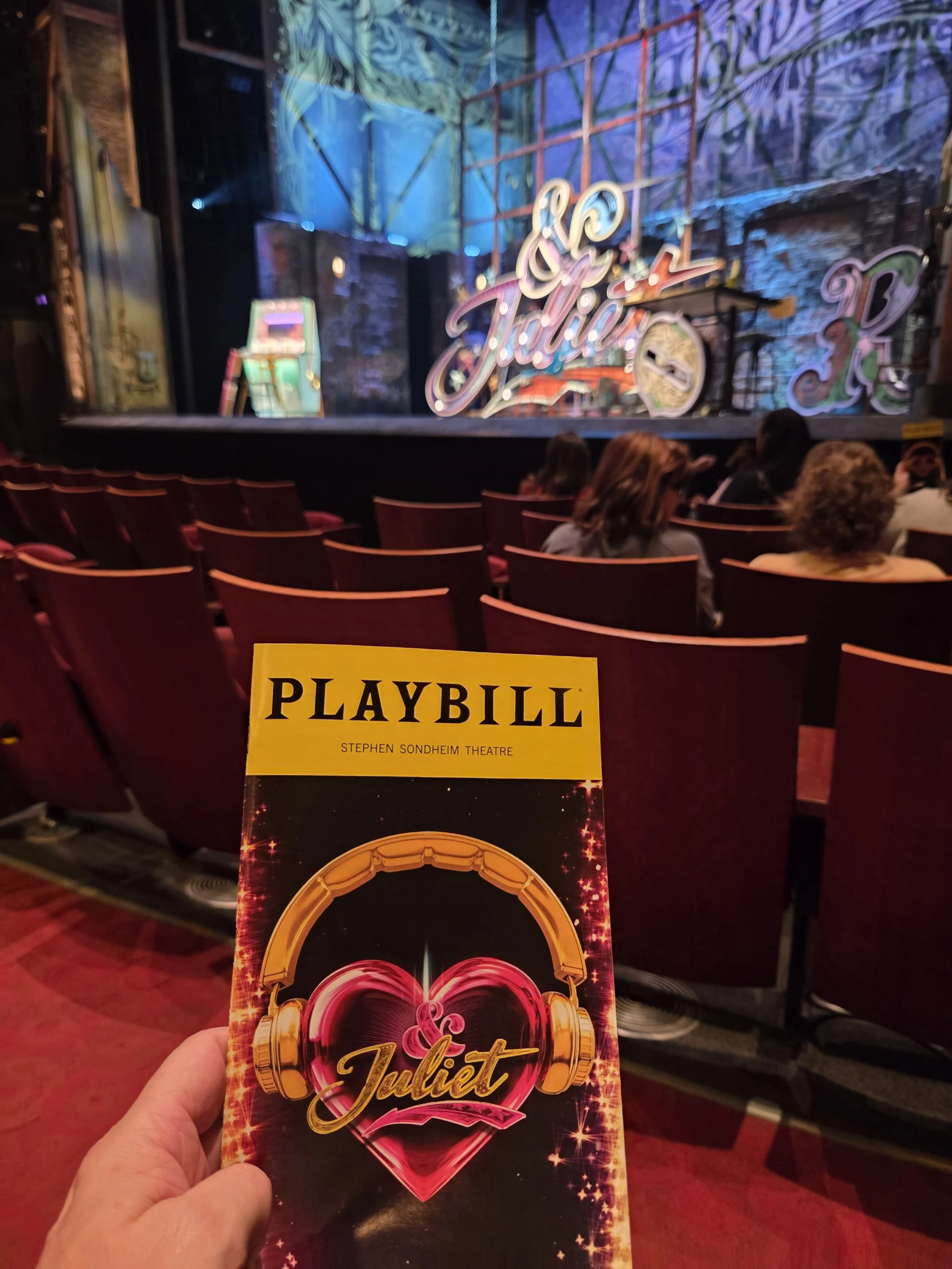
Two things readers should know about me before I dive into this review:
1. I am not usually a fan of jukebox musicals. Even when all the songs are by the same writer or artist, I find the effort to shape characterization and plot around pre-existing song lyrics forced … and even more so when the songs are by different writers and originally recorded by different artists. (I’m going to get hate over this, but I found the Broadway production of Moulin Rouge mostly just okay (“Tango Roxanne” being an exception); if you loved it, I’m happy for you). Most of the time I walk out of a jukebox musical thinking “I wonder how much more it could have been if the music had been original.” (Also Note: Musicals made from concept albums, like The Who’s Tommy, are not, in my mind, “jukebox” musicals.)
2. While I have not read, or seen, every one of William Shakespeare’s works, I can unequivocally state that Romeo & Juliet is my least favorite Shakespeare play (despite loving some of Mercutio and Tybalt’s lines). And this is coming from a guy who much prefers the Tragedies and tragic Histories to the romances and comedies. (And R&J IS a tragedy, not a romance, no matter how hard social media may try to tell you otherwise.)
Those two details help explain why & Juliet has been running for four years and I’ve only just seen it, a few months before it is scheduled to close. So what motivated me to see finally see it two weeks ago?
Anthony Gargiula.
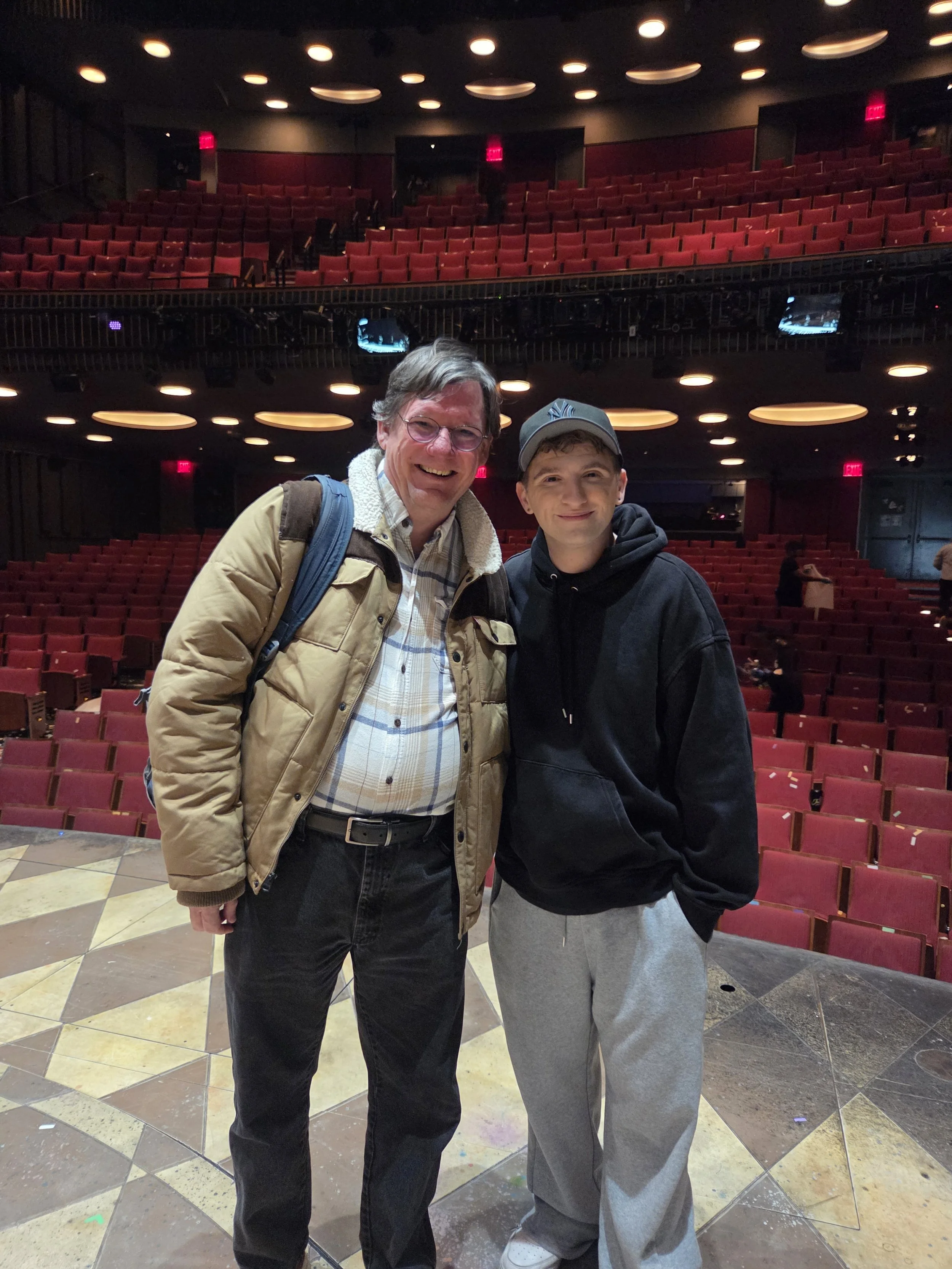
A little background, for those who haven’t been reading my blog or social media posts for very long: I grew up, and did high school theatre, with Anthony’s mother Jude-Ann. When your childhood friend’s kid makes his Broadway debut, you show up. Even more so when you know how hard he’s worked to get there.
But I admit: other than having faith that Anthony would be great, I went in with low expectations. Because, as noted above, it really isn’t my kind of show.
All I knew about the plot was that Shakespeare and his wife, Anne Hathaway (no, not that Anne Hathaway) argue over the ending of Romeo & Juliet, which inspires a rewrite in which Juliet doesn’t take her own life in despair over the death of a boy she’s known for three days, and thus goes on to further adventures. She, her nurse Angelique, and her pair of best friends (May and Anne) run away to Paris, where they make new friends, encounter old lovers, and end up in as many misunderstandings as a Shakespeare comedy of mistaken identities and mixed messages.
Man, did I love this. Way more than I expected to, obviously.
The show effectively skewers everything I don’t like about Romeo & Juliet, along with everything there is to love about Shakespeare’s romantic comedies. It does this by alternating who is writing the story we’re seeing: sometimes Anne, sometimes Shakespeare. Anne’s scenes are full of romance and female empowerment; Shakespeare’s scenes add drama and tension. They make a better writing team than they expect, even while at odds with each other. And the changes in the plot mirror the changes in their own relationship, to great effect. The story also shows us how easy it is for people to repeat behaviors they know are harmful to themselves and others. Juliet, Romeo (yes, he survives too), May, and even Will and Anne fall easily back into bad habits. Juliet ends up in another whirlwind romance marriage proposal that is comedic and dangerous in equal measure; Will can’t resist turning what Anne wants to be a happy story back to the tragic side of things. The show has a lot to say about gender and generational expectations (Juliet’s parents want to send her off to a convent because her romance with Romeo has embarrassed them and their standing in the community; Francois’ father is threatening to send him off to the army if he doesn’t marry soon; the introduction of non-binary May into the plot throws Shakespeare for a loss). There are LOTS of laughs along the way (usually from the dialogue, occasionally from the well-timed placement of a lyrics from a familiar song), and some heartfelt moments as well. I laughed, I teared up a bit, and I let out at least one cheer when something went right for characters I had come to care about (I won’t spoil who or when).
The performances were also roundly terrific. Gianna Harris’s Juliet is the center of the show, of course, and she is terrific, equal parts naïve and increasingly world-wise. I truly believed her swings from teenage rebellion to wanting to do the right thing to help a friend (while being a little selfish at the same time) to realizing what it means to mature into her own person rather than just being someone who responds to what others do to and around her.
Anne is almost as much the center of the show as Juliet, and I’m very happy I got to see Alison Luff before she departed the cast (Anne is now being played by Aly Michalka). Her Anne wants so much to just been seen (by her absent husband and by the world) that she self-inserts herself into the rewritten play as Juliet’s other best friend. Corey Mach’s Shakespeare is all macho bluster trying to be “Larger Than Life” despite his insecurities, and his wounded ego drives plenty of the plot. I don’t think Shakespeare comes off well at all (I don’t think he’s really learned the lesson the show wants you to think he’s learned by the end), but Mach is engaging in the role.
Jeanette Bayardelle imbued Juliet’s nurse, Angelique, with so much depth of emotion -- when she’s funny, she’s really funny; when she needs to be supportive, she is bedrock; when her own lost love is back and she’s not sure she can still have what she wants, her yearning is palpable. Joey Fatone’s Lance, with an outrageous French accent and broad physical comedy moves, was the main comic relief of the show, and he wears it well. Every one of his scenes had me smiling. Again, I’m glad I got to see Bayardelle and Fatone before they departed. (Tichina Arnold is now in as Angelique, with James Monroe Iglehart as Lance).
I recognized a lot of teenage me in Anthony’s character, Francois: the social anxiety, the need to live up to parental expectations despite them being at odds with who he really is, the wanting to be in love but not knowing how (okay, maybe some things haven’t changed…). Anthony’s interpretation of the character is endearing and adorable. He wants so much to make his father proud and to still be himself, and that awkward “caught in between” energy is evident throughout. (Feel free to assume I’m biased here, but I think Anthony knows me well enough to know that if I thought he’d given a poor performance, I’d be honest in this review.) May is a character that could have been played just for laughs; in other hands it probably would have been. But the writers treat the gender dysphoria, and the joys and anxieties of knowing who you are even if the world can’t figure it out, with so much care, and Cyrus Veyssi’s performance is subtle and evocative. From Francois and May’s meet-cute to their big moment of confrontation, Gargiula and Veyssi’s performances support and inform each other.
And then there’s Spencer Sutherland’s Romeo – who doesn’t really come into the action until almost the end of Act One; much life Fagin in Oliver!, the anticipation of when the character will show up threatens to overwhelm the moment when he actually does. I’m happy to report the anticipation pays off. Sutherland has been making a name for himself as a pop singer of large theatricality (picture the stage presence of Freddie Mercury in early Queen, or of Mika), and he brings all of that to Romeo’s himbo personality.
The ensemble were also roundly great, especially in the large choreography scenes. I particularly noticed, and couldn’t keep my eyes off of, Kenzie Zeigler and Makai Hernandez. Reese Britts and Mackenzie Meadows steal the few scenes they are in as Lord and Lady Capulet.
Not every pop song incorporated feels like a good fit, but more of them paid off than I expected. Highlights: “I Want It That Way” is pretty perfect for Anne and Shakespeare’s top of the show battle over whose version of Juliet’s story should get told. May’s “I’m Not A Girl, Not Yet A Woman” is appropriately heartbreaking for someone struggling for the world to see her as she wants to be seen. Juliet and Francois’ “Overprotected/Confident” was a joyous anthem to self-determination. Romeo’s intermission bookends of “It’s My Life” and “Love Me Like You Do” nailed the character’s motivations and self-absorption, and Angelique and Lance’s “Teenage Dream/Break Free” fit their returning romance. No surprise that I also thought both of the Francois-May big moments (“I Kissed A Girl” and especially “Whataya Want From Me”), along with the Lance-Francois-May reconciliation of “Shape of My Heart,” were all fantastic. “Roar” is a crowd-pleasing show-ender.
& Juliet runs through January 3rd, 2027. I’m hoping to see it a second time before it closes.
I’ve always loved live theater, and in the past couple of years I’ve been making a stronger effort to see more of it. Theater Thursday is an occasional series where I talk about live theater, both shows I’ve seen recently and shows I’ve loved in the past. And sometimes even my own theatrical experiences.
