JENNIFER HOLLIDAY, ACTRESS - Interview

It’s Beautiful Women Week here on Rambling On. Today, I talk to the incomparable Jennifer Holliday.  Jennifer is a woman who needs no introduction, but I’m going to give her one anyway. She shot to the top with her Tony Award winning role as Effie White in the original production of DREAMGIRLS, a role she’s reprising for the last time later this year. After lots of personal struggles, 2012 is poised to be a break-out year, as you’ll see in the interview below.
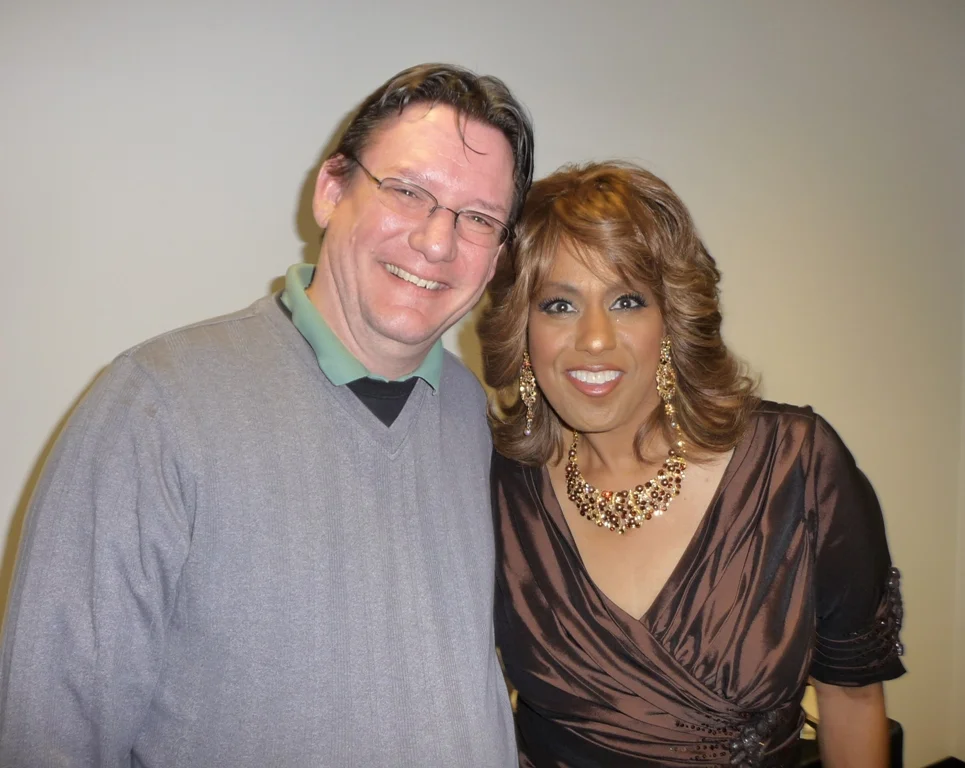
Jennifer Holliday and Anthony Cardno, Photo by Meg Radliff

Jennifer Holliday and Anthony Cardno, Photo by Meg Radliff


Jennifer Holliday, still beautiful. Photo by Meg Radliff.

ANTHONY:  I was excited when I found out you were on Twitter and we struck up an on-going conversation. I remember seeing you in DREAMGIRLS during the original run and being absolutely devastated by “It’s Over” and “I Am Telling You I’m Not Going.” We were sitting in the highest balcony seats and it felt like you were standing in the row in front of us. I’m sure you’ve been asked this a million times, but can you tell me a little bit about what doing the show was like, and share a favorite moment or two?

JENNIFER: Being involved in creating a show and being a part of something that is new and innovative. Nothing had been done like this at the time and of course I was young and you know you’re making something happen. You don’t know you’re making a hit that’s going to be around for generations to come, making history, that sort of thing. None of that came to mind.  It was a lot of hard work, and I was doing another show during the night while working on DREAMGIRLS during the daytime, so a lot of it was work and building something.  My memories are kind of in a big ball tied up from the time we put it together: out of town tryouts in Boston and opening and boom I was the star really overnight. A lot of it my memories are not the kind of memories people would think you would have of creating something. A lot of them are melancholy because it was so overwhelming. I try to look back and see where they are from that time, but I have a hard time trying to gather those up. That’s why I think I’ve haven’t written a book about it, because a lot of it was just so much that I’m still sorting through it after 30 years, I can’t find the happy moments out of it. Not that there weren’t happy moments, there were.

ANTHONY: What was the other show you were doing?

JENNIFER: A lot of people forget that DREAMGIRLS was not my first Broadway show. I was doing YOUR ARMS’ TOO SHORT TO BOX WITH GOD at night while DREAMGIRLS was developing during the day.

ANTHONY: You mentioned not writing a book about DREAMGIRLS. Have you ever seriously considered it?

JENNIFER: Well, you know, Sheryl Lee Ralph has a book coming out in March (Redefining Diva: Life Lessons from the original Dreamgirl) and I thought maybe it’s time for me to write something.

ANTHONY: Would it be more of a memoir, a self-improvement book, or … ?

JENNIFER: More of a book where people can take help from it. So I think it will concentrate on overcoming depression. It will be about working on the mind to get through depression. There was a government report recently that said 1 in 5 Americans suffered from mental illness in 2011. I think that’s what I want to talk about and how it was intertwined with my life and my career.

ANTHONY: On Twitter, you are so supportive of everyone who talks to you. I know you’ve had a lot of personal challenges, including the depression you mentioned. What’s gotten you through the tough times?

JENNIFER:  I think that the toughest part of the depression, and I actually tried to commit suicide when I was 30 years old, coming through that, working through that, was about having the right type of therapist and the right medication at that time, and “staying the course” (I know that’s from the Bush era but I just love the phrase). If you make progress even just a little … you keep going. Just be consistent, it will bear results and get you to where you want to go. I have lots of people who I’ve lost, people I knew who just gave up. Depression just wasn’t talked about a lot back then.  Phyllis Hyman in 1995 was supposed to be at the Apollo and took her life just hours before her show, and that was the first one that made me want to talk about it more, that’s when I became an advocate for mental health and suicide prevention. And then Susannah McCorkle, another a jazz singer, leapt to her death in 2001 after years of fighting depression and relapsing, and that was traumatic to me as well. People who give up right before things turn around, and that’s why I say you have to be careful talking about these things.

ANTHONY: Careful about how you talk to folks with depression?

JENNIFER: Careful about how you talk about finding the right help. I’ve dealt a lot with alternative, holistic methods for some of the problems I’ve dealt with. I still believe in doctors and medicine and treatment, I just think you sometimes have to go further. But stopping your meds and thinking you’re alright for a little while is sometimes the problem so I’m careful in how I talk to people about self-treating themselves. Find a doctor who understands your concerns about your meds and will work with you. There are still doctors who care, who take time and make time to listen. For me to be able to have clarity on that, it was a long time before the voices of darkness cleared away for me. One of the reasons I moved from New York City to Atlanta was NYC is a fast paced place and I couldn’t figure out how to slow down. Even getting from airport to apartment was stressful for me. I sleep better in Atlanta and that, sleeping, has a lot to do with our health. I was finally able to do that without taking anything. Things are quieter down here, things are not bustling after 10pm here, so that helped me a lot. I’m always revaluating: what can I do to get more peace, the kind of peace I’m looking for? That’s why 2012 will probably be more a year of prep than a year of performing. I don’t have a desire to be everywhere, but I do have a desire to do great things. I don’t want that at the expense of the peace I’ve found. I do want to have a balanced life.

It’s sad, but depression still has a stigma attached to it. A drug or alcohol problem is far sexier, especially if you go to rehab and “fix” it. Depression is still viewed as horrible, even with more discussion and acceptance.

ANTHONY: People still get that “why can’t you fix yourself, why do you need help” reaction.

JENNIFER: Exactly. Every situation is different. Mine was clinical depression; manic-depression needs to be handled differently, so do the other types. And you need the right professional help.

ANTHONY:  It’s also so true that we never know what’s going on in someone’s head; just because they’re so energetic and social on-stage doesn’t mean they go home happy with themselves. You know I’ve struggled with that, too. Speaking of being on-stage, though:  I just watched your duet with Jennifer Hudson again via Youtube, and of course I got to see you in concert in Chicago back in December. I’m always amazed by singers whose voices don’t falter, and you’re as much a powerhouse as you were in the 80s. What kind of vocal workout regimen do you follow to keep your voice so strong?

JENNIFER:  Discipline always. No vocal warm-ups, exercises, etcetera, outside of performance. That comes from the theater, doing eight shows a week. No drinking, no excessive talking, no smoking; being very strict about how you treat the instrument outside of the performance. That’s why my speaking voice is so different from the singing voice. People are sometimes shocked at the difference. My singing voice became the main voice, so everything goes into the performance: 200 percent. I’ve had no formal vocal training, never sought any. A lot of it I had to just learn for myself. Doing DREAMGIRLS eight shows a week, with one day off, having to be wonderful, to create magic: I had to take care of my instrument in a different way. No partying, no speaking before 3p.m. each day until the show each night.

ANTHONY:  So it’s really more about maintenance than further training?

JENNIFER: You know, even if your voice is trained, that doesn’t train you to perform every night. You have a legit voice, but it still doesn’t enable you to do eight shows a night. You still need the discipline. That’s why opera singers do less shows a month, to rest their voice. I’m grateful I started in theater first. If I’d started as a recording office first, my voice might not have held up as well, might not be the clear powerful voice it is.

ANTHONY:  We’ve had a “Jennifers” Duet. Now, what are the odds we can get the GLEE producers to cast you as Mercedes (Amber Riley)’s mother for an episode or four?

JENNIFER:  I think Glee would be a fun thing to do.  I don’t know how we could get that done. The wonderful thing about Hollywood is you can just happen to meet somebody and boom you’re there, then if you’re not out there in that network you may not get thought of for something like being on Glee even if people know I may have influenced some of what they do – “let’s not get Jennifer Holliday, let’s get someone who sounds like her.” But anything can happen. Dreams are still made and things that seem impossible can become possible.

ANTHONY:  It’s tougher not being in Hollywood or even New York, isn’t it?

JENNIFER: Yes. You know, Atlanta is a place that is becoming connected but a lot of people don’t even know that I live here, and I’m not a networker. But connections still happen. I did meet Amber through Sheryl Lee Ralph.

ANTHONY:  Speaking of Sheryl Lee, How often do you see the DREAMGIRLS cast?

JENNIFER: They’re mostly actors. I’m mostly a singer fulltime, earning a living just from singing. So our paths don’t cross a lot.  But I do see Sheryl Lee Ralph quite a bit because of her activism for AIDS and our relationship with the gay community. And I hardly ever  run into Loretta Devine but the three of us were all together for Sheryl Lee Ralph’s Divas Simply Singing AIDS benefit concert in LA this past October.

ANTHONY: Earlier in your career you did a lot of benefit concerts, especially for LGBT causes. What causes are important to you these days?

JENNIFER:  The same causes are there in terms of the gay community. It all started with HIV because AIDS pretty much cleaned out the Broadway community in 1981-83, around that time. And at that time it didn’t even have a name, it was the “gay white man’s disease.” People were just dying, there was no help for them so it took out a great deal of the Broadway community and had a large toll on our cast at DREAMGIRLS: Michael Bennett, Tom Eyan, Michael Peters, other creative staff and male cast. Both Sheryl and I were thinking about that early on and that’s been our mainstay in terms of activism ever since. And now it’s becoming one of the leading killers of African-American women because of so many men not being truthful and still being on the “downlow.” So that’s something that will still remain because of that connection I have.

Of course with my own problems with depression, that’s an important area for me too. And even though I have Multiple Sclerosis, I have never been a spokesperson.

I think I’m known to be a philanthropist because I help people with a lot of causes that aren’t as public. I’ve done charity performances, etc. “Everybody’s condition is my condition,” as far as I’m concerned. I don’t think I have to be personally touched by that cause or illness in order for me to give help. If I’m available and the timing is right, I’ll be there.

ANTHONY: I didn’t realize you had MS.

JENNIFER: People forget I have it because I am so energetic on stage, and I can walk, etc. It’s no secret but people kind of forget it because I don’t dwell on it, and because I’ve taken the stance that my depression was far worse than my MS was for me in terms of life-and-death. That’s how I’ve always looked at it. I think that’s because the medications that are out there, I’ve been waiting for them to get better. I have been unable to walk and been blind due to the MS. I’ve been taking care of myself, in fact I’ve undergone several controversial types of treatment to get help for my MS. That’s not for everyone.

You know, trying to figure out how to speak about a disease they don’t know a lot about is difficult. You don’t want to give people false hope, and when people are searching for an answer they don’t want to hear certain things. So if people see me out working through the pain, then they can try to draw from that. Even thought they have to take the meds and they’re in a particular situation that’s different from me, they can take inspiration. I’m working with a woman now who also has MS and is also a singer but is in a wheelchair, and I tell her I can’t promise you’ll walk or sing again, but I do you want you to take your medicine, etc. It’s hard when you’re a person like me who grabs life; how do you talk about a cure that worked for you but you know is controversial that might not work for everyone?

I do believe prayer works, too. I think everything starts in the mind. I was diagnosed seventeen years ago, and by the time they narrowed down my symptoms I couldn’t really walk. They did a spinal tap and other tests, to say conclusively “yes, it’s MS.” I asked them “Why can’t I walk?” and they said “Because your brain can’t send a message to your legs.” I thought, “My brain already can’t send a message to anything because I’m clinically depressed and take meds for that! So the depression has to go so I can put my energy to fighting a disease no one really understands and gets misdiagnosed.”  So I started working on my mind, my outlook. And then they put me on the MS meds and one of the side effects is depression and suicidal thoughts! So I had to get off of that medication, and that’s why I explored the alternative methods I mentioned earlier.

ANTHONY: How did you go about that?

JENNIFER: You do your own homework and your own research. Doctors may not tell you the alternatives. So you have to go and research. I had to take myself off of the medicine because it was bringing on the depression and heavy thoughts of suicide! And I hadn’t read the paperwork to know that’s why I was feeling worse.  So I did that and now here I am, and I still suffer greatly with the illness and I was last blinded for almost three months in 2007. But I continue to use all alternative meds and procedures that have allowed me to be my best self. As a performer I’m way better than I used to be before, but a lot of this is me telling myself that this is how I want it to be.

ANTHONY:  I know fans are hoping/wishing for a full pop album. Is there any chance we’ll see one soon?

JENNIFER:  I do want to record this year, but I don’t know what I want to do. I was thinking of doing an album of love songs: some cover tunes and some original tunes as well. I will make a decision this month.

ANTHONY:  Regardless of what genre your next album is, I’m interested in knowing how you decide what songs to record or add to your concert repertoire.

JENNIFER:  It depends on whether I want to try something new, maybe a favorite song that I’ve never performed before. A lot of stuff sounds new to me that I want to try, a jazz standard, a pop song. That’s how I’ve been looking at putting the concerts together. A lot of people think I’ve recorded lots of cds, but it’s only been five albums and two “best of’s,”, so it’s not a lot of material to use in a 90 minute concert unless there are the diehard fans. I had someone tell me “oh I loved Love Story” and I said “oh what album was that on? Oh, 10 people bought that album…”  In a way it’s good that I don’t have lot of material because as I move forward (hopefully singing for another 20 years or so), it gives me a realm of possibility. I can keep recording and it’ll be new to me and new to my listeners and fans, and I’m excited about that.

ANTHONY: Where will you be appearing in the early part of 2012?

JENNIFER: I’ll be in San Diego with Marvin Hamlisch and the San Diego Symphony Orchestra on February 10th and 11thdoing the “Romance with Broadway’s Best” show. I’ll also be doing a number of private performances in the first part of the year. And you know, the recording industry has changed so much that I’m not sure I can get a label deal, so I’ll have to do an independent release with this album.

ANTHONY: Some of my favorite performers are independent artists putting their own releases out there. My friend Casey Stratton had one major label album and went back to producing and releasing his own stuff. It’s not the easiest way to get your music out there, but it gives you more creative control. To bring our conversation full-circle: You just announced that you’ll be returning to the role of Effie White in a special week of DREAMGIRL performances at The MUNY in Saint Louis. Does playing that role ever get old?

JENNIFER: I have played Effie every five years or so in revivals, but I am pretty sure that at 51 years old, this will be the last one. I don’t want to turn into Norma Desmond! I’ll be playing to 11,000 people a night in the oldest and largest open-air musical theater in the country. It’s another dream come true, so it just goes to show it’s never too late to dare to dream new dreams.

ANTHONY: I am going to make every best effort to be there for a performance. And now for my usual final question: What is your favorite book, and what would you say to convince someone who hasn’t read it to convince them that they should?

JENNIFER:  There are so many to choose from. I love The Purpose Driven Life by Rick Warren.  I think it speaks to me now, to where I am and I think it can help people. It’s a Bible-based book; if someone is searching it’s a great support.

I also love Love Leadership by John Hope Bryant.  Another deep one!  Not a Christian book but more about how you do business and work with others and involve loving yourself and others.

ANTHONY:  Jennifer, thank you so much for taking the time to talk with me, and for your friendship and support on Twitter!

Don’t forget, you  can find Jennifer on Twitter as @jennifersspot, and you can “Like” her Fan Page on Facebook as well!

ANDREW P. MAYER, Author - Interview

This week my guest is Andrew P. Mayer, author of the steampunk-meets-superheroics trilogy THE SOCIETY OF STEAM.

Andrew P. Mayer

Andrew P. Mayer

Andrew Mayer was born on the tiny island of Manhattan, and is still fascinated by their strange customs and simple ways. When he’s not writing new stories he works as a videogame designer and digital entertainment consultant. Over the years he has has created numerous concepts, characters, and worlds including the original Dogz and Catz digital pets. These days he resides in Oakland, CA where he spends too much time on the internet, and not enough time playing his ukulele. (from the author’s website)

ANTHONY:  Andrew, thanks for taking the time to chat with me.

ANDREW:  Thanks for having me!

ANTHONY: With The Falling Machine, the first book in The Society of Steam trilogy, you were described as basically the closest thing we’ve got to “What if the Silver Age of Comics happened in the 1800s?”  Did praise like that (Clay and Susan Griffiths even compared you to Stan Lee) put any pressure on you during the writing of the second book?

ANDREW:  Writing on the second book had been completed by the time the first one came out. Between January and May it seemed like everything was happening almost at the same time, with copy edits, and whatnot. It was all a blur to me, especially since I’d never published a novel before.

But the pressure on the third has been huge. I definitely read my reviews, and as a game developer I’m always trying to figure out how I can respond to my audience.

A lot of writers say you should ignore all that, but it’s interesting when you find someone has a criticism of your work that you find yourself agreeing with, and it makes me want to respond.

Ultimately though, it’s all about finishing.

Hearts of Smoke and Steam (Society of Steam, Book 2)

Hearts of Smoke and Steam (Society of Steam, Book 2)

ANTHONY:  Hearts of Smoke and Steam, the second book, is now available. Where does the action pick up in relation to the end of the first book?

ANDREW:  It starts out a few months after the events of Book One, with Sarah Stanton trying to pull together her life and figuring out how to rebuild the Automaton after she’s run away. Unfortunately for her the consequences of looking to find someone who could rebuild Tom have left her more vulnerable than she realizes.

ANTHONY:  From the way The Falling Machine ended, it was pretty clear that Society of Steam is a fully intentional trilogy, rather than what Jay Lake recently described as an accidental one (where a book does so well, the publisher says, “let’s give the public a couple more”). Was your publisher on board from the beginning for a first book that ended with a cliffhanger, or was there any discussion of making it work as a stand-alone just in case sales weren’t good enough to support a sequel?

ANDREW:  It’s funny but I get a lot of people complaining about the cliffhanger. For me it seems thematically clean—Sarah has made a journey. But I can see why some folks are upset that it ended the way it did…

The series was originally intended as two novels. Honestly I had never completed one before I started, so there was some hubris in thinking I’d even be able to write two. But then, near the end of 2010 I called Lou and asked if we could do a third one, as I’d written four fifths of the novel, and had only just reached the big battle at the end. He was all for it, and lo, a trilogy was born!


ANTHONY:  Did you take any kind of break between writing books one and two? And if so, did you work on anything else in between?

ANDREW:  I took a sort of break. I had fully intended to work on some other things during that time, but my life as I knew it was sort of collapsing, so that ended up taking a lot of my time. I did manage to start putting a plan together for what I wanted to do next, and I’m hoping to start working on those things the moment book three is wrapped up!

The Falling Machine (Society of Steam, Book 1)

The Falling Machine (Society of Steam, Book 1)

ANTHONY:  I’ve described The Falling Machine to friends as a mystery with two detectives: Sarah Stanton has the more straightforward search for Dennis Darby’s killer, and then there’s the Sleuth’s back-alley attempt to pull the bigger picture together. Does Hearts of Smoke and Stone have a similar structure?

ANDREW:  Hearts trades in the detective mystery for more of an action/romance plot. In the first book Sarah was looking for trouble, and in the second book she’s found it!

But there are some similarities. I’d say that Anubis picks up the baton that the Sleuth drops in book one, and he gives us some insights into the Children of Eschaton.

ANTHONY:  Speaking of The Sleuth, I absolutely adored the little glimpses we got of the relationship between him and Dennis Darby.  Is there any chance we’ll see their history developed throughout the second and third books?

ANDREW:  You’re not the only one who has told me that he wants to see more of them. We do get some more glimpses into their past, but not to the same degree. It really becomes the tale of the next generation going forwards.

That said, I’m not done with Darby and Wickham yet. With a little luck, I’ll be putting out more of their adventures before the end of 2012.

 ANTHONY:  How long do you anticipate it will take to complete the final chapter? And will that be it for these characters and this fun world you’ve created? Or is there the possibility of more stories beyond the trilogy?

ANDREW:  Forever? No, wait… Two or three months.
I’m writing furiously, but the story has been wanting to grow even as I’m heading towards the finish line, so I’ve needed to replot a little bit to get it to where I want it.

The goal now is to get a draft down as soon as possible and have the manuscript in the my editor’s hands sometime in March.

As for more: yes, definitely.

ANTHONY:  That makes this reader very happy.  In general, what is your writing process like? And how, if at all, has it changed over the course of the books?

ANDREW:  Outline, write-write-write, revise outline, write-write-write, revise outline, etc until done. That worked really well for the first two books, but I experimented with some different tools and methods when I started book 3, mostly because I wanted to see if I could improve things a bit. After a few months I realized that it wasn’t working out for me, and I went back to my previous process.

I also think that getting a good ending demands that I replot. I always want to be expanding, and at some point to get to the end you need to start drilling down. It’s been an interesting challenge.

ANTHONY:  It seems you’re rising to that challenge, though! Now for my usual closing question: What is your favorite book, and what would you say to someone who has never read it to convince them that they should?

ANDREW:  One book I absolutely love is Anthony Burgess’ “A Clockwork Orange.” It takes you into a believable near-future and at the same time casts a burning light onto our own culture. That’s something I think that all great sci-fi should do.

It’s not an easy story to read because the protagonist is basically a monster. But understanding why such a terrible creature can be sympathetic is one of the joys of the book.

I also adore the way Burgess unapologetically played with language and idiom, and I always tried to put a little of that into my work. In the society of steam I think it’s there with the accents, and the cadence that I use with the Automaton.

ANTHONY: “Clockwork” has been sitting on my TBR pile for a while now. I’ll have to get to it and see if I recognize any of Burgess’ influence on you. Thanks again for agreeing to be interviewed, Andrew!

You can read more about Andrew Mayer and the Society of Steam (including an excerpt from THE FALLING MACHINE) on www.andrewpmayer.com. You can also follow Andrew on Twitter as @AndrewMayer, and he has an author page on Facebookas well. In fact, The Society of Steam has a page of their own on Facebook!

DON DELILLO's MAO II - Book Review

Don Delillo is one of those writers I feel like I should have read long before now. Somehow, he did not come up in any of my Lit courses in college, and I have not sought him out since then. Two years ago the owner of my local independent bookstore recommended MAO II.  Dave’s recommendations have always been spot-on before and as is my habit when recommendations are made while I’m in a bookstore, I immediately purchased the book, put it on a shelf at home, and promptly forgot about it.   But lately I’ve been on a “clean out the bookshelves” binge, and this was one of the books I decided I wanted to read before trading in at the used bookstore.

Plot-wise, the back cover tells us MAO II is the story of reclusive author Bill Gray who, stuck for years now on a failed novel, is inspired to leave his reclusive life and become involved in a group’s attempts to get a French poet released from hostage captivity in Beirut.  Bill’s sudden change in attitude is brought on by an encounter with a world-renowned photographer, and his actions leave his obsessive-compulsive assistant Scott and Scott’s girlfriend Karen at a loss for what to do while waiting for Bill’s return to what they consider normalcy.

That’s the plot, but the book is “about” something larger. It took me a few days after reading the book to figure out exactly what that larger thing is. Ultimately, I think, the book is about the Cult of Personality. DeLillo litters the book with references to Andy Warhol, to Chairman Mao, to the Ayatollah Khomeini. Anyone who fails to draw at least a surface connection between Bill Gray and J.D. Salinger just isn’t paying attention. Scott is concerned that Bill’s reputation and reprint rights are based on what people think he is up to in his seclusion, and that if he publishes this latest novel (failed or not, we never really get to see the contents) people will no longer be intrigued. The French poet is held hostage by a Communist terrorist building a following in Beirut, whose followers give up their own identities to be a part of his. Even the photographer, Brita, builds her career around a sort of cult: she travels the world photographing writers almost exclusively.

The opening section of the book, which focuses on Karen and takes place at the Mass Wedding lead by the Rev. Moon at Yankees Stadium, almost lost me. DeLillo bounces between at least three (that I could count) distinct points of view, sometimes in mid-paragraph, and the feeling I had by the end of the section was that this work was going to be too pretentious, too arty for me. Had the rest of the book continued in that vein, I might not have been able to finish it.  Happily (for me), the remainder of the book is written a bit more traditionally. Actually, it becomes a bit heavy on the dialogue side for a while — characters jumping on various soap-boxes and rambling, dissembling, reminiscing, pontificating. At first, the penchant for characters to spout non-sequiturs bothered me, but ultimately that’s what real conversations are like, aren’t they?  So DeLillo does capture that aspect of real life, even if some of his diatribes go on a bit long. He also does a nice job of allowing we, the readers, to see where all of the characters ultimately end up even if the characters themselves have lost track of each other.

I can’t say that MAO II has inspired me to rush out and start reading everything Don DeLillo has ever written, but I am glad I made the effort to read the book.

READING HABITS - Anthony R Cardno

I made the decision not to post book reviews here on www.anthonycardno.com anymore because I felt like it was a conflict of interest with advertising my own writing.  That doesn’t mean I can’t discuss books I’m reading, though, right?

My reading tastes are all over the map. I keep it varied for a number of reasons:

1. I burn out easily. Too much of any one author or in any one genre makes me antsy and bored. If I’ve read 5 books in the same genre back to back and I’m not enjoying the last one, I start to feel guilty that I’m not giving the book a fair shake because I’m watching for the tropes (if the titles are all the same genre) or the author’s tics (if I’m reading a lot of one author).

2. I feel the need to expand outside my comfort zone. I’ve challenged myself to read more non-fiction (and to read more non-fiction than just memoirs), and to read more fiction in genres I don’t ordinarily visit. Expanding my horizons can only help my writing, right?

3. I keep meeting interesting new authors on social media like Livejournal (Jay Lake) and Twitter (Jeremy C. Shipp, Bryan Thomas Schmidt) and that extra contact increases my urge to sample their work sooner rather than later.

4. Book Clubs. I joined my office’s book club to help me read more “literary fiction,” and I joined Shara’s book club on Livejournal to read more fantasy and SF, as I’ve largely been concentrating on mysteries and urban fantasy in the past year or so. For the office book club I just finished Robert Goolrick’s A RELIABLE WIFE, and for Shara’s book club I’m in the middle of Octavia E. Butler’s FLEDGLING.

5. Being a Paid Reviewer. Last year I sold a book review to ICARUS magazine, published by Lethe Press. They’ve offered me the opportunity to do more for them. They want reviews on books in the LGBT horror/sf/fantasy realm, an area I’m not all that well-read in. Just finished my first review for them: LYNX by Joely Skye.

I tend not to read books that sound too similar to my current WIP though. So I’m avoiding college-set mystery-thrillers at the moment so they don’t influence what I do with Ambergrin Hall.

I’m wondering, fellow writers, what you read and how far-ranging your reading is and how it influences your own writing.

Why I'm Switching - Anthony R Cardno

I’m switching, and that’s all there is to it. It’s time for a change. I’ve made up my mind, you can’t talk me out of it, there’s no turning back.

Switching nights for my Interview posts, that is. Why, what did you think I meant?

I’ve been posting interviews (in the weeks when I have them to post) on Wednesday nights, but Wednesday nights have become increasingly crowded for me. If I make it to a computer in time, I try to check in on the weekly live ustream that Forrest, Andre and Alex Burnham do at 7pm (who are they? Check the links to the right, music lovers!). Then at 9pm the #sffwrtcht (Science Fiction and Fantasy Writers Chat) session starts on Twitter, and I hate missing that. So by the time I’m really ready to start putting the post together, it’s late and I’m cranky and it creates more stress than it should. This interviewing thing is supposed to be fun, right?

Tuesday nights in my world are less busy (at least currently) and therefore I have more time to polish the interview posts before I hit “publish.” So, Tuesdays it is. I also intend to increase the non-interview post frequency — on subjects writery, musicy and fundraisery. (No, those are not really words. I’m a former English teacher. I can make up words if I want.) — to every Friday evening.

Tonight’s interview, which will be up in the next hour, is with Luke Herr, aka Koltreg, the writer behind SOCIALFIST and CHANGELING.

Next week: author Chad Helder (THE VAMPIRE BRIDEGROOM, THE POP-UP BOOK OF DEATH).

After that? I’ll be chatting with author Jay Lake (MAINSPRING, GREEN, THE SPECIFIC GRAVITY OF GRIEF, the upcoming ENDURANCE), and author BRYAN THOMAS SCHMIDT (THE NORTHSTAR SERIAL PART ONE, the upcoming THE WORKER PRINCE) will be back for a second interview. Webcomic writer-artist Allan Wood (ALLAN, BLUE CIRCUS) is upcoming, as well as pop culture reporter Joshua Estrin (Celebbuzzz on Twitter), author Neil Ostroff (AFTER, DEGENERATES, THE DROP OUT), and … well, that’s probably enough teasers for now.

Check back in a little while for the Luke Herr interview, and please go back and revisit my earlier interviews!

CHAD HELDER, Author - Interview

This week, we sit down with horror author Chad Helder.

Chad Helder

Chad Helder

Chad Helder creates dynamic and innovative dark poems and scary stories that spring from the dark crevices of the horror genre. He is a Stoker Award winner (“Superior Achievement in an Anthology” for UNSPEAKABLE HORROR, which he co-edited with Vince Liaguno) He is the author of THE POP-UP BOOK OF DEATH and THE VAMPIRE BRIDEGROOM and his comics work has appeared in Bluewater Productions’ VINCENT PRICE PRESENTS and BARTHOLOMEW OF THE SCISSORS.

The Vampire Bridegroom, Chad Helder

The Vampire Bridegroom, Chad Helder

ANTHONY: Hi, Chad! Thanks for joining us.

CHAD: Thank you so much for your interest in my book and giving me the chance to share my ideas about it.

A: Your collection THE VAMPIRE BRIDEGROOM: POEMS AND TALES came out in July. Tell us a little about how the book came together.

C: I’ve been blogging about the horror genre and “gay horror” since 2006 (and I’ve been writing poetry since 1994), and for years I’ve been dreaming about writing my own personal “ultimate” response to the horror genre through poems–so it started out with a big ambitious goal. Ever since I first started writing poetry, my poems have been filled with images and metaphors from the horror genre–it does feel like horror chose me. The book is a big horror collage with a variety of poems (almost all of the poems contain stories), and it weaves together a lot of personal themes of gay identity with the tropes and motifs of the horror genre. It is my desire that even horror fans who don’t like poetry will find a lot of satisfying content. I have to say, for better or for worse, I really held nothing back when I wrote this book–it is the best book I could write.

A: Jay Lake often talks about an author’s “span of control,” in other words the length of work the author feels most comfortable in. Most of the stories in VAMPIRE BRIDEGROOM are less than 5 pages long. Do you make a conscious effort to only work in very short form? Have you written anything longer than what appears in VAMPIRE BRIDEGROOM?

C: Over the years, I have also really enjoyed drafting some novels, but I’ve never reached a feeling of creative control or artistic control with the novel form. For The Vampire Bridegroom, I decided that I wanted psychologically intense poems and monologues with lots of poetic devices. My first love in the horror genre was Poe’s “Tell-Tale Heart” monologue–a work with lots of richness and also lots of mystery in a very confined space. In lots of ways, I am always trying to write my own “Tell-Tale Heart.” The shortness of the individual pieces in Vampire Bridegroom also helps create a collage-like feeling, I think. I didn’t want any one thing to dominate the book. That being said, some of the poems feel very large to me, especially The Gory Boy, even though they just cover a few pages. For some of the poems that have a flash fiction feel, I actually fashioned the storytelling after movie trailers–lots of quick cuts and fragmentary images.

A: Some of the pieces in TVB are in true short story form and some are pure poems, but most of them toy with format and fall somewhere in-between. How do you decide how “poetic” a piece is going to be? Have you ever started something as a poem and realized it really needed to be a short story, or vice-versa?

C: I really love to play with the gray area between poems and stories. I called the book “Poems and Tales,” not because the pieces are either/or, but rather because everything falls somewhere on the spectrum between poems and tales. I thought it would be cool to have a wide variety of styles to add to the collage feeling. I start out writing most things in poetic lines. I like how a single line needs to have something substantial–a disturbing image or a startling metaphor or a vital piece of information. If a line is empty, it’s easy to cut it out, so writing with line breaks helps me keep off the fat. Sometimes, the lines get unruly and they become little paragraphs, and I try to just let that happen if it happens. I still try to keep it tight and concise, but to answer your question, sometimes poems do become prose stories. Similarly, sometimes I have huge back stories behind a poem, and the whole thing just gets crystallized into a short poem (like with Sweet Midnight).

A: Tell us a bit about the mythos of The Gory Boy and Queen Bloody Mary. They pop up several times in the collection, either obviously or obliquely. Where did the concept come from, and are you developing it further?

C: That poem/fairy tale came from a variety of places–it is a pastiche of various elements. Most prominently, the Gory Boy is like an evil Peter Pan figure–the archetype of the eternal boy. Also, I had a traumatic experience with Bloody Mary as a little kid (which I write about in one of the poems), and ever since I’ve been fascinated with the concept of a mirror realm, or the place where Bloody Mary lives–she is the ruling central figure in this alternate dimension, but she is only referenced in the story. In addition to that, I love the Grimm’s fairy tale called “The Juniper Tree,” the grisliest of Grimm fairy tales from which my story borrows a lot of elements. I wanted to create a fairy tale-like back story for the Gory Boy character, so I used “Juniper Tree” as the starting point. To sum up, I wanted to create this shadowy Peter Pan figure, give him a fairy tale origin, and then move him into the contemporary world of urban legends where Bloody Mary lives. I think it is my favorite story in the book.

A: I got the Peter Pan sense from Gory Boy. I haven’t read “The Juniper Tree,” so now I have some homework to do! Thanks! You’ve also written the Pop-Up Book of Death and edited Unspeakable Horror: From the Shadows of the Closet. Tell us a little about those works, please.

C: Pop-Up Book of Death is like a companion to The Vampire Bridegroom, although Pop-Up is a lot more poetic, and Vampire Bridegroom is even more focused on the horror genre. Both books are dark and surreal and involve my quest to weave together my personal obsessions with a lot of deep, nightmarish stuff. A lot of the Pop-Up poems are based specifically on my actual dreams, so in that sense Pop-Up is more personal, but both have shaggy dogs, scary apes, neanderthals, and my obsession with vampires and beasts.

I co-edited Unspeakable Horror with Vince Liaguno. It’s a collection of gay horror–short stories that feature gay characters and use the horror genre as way to confront the anxieties of gay life. This book most prominently deals with the theme of coming out and all of the anxiety and danger that entails. We were very honored that the anthology won the Bram Stoker Award. Gay horror works well because the anxieties of gay life really translate well into horror metaphors. I think telling horror stories is a healthy way to confront those anxieties–not everyone agrees. We are now reading stories for the sequel.

A: So what’s next for Chad Helder?

C: I am working on some horror fairy tales, but I’ve felt pretty lost all summer–trying out a bunch of different things and experimenting in my notebook. But confusion can be a good thing–there are always lots of possible paths that can emerge.

A: Now for my usual last question: What is your favorite book, and what would you say to recommend it to someone who hasn’t read it yet?

C: My favorite book is Moby-Dick by Herman Melville. I would only recommend it to readers who are interested in works of literary obsession–most people I encounter don’t seem to be, or they had negative experiences with the book at some point because they weren’t ready for it. The book is as huge as a religion and as deep as the human psyche. It’s that big.

A: Thanks for chatting with me, Chad!

C: Thank you so much for the interview–I really appreciate the opportunity to tell readers about my book.

* * * * *

Chad Helder can be found lurking on his personal website, on the website for The Vampire Bridegroom, and also occasionally on Twitter.

SARAH DESJARDINS, Actor - Interview

This week we have Part Two of what is becoming a series of interviews with the cast of The Hub’s mini-series CLUE. Sarah Desjardins joins me to talk about acting and philanthropy.

Sarah Desjardins, Photo by Karolina Turek

Sarah Desjardins, Photo by Karolina Turek

ANTHONY:  Hi, Sarah! Thanks for chatting with me.

SARAH:  Of course! Thanks so much for the opportunity!

ANTHONY:  Let’s start with something I just realized I haven’t asked any of the other actors I’ve interviewed: how did you get started in this crazy business? What was your first amateur acting gig, and your first professional one?
SARAH:  Well when I was about six, that was the first time I ever discovered it was possible to be on T.V. I remember asking my mom “how do I do that?” and a couple months later I had my first agent. Unfortunately my parents decided I was too young and that they would have me try again when I was older but only if I wanted to and took initiative. So once I made it to high school I jumped right into the theater scene. I took part in all the school plays and musicals, still do! My first amateur gig was in grade 8, I was 13 and I was a supporting role in one of the junior stage productions. I had braces up until my sixteenth birthday and the moment I got them off I had headshots done and got with my current agent. After about 9 months with my agency I booked my first professional gig which was Magic Beyond Words: The J.K. Rowling Story.

ANTHONY: Who did you play in the Rowling movie?

SARAH:  I got to portray Diane Rowling (J.K. Rowlings younger sister) from age 13-20 and it was quite a lot of fun! Being a Harry Potter fan it was fantastic to be involved in the legacy in some way. Unfortunately I did not get to meet her as this was an unauthorized biopic, not to mention she is a very private person.

ANTHONY:  You first came to my attention as part of the CLUE cast. What was the audition process like for that?
SARAH: The audition process was long! haha. I actually discussed this with my fellow cast mates, out of the six of us they all auditioned either once or twice while I auditioned seven times. They made me work for it! I first had to send in a tape, afterwards I went in for the Vancouver casting director and I proceeded to go in for a callback as well as a director/producer session. This took place over a couple of weeks and afterwards my agent informed me that they weren’t casting anyone from Vancouver and they were moving on to Toronto. A few weeks later I got another audition for Clue but this time it was for a minor role. Within the next few days I had another call from my agent saying I had another callback but for Whitney! I was ecstatic! I then had another directors session and the day afterwards I also had another session with the producers! Two days later I got the call that I booked the role. It was a VERY long journey but I couldn’t be more happy with the result!

ANTHONY:  Sounds like the audition process was longer than the actual shoot! The show was conceived and filmed as a complete mini-series. How long did filming take, and what were some of the locations you guys used?

SARAH: We had a total of 26 shoot days of which I took part in 25. We shot it over the course of about a month and a half during the summer in my lovely hometown of Vancouver, Canada. We shot in a lot of cool, unique locations among my favorites would have to be the Britannia Mines, which is where we shot all the scenes in the tunnel to the secret room as well as the warehouse where we found Adam Ellis. We also shot some of the street scenes on the set where the movie Watchmen was filmed. It’s basically an entirely fake town, it was awesome! Last but not least The Secret Room! It was built entirely for the show inside an abandoned bank and it was stuffed full with all kinds of neat gadgets, I’d always find myself fooling around in there.

ANTHONY: The Clue cast was a mix of American and Canadian actors. There’s such a great chemistry on-screen. Did you know any of the other teens before filming began?

SARAH: I didn’t actually! But we were so lucky to all get along so well with each other, I was nervous about meeting the rest of the cast for the first time not knowing whether we would all get along or not but we truly bonded and it was always exciting coming to work every day because I got to have a great time with my friends! One thing that I found kind of funny was that for the most part we all clicked best with our Clue counterpart! It just shows that each of us in one way or another are similar to our character.

ANTHONY: I knew from following most of you on Twitter that you built a really strong bond with most of the cast, and that you’d like to work together again. Has The Hub given you all any hint that a second series might be in the near future? I’m sure series creator Raven Metzner has a ton of ideas for how to continue the story, based on that ending.
SARAH:  We did.  I feel so lucky to have made such great friends from this experience, I will always be thankful!  As for a possible second series, we did know while we were filming the first five that there was a possibility of doing more but as of now that is entirely up to The Hub! I know the entire cast and crew would love to but it’s completely in their hands.

ANTHONY:  How much of that ending did you know when you started filming?

SARAH:  We actually got the scripts for all 5 episodes when we started filming so I knew right away, but it was still extremely cool to see how it turned out because of course we weren’t there for the very last part! I myself am dying to know who is watching us on the security footage. They definitely left it as a great cliffhanger so we would have an option to continue, we’ll see what happens!

ANTHONY:  How did you develop or prepare for playing the character of Whitney (“Ms. White”)?

SARAH:  Her personality actually came quite naturally to me, I’m not quite sure what it was considering we aren’t too much alike but I suppose it was just very easy to see her side of things. I completely understood where Whitney was coming from! She could be easily misconstrued as a nag or bossy but she just cares so much about everything and everyone around her and wants to bring out the best in people. One of the biggest similarities we share is I do care a lot about other people and their needs as well as wonderful causes!

ANTHONY:  As you said, Whitney is a very socially-conscious, “get involved,” charity-minded character. I know when the CLUE miniseries originally ran, viewers were able to try to win character-based prize packages, and the Whitney package included a donation to a charity of the winner’s choice. Did you ever find out what charity benefitted from that?


SARAH:  I didn’t ever get to find out no! But honestly just knowing that money went to an amazing charity that really needed it is enough to warm my heart.

ANTHONY:  What causes/charities are important to you, and why?

SARAH:  My strongest connection to a charity would have to be B.C. Children’s Hospital. They actually saved my life, I was born with my small intestine outside of my body so as soon as I was born I was rushed into emergency surgery. They hold a special place in my heart and they are a central hub where children all over Canada are brought to be treated so it is very important to recognize the help that they need. I also recently got involved with Generation On through The Hub and they are fantastic! They are all about encouraging the younger generation to get involved with charities that matter to them and to participate in volunteer work that will help make the world a better place, which is so important because the younger generation truly are the supporters of the future.

ANTHONY: I’ve contacted the Generation On folks to see about doing an interview and featuring them here; they’re doing such important work. I know your co-star Sterling Beaumon has served as a spokesman for them. Now to abruptly switch topics:  tell me a bit about your latest project (at least, latest according to your IMDb page!), Kiss at Pine Lake.

SARAH: Well I actually shot it before Clue! It’s a Hallmark Channel Original Movie that will be released in August 2012 about two people Luke and Zoe who at age fifteen almost had their first kiss on the last day of summer camp. Now 15 years later Luke has taken on camp Pine Lake as his special project and Zoe works for a high powered investment group who wants to buy it only to tear it down and build a wellness resort. Zoe is sent to convince the owner to sell and as they are reunited once again they find their love beginning to re-kindle. I played young Zoe who is mainly played by the lovely Mia Kirshner.

ANTHONY: Are there any other projects on the horizon you can tell us about (or hint at, at least)?

SARAH: I have a minor role in the feature Red Machine staring: James Marsden, Thomas Jane and Billy Bob Thorton! I’m super excited  I have had the privilege to audition for many other amazing projects since Clue and there are a few projects that hopefully will develop for me in the near future.

ANTHONY:  I’ll be looking forward to Red Machine. Great cast! And now my standard final question: What is your favorite book, and what would you say to someone who hasn’t read it to convince them that they should?

SARAH:  As much as I’d love it to be some deep, insightful book I am a sucker for the typical teenage romance which it would seem Sarah Dessen has mastered. My favorite book is Along For The Ride by Sarah Dessen. One of the reasons would definitely be that I can relate so much to what the main character (Auden) is going through in her life, I also have a lot of her habits. If you love a good romance or have a tough family situation it definitely is the book for you, it touched my heart in ways I never expected and I hope it touches yours too!

PS. If it’s ever made into a movie, I nominate myself to play Auden! haha 

ANTHONY:  We’ll have to start a Twitter campaign and get Sarah Dessen’s attention,then, won’t we!  Thanks again, Sarah! It’s always a pleasure to chat with you.

You can find Sarah on her IMDb page, her Facebook page, and her Youtube account,  and you can follow her on Twitter as @SarahDesjardins.

You can find “Part One” of my only-slightly-unintentional series of interviews with the CLUE cast by clicking on Brad And Todd Mann. “Part Three” will hopefully appear in a couple of weeks, when I interview Zach Mills.

JASON O'DONNELL, Pop Culture Blogger - Interview

The following is my first Guest Post, by my good friend Jason O’Donnell.

Image credit: Some rights reserved by Ford Buchanan

Image credit: Some rights reserved by Ford Buchanan

Following is the start of a conversation between me and my dear friend and published author, Mr. Anthony Cardno. I encourage you all to read through my comments to Anthony below and jump in the conversation with your own suggestions, insights, and experiences. This is, of course, a discussion, not the end all be all of twitter etiquette.

Anthony pondered on Twitter: “Wondering what I’m doing wrong that even when I ask for a RT, very few of them happen. Am I missing something RT-etiquette-wise?”

Not surprisingly, I have some very particular ideas about this specific behaviour (based on my experiences working in social business) and quickly replied with the following:

Jason to @talekyn Yes. Don’t ask. If your content is compelling, RTs will happen. Asking is seen as intrusive.
Anthony to @acdntlpoet Makes sense. And you know I very rarely ask. Which means apparently most of what I tweet is not compelling.
Jason to @talekyn kind of. Also depends on your audience, reach, etc… We can take this to a much more in-depth conversation 

Obviously, that’s no where near the end of the discussion. Simply said, there is no single answer to this question. People are making their living as consultants telling you how to to do just this. Not one of them has the right answer in a an easy to distribute formula; because the answer isn’t really formulaic.
As I noted above in my initial reply, the key to seeing your content re-shared is to put forward compelling contents. Oh, but if only the answer were so easy! While I can tell you at a high level what will get your content shared out, it all falls apart in the details and subtleties and actual implementation/ practical application; because not all content is created equal.

But let me step back for a moment and address etiquette before moving on into some best practices: Asking via Twitter for others to retweet you is seen as bad manners, neediness, and laziness. More to the point, it is a bit more indicative of immaturity in the space, or evidence of the size of your network (add totally inappropriate size queen joke at will). By immaturity in the space, I mean that coming from an individual I will see these requests in the same light as I see forwarded emails asking me to “keep the chain going”, or Facebook status updates asking to “post this to your status if you agree / just for one hour”, etc. From a corporate account, it just comes off as poor marketing strategy.

Exposing the size of your network isn’t really a big deal in and of itself (I can see your numbers in any space I play). Rather, asking for RTs presents the impression of a smaller and/or less engaged network, minimal confidence in your message, and generally short selling yourself. Now, I am not saying that asking for a RT is going to leave people with the impression that you are just a speck in the world, but I AM saying that it is one small action which builds how people perceive you when combined with other small actions and methods of presenting yourself.

Yes, I am talking from a more marketing centric approach, with a few assumptions in terms of how you use social media to connect with your audience and spread your message. The assumption is that you are a different type of user, one who is building a personal brand and using social avenues to build up your name and digital eminence. Obviously, if you are just using social media to stay in contact with friends and family, then the concern over perception won’t really apply. But, perception is big for driving and motivating others to share your content.

Rather than continuing to focus on the negatives of asking for RTs, let’s rather focus on what you CAN do to get people to share your content. There’s a great presentation here (http://nytmarketing.whsites.net/mediakit/pos/ ) on the psychology of sharing. From this presentation we can see that one of the biggest factors is determining how the information we are sharing will be useful to the recipient. Take this the next step and you can translate this into your own content by providing that clarity to the person you’re sharing with, so they can in turn re-share easily.

Let me take an example:
@talekyn: Two medical causes are important to me: Cancer and Juvenile Diabetes. Read my diabetes interview with 9yo Frank John:anthonycardno.com/?p=276
Good content here, and likely worthy of a retweet, but I have two problems:
1. It is passive… ok, so these are important to you. They are indeed important issues, but I am not compelled to RT immediately because there isn’t a real message here.
2. I have to click and read to determine if I want to RT. That is going to take some time, and I may lose the originating tweet before I am done with the interview.

Presuming the interview is compelling enough for me to want to RT it, I now need to go back to find the tweet to pass it on (or, one better, tweet/retweet from within the blog post itself). Most people won’t go back to twitter to retweet unless the content is REALLY moving. A well composed tweet that will compel a stranger to read your content will also be compelling enough to garner retweets with out specifically asking for them. Compelling content which resonates with others to the point where they want to share with their own network is what you’re looking for here; adding social sharing buttons in your blog will also help enable users to easily share out your content to the spaces and networks where they play.

Let me see if I can “re-swizzle” (yep, I said it) your tweet above to something which I may be compelled to click into and retweet:
@talekyn: How Frank John, a 9yo living with Juvenile Diabetes and fund raising for JDRF, is putting me to shame: anthonycardno.com/?p=276

Forgive the forced self deprecation, but I think this will work in your favour here: I switched it up a bit, made the reader curious as to what a 9 year old is doing better than you. Because if they can do it better than you, they can do it better than me too, so now I am intrigued and want to read more. It is a more active voice, but not demanding; compelling me to look further. Plus, the tweet provides me with the key points before reading more into the blog: this 9 year old is doing good work for diabetes awareness/cure. I am both compelled to read AND pass it on now, because there is a story here beyond the normal “please send money” charity call. It is interesting, much like your earlier tweet:

@talekyn #LifeWouldBeBetter if my 9 year old cousin didn’t have Juvenile Diabetes. Meet him on my site: anthonycardno.com/?p=276
The tweet above also has that hook, but unfortunately Tweeting this out at 11:30pmEDT on a Friday night means very few people in your particular audience will be seeing it, and you need visibility in order to glean retweets. So, now that you have the compelling content, let’s look at targeting the right audience…

Who are your followers? Are they cast amongst disparate time zones, or predominantly in one? What ages? Nine-to-fivers or in school? By example, I am at my computer from8amEDT until8pmEDT M-F, because of that, I am more likely to retweet something posted in that time frame than I am other times since my usage of twitter is heaviest during work. Weekends and other times when I am outside the house, I’m far more likely to miss content because I tend to turn off most social channels when not at work. Conversely, my fictitious high school aged neighbor may be more likely to see and subsequently retweet late on school nights when s/he is finally back home from school, extracurricular activities, and is “wasting time” on the internet. Not to mention that demographic has a much different usage style of social channels as direct, near-real-time communication and may not be as inclined to retweet blog content outside of some of the more viral types of content.

Having a sense of your follower’s schedules / behaviours / demographics will help guide you towards those ‘sweet spot’ times to post for the greatest impact and visibility. If you use bit.ly or some other URL shortener, or use google analytics on your site (WordPress makes this stuff very easy), you can track some basic metrics and see when when your audience is most active and more likely to marketing out your links. Also, keep promoting your content (with appropriate pauses in between duplication) until you see a drop off in click-throughs. Duplicating content isn’t a bad thing on Twitter as most people don’t see everything unless the spend time going back in their timelines up to the last time they logged in. Unless your users are all like me with a stake in the social business game, they are most likely missing a ton of stuff posted when they aren’t watching. Heck, I even miss stuff, and I am watching like a hawk and make a point to go back in all my timelines to ensure I don’t miss things!

Here ends the first round answer as to why you aren’t seeing a good amount of retweets, even when (or because) you request them. With your following of 490 users on Twitter, I’d predict you’d garner maybe around 10 retweets for some good content if you market it more than once. Until you are a celebrity and people hang on your every word, I’d not expect more than that…. unless of course you happen to stumble on that next bit of viral content and it spins out of your control… but we can only hope for that 

Yes, this was a rather lengthy post, and not intended as the end all be all to explaining social behaviours. I am sure many of my own readers have their own ideas and experiences to share, which I fully encourage! Please feel free to comment here, or in any of the other channels which you may have found this post shared out… the key to being social on the internet is, of course, engaging in good discussion! So whether you agree or disagree, please let me know 

You can comment on this post (although it may take a while before your comment to show up, since I moderate all comments), or you can go to Jason’s blog and comment there.