HOW TO RUN A BLOG TOUR FOR A SEQUEL

This week’s guest post is by author Bryan Thomas Schmidt, a frequent guest on this site. Bryan is on a blog tour to promote THE RETURNING, the second in his Saga of Davi Rhii science fiction series. We considered doing another interview, but as we’ve now interviewed each other at least four times between our two blogs, I thought a guest post by Bryan would be a nice change of pace, and what better topic to discuss than how to do a blog tour for a sequel without spoiling the first book in the series?  So here he is, ladies and gentlemen, Bryan Thomas Schmidt:

Borali-Military-Crest-300x300.jpg

How To Run a Blog Tour For A Sequel Without Spoiling Book 1

Okay, first of all, the fact that Anthony asked for this topic proves he’s not really my friend, let’s just get that out of the way first.  I mean, I suppose it’s a compliment that he thinks I actually have the answers to this. After all, The Returning is only my second novel ever published. And having been a beta reader for me on it, he of all people should know how tightly the storylines interlap as well as how much the success of this particular sequel depends on suspense and surprise.  To be fair, though, I did it to myself. I’m the one who wrote the novel this way, after all. The fact that he’s an opportunist taking advantage of my self-made quandary is just an unfortunate side effect really.

So let’s get on with it then. How do you run a blog tour for book 2 of a trilogy? Very carefully. Just as craft goes into the writing, so must it be applied to your marketing.

First, choose some excerpts and plot/character details which can be shared to tease the book without ruining the rest of the plot. Not easy, but doable. They should involve the old familiar characters, particularly the protagonist and also the antagonist when possible. And they should be fast-paced and tension filled. You can share the romantic subplots sometimes but usually those emotional highs are best saved and it’s the drama of the obstacles which draws most readers in.

For example, the reading excerpt from this book I have been using is a subplot scene involving my protagonist, Davi Rhii, fighting with his girlfriend/fiancée, Tela, witnessed by his archrival Bordox. It’s told through Bordox’s POV and so we get not only character and plot development for Davi and Tela but also for Bordox. Their relationships were all established in book 1, The Worker Prince. We knew Bordox would want revenge because he always blames Davi for his troubles and Davi really put him in his place in Book 1. Davi and Tela’s romance developed in book 1, but most couples go through phases where they have fights, so no surprise there. Thus, that scene is not a spoiler but it does have enough juice to intrigue fans of the series and new readers as to the kinds of issues book 2, The Returning, holds in store.

Second, choose story descriptions which don’t give too much away about the prior book or the latest. You can tell them the basic plot without ruining the ending. You don’t have to ruin the first book’s ending. Instead of saying “they fought and so-and-so won, but now they’re at it again,” you can say: “In book 2, the characters find themselves in conflict over x, y and z and the repercussions of book 1 are impacting their personal relationships and lives.” See how that avoids mention of the ending yet sets up the conflict in the second book as well as characters? It tells you there’s going to be obstacles to overcome and that the events of the first book do play a role in shaping things but also leaves you room for new things as well. (Dang, even when I’m describing generic sentences I’m writing generic sentences. This could ruin my craft.)

What intriguing tidbits can you offer to tease without giving it away? With The Returning, for example, I can say: “Davi and Tela find their future together threatened by difficulties with their relationship.”  Generic? Yes, but promising because our favorite couple, the antagonist and his love interest, aren’t so perfect after all. In The Worker Prince, we rooted for them to get together so now that’s threatened? Readers will want to know why. There’s complication and complications make for interesting drama. Here’s another example: “Xalivar is back with a vengeance seeking revenge on Davi and all those who defied him.” We don’t know if Xalivar won or lost in the last book, but he wants revenge and that’s well within his character so we’re not spoiling anything. People who enjoyed the larger-than-life villain will enjoy seeing him up to his old antics and how the heroes overcome it.

Here’s a third: “Davi, Farien and Yao reunite for a mission to investigate the murders of Vertullians throughout the system by those opposed to their obtaining citizenship, finding their lives and friendships threatened by what they discover.” Our three buddies with great rapport are back and they are hunting killers and in danger? Who doesn’t want to know what happens?

The-Returning-front-cover-197x300.jpg

Here’s the full description I’ve used for the back of the book, Goodreads, etc.:

The Vertullians are free and have full citizenship but that doesn’t mean they’re accepted. Now someone is sending assassins to kill and terrorize them and it’s riling up old enmity all over again. On top of that, Xalivar is back with a vengeance seeking revenge on Davi and all those who defied him. So Davi, Farien and Yao reunite for a mission to investigate the murders of Vertullians throughout the system by those opposed to their obtaining citizenship, finding their lives and friendships threatened by what they discover. Meanwhile, the new High Lord Councilor, Tarkanius, Lord Aron, and Davi find themselves fighting all over again to preserve the unity of the Borali Alliance, while Xalivar’s allies and even Lords on the Borali Council work against them in an attempt to tear it apart. Davi and Tela find their future together threatened by difficulties with their relationship, and Miri’s adjusting to her new status as a non-royal. The action packed, emotional, exciting Davi Rhii story continues.

I tease familiar character names and remind readers new and old that there will be more political backstabbing, family drama, romantic entanglements and life-on-the-line action. All things people loved about The Worker Prince.

Second, choose the types of post you’d most like to feature: interviews, excerpts, reviews, video blog entries, character interviews, humorous dialogues, guest posts, etc. It’s best to have a variety and spread them out so you don’t run a whole week of reviews or excerpts, etc. Then contact the bloggers you’d like to see participate and ask if they’d be interested, offering post options. When guest blogging, it’s usually best to find a topic or way of discussing one that relates to the blog’s theme and offer that. I also use anchor blogs, big blogs with lots of traffic, on Mondays to start my week and Wednesdays for a boost when I can and scatter the others between. When possible, I have each link to the next day’s post.

It’s important to pick a variety of blogs, too. You don’t want all blogs that reach the same audience. You are trying to let as many people as possible know about your book. Now if your book’s family friendly, an erotica blog probably isn’t the best fit (i.e. use common sense) but I’ve had mystery writers invite me to write about craft on their blogs and so on. Small blogs can reach people, too, especially as they grow and the posts sit there over time. Obviously, the more built-in the audience, the better, but still, you can benefit from the variety of sizes just the same.

Third, start writing. It’s best to start a month or more in advance. You’ll have a lot of content to develop and the more time you have to prepare it, the better quality it can be. You’ll also have time to adopt any changes the host sites might request, etc. Remember to capture the excitement you had in writing the book. There’s plenty of elements from craft of dialogue to plotting to genre choices to character arcs and more you can guest post on. By being creative, you can still tease your book and work in aspects of it without a sales pitch, like I’m doing with this post. Readers love to dig in more in depth to the workings of a novelists mind and they find the behind-the-scenes insight helpful and interesting. And, if you want them to buy your book, you need to convince them you’re interesting. Why else should they agree to dedicate hours to hanging with your mind and creative output? Use humor, provide links and examples, and provide pictures and a bio on every post, including links to not just your book page and site but also to other helpful tools and books you might mention in the post.

Fourth, visit the posts and answer comments. Dialogue with the blogger and readers. Don’t just let it post and disappear. A key part of what makes blogs and blog tours successful is the chance to interact with bloggers/authors. Be personable and have fun. If you get a troll, either ignore them or make a joke. Don’t engage in a flame war. Instead, have fun and answer with as much personality, intelligence and interesting data as you can. That will build relationships with whole new readers. I’ve had people buy my book and even become friends doing that. And those people will then help spread the word with no effort from you.

Blog tours are a lot of work. So is book promotion. But in the present climate of publishing, more and more of that onus falls on the authors. The beauty of blogs is that they’re free and you can reach out beyond your own circles to a wider band, helping draw traffic and attention for others doing solid work and writing while, at the same time, promoting yourself. So there you have it, a few tips to doing a blog tour for a second book without ruining the first. Hit me back in a month or two and I’ll tell you if they work or not. Meanwhile, thanks to Anthony for inviting me to Rambling On.

Bryan Thomas Schmidt

Bryan Thomas Schmidt

Bryan Thomas Schmidt is the author of the space opera novels The Worker Prince, a Barnes & Noble Book Clubs Year’s Best SF Releases of 2011 Honorable Mention, and The Returning, the collection The North Star Serial, Part 1, and has several short stories featured  in anthologies and magazines.  He edited the new anthology Space Battles: Full Throttle Space Tales #6 for Flying Pen Press, headlined by Mike Resnick. His children’s book 102 More Hilarious Dinosaur Jokes For Kids from Delabarre Publishing. As  a freelance editor, he’s edited a novels and nonfiction.  He’s also the host of Science Fiction and Fantasy Writer’s Chat every Wednesday at 9 pm EST on Twitter, where he interviews people like Mike Resnick, AC Crispin, Kevin J. Anderson and Kristine Kathryn Rusch. A frequent contributor to Adventures In SF PublishingGrasping For The Wind and SFSignal, he can be found online as @BryanThomasS on Twitter or via his website. Bryan is an affiliate member of the SFWA.


THE RETURN OF EVELYN LAFONT - Author Interview

It’s Sexy Saturday ( yet another “should be a Twitter hashtag but probably isn’t”). It’s also the one year anniversary of the very first interview I posted here on Rambling On. So to celebrate, I’m welcoming back Evelyn LaFont, my first interviewee. But just to be different … this time, Evelyn answers my questions via VIDEO! I know! Even I’m surprised at the way I’m branching out into new technologies! (Insert derisive laughter here.)

Evelyn is a full-time writer living in Florida with her perfect orange kitties and totally alpha hubby who saves her from squirrelsstray dogsglue and herself.

Her debut paranormal romance series, The Vampire Relationship Guide, is a four-novella romp that takes a satirical look at what could happen if a clueless human chick really dated a vampire. It’s also got some good sex and romance shoved up in it, making it a lovely four-course meal that won’t leave you feeling bloated after consumption.

Her newest series, Pack Mistress (Quick ‘n’ Dirty Erotic Paranormal Romance) follows the adventures of red wolf Pack Mistress Lorena as she satisfies the males of her south Florida pack while trying to find herself. It’s more serious than VRG, and more erotic. The novel is being released in serial format, with new 30-35 page installments every other month in 2012.

Without further ado, here’s Evelyn … but scroll down below the video for a chance to win some books!

OH! WARNING! Some of this conversation may be NSFW. (On the plus side, there’s an adorable cat in the background for most of it.)

WIN EVELYN’S BOOKS!  Yep, win The Complete Works of Evelyn LaFont in e-book format. All you have to do is leave a comment telling us your Favorite Supernatural Being Pick-Up Line. (Either the line you’d use to pick up a vampire, werewolf, zombie, angel, demon, etc, OR a line you think they’d use to pick up a mortal.)

Winner will be chosen at random from all comments posted between now and Saturday, MAY 5th! So fire away!

And don’t forget, you can find Evelyn on Twitter as @keyboardhussy, on her own website, on Facebook, and at the book links at the top of the page!

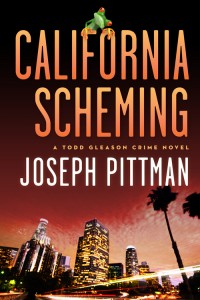
JOSEPH PITTMAN, California Scheming - Author Interview

It’s Thriller Thursday (another should-be-hashtag on Twitter), and who better to chat with today than my old friend Joseph Pittman, author of the Todd Gleason crime novels?

Joseph Pittman

Joseph Pittman

JOSEPH PITTMAN was born in the borough of Queens and lived there for the first seven years of his life, before his family moved to Upstate New York.  A graduate of Fayetteville-Manlius High School, he then went on to get his Bachelor of Science at SUNY Brockport, where he majored in communication, with a concentration in journalism.  While attending Brockport, he was an editor for “The Stylus,” the school newspaper, where he had a weekly book review column.

Upon graduation, he returned to New York City, where he began his publishing career.  After short stints at Putnam Children’s Books and at Viking Penguin, he landed his first editorial job at Bantam Books, where he assisted with such authors as Jonathan Kellerman, Michael Palmer, Rita Mae Brown, actress Ali MacGraw and General Norman H. Schwarzkopf.  He moved to NAL as an editor and worked with authors such as Max Allan Collins, Lawrence Block, Stephen King, Martha Grimes, Jeff Abbott, Joan Collins, Judith Gould, and many other best-selling and acclaimed names.  His career has also taken him to the world book clubs (Doubleday Book Club), and small presses (Alyson Books).  He is currently Editorial Director of the new Vantage Point imprint.

His novels include TILTING AT WINDMILLS, WHEN THE WORLD WAS SMALL, LEGEND’S END, and A CHRISTMAS WISH.  His crime novels featuring Todd Gleason are LONDON FROG and CALIFORNIA SCHEMING.  He’s at work on several other projects.

ANTHONY: The second Todd Gleason novel, California Scheming, is now available. For my newer readers, remind us who Todd is, and where do we find him at the start of the new novel?

JOE: Todd Gleason is a con man.  Once a small time con, he only stole from the rich, but never gave to the poor…unless you count him.  He’s doesn’t like to talk about himself, his past, and definitely not the father who walked away when he was five.  Todd lives alone in an apartment in Manhattan—though he does have a pet frog, named Toad.  Todd has a habit of speaking first, acting second, thinking last.  It usually lands him in a lot of trouble.  After his successful con in LONDON FROG, Todd is taking a sojourn on Bermuda, relaxing in the arms of the lovely Lana Davies.  But this being Todd, his idyllic holiday can’t last.  Trouble comes looking for him.

The plot revolves around a noted bank robber named Fast Cash, who disappeared seven year ago…never to be heard from again.  His “widow” has him declared legally dead—and that’s when the dead bodies start turning up.  What Todd needs to do is rescue a long-time friend of his from a loan shark and the only way he can imagine is finding the missing cash that Fash Cash stole all those years ago…all three million.  Let the fun begin…

ANTHONY: I hear you had some interesting adventures researching the new book. So dish!

JOE: Not sure “adventure” is the right word. The early chapters of the book are set in Bermuda.  I was going to use the Bahamas, but I’ve never been there.  Bermuda I knew, so I picked that.  There’s a bar in SCHEMING modeled after a local watering hole in the main town of Hamilton.  For the Los Angeles sections, I visited LA twice.  One of my visits had me staying for 10 days at The Standard Hotel on Sunset Boulevard, just so I could soak up the sun, the atmosphere, and the attitude.  There was lots of all.  I also got as close to the Hollywood sign as they’ll permit, and did a visit to Marina Del Rey, because there is a scene on a yacht that launches for there.  Otherwise, I drew on experience of driving around West Hollywood, Beverly Hills, and Palos Verdes, all setting for the book.  For a guy used to walking all over Manhattan, car culture was a cruel shock.  Part of making the LA scenes successful was getting the lingo down—“Take the 101 to the 10 to the 405.”  I actually know what all that means, now!  There are also some scenes set in Manhattan—when you read the “Raven” bar scene, please remember this book is fiction.

ANTHONY: I’ve already recognized one of my favorite NYC diners in the early pages of the book! For new readers, is it vital to have read the first Todd Gleason novel, LONDON FROG, before diving into CALIFORNIA SCHEMING, or does each book largely stand on its own?

JOE: No.  Each book is designed to stand on its own—new characters and cons are introduced in each book.  So far I haven’t yet had a recurring character other than Todd…and Toad, the frog.  He’ll be in each book for sure.  There are recurring themes about Todd’s character, what has helped shaped him.  But I haven’t explored all that yet.  Maybe Book #5 in the series will reveal a bit more about Todd’s past.

ANTHONY: I know that like me, you’re not a huge fan of outlining. Did any plot twists take you by surprise while writing CS?

JOE: In between the first draft and final draft, there was one big change.  The killer.  Something just wasn’t sitting right with me about the ending, so I had to go back and think.  Maybe that’s where an outline would have come in handy, but what’s the fun in knowing what’s going to happen?  I like to go by Todd’s instincts—he has to think on his feet when a problem occurs, so that’s how the writing goes too.  I had some other fun things in the book, but they ended up on the cutting room floor.  I think I was twisting the plot one too many times, so something had to go.  There was a great scene with Beverly Mills of Beverly Hills, my blowsy, big-bosomed real estate lady, executing a scam poolside in West Hollywood.  In the end, I cut it and it hurt.

ANTHONY: Maybe the Beverly Mills con can be a short story! Speaking of which, tell us a bit about “The Perils of Penelope Pittson,” the first Todd Gleason short story. Where and when is it appearing, and where does it fall in Todd’s chronology?

JOE: Perils will appear in the anthology, CRIME SQUARE, to be published in the coming weeks.  There is no chronology with this story with FROG and SCHEMING…it just exists.  The story takes place on New Year’s Eve in Times Square, where Todd is protecting a woman.  But he imagines himself back in the 50s, what if he were a P.I. and she a damsel in distress.  The two plotlines end up having many parallels.  I wrote the story in the style of an old detective movie, so some of the lines and dialogue are flat out funny.

SCHEMINGnew-200x300.jpg

ANTHONY: How is the third book, which takes Todd to the south of France, progressing?

JOE: Ah yes, the long-rumored third book, THE CANNES CON.  I’m writing it, but I’m also toying with switching that book to #4 in the series and writing another idea I have.  That one is set mostly in New York City and environs and it’s called BROOKLYN HEIST.

ANTHONY: Man, I love your titles. Other than Todd’s adventures, what else are you working on right now?

JOE: The next Linden Corners “windmill” novel comes out in October from Kensington Books.  It’s called A CHRISTMAS HOPE.  Then in Spring 2013 is BEYOND THE STORM, a stand-alone novel with new characters and town.  More Linden Corners books are in the works, too.  My big suspense novel, THE ORIGINAL CRIME, may see publication as an original ebook later this year.  Still working on those details.  I don’t lack for ideas…just time.  But I’m having fun writing about these worlds I’ve created.  I hope readers are enjoying them.

ANTHONY:  More for me to read! And now my usual closing question: what is your favorite book (by someone else) and what would you say to someone who hasn’t read it to convince them that they should?

JOE: My favorite book?  It’s an oldie, but a goodie.  THE PRIZE, by Irving Wallace.  It’s set in the world of the Nobel Prizes and features a huge cast of characters.  It’s pure storytelling, absolutely riveting.  A big, old-fashioned read.  Wallace was one of my early favorites and I still have all the hardcover editions of his novels in my collection.

You can find out more about Joe’s projects by checking in on his website. Joe also occasionally appears on Twitter as @JosephPittman13, and he also has an author page on Facebook.  You can also find my earlier interview with Joe right here.

LINDA POITEVIN, Sins of the Son - Author Interview

This week I’m taking part in the Blog Tour for Linda Poitevin’s SINS OF THE SON, the second book in her series The Grigori Legacy.  And don’t forget, after the interview, to check down below for a chance to win TWO different giveaways!

Sins of the Son Blog Tour

Sins of the Son Blog Tour

Linda Poitevin was born and raised in B.C., Canada’s western most province. Growing up in an era when writing was “a nice hobby, dear, but what are you going to do for a living?”, Linda worked at a variety of secretarial jobs before applying to be a member of the Royal Canadian Mounted Police (RCMP). Due to an error in measurement, however, she was turned down when she didn’t meet the height requirement of that time. Undeterred, Linda became a civilian member in the force and was a dispatcher for two and a half years, during which time she met her husband, a police officer.

Linda Poitevin

Linda Poitevin

Following their transfer to Ottawa, Linda went on to become a real estate agent and then a human resources consultant before starting a family. She has been a stay-at-home mom ever since and has homeschooled her youngest daughter for the last nine years. Now that she has realized writing can be more than a nice hobby, she continues to live her dream of being a cop vicariously through her characters.

Linda currently lives near Ottawa with her husband, three daughters, one very large husky/shepherd/Great Dane-cross dog, two cats, three rabbits, and a bearded dragon lizard. When she isn’t writing, she can usually be found in her garden or walking her dog along the river or through the woods.

In addition to her books, Linda also does freelance writing and editing. Information about her services can be found at www.lindapoitevin.ca. Linda is a member of Science Fiction & Fantasy Writers of America, Quebec Writers’ Federation, Romance Writers of America, RWA Futuristic Fantasy Paranormal Chapter, and Ottawa Romance Writers’ Association.

ANTHONY: Welcome back, Linda! It’s always great to have people come back for a second interview.

LINDA: Thanks so much for having me back, Anthony! I’ve really been looking forward to this. 

ANTHONY: So let’s start out with a little recap: what is The Grigori Legacy series all about, and who are Alexandra Jarvis, Aramael and Seth?

LINDA: The Grigori Legacy series melds angel mythology with suspense, thriller, and police procedural aspects to create a world where God is a woman, Heaven and Hell are real, and homicide detective Alexandra Jarvis has been thrown into the struggle between them…with humanity’s very survival hanging in the balance. Aramael is–or was, in book 1–an angel who hunts Fallen Ones and the soulmate Alex was never supposed to have; and Seth is both the son of the One (God) and Lucifer and a pawn in their ongoing cosmic game.

ANTHONY: The first book, SINS OF THE ANGELS, was very clearly focused on Alex and Aramael: their relationship and their struggle with serial killer / fallen angel Caim. Some of Alex’s fellow cops  and Aramael’s fellow angels play strong supporting roles, and of course there’s a major subplot involving Seth, but mostly it’s Alex and Aramael’s story. The focus shifts for SINS OF THE SON. Not unexpectedly,  because the book is about him, Seth joins Alex at center stage. How hard of a decision was it to make Aramael slightly less of a presence?

LINDA: The series really is about Alex as a main character, so lessening Aramael’s presence wasn’t really a decision, per se, it was more just a natural progression in Alex’s story.

ANTHONY: You expand Heaven’s ranks a bit by bringing in perhaps the most well-known arch-angel ever, Michael. I believe you hinted at the reason for his absence in book one, and we get closer to the full story in book two. Do you have detailed histories written out for each of the major angelic characters (Michael, Raphael, Aramael, Verchiel, Mittron, etc), keeping track of where and when they’ve crossed paths in the past?

LINDA: Wow, the more questions like this that get thrown at me, the more I realize how much of a pantser I really am, lol. Perhaps my subconscious has already worked out these details, but they only surface as I’m doing the actual writing…so no, no written histories as yet. I am, however, working on writing them down as I uncover the details, and I plan to put them up as a series of short backstories on my website…eventually. 

ANTHONY: You also introduce two more main human characters, Detective Hugh Henderson and Doctor Elizabeth Riley, who play much larger roles than any of Alex’s fellow cops or family did in book one. Was your plan always to expand the human cast in book two to give Alex a bigger support network, or did you find that the story as it developed necessitated letting Alex share the spotlight with other humans?

LINDA: It was definitely something that developed with the story…poor Alex really needed some kind of human sidekick. 

Sins of the Son

Sins of the Son

ANTHONY: Good point. Although I have to admit: at one point I thought there was a very real possibility that you’d pull a George RR Martin and kill off your main viewpoint character. Was there ever any thought to killing off Alex and turning the series over to Henderson and Riley? (Hey, even JK Rowling considered killing off Ron Weasley at one point!)

LINDA: Really? You thought I might kill off Alex? For real, I mean? That possibility honestly never even crossed my mind! I cannot guarantee the safety of all my characters, however. (Mwahahaha!)

ANTHONY: Yes, really. And I adore that evil laugh. Now, you gave us  a very well-developed, if non-conventional, look at the hierarchy of Heaven in book one, so it makes sense that you’d give us a glimpse of Hell in book two. It’s a small glimpse, most scenes featuring only Lucifer and Sammael. Do you have maps of Heaven and Hell in your head, and how completely does Hell mirror Heaven?

LINDA: I have a clear vision of Heaven, but not necessarily a map of it, no. Hell itself mirrors Heaven very closely, but in an anti-Heaven kind of way. You’ll see more of that in books 3 & 4.

ANTHONY: Taking yourself out of creator/author role for just a moment: as a reader, would you be #TeamAramael or #TeamSeth? (Please don’t say #TeamHenderson….!)

LINDA: #TeamHenderson was never even a possibility, so you’re safe there! And I remain firmly on the side of #TeamI’mStillNotTellingYou, lol!

ANTHONY: Curses, foiled again! You can’t blame a boy for trying, though! On a more craft-oriented note: did your writing process change at all from book one to book two?

LINDA: Hugely! The Grigori Legacy is my first attempt at a series, and while I’ve never been a plotter, book 2 forced me to take a more long-range view of the series…and to start keeping at least a few notes about backstories (just so I didn’t get myself too lost!). I was also writing under contract for the first time and so there was an element of expectation I’ve never had before. For the most part that worked in my favor, keeping my butt in the chair and on schedule, but every once in a while it resulted in some serious performance anxiety, too. Book 2 taught me how to work through roadblocks created by my own insecurities.

ANTHONY: Okay, so you know I have to ask: when’s book three coming out? Can you at least tell us the title and tease us a little of the plot?

LINDA: In book 3, Sins of the Righteous, Seth’s decision in book 2 creates unforeseen complications for the entire universe, Alex is stretched to her limits with trying to keep both her relationship and humanity glued together, and more impossible choices will have to be made. No pub date has been set yet, but you can be assured I’ll let everyone know when I do (most likely by yelling it from the rooftop!). 

ANTHONY: You’ve got a plan for the end of the series, right? Have you known it all along, or did it evolve from what you’ve written in the first two books? Does the ultimate series-ending allow for other books/characters in the same world at some time in the future?

LINDA: I do have an end in mind, yes. It evolved through the first two books and cemented itself at about the 3/4 mark of Sins of the Son. I think there would be room for other books/characters in the future, but I’m not sure I’d want to go there. I like the idea of ending this series as planned and moving onto a fresh idea (and yes, I already have one in mind). 

ANTHONY: My usual closing question is about favorite books, but you fielded that one last time. So, let’s change it up: what’s your favorite movie and what would you say to someone who has never seen it to convince them that they should?

LINDA: My favorite of all time isn’t actually a movie, but a mini series: the BBC production of Pride and Prejudice. If someone has never seen it, I’d tell tell them that it is head and shoulders above the Hollywood version, with brilliant acting (Colin Firth is just sooooo good in it!), and a script that stays unbelievably true to the story itself. I love the series for the snapshot it provides into another era…and for its historical accuracy.

ANTHONY: Thanks again, Linda!

LINDA: Thank you, Anthony, for another wonderful invitation to visit!

SoS-giveaway-necklace-225x300.jpg

Now, on to news about those giveaways:

GIVEAWAY #1: You can win a copy of SINS OF THE SON, just by commenting on this post! It’s easy. Just  choose who you think Alex Jarvis should end up with when the series concludes. Are you #TeamAramael? #TeamSeth? #TeamHenderson? Or #TeamSomeoneElse? Have fun with it, and add your reasoning if you feel like it!  A winner will be chosen by random, by me, on the last day of the SINS OF THE SON Blog Tour, which is APRIL 26th, 2012. Chosen winner will be notified by email to arrange delivery, so please provide good contact information!

WIN THIS!

GIVEAWAY #2: All of the book winners from all the stops on the SINS OF THE SON Blog Tour will be entered into a Grand Prize drawing for this beautiful necklace/earring set designed by Cemetary Cat, aka @psynde on Twitter:  Winner will be chosen by Linda herself, who will then contact the winner to arrange delivery.

Remember, you can find Linda on Twitter as @LindaPoitevin, you can find her author page on Facebook, and of course you can go right to her own webpage for even more information and goodies.  And here’s a link to my original interview with Linda when SINS OF THE ANGELS was released.

And you can see the full list of SINS OF THE SON blog tour stops (with lots of other interviews, guest posts by Linda, and chances to win) RIGHT HERE.

MYKE COLE - Author Interview

This week’s author interview is with Myke Cole. Credit where credit is due, this is another author I might not have picked off the bookshelves if he hadn’t taken part in Bryan Thomas Schmidt’s #sffwrtcht round-table on Twitter.

Myke Cole

Myke Cole

As a secu­rity con­tractor, gov­ern­ment civilian and mil­i­tary officer, Myke Cole’s career has run the gamut from Coun­tert­er­rorism to Cyber War­fare to Fed­eral Law Enforce­ment. He’s done three tours in Iraq and was recalled to serve during the Deep­water Horizon oil spill. All that con­flict can wear a guy out. Thank good­ness for fan­tasy novels, comic books, late night games of Dun­geons and Dragons and lots of angst fueled writing.

ANTHONY: Hi, Myke! Thanks for taking some time to chat with me.

MYKE: Thanks for having me.

ANTHONY: During your visit to the #sffwrtcht on Twitter a few weeks back, we discussed “military fantasy.” Most of the series I can think of in that area are still high fantasy but with heavy martial elements (Lord of the Rings, Game of Thrones). How difficult was it to find a publisher for a “modern warfare” setting with fantasy elements?

MYKE: Really, REALLY difficult. Many publishers were skittish about the idea, worried that high fantasy and hard military stories attracted vastly different audiences. They were tempted by the idea that my work might attract both, but more concerned that it would attract neither. In the end, we found someone willing to take a risk on the idea, but it remained a risk. This soon after publication (less than 2 months after release), we still don’t know if that risk has paid off or not.

ANTHONY: Do you think “modern military fantasy” is a market that will grow? Will it ever equal the plethora of military science fiction on the market?

MYKE: That’s impossible to answer. On the one hand, authentic military stories have a lot of resonance in a country that has just wound down one war and is trying to wind down another (all while vigorously rattling sabers at a recalcitrant Iran). Movies like Act of Valor and Battleship are capturing/responding to that Zeitgeist. On the other hand, we’re damn well sick and tired of war (and particularly counterinsurgency operations) and the tremendous drain they have placed on our national energy (emotional, financial and . . . well. . . sanguine). That fatigue might make concepts like SHADOW OPS seem tired even though its relatively new in the fantasy field. But, honestly? Who knows? Nobody predicted the intense popularity/longevity of either paranormal romance or zombie fiction. Who knows where this will go?

ANTHONY: Now that Shadow Ops: Control Point has been out for a few weeks, what kind of audience has gathered around it? Is it mostly military fiction fans, mostly fantasy fans?

MYKE: I’m surprised (and thrilled) by how diverse my audience is. I get a lot of fan mail from service members and the “core” fan base of hard military stories (folks who enjoy Jack Cambell, John Ringo, David Weber, etc . . .). But I’ve also been pretty vocal about my appreciation of romance and have guest blogged for a few major romance writers. This outreach has resulted in a fairly large number of romance readers trying my work, and it’s a real delight to get insights from a mostly female audience who bring a fresh (and character focussed) perspective to hard-edged military work. Here’s hoping those same folks will come back for FORTRESS FRONTIER.

ANTHONY: You’ve drawn from your own military experience to inform the battle sequences. Was there any  point where you wrote a scene and thought “no, that’s too close to reality to use?”

MYKE: Absolutely. You have to remember that I’m still in service. Just today, a Commander (O-5), complimented me on CONTROL POINT, which he had read on a plane between duty stations. I am always aware of senior officers like him reading my work and how it will reflect on my service. Balancing that concern with my 1st amendment rights and my duty as an artist to create compelling and thought-provoking stories is a balance I will navigate as long as I combine my two careers as writer and officer.

ANTHONY: The parallels between the fictional US incursion into The Source and the real-world incursion by Europe into North America in the colonial period can’t be ignored, especially in the way the indigenous people are treated by the FOB. Was this something you intended to explore from the beginning, or did it develop as you wrote it?

MYKE: It is absolutely something I intended to explore in the story, but I was thinking more of the relationships between the US military and the native Iraqis and Afghanis that surround (and work on) our FOBs and COPs in those countries.

ANTHONY: You hint throughout the book as to how other nations have reacted to The Reawakening of magic on Earth. Russia plays a role in a particularly brutal scene midway through the book, India is at least mentioned, and there’s at least a few hints that Europe is completely Muslim-run at this point in history. Will we see more development of the political state of the world post-Reawakening in future books? Will that play a major role, or will it stay essentially background to Britton’s story?

Shadow Ops Book One: Control Point

Shadow Ops Book One: Control Point

MYKE: The SHADOW OPS series was *never* intended to be solely Oscar Britton’s story. While he gets major screen time in FORTRESS FRONTIER, he is not the main character. BREACH ZONE has a different protagonist as well. I had always intended the series to slowly develop a small ensemble (think George R. R. Martin or Joe Abercrombie lite). I strongly believe in fully-formed, fleshed out characters, and the ones I’ve created are far too interesting to me to ignore in favor of Oscar Britton (though he’s interesting to me as well).

As for the foreign countries question: Yes. India is a major player in FORTRESS FRONTIER, and I am currently planning to have an independent Quebec play a strong role in BREACH ZONE.

ANTHONY: How did you decide on the breakdown of the various schools of magic and which abilities would be rare/”prohibited?”

MYKE: The basis for the magic system was always elemental (along the Greek conception of elements), and it developed with the story. I knew there was a baseline of incredible institutionalized fear in the global reaction to magic, and I tried to logically extrapolate how that fear would play out along religio-cultural lines. That thinking gave rise to the Geneva Convention amendments and special religious prohibitions. Fortunately, I have many years in civilian government service dealing with international relations/policy making, and that helped me to think about what fears/reactions might play out on a strategic scale in various countries. It was a really fun exercise and I’m still doing it with each book I write.

ANTHONY: You put your main character through one hell of an emotional roller-coaster. Some of the worst moments are almost blink-and-you-miss-it they happen so fast and yet they have lasting repercussions through this, and I suspect future books. Did you ever think “enough is enough for one book, give the guy a break?”

MYKE: Hell, no. Perhaps my three favorite fantasy authors are Peter V. Brett, George R. R. Martin and Joe Abercrombie. They beat the crap out of their protagonists, nonstop, book after book after book. It’s so bad that I actually posit in a forthcoming essay that many of Martin’s characters suffer from PTSD. You can read about that essay here.

ANTHONY: There are also some great secondary characters developed, and some great character reversals as well. Without giving too many spoilers, did you outline heavily for this and know all the character arcs before you started, or did some of the developments catch even you by surprise?

MYKE: I am a religious outliner. I have detailed character arcs planned for everybody before I write a word of prose. I envy those writers who say that they can just put characters on the stage, stand back and take dictation. That never happens to me. That said, there were a few points in the story where beta readers came back to me saying that a character behaved in a way that didn’t gel with that characters established personality. In those cases, I did have to think carefully and rework it (usually with a lot of self-derision. I really come down hard on myself when I don’t get character right, because I think it’s the most critical element of good writing).

ANTHONY: It seems like you worked hard to make even the scuzziest characters at least somewhat likable (personally, I’m think Fitzy here, but other characters could fit that description as well). Was there a temptation to let characters fall into various military-related stereotypes just to advance the story?

MYKE: Not at all (though I do believe that stereotypes are a useful thing in writing and not to be totally ignored). My favorite villains are the ones I can identify with (Jardir, Jamie Lannister, Inquisitor Glokta, Jorg, Elric of Melnibone, Dr. Doom, Magneto, etc . . .) I worked really hard to understand what motivated my villains. I wanted them to feel like they were justified in pursuing their goals. They might be wrong, but THEY, at least, should believe they are right.

ANTHONY: And my usual closing question: What is your favorite book, and what would you say to someone who hasn’t read it to convince them that they should?

MYKE: I can’t pick a favorite, but if you haven’t read Peter V. Brett’s Demon Cycle, you MUST. The first book, THE WARDED MAN is a singular work of fantasy and is the most influential piece of literature in my life. If you like my work at all, THE WARDED MAN is a big piece of the why.

You can find out more about CONTROL POINT and Myke’s other writing by checking out his website, following him on Twitter as @MykeCole, and friending him on Facebook.

GORDON McALPIN & THE MULTIPLEX - Interview

Today I welcome Gordon McAlpin back. It’s been a week of returning favorites. You’d think there was an anniversary coming up or something.

Gordon McAlpin

Gordon McAlpin

Gordon McAlpin lives in Minneapolis with his cat Punk. In his twenties, he watched over a dozen movies a week. Gordon has written movie reviews, co-hosted a movie podcast, and edited a movie news blog, but now he just writes and draws Multiplex. While he has never worked at a movie theater, he has had several equally terrible jobs.

From 2004–2006, Gordon created Stripped Books, a series of non-fiction strips covering book- and comics-related events in comics form. Multiplex began in July, 2005, and is Gordon’s first on-going comic strip.

Gordon draws Multiplex in Adobe Illustrator CS5 on a Mac and happily endorses the Astute Graphics’s Phantasm CS and VectorScribe plug-ins. He uses Coda to update and maintain the Multiplex website and hosts the site on Rackspace Cloud Hosting.

ANTHONY: Welcome back, Gordon! Thanks for agreeing to chat again.

GORDON: No problem. Thanks for asking!

ANTHONY: You used Kickstarter to successfully fund the publication of MULTIPLEX BOOK ONE: ENJOY YOUR SHOW. It’s time to get Book Two: THERE AND BACK AGAIN. How long is this campaign running for, and what are some of the rewards you’re offering to those who contribute?

GORDON: This campaign is running for 23 days total. This is a bit shorter than most, and much, much shorter than my first project, which went for the maximum of 90 days. When I ran the Kickstarter project for Multiplex: Enjoy Your Show, I was literally the first webcartoonist to do it — not the first cartoonist, jus the first webcartoonist. So I assumed more time = more money. What I didn’t realize was that it would be more stress and more work, because I had to promote the project for three months. That got old kind of fast. So I decided to do a much shorter one this time: three weeks, which I rounded up to 23 days so that I could end it on midnight before an update day. This way I get the initial flurry of interest and the last-minute drive much closer together. That might have been a mistake, but it’s been doing well so far. We’ll see how it plays out, won’t we?

As for the rewards, you can get artist’s editions of the book (or both books, even), a T-shirt with some as-yet-undecided movie parody image (like the Breakfast Club one I did for Book 1), a print, sketches, an original hand-drawn Multiplex comic on the subject of your choice — on up to some kind of jokey ones like a print of a Multiplex comic with yourself “George Lucased” into it or me flying/driving to your home to watch the movie trilogy of your choice on Blu-ray.

Gordon McAlpin, photo by Charlene Epple

Gordon McAlpin, photo by Charlene Epple

ANTHONY: You’ll really watch any trilogy of the person’s choice if they donate at the highest level? This makes me hope I hit the lottery before your Kickstarter ends, just so I can make you sit through The Never-Ending Story movies. Seriously, what trilogy would you most and least like to sit through if someone did donate at that level?

GORDON: Absolutely! I mean, it was really mostly a joke, but yes, I would absolutely do it. It’d be great if the staff of a movie theater were to make that pledge collectively. I can’t imagine any single person wanted to give me THAT much money. I was shocked that someone went for the “Leet Pack,” which gets them a portable hard drive with every Multiplex file (strip, reference file, background, etc.) in its original Illustrator format, signed by me. And some other stuff, of course.

The trilogy I would most like to see… I think the Mad Max movies. They’re pretty awesome, and I’ve only seen each of them once or twice ever, so they’ll feel pretty fresh.

Least like… probably the Matrix. The first one is awesome, of course, but I can’t even look at it anymore because the sequels were so bad, especially the third one.

ANTHONY: Book One got some really good reviews, and I remember how excited I was to find a copy randomly on the shelf at my local Borders (alas, poor Borders, we knew it well, Horatio…). What lessons did you learn from the production of Book One that you’ll apply to producing Book Two?

GORDON: I was mostly very happy with how the book turned out, physically. There were some mistakes that slipped past me and the freelance proofreaders I brought in, so there’s stuff I’ll be able to keep my eye out for now.

Johanna Draper Carlson gave a review of the book that pointed out a few things I hadn’t thought of, like a table of contents or providing a better introduction to the strip in the front matter than I did. I’ll be taking some of those comments to heart with Book 2’s design.

But I’ve produced books and other printed stuff as part of my “day job” as a freelance print production artist for over a decade, so there wasn’t much I was going to learn from doing yet another book. The only big difference was that this was MY book, you know?

ANTHONY: There are those who say “why bother buying a print edition of one storyline when I can see the entire series archives online for free.”  So what can we expect in the print edition of book two that we didn’t see online?

GORDON: About 236 dpi? (Mathematically not accurate, I know.) Aside from much better reproduction, there will be something like 25 bonus comics. Those will also be in the Chapter eBooks that I’ll be releasing as I get the material done, just like with Book 1. Chapter 6 is already out.

There isn’t a new story in this book, like the “Prequel” story in Book 1, because I felt like there was already a pretty strong main thrust to the volume and that any new, longer story I added would just feel like filler. But the bonus comics here will serve the same purpose as in Multiplex: Enjoy Your Show — fleshing out the narrative and characters in a way that I couldn’t (or failed to do) the first time around.

ANTHONY: For those who don’t follow Multiplex on line, give us a summary of who the main characters are, and where we find them as THERE AND BACK AGAIN starts.

LtoR: Kurt, Melissa, Becky, Franklin & Jason. Your friendly neighborhood Multiplex 10 staff

LtoR: Kurt, Melissa, Becky, Franklin & Jason. Your friendly neighborhood Multiplex 10 staff

GORDON: Jason is a movie snob, a bit of a jerkass, but always honest (some might say to a fault), so… that’s his one redeeming quality, I guess. Oh, girls think he’s cute, too, but his mouth gets in the way.

Kurt is a horror movie buff and just in general muuuuch easier to please. He’s goofy, but not stupid, and has a cruder sense of humor than Jason (although it’s slowly rubbing off on Jason).

Becky is a quiet, bookish science nerd with a romantic streak, who was kind of in love with Jason for a bit (see Book 1), but might just be getting over it…

Melissa, Kurt’s girlfriend, is a bit more worldly than Kurt. She’s pretty protective of Becky (her roommate and best friend), so she can be a bit of a scold when Jason is a jerk to her, but otherwise she’s sort of aimless and just likes to enjoy the moment. Which is how she can handle with Kurt’s abysmal taste in movies.

Franklin hasn’t done a whole lot at this point, but he’s a ladies’ man and computer nerd rolled into one.

Jason’s girlfriend at this point is Devi, who worked at the theater over the previous summer but is now attending the SVA in New York, so there’s going through some long-distance drama (still). Devi is a lot like Melissa: worldly but also a little boring. (I hate to say that about her, because I love her, but that was always the idea.)

Book 2 picks up where Book 1 left off, but there’s not a long going on with them yet. Multiplex didn’t really have a whole lot of continuity at this point, and it’s not really a plot-driven comic. It’s the 2006 Christmas season. Devi is back home from school for the winter break, and that pretty much sums it up, really. It’s a pretty good jumping-on point.

ANTHONY: Your art and story pacing clearly improved over the course of the strips collected in book one. What noticeable differences are there over the course of book two?

GORDON: I think my writing — in terms of character — is what improves the most throughout this book. The art evolves less noticeably in Book 2 than Book 1. You have to keep in mind that I was basically relearning how to draw in the material you see in Book 1, so it was bound to start off VERY roughly.

Mostly, I think, I just get a little better at the actual drawing/posing/whatever of the characters in Book 2.

ANTHONY: The estimated delivery date for the rewards is November 2012, which I guess rules out Book Two making its’ debut at NYC Comic-Con this year. I don’t suppose you’ll be getting a table anyway?

GORDON: If things pan out with financial aid, I’ll be a poor grad student when NYCC rolls around, so I don’t think so.

The November thing is definitely an estimate, though, for the ebooks. The print books will be out in March of 2013.  If I end up going with a Chinese printer, it could be later than that. We’ll see.

ANTHONY: You know I have to close with a question. Last time we talked your favorite movies and favorite books, so this time, tell me what each of the Multiplex main cast’s favorite movies are, and what they would say to convince someone who hasn’t seen that movie that they should go watch it immediately.

GORDON:

Jason: The Apartment. “It’s the perfect blend of comedy and drama, with just a bit of schmaltz-free romance.” And then he would blather away for another few minutes.

Becky: Sense & Sensibility. “It’s so wonderful. Emma Thompson makes me start bawling every single time.”

Melissa: The Princess Bride. “Cary Elwes. yummm Oh, it’s inconceivably funny, too.”

Franklin: Die Hard. “It’s the best American action movie ever, man!”

Kurt: Night of the Living Dead. I wrote a whole storyline leading up to Kurt introducing this flick, so I’m just going to give you the URL of the strip where he explains it… http://www.multiplexcomic.com/strip/606

ANTHONY: I loved Kurt’s intro for Night. Thanks again, Gordon!

GORDON: No problem!

You can follow Gordon on Twitter as @gmcalpin and be updated about the webcomic by following @multiplex10.  You can join in the current action at Multiplex, where Jason, Kurt and the gang are filming a zombie flick (yes, a zombie flick). And of course you can (and I hope you  will) donate to Gordon’s Lightning Round Kickstarter for MULTIPLEX BOOK TWO: THERE AND BACK AGAIN. Oh, and Multiplex has a Facebook page as well.

DELIA SHERMAN - Author Interview

Today I welcome fantasy author Delia Sherman, a long-time favorite of mine.

Delia Sherman, Photo by Laurence Tannaccio

Delia Sherman, Photo by Laurence Tannaccio

Delia Sherman was born in Tokyo, Japan, and brought up in New York City, with occasional visits to her mother’s relatives in Texas and Louisiana and her father’s relatives in South Carolina. Much of her early life was spent at one end of a classroom or another, including Brown University, where she earned a Ph.D. in Renaissance Studies in 1981, and Boston and Northeastern Universities, where she taught Freshman Composition and Fantasy as Literature until she realized she’d rather edit and write. Pursuing her love of history and travel, she has set novels and short stories for children and adults in many times and places.

Her books include Through a Brazen Mirror (Ace, 1989),  The Porcelain Dove (Dutton, 1993; Plume, 1994), Changeling (Viking, 2006), The Magic Mirror of the Mermaid Queen(Viking, 2009) and her latest, The Freedom Maze (Big Mouth House, November 2011).

Delia lives with fellow author Ellen Kushner in a rambling apartment in New York City. She is a social rather than a solitary writer, and can work anywhere, which is a good thing because she loves to travel, and if she couldn’t write on airplanes, she’d never get anything done.

Set against the burgeoning Civil Rights movement of the 1960s, and then just before the outbreak of the Civil War, The Freedom Maze explores both political and personal liberation, and how the two intertwine. In 1960, thirteen-year-old Sophie isn’t happy about spending summer at her grandmother’s old house in the Bayou. But the house has a maze Sophie can’t resist exploring once she finds it has a secretive and playful inhabitant. When Sophie, bored and lonely, makes an impulsive wish inspired by her reading, hoping for a fantasy adventure of her own, she slips one hundred years into the past, to the year 1860. On her arrival she makes her way, bedraggled and tanned, to what will one day be her grandmother’s house, where she is at once mistaken for a slave.

ANTHONY: Delia, thanks for taking a few  moments to chat with me about THE FREEDOM MAZE. I have to start by saying: I absolutely loved the book. Such a great story, told in a straightforward manner but still with a touch of whimsy in the right places. At the end of the book, you say you’ve been working on this story for eighteen years. I know Neil Gaiman had a similar experience with THE GRAVEYARD BOOK. He said that although his initial idea came years ago, he never quite felt his skill was up to the task of telling the story until recently. Why did it take you eighteen years to bring Sophie’s story to the page?

DELIA: One reason is What Neil Said.  My reach exceeded my grasp in a big way.  When I started it, I’d never written for young readers before, so I had to learn a different way of pacing, a different way of dealing with exposition, a slightly different focus of attention.  Another is that the first publisher I sold it to asked for revisions I did not feel comfortable making, which ended in my buying the manuscript back from them.  Yet another is that new research became available, which allowed me to make the book more historically and sociologically accurate than it could be when I began.  And a third is that the dialogue on race and representation and Writing the Other came out into the open, making it more possible for me to address the troubling question of what a white woman was doing writing about slavery.  I guess the bottom line is that THE FREEDOM MAZE took the time it took because that’s the time I needed to get it as right as I humanly could.

ANTHONY: Sophie clearly follows in the footsteps of the Pevensie siblings, Alice, and most specifically the kids in Edward Eager’s THE TIME GARDEN, which you reference repeatedly. But Sophie’s adventure is not quite like her literary predecessors. When did you decide that you would concentrate on the, shall we say, more mundane aspects of living in the past, rather than sticking to “the grand adventure?”

DELIA:  Oh, I knew that from the very beginning.  I’m not good at writing about “grand adventures.”  Never have been.  I like reading them, but writing them?  No.  My second novel, THE PORCELAIN DOVE, is all about what happens at home while the hero is off achieving the quest.  My favorite chapters in THE LORD OF THE RINGS is “The Scouring of the Shire.”  I love the magic that surrounds, grows out of, and leaks into ordinary daily life.  It’s pretty much what I always write about, in different contexts.

 ANTHONY: Have you been made aware of any impact your book has had on awareness or republication of THE TIME GARDEN or the rest of Edward Eager’s books?

DELIA: Like any other author, Edward Eager goes in and out of fashion, but he is plenty important enough to remain in print.  I hope kids who aren’t familiar with his work will be inspired by THE FREEDOM MAZE to read it, but I suspect there are always going to be more kids who read Eager than who read me.

Freedom Maze by Delia Sherman

Freedom Maze by Delia Sherman

ANTHONY: I know you go on a lot of writer’s retreats. How much of THE FREEDOM MAZE was written “communally,” so to speak, and how much at home / in private? This also leads to a larger question: how has attending retreats and conferences affected your own writing habits over the years?

DELIA: None of FREEDOM MAZE was written on retreat–or at least not the kind of retreat in which several writers get together to share writing time and brainstorming sessions.  I did take time away from home, once alone and once with Ellen (who was crunching her own project), to work on it away from the distractions of Real Life.  That kind of retreat is, and will always be, invaluable to my process.  The kind of community that helped me with THE FREEDOM MAZE was more my reading group and the kind friends who read and commented on the history, the structure, the pacing, the representation of slavery and slaves, the dialect, the botany, the costuming, the emotional plot, Sophie’s development, the rites and rituals of Voudon and symbols of the Orishas, and just about everything else (except the commas, which NOBODY messes with if they know what’s good for them).  That community is something I have accrued over the years, mostly after the early drafts of FREEDOM MAZE were already written.  Recently, I’ve learned to talk plots through, to brainstorm, to try out ideas and trajectories of emotion and action, figure out which ones are worth pursuing and which lead only to blind ends or places I’m not interested in going.  Macro-plotting is a skill, both for the one who is asking for help and the ones who are giving it.  It involves trust on the one hand, and flexibility and non-investment in your suggestions on the other.  The helpers have to learn to ask questions.  The helped has to be open to new ideas and ways of looking at things without falling into the trap of letting somebody else’s aesthetic take over their book.  I have found I love writing in community.  It makes my task easier and keeps me from following quite so many false narrative trails.  But finally, it’s my obsessions, my tarot deck of characters, my sense of style and story that goes down on the page.

ANTHONY: THE FREEDOM MAZE clearly is a tale complete in-and-of itself. Then again, to my mind so was THE LION, THE WITCH AND THE WARDROBE. So I have to ask: will readers see Sophie Fairchild Martineau, “the creature,” Papa Legba and the rest again?

DELIA: I haven’t the slightest idea.  When I first turned in this book, back in 1990, I think, I had sketched out a sequel in which both Antigua and Sophie come to New York in their different times, and perhaps overlap briefly.  I could still write it.  But not in the foreseeable future.  There would be a LOT of research involved, and although it would be fun, I’ve got other projects I need to work on first.  But thank you so much for asking.

 
ANTHONY: You’re welcome! Now for my usual closing question: What is your favorite book, and what would you say to someone who hasn’t read it to convince them that they should?

DELIA: I love many books.  My favorite tends to be the one I just finished that I can’t stop talking about (right at the moment, Jeanette Winterson’s WHY BE HAPPY WHEN YOU CAN BE NORMAL?, which is a stellar memoir about adoption, the feral mother to end all feral mothers, love, and madness).  However, if what we’re talking about is the thing I go to when life gets to be too much, when I want to crawl into a text and pull it up around me like a magic robe, I read THE LORD OF THE RINGS.  It’s not a perfect book, but it’s one you can live in over and over again.  I think I’ve read it 20 times, and every time, I find new things to think about–or maybe new ways of thinking about the things I find.  It makes me laugh, it moves me, it makes me believe in community and friendship and hope.  It scares the living daylights out of me and saddens me and comforts me.  It’s one of the great books of the 20th century, and it has had a greater effect on how I look at the world than almost any other book I can think of, except maybe Francis Hodgson Burnett’s THE SECRET GARDEN, which turned a New York girl into a gardener who believes in magic.  And if all that didn’t convince someone to read it, well, then, I’d just have to feel sorry for them.

ANTHONY: Thanks again, Delia!

You can follow Delia on Twitter as @deliasherman, and you can learn more about THE FREEDOM MAZE and Delia’s other books by visiting her website.

KAARON WARREN - Author Interview

Today I welcome one of my favorite Australians, author Kaaron Warren. (Australians and Canadians seem to be a theme around here…)

Kaaron Warren

Kaaron Warren

Kaaron Warren sold her first short story, “White Bed,” in 1993. In the time since, she’s published over 70 short stories, and multiple novels (including MISTIFICATION, SLIGHTS and WALKING THE TREE) and short story collections (including THE GRINDING HOUSE, THE GLASS WOMAN and the forthcoming THROUGH SPLINTERED WALLS). Currently in Canberra, she’s lived in Sydney and Melbourne. The unusual spelling of her first name was a personal choice, she says, “Even at 17 I wanted my writing to be remembered, and I thought that a memorable spelling would help me in that quest. Does it work?”

ANTHONY: Kaaron, first of all: congrats on your recent Stoker Award nomination for Superior Achievement in Short Fiction. Where were you when you got the news, and how does it feel?

KAARON: Because I live in the future (Australia) it felt as if I had to wait an extra day! It was midnight when the email came. I wasn’t quite sure I read right, so re-read it a few times. It was amazing. Just amazing. Making this sort list has been a long-time career goal.

HWA members who are considering their votes can read the story by contacting me.

ANTHONY: Is this your first Stoker nomination?

KAARON: Yes, it is. I made the preliminary ballot with my novel Slights.

ANTHONY: You’ve had short stories published all over the map (geographically and thematically). How does your writing/revising process differ from editor to editor?

KAARON: Writing stays the same, though obviously style may alter depending on the market. If the story is for a specific anthology then I’ll take on a different voice.

Every editor is different in the way they approach things, but I’ve seen the same actions from all the good editors I’ve worked with. Firstly, they want to make sure the story is right, so they’ll ask for more clarity in some places, check continuity, find the plot flaws, ask for more information. They they’ll want the words to fall well, and will look for repetitions or clumsy phrasing. All editors have slightly different processes and I try to work within them.

ANTHONY: I know some authors approach the writing of a novel differently than they do a short story or novella. Are there any differences in your own creative approach to different length works?

KAARON: Creatively, writing a short story and a novel are very similar. I come up with my Spark (the central idea, a character or title), the thing that sets my mind buzzing. That’s the same for all lengths, including novellas. Then it’s the hard work of turning it into a story. Whether it’s long or short will depend on how many paths I take; how much I want to expose of a character’s life.

ANTHONY: They say “write what you know,” and some beginning writers I think that the adage too much to heart. How do you interpret that saying, and how does it apply to your own work?

KAARON: I used to say I wasn’t a fan of ‘write what you know’ but I do think it depends on how you interpret it. If it applies to the senses and the emotions then yes, you should use these to bring your story to life. If you’ve smelt a rose, or horse shit, or old sweat, or bread baking, you’ll know how to describe it.

But as far as writing your own life onto the page? Ugh. An office worker writing about what it’s like to catch the bus every day? No. unless you use it as part of a larger story. Many of my ideas came while catching public transport, and the people I observed. Like the man who would always run from the train to the bus stop, even though we had 20 minutes to wait before the bus came. It made me so curious. Why are you running? I haven’t written about him yet, but I will.

My story “The Wrong Seat” was written during the four hour bus trips we used to take between Canberra and Sydney when we first moved to Canberra. They were very smelly trips and I always wondered; how do people make so much stink? And why? I wrote a sad ghost story about a woman haunting the bus.

So my interpretation is this; take the things you see, hear and feel and imagine them in someone else’s life.

Through Splintered Walls by Kaaron Warren

Through Splintered Walls by Kaaron Warren

ANTHONY: Your next release is Through Splintered Walls. Tell me a little about the book, and when it will be available.

KAARON: Though the Splintered Walls will be launched at the Australian National Convention in Melbourne in June. You should come along!

It’s part of the Twelfth Planet Press Twelve Planets series.  The book holds four stories inspired by the Australian landscape.

“Sky” is a horror-SF novella about a finger found in cat food and where it came from. I think it’s one of my most disturbing stories. I had to work hard to allow it to fall the way it fell. I’m writing about abhorrent people and practices and trying to make them sympathetic. That’s part of the trick of horror writing, I think. Making awful things seem believable.

“Road” was inspired by the many roadside memorials you see when you travel anywhere in Australia. They are heartbreaking, I think. So I wrote a nasty ghost story about them.

“Mountain” began when a truck full of cat food overturned on Clyde Mountain, the main route from Canberra, the inland city where I live, to the coast. The thing was, the truck was cleaned out. People stole that cat food; almost all of it. And this greed shocked me, and started me thinking about what there was on the mountain that made people behave that way.

“Creek” is a sad story about loss, love and women who quake.

Next year’s Australian National Science Fiction Convention will be held in Canberra, and I’m one of the special guests along with Nalo Hopkinson, Marc Gascoigne and Karen Miller.

ANTHONY: And my usual final question: What is your favorite book, and what would you say to someone who hasn’t read it to convince them that they should?

KAARON: This question will make a good friend of mine laugh, because of what he calls my FBOAT. Favourite Book of All Time. Because there are lots! And each time I see him I say, Oooh, this is my FBOAT.

These are some of them. I think it’s a tough list to get onto. I’m pretty picky. All of them are on this list because they make the world slow down when I’m reading them, and that’s why you should do so.

Georges Perec “Life: A User’s Manual”

Barbara Kingsolver “The Poisonwood Bible”

Suzy McKee Charnas “Walk to the End of the World” and the whole Motherlines series.

D M Thomas “The White Hotel”

ANTHONY: Thanks again, Kaaron! Good luck (or break a leg, or whatever charm you Aussies use) on the Stokers and the Ditmars!

You can find more of her work on Kaaron’s website. You can also follow her on Twitter as @KaaronWarren. The link to Twelve Planets Press’s website is above.


SEANAN McGUIRE - Author Interview

This week I welcome the lovely and talented, and occasionally just a little bit — okay, occasionally a lot — scary Seanan McGuire.

Seanan McGuire

Seanan McGuire

Seanan is the author of the October Daye series of urban fantasies, the first seven of which have been purchased by DAW Books; the InCryptidseries of urban fantasies, the first two of which have been purchased by DAW Books; and the Newsflesh trilogy, published by Orbit under the pseudonym “Mira Grant.” She’s working on several other books, just to make sure she never runs out of things to edit. Her short fiction has appeared in multiple anthologies, and she was a 2010 Universe Author for The Edge of Propinquity. Seanan was the winner of the 2010 John W. Campbell Award for Best New Writer, and her novel Feed was named as one of Publishers Weekly’s Best Books of 2010. In her spare time, Seanan writes and records original music. She has three CDs currently available (see the Albums page for additional details). She is also a cartoonist, and draws an irregularly posted autobiographical web comic, “With Friends Like These…”.

ANTHONY: Seanan, thanks for taking the time out of your absolutely insane writing schedule to chat with me. How many different series do you have running at the moment?

SEANAN: It’s either three or four (or possibly five, depending on how you count), it’s hard to say–I have one series on the way out, the Newsflesh books as Mira, but I still have one book yet to be published.  At the same time, I’m working on the next Mira Grant project, which isn’t even properly announced yet.  So the number is sort of squiggly.

ANTHONY: Do you find any significant differences in your work ethic or habits from one series to another?

SEANAN:  Nope.  I am a very efficient little Halloween girl, and I approach everything with the same set of checklists, research habits, and absolutely rigorous schedules.  It’s how my brain naturally functions.  Now, I do tend to listen to different music depending on what I’m doing, but that’s all part of setting the proper mood.

 ANTHONY: Let’s talk about your newest series, INCRYPTID. Where are we at the beginning of the series and who are the main characters, both heroic and villainous?

SEANAN:  At the beginning of the series we’re following Verity Price, the latest in a long line of cryptozoologists, as she undertakes her journeyman studies in Manhattan and tries to get to know the local cryptid community.  Her family–now the Prices, formerly the Healys–split off from an organization called the Covenant of St. George about four generations ago.  The Covenant hunts monsters.  The Prices protect them.  Conflict is inevitable.

 Verity’s family currently consists of her parents, Kevin and Evelyn, her siblings, Alexander and Antimony, her Aunt Jane and Uncle Ted and their kids (Arthur and Elsinore), and assorted grandparents.  She also has her adopted cousin, Sarah Zellaby, a telepathic mathematician who looks human but actually evolved from a species of parasitic wasp.  It’s complicated.  I am super excited.

 ANTHONY:  Fantasy, horror and SF seem to move in ways — we’ve been riding the vampire/werewolf/zombie wave for a while, angels seem to have peaked recently … cryptids seem to be the upcoming thing. In a world that seems to grow smaller and more interconnected by the day, with less unexplored/”dark” places to capture our imagination, why do you think the concept of cryptids is more interesting than ever? I mean, we even have shows like “Bigfoot Hunters” on cable television, “reality” rather than scripted dramas.

SEANAN:  Because the smaller the world gets, the more things we’re discovering in the shadows.  Twenty years ago, the giant squid was barely a real thing, and now it’s not even the biggest thing in the ocean.  Ten years ago, we were just discovering that the tree lobster–a stick insect the size of your hand–wasn’t extinct.  Every time we say “that’s it, we know everything,” we find something else.  Cryptids represent a mystery that might actually be something we can solve.  And they’re a part of our cultural makeup.  No matter where you go, there are cryptids, ghoulies and ghosties and long-legged beasties, and things that go bump in the night.

Discount Armageddon by Seanan McGuire

Discount Armageddon by Seanan McGuire

ANTHONY: Without risking any spoilers, what can we expect for Verity Price and the rest of the characters moving forward?

SEANAN:  You know.  Stuff.  More books, hopefully.  I’ve finished the second volume, Midnight Blue-Light Special, and I’m itching to get to work on the third.  There are talking mice.  The usual.

ANTHONY: One question I always hate to get is “which of your characters is your favorite?” (Followed quickly by “Who would win in a fight…”) So I won’t ask you either of those, but it’s natural to want to compare all of your strong female leads. So: what do you admire most about Toby, Verity, etc.?

SEANAN:  Toby has more than her fair share of stubborn.  She could be stubborn on an Olympic level, and once she says she’ll do something, she will.  Not.  Give.  Up.  Verity is fearless when she’s defending her friends or the people (and cryptids) she cares about, and while she knows she’s mortal, she really doesn’t give a shit.  Velveteen is more powerful than she thinks she is.  And Rose Marshall is all about doing the right thing, no matter how much she whines.

ANTHONY:  The Field Guide to Cryptids on your site really whetted my interest in the book, perhaps moreso than reading the descriptive blurb on various bookstore websites. Who did the illustrations, and will we be seeing those in the book itself?

SEANAN:  The Field Guide illustrations were done by the amazing Kory Bing, who is just incredible to work with, and does a fabulous web comic called “Skin Deep” that you should totally check out.  I’m so excited to be working with her, and I can’t wait to see what she comes up with next.  The illustrations won’t be in the book; it’s not that kind of book.  But maybe we’ll do a picture book or something somewhere down the line…

ANTHONY:  How much fun was it cataloging and categorizing the various extant and extinct Cryptids of North America?

 SEANAN:  So much fun.  Sooooooo much fun.  And there’s so much more to come.

 ANTHONY:  And my usual closing question: What is your favorite book, and what would you say to someone who hasn’t read it to convince them that they should?

My favorite book in the whole history of all the books ever written, ever, is IT by Stephen King.  And you should read it because every twenty-seven years Pennywise the Dancing Clown kills a bunch of people, and now that it’s 2012, the twenty-seven year cycle is starting again, and you want to know how not to wind up on his dance card.

You  can follow Seanan on Twitter as @seananmcguire. You can become a Fan of hers on Goodreads. You  can friend her on Facebook,  follow her adventures on her livejournal and check out all of her books on her own website.